
Midwest Invitational Rodeo Comes to Wayne County Fairgrounds
Clip: Season 50 Episode 23 | 13m 14sVideo has Closed Captions
The Midwest Invitational Rodeo discusses the rich cultural history of the Black rodeo.
The Midwest Invitational Rodeo, featuring African American cowboys and cowgirls, will visit the Wayne County Fairgrounds in Belleville in June. Ahead of the event, “American Black Journal” explores this part of Black history that’s rarely told. Guest host Trudy Gallant-Stokes talks with the Midwest Invitational Rodeo founder and a rodeo athlete about the rich cultural history of the Black rodeo.
Problems playing video? | Closed Captioning Feedback
Problems playing video? | Closed Captioning Feedback
American Black Journal is a local public television program presented by Detroit PBS
Midwest Invitational Rodeo Comes to Wayne County Fairgrounds
Clip: Season 50 Episode 23 | 13m 14sVideo has Closed Captions
The Midwest Invitational Rodeo, featuring African American cowboys and cowgirls, will visit the Wayne County Fairgrounds in Belleville in June. Ahead of the event, “American Black Journal” explores this part of Black history that’s rarely told. Guest host Trudy Gallant-Stokes talks with the Midwest Invitational Rodeo founder and a rodeo athlete about the rich cultural history of the Black rodeo.
Problems playing video? | Closed Captioning Feedback
How to Watch American Black Journal
American Black Journal is available to stream on pbs.org and the free PBS App, available on iPhone, Apple TV, Android TV, Android smartphones, Amazon Fire TV, Amazon Fire Tablet, Roku, Samsung Smart TV, LG TV, and Vizio.
Providing Support for PBS.org
Learn Moreabout PBS online sponsorshipWelcome to American Black Journal, Nicole and Staci.
- Thank you so much.
- So great to have you here today.
And Staci, I saw you riding.
You are awesome.
Talk about black girl magic.
That is incredible.
So, tell us how you got into rodeo and I understand this was late in life, not until your late twenties?
- Absolutely.
It was definitely late in life.
I always wanted to learn how to ride a horse.
And then someone from church actually introduced me to someone at the barn at Ruth Park in Detroit, Michigan.
And I started taking lessons from him, Keith Morale, and the rest is history.
I bought my first horse from him, and I got started into the life of rodeo, and it has been an amazing journey.
- So, still most of us could not just launch in like that, and be so good at it.
But you were already an accomplished athlete?
- Yes ma'am.
- So, tell me about the other things that you were doing, that kind of built up to this?
- So, growing up, I played basketball and softball.
I had an athletic scholarship to Tuskegee University for softball, in addition to a academic scholarship.
As I got older, I realized that I could not really play basketball and softball forever, especially here in Michigan.
Softball is seasonal.
And when I found horses, and the events that you can do, and just continue to participate to whatever age, as long as you could lift up the saddle and get on a horse, you're good to go.
- Awesome.
So, I'm gonna bring Nicole in, and we're gonna come back and get some more details about your specific riding, Staci.
But, Nicole, your family has been involved with this for many, many years.
Tell me about your background.
- Yeah, so actually, my family has started Bill Picket Rodeo.
We're going into our 39th year.
I actually became involved with that, helping out my aunt and uncle, traveling with them.
Basically, as a hobby and just, I saw something.
I saw something that I'd never seen before.
And the bug, like Staci said once that bug gets you, it's yeah, it's nothing like it.
- Awesome.
So, talk about, yeah, like you said, you've had a long history and you've been doing the Bill Picket Invitational.
So, I mean, we learned very little, you know, in history and school about the black cowboys, but just give us a brief kind of history, and the names and people we need to know about.
- You know, what, I'm glad you touched on that.
'Cause that's something that I definitely believe in.
Being the mother of African American children, and then also, growing up in an area, predominantly white area.
I went to private schools, the majority of my life.
So, I moved to Denver, my family and I moved to Denver.
And we went to a rodeo, and growing up, you, black history month wasn't anything that I was very excited about, because we only talked about Rosa Parks and Martin Luther King.
Not that those aren't people that we should be proud of, and slavery.
And so you don't know anything about it.
You don't hear anything about it.
So, I went to Denver, and Denver of all places, they celebrate Juneteenth.
I had no idea what Juneteenth was.
I, you know, I celebrate the 4th of July.
Also to, just moving in different areas.
You know, my African American children need something, and I, as well, needed something to be proud about or proud of.
And then you find out that the original cowboy looked like you, you know and then you, you realize that there was, you know the lone ranger may not have been, you know the person that is depicted on, you know, when you see on TV and then I just wanted, I think if we know more, we can do more or if we see things, we can get excited about it.
You know, when kids see Staci, you know, they're like oh my God, a cowgirl, when they see her come off on that horse and she has on a cowgirl hat.
And you know, she's just we have pictures of people and we see things.
But when it's us, that gives us a sense of pride that we can do it too.
So being with the rodeos or going around to the different rodeos.
The rodeo that we do is a little bit more we focus on education, you know, you'll see a reenactment of a Bass Reeves, you'll see a Stagecoach Mary, you'll see a Bill Picket.
So, it's little subliminal messages that you're getting that you don't actually realize that we're educating you too, you know and then you see this competition and it is so fast paced.
You know, people wanna think that they're gonna leave, you know, and Staci will do something and you know, it's seconds, you know, it's not a minute.
You're not gonna leave out and come back in and catch your, you know, the, no, if you blink, it's done you know, so we have the best athletes coming in.
And just to know that these people that look like us, you know, you could do that.
You, could be that you can make a career out of it.
This is what Staci does.
She travels all over the country and she doesn't just compete in rodeos that are African American.
You know, she has worked to the level, you know, where she's able to compete in any rodeo.
It's just not, you know, women of color.
It's any rodeo, she competes with the best of them.
- Absolutely.
So I'm gonna go back in a minute to a little bit more of that history because we really need to know and learn those important names in history.
But Staci, I was not even familiar with the, what you do.
So describe it.
And then when I saw it, I thought, man, that's scary.
I mean, you've gotta have a lot of nerve and a lot of confidence to get out there and race around those barrels.
Like you do.
- The speed that she goes.
I mean, she's, it's incredible.
- So describe what it is that you do and what the goal is?
- So the event that I compete in is called barrel racing and three barrels are set up and you run in a cloverleaf pattern.
So you go around each barrel, fastest time wins.
And that is definitely what everybody strives for, is to set the pace so that you can essentially earn money doing it.
What I enjoy most about it would be, it's such an adrenaline rush.
And you, like you said, you have to have a lot of confidence.
You have to definitely have a positive mindset, stay confident in everything that you're doing because the littlest of things can knock you off your game and can mentally get in your head just like any athlete.
So I would definitely, I love, well, I take my horse around to different schools.
So I'm an educator by day, right?
And I take my horse to different schools just to expose kids, to expose our kids to different sports because they don't know.
- Tell us what your horse's name is?
- My horse's name is Reese's Cup.
Like the candy.
- So Cute.
- (laughing) He is super sweet.
He is an old man now, he is 18 years old.
- Wow.
And that that's pretty old in horse years?
- Yes, I've had him since he was nine.
And he's been my he's my first and only horse.
- Wow.
- [Staci] Yes.
- So obviously you don't just jump up and start doing that barrel race.
You had to work your way into that.
So first of all, like you said you had to learn how to ride a horse.
And then what were the steps that got you up to this point?
And then when you were looking at these different activities what made you pick that particular one?
- Well, initially I wanted to learn how to just ride a horse and the steps for that was just being consistent and taking lessons.
And definitely saddle time, you have to ride consistently on a everyday basis just to get to a level where you are secure and confident and safe on a horse.
Outside of that, when I started to move into the progression of trying to compete, you have to have horsepower.
So every horse is not a barrel racing horse or a steer wrestling horse.
Like just you, you have horses and they have specific jobs that they do and so my horse, he was a barrel racing horse and a pole bending horse.
He was trained in for those events.
So that helped me out.
I honestly, I got lucky with my horse.
That is a crucial part in the partnership of becoming a great competitor.
And I'm not gonna say that I'm great.
I'm good, there's always, - Look like your pretty good.
- There's room for growth, but definitely he's been a great starter horse that has taken me to different levels.
I've won mid-state's championship, world racing championship for 2017.
And it's been an amazing experience but for sure, practice is crucial.
- As we talked about the history that we talked about Bill Pickett, and he started a particular form of rodeo and was credited with being kind of the father of that.
So talk about that.
And as Staci mentioned that there are different you know, types of performances, different skills required for whatever competition you're in.
- Yeah.
So, you know what, Staci would be more into the rodeo and the different skills and the different techniques.
You know, I am actually more of the promoter, people that bring it together, more educating, you know, making sure that people are singing the Negro National Anthem.
What did Bill Picket do?
He just started, you know an event that we are doing years later and it was just something fun.
It was just a fun competition or it didn't even start as a competition.
He just started as an activity, you know that he did to show his strength in the might that he does, you know, or the might that he had.
- Awesome.
Well, I'm gonna let you wrap up at the end on Nicole and talk about this great invitational.
That's coming to our area very soon, but Staci, I'm curious, what's the reaction of people when you come in?
I'm sure they probably look at you and say she doesn't know what she's doing.
And then all of a sudden.
- Yeah.
Staci tell 'em about that.
How, you know, what competing in a man's world and having to deal with the guys and how you have to boss up and tell 'em and show 'em.
(Staci laughing) - You know what, don't let her smile fool you, Staci, when she gets out there, she is intense.
Nobody.
She's not anybody that you play with either, and she gets the respect of the guys as well, you know, and what she does, she knows her horses and the things that she, you know the places that Reese Cup goes.
Reese Cup goes to Chicago for special treatments and water baths and all these other things.
So, Reese Cup is not just a normal horse.
And like I said, Staci is just an amazing, amazing athlete.
- So tell us about how people can see you right here in the Metro Detroit area.
- So at the rodeo, June 10th and 11th at the Wayne County Fairgrounds I will be competing there in barrel racing.
So I will run Friday night and I will run again Saturday night.
So everyone has an opportunity to see me for sure once, maybe even twice.
- All right and Nicole, tell us about the entire event.
And there's a great website where people can go and learn more.
I mean, this is talk about a source of cultural pride.
This is an awesome occasion.
- Thank you so much.
You know again, going back to Staci, you know our rodeo contestants are approachable.
You're able to talk to them.
You're able to touch them.
They are walking in, you know, with on the grounds, you know, saying hello to the kids.
Staci being an educator, you know, she brings her kids from the school that she works at and allow them to see.
And Michigan State is a school that is, has a rodeo team but we don't know that, they're agricultural school.
They veterinarian school.
If we can show them or show our children, they can be it.
Or if they can see it, they can be it.
Touching, feeling.
We're able to do all of that.
We're able to, we have something, you know like a mechanical bull.
We have, you know, the 4H that's out there.
We have so much to offer that it's not just a rodeo.
So we encourage people to get there early.
'Cause once that show starts at seven it's nonstop.
So we invite people to get there probably about four or five, and then they can fellowship and meet you know, wonderful people like Staci and, you know seeing her prepare and getting ready for, you know the events that she has coming.
- Sounds like a great event, wonderful for families and people are always asking for activities.
You can involve families something that everybody can do together.
So get out there, enjoy and good luck to you, Staci.
I know you're gonna be awesome.
And thank you so much, Nicole, for making sure that this history is being preserved and passed down and that young kids can now learn about the black cowboys.
- Thanks Staci for competing.
Thank you so much.
- Thank you.
- Thanks for joining us.
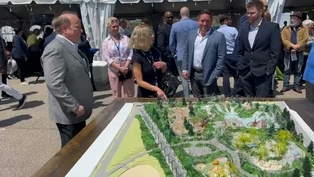
Detroit Breaks Ground on New West Riverfront Park
Video has Closed Captions
Clip: S50 Ep23 | 4m 43s | AJ Walker takes viewers to the groundbreaking for the Ralph C. Wilson Jr. Centennial Park. (4m 43s)
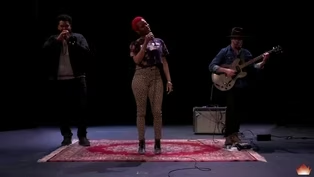
Grammy-Nominated Trumpeter Kris Johnson Performs
Video has Closed Captions
Clip: S50 Ep23 | 2m 59s | Grammy-nominated Detroit trumpeter and composer Kris Johnson performs an original song. (2m 59s)
Providing Support for PBS.org
Learn Moreabout PBS online sponsorship
- News and Public Affairs

Top journalists deliver compelling original analysis of the hour's headlines.

- News and Public Affairs

Today's top journalists discuss Washington's current political events and public affairs.










 New Season
Support for PBS provided by:
American Black Journal is a local public television program presented by Detroit PBS