VPM News Focal Point
Migration | May 2, 2024
Season 3 Episode 10 | 26m 46sVideo has Closed Captions
What are the driving forces of migration into and out of Virginia?
We explore why people leave places they have known and loved to relocate, sometimes to places where they are not welcomed. What are the driving forces of migration into and out of Virginia? And what are the economic, cultural and demographic impacts?
Problems playing video? | Closed Captioning Feedback
Problems playing video? | Closed Captioning Feedback
VPM News Focal Point is a local public television program presented by VPM
VPM News Focal Point
Migration | May 2, 2024
Season 3 Episode 10 | 26m 46sVideo has Closed Captions
We explore why people leave places they have known and loved to relocate, sometimes to places where they are not welcomed. What are the driving forces of migration into and out of Virginia? And what are the economic, cultural and demographic impacts?
Problems playing video? | Closed Captioning Feedback
How to Watch VPM News Focal Point
VPM News Focal Point is available to stream on pbs.org and the free PBS App, available on iPhone, Apple TV, Android TV, Android smartphones, Amazon Fire TV, Amazon Fire Tablet, Roku, Samsung Smart TV, and Vizio.
Providing Support for PBS.org
Learn Moreabout PBS online sponsorshipANGIE MILES: You can learn a lot about a place by paying attention to who's moving there and who's leaving.
Studying patterns of movement in and around places can also tell you a great deal about people.
That's where we're putting our focus today.
We'll show you how recent transplants bring their cultural traditions with them.
New arrivals, as well as immigrants from centuries ago, are changing the landscape of Virginia, from the Eastern Shore to the Shenandoah Valley.
Let's talk migration on VPM News Focal Point.
Production funding for VPM News Focal Point is provided by The estate of Mrs. Ann Lee Saunders Brown.
And by... ♪ ♪ ANGIE MILES: Welcome to VPM News Focal Point.
I'm Angie Miles.
People and place, each of these has a significant impact on the other.
We're going to take a close look at how Virginia, as well as some specific regions of the Commonwealth, are being shaped by those who've migrated here.
We begin by looking at the state as a whole, what makes Virginia attractive or not as a place to live.
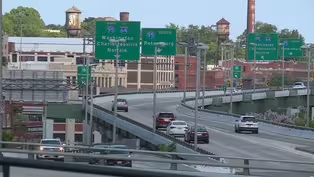
Over the past three years, the fastest growing metropolitan area by percentage has been Winchester, with a significant number of new residents moving west from other parts of Northern Virginia.
The city of Richmond had unprecedented growth during that same time period.
Special correspondent A.J.
Nwoko explains what's driving the recent popularity of the capital city.
(car whooshes) PAUL PATENAUDE: And we said, "Okay, where do we want to move next?"
A.J.
NWOKO: Paul Patenaude is used to a life in motion.
PAUL PATENAUDE: We've lived in, I'm going to say seven or eight different states in many different cities.
A.J.
NWOKO: But after 10 years in Greenville, South Carolina, the retired engineer says, he and his wife were finally ready to wind down in the capital of the Commonwealth.
PAUL PATENAUDE: We said we want to be close to family.
Close to the ocean, but close to the mountains.
Close to an interesting center, like Washington, DC.
A lot of things, and you boil them all together, and Richmond was in the top tier.
A.J.
NWOKO: Factors that Greater Richmond Partnership President and CEO, Jennifer Wakefield, says have also been key to Central Virginia's growth.
JENNIFER WAKEFIELD: Nearly half of all the new residents into Virginia have been locating in the Richmond MSA.
A.J.
NWOKO: There are approximately 1.3 million people in Virginia.
JENNIFER WAKEFIELD: And we are continuing to grow.
(car whooshing) A.J.
NWOKO: Wakefield says Virginia has been growing at a rate of around 1% a year since 2020.
But according to a University of Virginia study, it's still just the second fastest growing area in the state with a much smaller Winchester leading Virginia with a 4.6% growth in the past three years.
But with recent expansions of companies like Amazon and CoStar, Wakefield says Richmonds size and location gives it an edge when competing for economic opportunities.
JENNIFER WAKEFIELD: We have been named the number 11 hottest job market by the Wall Street Journal recently.
And so that in turn attracts other companies to want to think about considering locating in Richmond, Virginia.
To have positive migration into a community it makes sure that it's a healthy community and that there are new jobs for residents that are here, and for those that are choosing to relocate.
A.J.
NWOKO: Which can directly impact the value of goods (bus buzzing) and services.
JENNIFER WAKEFIELD: What happens is when you lose population, companies tend to leave those markets, which means jobs tend to leave those markets, which mean average salaries tend to leave those markets.
A.J.
NWOKO: For VPM News, I'm A.J.
Nwoko.
ANGIE MILES: Wakefield says that growth is a plus, but can put a strain on infrastructure.
Several areas around Richmond, by the way, including Goochland, Louisa, New Kent and Caroline counties, also grew rapidly over the past decade.
Previously, Loudoun County saw the most significant population growth for several years.
ANGIE MILES: For those already living here, do they see things the same way as newcomers?
We asked people of Virginia to highlight the state's major draws and drawbacks.
BRISON BONDS: What's good is the mountains, the hiking trails, you might have different variety of foods to eat depending on what cities you go to.
And it's a big thing for for us, seafood and stuff down here.
When you go out towards the Tidewater area, isn't really no bad things here in Virginia.
GREG BROWN: The variety of the geography.
You've got mountains to the ocean and everything in between.
There's a little bit of something for everybody, but I think the drawbacks to that is a lot of people come here and we don't have the infrastructure to support it.
We don't have the roads.
We don't have the school systems.
We don't have, everything that we really need in place.
SARWAH KORANTENG: The proximity to DC, Maryland.
I do have a business, and so to me, moving down here was going to open me up to those other states as well.
I think what is, well, the shortfall is, the expense.
Virginia is very expensive.
RONNY HENDERSON: Well, to come here, it's the beauty of the place.
It's gorgeous.
We have people from everywhere.
You know, every race, nationality, people are friendly.
But the con is they tax you to death.
If they knew how many socks and underwear you had, theyd tax them too!
ANGIE MILES: Taxes are part of life in the Commonwealth, whether you're from here or you've come here.
The U.S. Census reports that more new immigrants in Virginia come from El Salvador than from any other country.
Multimedia Reporter Billy Shields spoke with migrant families in Richmond.
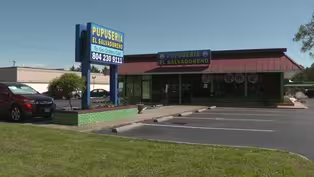
(food sizzling) (metal clanging) BILLY SHIELDS: For José Galo, it's another day at the office, making pupusas for the lunchtime crowd at his Midlothian Turnpike restaurant.
The overwhelming majority of his customers are migrant workers.
(José speaking in Spanish) BILLY SHIELDS: They're made from two fried layers of cornmeal with fillings inside, a specialty from his native El Salvador.
It's a country he left when he was 17, crossing the border without papers in 1996.
(José speaking in Spanish) BILLY SHIELDS: He worked restaurant jobs in Maryland and Virginia, similar to what he does now.
He got help from an employer to become naturalized, and eight years ago, he opened his own restaurant.
(José speaking in Spanish) BILLY SHIELDS: The business is set up by and large to cater to a growing Latin American population on the South Side.
According to the U.S. Census Bureau, more than 7% of the population of Richmond was born in another country.
EDWIN GALO: So pretty much our core customer base is probably a lot of Latin, Latin people, a lot of workers, a lot of construction workers, outdoor people who work, grass, you know, all that, so.
It's a lot of Latin people.
BILLY SHIELDS: That is Galo's son, who manages the restaurant.
It's due to this increasing Latin American population that the offerings here are pretty close to what you'd see in a restaurant back home in El Salvador.
The 22-year-old Edwin Galo is proud of his father.
EDWIN GALO: Someone who comes here not knowing anything about the country, just starting fresh from zero, and having to work hard to achieve something they want in their life.
BILLY SHIELDS: The restaurant still has its first employee, Yolanda Velez-Pérez.
(Yolanda speaking in Spanish) BILLY SHIELDS: Almost a decade ago, her native Guatemala was a dangerous place for Velez-Perez.
(Yolanda speaking in Spanish) BILLY SHIELDS: Velez-Perez and her son were granted asylum by the U.S. government eight years ago, allowing them to stay here.
(Yolanda speaking in Spanish) BILLY SHIELDS: For the Galo family, Edwin says he's grateful that his father took the risk.
EDWIN GALO: I feel very appreciative of them taking that, just making that decision to come here and wanting to have a better life.
BILLY SHIELDS: Now he wants to ensure he rewards that risk.
EDWIN GALO: I work around 10, 11, 12 hours a day, just because I've seen how much my dad works.
And you know, I want to continue the essentially, like building a legacy here.
BILLY SHIELDS: It's a small business on busy Midlothian Turnpike.
If you blink, you might miss it.
But it's full of stories of people from all over the Americas who came to Virginia in search of the American dream.
For VPM News, I'm Billy Shields.
ANGIE MILES: Virginia's Latino population has increased by 32% since 2010.
There are nearly 910,000 Latinos in Virginia as of the 2020 census.
That's more than 10% of the state's population.
ANGIE MILES: VPM News Focal Point is interested in the points of view of Virginians.
To hear more from your Virginia neighbors, and to share your own thoughts and story ideas, find us online at vpm.org/focalpoint.
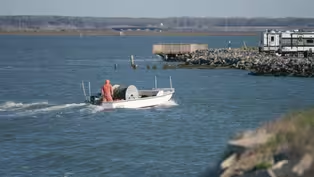
ANGIE MILES: Alongside the embrace of nearby waters and among fields of fertile soil, the rhythm of Latino life on the Eastern Shore beats strong.
According to the U.S. Census Bureau, 9.7% of Accomack County's population is Latino, and the Legal Aid Justice Center says approximately 1500 seasonal migrant farm workers travel there to work on produce farms.
The Shore is also home to Tyson and Perdue chicken processing plants, oyster farms, and nurseries, all major sources of employment for Latinos.
Multimedia Reporter Keyris Manzanares traveled there to meet with immigrants who arrived with dreams of abundance and opportunity, and, over time, have become changemakers in their community.
(Alejandro speaking Spanish) KEYRIS MANZANARES: Alejandro Cruz was once a migrant farm worker who picked and harvested tomatoes and later scallops on Virginia's Eastern Shore.
(Alejandro speaking Spanish) KEYRIS MANZANARES: Cruz says he takes pride in knowing he helped fill shelves at grocery stores, but it came at a cost.
(Alejandro speaking Spanish) KEYRIS MANZANARES: When summertime hits and tomato season starts, Cruz says, migrant camps on the eastern shore come alive with people arriving from Mexico, Central America, the Dominican Republic, and Haiti.
Lipman family farms hires the largest number of agricultural workers who come to Virginia on temporary work permits called H2A Visas.
Often one of the first people these workers meet is Cecilia Hernandez, with Legal Aid Justice Center.
(Cecilia speaking Spanish) KEYRIS MANZANARES: Working conditions in the fields can be grueling for migrant workers due to a lack of many essential protections.
Workers also face isolation and hunger.
Hernandez says, when there's no work due to rain or harvest, there is no pay.
(Alejandro speaking Spanish) KEYRIS MANZANARES: In 2020, poultry plants in Accomack County were hotspots for COVID-19.
Most recently, Tyson and Purdue are facing a federal investigation after reports surfaced that migrant children were helping clean the company's plants.
In search of better pay, Cruz left the tomato industry and started fishing scallops.
He says he was able to prosper and provide a better life for his family.
(Alejandro speaking Spanish) KEYRIS MANZANARES: Hernandez says a challenge faced by many Latinos on the Shore is misinformation surrounding tax filing and H-2A Visa requirements.
(Cecilia speaking Spanish) KEYRIS MANZANARES: Juan Gomez is a part of that second generation.
Born and raised on the shore by Mexican parents, Gomez stepped up to the plate when he saw how COVID-19 affected the tight-knit Latino community.
JUAN GOMEZ: I think it's just seeing a younger me just look in the eyes of our kids that come to our clinics and understand the importance of maybe not having adequate housing, maybe not having adequate food supplies, or currently, “Do my parents know what health insurance is?
” KEYRIS MANZANARES: As an outreach specialist for Eastern Shore Rural Health, Gomez makes sure that migrant workers and longtime Latino residents have access to care.
In 2022, the center served 1,308 migrant and seasonal farm workers.
JUAN GOMEZ: Our migrant population is here on a seasonal basis, so when they're here, we provide all the health services that we can.
My team goes out and does blood pressure checks, does glucose checks.
We are making sure that our population that's here is being seen and that their voices are being heard.
KEYRIS MANZANARES: The importance of bilingual education is what drove Zorylu Bonilla to move to the Shore in 2002 to teach at Accomack County Public Schools.
ZORYLU BONILLA: My first job here as a teacher was as a bilingual kindergarten teacher.
It was a pilot program at Accomack Elementary School.
Well, it grew to the point where maybe more than half of the classroom be Latinos in some classrooms.
In the high schools, you walk down the hallways, a lot of faces that are of Latino heritage.
KEYRIS MANZANARES: Bonilla says, these students, along with their families, have added rich and varied traditions to the depth of culture on the Shore.
ZORYLU BONILLA: We see a lot of variety of Latinos here.
We have entrepreneurs, we have workers in the field, we have workers in the chicken factories.
We have teachers.
We are definitely growing here and making this community a part of us, and we are becoming a part of the community as well.
KEYRIS MANZANARES: Liliana Velasquez came to the Eastern Shore in 2002 as an agriculture worker.
Now she's a proud business owner on Chincoteague Island.
(Lilian speaking Spanish) KEYRIS MANZANARES: When it comes to the impact of Latinos on the Shore, Velasquez says... (Lilian speaking Spanish) KEYRIS MANZANARES: For Alejandro Cruz, it's been a long journey.
He was able to bring his wife to the Shore and raise his children all while extending a lending hand to those in need.
(Alejandro speaking Spanish) KEYRIS MANZANARES: For VPM News, I'm Keyris Manzanares.
ANGIE MILES: Cecilia Hernandez and other advocates on the Shore have established the Agricultural Workers Advocacy Coalition.
With tomato harvest season on the horizon, the group is preparing to welcome workers and is continuing to provide aid, assistance, and awareness.
Eastern Shore Rural Health is also planning a health fair for the summer.
They expect to see migrant farmworkers and provide healthcare screenings.
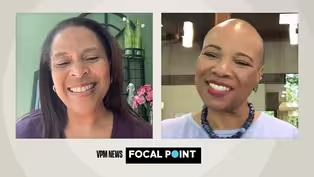
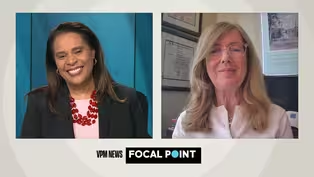
ANGIE MILES: During the 20th century, millions of Black people left America's rural South in search of a better life in the North.
Over the last 30 years, however, a new migration of people has been occurring as Americans are moving en masse to the South.
Our guest, Jeanne Milliken Bonds, is a public policy professor from the University of North Carolina, and she studied this most recent trend.
Thank you so much for joining us.
What is the big story when it comes to Virginia and migration in the last several years?
JEANNE MILLIKEN BONDS: Well, the South has been attracting population from all over the country as well as internationally for the past five decades.
And so the South has really emerged as the nation's primary growth magnet.
Within Virginia, you have some counties and independent cities that have gained in population, and you have others that continue to lose population.
ANGIE MILES: What is it about Virginia, the South, but Virginia, that's attracting so many people?
JEANNE MILLIKEN BONDS: The climate, the jobs, a lot of economic development taking place in the South, less expensive housing, less expensive taxes.
All of those were drivers that were bringing people to really rediscover the South and move back into the region.
ANGIE MILES: The southern parts of Virginia have lost population in recent years.
Again, do we know reasons for that?
JEANNE MILLIKEN BONDS: Those areas are your more rural parts of Virginia, the ones along the border with North Carolina and the southwestern, changes in the economic structure.
Coal, for example, in the southwestern part.
So you have some changing economic dynamics.
And again, you have that white native population that's aging, plus you have deaths of a lot of the white population from COVID recently, but also opioid deaths in that area.
So many of those counties are defined as biologically declining, or even biologically dying.
So you have a dynamic within Virginia, as well as other states, where you have some counties and cities that are just natural magnets for growth.
In Virginia, that's Northern Virginia, the Tidewater area, Charlottesville, and Richmond.
(upbeat music) ANGIE MILES: You can watch the full interview on our website.
ANGIE MILES: When you think of diversity in Virginia, you might think first of Hampton Roads because of the military, or Northern Virginia because of its proximity to the nation's capital.
But what about the Shenandoah Valley?
At last check, more than 70 different languages are spoken in Harrisonburg public schools.
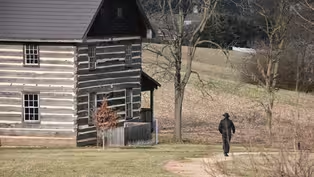
Much of the culture, color, and complexity of the area can be traced to the simple values of kindness and welcome that were integral for some of the earliest immigrants to Rockingham County.
SAM FUNKHOUSER: Brethren and Mennonites, like other religious minorities in Europe, were persecuted, and that was really the reason they came to America.
So starting in the late 1600s, Mennonites started coming to America from Europe, almost exclusively settled initially in Pennsylvania.
Pennsylvania was the only colony that offered religious freedom.
People like Brethren and Mennonites who didn't want to fight in the Revolution, were treated very harshly.
They had their properties confiscated.
They had their homes taken.
They were imprisoned and a few were even killed.
And so that experience in Pennsylvania prompted some to move.
Some went west and when they hit the mountains, went over the mountains into Ohio, and then some when they hit the mountains, came down the valley into Virginia, RUTH JOST: A war came, and there were soldiers all over the valley here.
SAM FUNKHOUSER: Ruth Jost is a descendant of many of the Mennonite families here in the valley, and she does our storytelling station for field trips.
She tells many of her family stories and particularly the stories of family members during the Civil War, RUTH JOST: My ancestors came to Southeast Pennsylvania, and that was an area where it was known that if you're trying to get north to get to freedom, if you could get as far as southeast corner of Pennsylvania, you could probably make it.
They didn't hold slaves.
Mennonites and Brethren believed that was wrong, and that's because they believed a couple things here that Jesus taught.
Jesus taught us to do unto others as we would want them to do to us.
We wouldn't want somebody to make us a slave.
We wouldn't do it.
SAM FUNKHOUSER: If you were a member of a Brethren and Mennonite church, and you purchased enslaved persons, they would kick you out.
If you wanted to join their church from another group and you were an enslaver, you owned enslaved persons, the people you'd enslaved had to be set free, not sold, set free.
LEO HEATWOLE: His uncle was a shoemaker.
SAM FUNKHOUSER: Leo Heatwole is a descendant of David Heatwole who built our shoemaker shop, and he's one of our volunteers that helps with our field trips.
LEO HEATWOLE: David Heatwole was my great, great, great, great, great-grandfather.
I'm the eighth generation.
His parents were immigrants from Germany who left to come to America for religious beliefs.
They brought a faith, religion, basic peace position to the valley.
RUTH JOST: As I've grown up in this community, I see a lot of people who spend a lot of time and energy and resources in projects and organizations that can help other people.
MAN 1: That's the weight.
RUTH JOST: I think it comes out of a realization that if we're not going to take part in the military solutions, we need to be trying to extend what we see as Jesus' example in healing relationships between people.
SAM FUNKHOUSER: Brethren and Mennonites, they tended to be agricultural or work in trades like the shoemaker shop.
They certainly had an economic impact on the Shenandoah Valley and how it developed.
During the war, Brethren and Mennonites didn't fight, though they tended to stay out of politics.
I would say probably roughly 10% of the population here is Brethren and Mennonite.
You know, they're certainly one part of the cultural tapestry that makes up the Shenandoah Valley.
ANGIE MILES: You'll find an extended visit with the Brethren & Mennonite Center online, as well as an interview on restorative justice we conducted previously with Howard Zehr of Eastern Mennonite University.
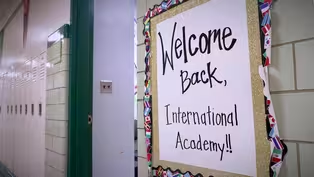
We also have a story on how learning loss is addressed in Northern Virginia at an international academy with students who've migrated from all over the world.
That's vpm.org/focalpoint.
Thank you for watching.
We will see you next time.
Production funding for VPM News Focal Point is provided by The estate of Mrs. Ann Lee Saunders Brown.
And by... ♪ ♪
Dr. Lauranett Lee on the Great Migration
Video has Closed Captions
Clip: S3 Ep10 | 12m 49s | Historian talks about the reasons and the consequences of Black people leaving the South (12m 49s)
Video has Closed Captions
Clip: S3 Ep10 | 2m 57s | Its location has led the Richmond metro to be among the fastest growing areas in the state. (2m 57s)
How Latinos are contributing to life on the Eastern Shore
Video has Closed Captions
Clip: S3 Ep10 | 7m 52s | Having once arrived with dreams of opportunity, Latinos now call the Eastern Shore home. (7m 52s)
International school addresses learning loss
Video has Closed Captions
Clip: S3 Ep10 | 4m 13s | Unique school within a school says their methods are effective against learning loss. (4m 13s)
Mass migration: Why are people moving south?
Video has Closed Captions
Clip: S3 Ep10 | 7m 9s | People are moving to the South en masse. Only some Virginia areas are benefiting. (7m 9s)
Modern diversity dates back to early immigrants
Video has Closed Captions
Clip: S3 Ep10 | 6m 38s | Descendants of early Mennonite immigrants speak about the impact on the Shenandoah Valley (6m 38s)
Running a Latin American restaurant on Southside
Video has Closed Captions
Clip: S3 Ep10 | 3m 54s | A Salvadoran migrant to Southside Richmond is chasing the American dream. (3m 54s)
Providing Support for PBS.org
Learn Moreabout PBS online sponsorship
- News and Public Affairs

Top journalists deliver compelling original analysis of the hour's headlines.

- News and Public Affairs

FRONTLINE is investigative journalism that questions, explains and changes our world.












Support for PBS provided by:
VPM News Focal Point is a local public television program presented by VPM