Inside the Cover: Expanded Edition
Mike Matson "Courtesy Boy" Part 1
Season 1 Episode 102 | 26m 15sVideo has Closed Captions
Ted talks with Mike Matson, author of "Courtesy Boy" in the first of a two part interview.
While his career as a Kansas broadcaster flourished, Mike Matson struggled in his personal life with alcoholism. Ted interviews Mike about his memoir, "Courtesy Boy". Mike opens up about the roots of his addiction, his road to recovery, and his hope to inspire others with his story.
Problems playing video? | Closed Captioning Feedback
Problems playing video? | Closed Captioning Feedback
Inside the Cover: Expanded Edition is a local public television program presented by PBS Kansas Channel 8
Inside the Cover: Expanded Edition
Mike Matson "Courtesy Boy" Part 1
Season 1 Episode 102 | 26m 15sVideo has Closed Captions
While his career as a Kansas broadcaster flourished, Mike Matson struggled in his personal life with alcoholism. Ted interviews Mike about his memoir, "Courtesy Boy". Mike opens up about the roots of his addiction, his road to recovery, and his hope to inspire others with his story.
Problems playing video? | Closed Captioning Feedback
How to Watch Inside the Cover: Expanded Edition
Inside the Cover: Expanded Edition is available to stream on pbs.org and the free PBS App, available on iPhone, Apple TV, Android TV, Android smartphones, Amazon Fire TV, Amazon Fire Tablet, Roku, Samsung Smart TV, and Vizio.
Providing Support for PBS.org
Learn Moreabout PBS online sponsorshipGood evening and welcome to our second expanded edition of Inside the Cover I Am Ted Ayres and I am truly honored to be a part of the programming here at PBS Kansas, the home of seriously good TV in South Central Kansas.
I hope that you watched and enjoyed our first show that featured author Michael J. Travis and his book about Kansas Craft Breweries.
Tonight, we are excited to feature another Kansas author.
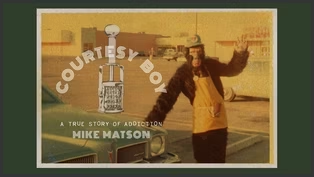
Mike Matson and his book, Courtesy Boy.
Mike lives where he was born in Manhattan, Kansas.
However, he grew up in Wichita, which provides the foundation for this book.
Mike currently works for the Manhattan Area Chamber of Commerce, and he also serves as a columnist for the Manhattan Mercury.
Mike describes himself as a proud tech school graduate of Brown Institute in Minneapolis.
His career has been devoted to three broad areas journalism, politics, government and advocacy.
He started his journalism career as an all night deejay on Wichita's KAKE Radio, culminating in covering politics and government for WIBW TV and a statewide radio news network in a politics government arena.
He served as communication director, press secretary for Kansas Governor Bill Graves and his two successful statewide political campaigns relative to advocacy.
Mike worked on communications policy and strategic planning for Kansas Farm Bureau and the Kansas Leadership Center.
Prior to his current position with the Manhattan Area Chamber, it is clear from Mike's career history that he is a man comfortable with words.
Courtesy Boy is Mike's second book.
It was honored as among the top independent small press books of 2022 by Shelf Unbound, a digital indie book review magazine.
Courtesy Boy also earned recognition from American Book Fest as among the best half dozen creative nonfiction books of the year.
The folks at Shelf Unbound wrote, “If you were to imagine an author, peer group readers will see shades of Jeannette Walls and Frank McCourt in Mike Matson's searingly honest examination of conscience.
He's Anne Lamont with testosterone.
” If you know those authors, This is high praise.
Indeed.
I found Courtesy Boy, to be an engaging and important read.
It is subtitled A True Story of Addiction.
And Mike notes that “my motivation is to help those suffering and their loved ones connect the dots between the destructive traits and behaviors and the potential for addiction.
” It is now time to go inside the cover.
Mike, welcome and thank you again for being our guest on our show.
So pleased to have you.
I appreciate that.
As you know, I really appreciated your book and there's so much to talk about and I'm not certain that 30 minutes will give us the time we need.
But I want to give you and Courtesy Boy, as much attention as I can.
So if you're ready, let's get started.
Let's do it.
Mike, your sister Vicki wrote in the foreword.
Would you agree with what your sister wrote?
I would Ted, it's probably important to point out from the outset that the story is about my young adult life.
It starts the night I graduate from high school at Wichita Heights in 1975 and culminates in August of 1991, the day I had my last drink.
I was very fortunate that my sister was willing to write that foreword.
She has seen me throughout this process and sort of gets a sense of what I've been through.
And so when she says ruin and redemption, that's that's I'm flattered by those words.
We can get into this.
But the story is about a dichotomy, right?
It is about professional success on the one hand and on a parallel track.
Personal destruction.
And so she was able to see that, see me come through that.
And so when she used those words ruin and redemption, I never really thought about it from that perspective.
But that's a pretty good way to capture it.
Well, it really is.
And when people read your book, they're going to understand that.
And you've touched on a number of areas just then and I want to get into.
So in the preface you wrote, Mike, that: Mike Was this a difficult book for you to write?
It in many.
Yes and no.
So so again, this is a chronology sort of a ramp up to a lot of loss and so early on.
It starts when I'm 17 years old and I move out of home into an apartment with two chums here in Wichita.
And it culminates with with after three stints at rehab.
Right.
Sort of this this really difficult realization that that, you know, this is this is ruining my life.
And so the early part, right when I was a young adult hanging out with my friends and were partying all the time, that was fun to write, right?
Because I get to relive that.
You know, I had a chance to to reconnect with a lot of the people that I was involved with in my life at that time.
I was going.
To ask you about that.
Yeah.
So that that part was fun.
And then as we move forward in the chronology and as the losses continue to mount and as I struggle with addiction to alcohol, I went through a lot.
Right.
And that part was kind of difficult to relive.
And so when I was writing it, it was I did the fun parts first and I saved the hard parts for the last.
Where that absolutely makes sense.
And I talked about in the introduction, Mike, about the recognition that the book has received from critical sources.
But can you give us a sense of the reaction of your readers?
Have you had contact with the individuals who have read your book?
Yeah, I have.
And it I kind of separated into three, three buckets, right.
One bucket is people who enjoy the writing.
And I'm flattered and I'm humbled, humbled by that.
You know, you'd mentioned it in the intro, right?
I've written all of my career.
And so when I started writing a book, I had no idea that I that it would receive the sort of compliments that it has.
And so that's humbling.
The second bucket would involve people who know me right and know me professionally.
And so they enjoy that, too.
But the third bucket and this gets directly to addiction and how ubiquitous it is in our society is from people who have read it and will come up to me and say, Oh my gosh, that's me, or that's my father, or my brother suffers from that.
Or Sally had those exact same behaviors, right?
Or Billy did this.
Write it.
I wish I could say I'm surprised of the number of people that have come to me with personal sort of circumstances related to addiction.
But there have been dozens.
Well, I would guess as an author and knowing you professionally and personally, that those responses have to be very gratifying to you.
Yeah, they are.
And it's it's and it's I struggle with that sometimes because at the core of addiction, the core of alcoholism is individuals become self-obsessed.
Right.
And to recover, you need to get out of yourself.
And there's a whole bunch of different ways you can do that.
I've been able to do that over the years.
And so when people say when you get compliments for the writing or compliments for the book, it's really easy for me to lapse back into, Yep, I'm pretty good, right?
I'm a good writer and I agree with everything you say.
And so I've got to be careful with that.
Yeah, I understand.
I wrote a review of your book, Mike, and I said, “Matson has a rich vocabulary, a gift for phrasing and description, and a remarkable memory.
” Your book, your book covers 16 plus years.
How did you go about writing the book in such detail?
I have been blessed with what my family calls a granular memory.
I can remember dates.
I can remember very specific events.
I can remember people that were involved with those events.
And so that that's a gift, right?
And so that was a huge part of writing the book.
And so when I made the decision to to write about the first 16 years of my adult life based on this premise, that in those 16 years, in hindsight, I was able to recognize negative behavioral traits that I was exhibiting that hadn't really been lifted up in other books that I had read addiction memoirs.
I made the decision to just start of start to chronicle all of these events.
And so I did what I described as dozens of pools of word vomit in which I was able to just kind of download that onto a screen and I'd have files.
And then that was sort of the nut, the kernel, the core of how I was able to sort of build the book from there.
Interesting.
Interesting.
Mike, you write with such candor and openness.
Did you ever have second doubts or say, I'm in too deep?
I mean, did you ever have second doubts?
Yeah, every day as I was writing it.
But when I made the decision to write the book right, I knew plugged into writing communities and author communities.
And they say, write what you know.
Right.
That is the mantra that you get from those who have done this.
And so what do I know?
I knew recovery from addiction.
And so I made the decision to write about that.
And then I thought, well, what's the hook?
What will separate my book from the dozens of others write addiction memoirs.
And so I just started reading them.
And I read probably 18, 20 addiction memoirs, just to get a sense.
And I knew I had this notion of lifting up negative traits and behaviors that I knew I exhibited back then.
And I didn't see those in the books that I had read.
And so when you are doing that, when you're being that self honest and you're putting that in paper and you're talking about how dishonest you are or how you are not loyal to your friends or how you were thinking about yourself instead of others.
Right.
And that's what I wanted to lift up.
And so from that perspective, as I was going through it, there were two things that were going through my mind.
One was, yep, that's what happened.
But the other was, Gosh, I wonder how this is going to be accepted.
I wonder how this will land.
And so that that gets to your question.
Well, and you mentioned earlier that you have not had a drink since August of 1991.
Was writing this book therapeutic or had you already really resolved and absolved yourself?
Well, that's a great question.
Right.
So.
So my recovery from addiction slash alcoholism is not unique.
Right.
There are there are people walking the planet who have gone through what I've gone too, right.
And it is it's a difficult thing to walk through, but when I was writing it, I'd had enough sobriety to understand what I was doing.
And I wasn't worried about relapsing.
But I was I was wanting the journalist in me kicked in, and I wanted to make sure that what I was writing about was true and accurate.
So that's kind of what drove me with respect to that.
One of the things that I found very interesting and we've talked about it a little bit, but in the book you refer to yourself as Mike or Matson.
Why was that?
Yeah, that that goes back to sort of the earlier comment.
It was I started doing it in the first person.
Right.
And, and when I go back and read it all, it was I did this, I said that I responded this way and then the this part of my recovery that gets me out of myself started to kick in.
And two things.
It was I didn't think I was being true to myself if I was doing it that way.
So I wanted to get away from that.
And it just sounded clunky right.
And there were other there are other authors that are probably more proficient than I am that can write that way, that that write memoirs that way.
I just didn't feel comfortable doing that.
So I took myself out of it, flipped it around and wrote it in the third person.
And it was much easier for me.
Well, and in that sense, as a reader, you know, once you get over that and you accept it, it really helped.
I think you tell the story.
Yeah, it did.
It gave me sort of some freedom to be able to say, Well, this is still me, but I'm telling for.
You pull yourself away and it looks down upon yourself.
Exactly.
Again, we've talked about it, Mike.
I found the book so engaging because of your personal story and because it provides such a rich history of Wichita and Kansas, but particularly Wichita in the seventies and eighties.
It was a real trip down memory lane.
In the process of writing the book, have you visited these old haunts that you talk about in the book?
Yes, I did.
That was the journalist in me wanted to get back in that space.
Right.
And so it starts that it starts the night I graduated from high school, from what was then Henry Levitt Arena.
Right.
And today it's called something else.
I think it's Charles Koch Arena.
But I graduated from Wichita Heights in 1975.
And so we the day after I graduated from high school, I moved with two friends to an apartment in Woodgate.
So I went to Woodgate, spent some time there, walked around the pool, did all of that.
I worked a little bit.
Different today than it was.
Little bit different.
That was I was there when it was two years old.
So it was still pretty shiny, pretty brand new.
The title of the book stems from the title of the job that I had at a supermarket on the northwest end of town.
Mr. D's IGA, he called the individual young men who would sack and carry out and stock groceries, courtesy boys.
And so that's what led to the title of the book.
And so I was living in Woodgate on the east side of 21st Street and working at Mister D's IGA on the west side of 21st Street.
And so, yes, in fact, there's a chapter in the book in which I describe the drive, and I used it as a vehicle to introduce a new car.
Right.
I'm driving from the east side to the west side on 21st Street in the late seventies.
And it was a lot it's a lot different then than it was now.
My time in Wichita goes back to about 1996.
And so some of the places you talk about I've been to or experienced, others I only heard about, so it was just so much fun to to have that perspective of someone who actually lived it.
Courtesy Boy is divided into five time periods.
The first section is called Woodgate and runs from May 27, 1975 to November 14, 1977.
Was there a significance of why you selected I mean, based on what you've just already told me and our audience, you start upon graduation from high school and Woodgate.
So that explains May 27, 75.
But what was it about this two year period that you focused on?
Well.
This this is part and parcel of my problem that led to addiction.
My father was overbearing and he was difficult.
And I wanted nothing more than to get away from him.
Now we're going to talk about your dad.
And so so literally the day after I graduated high school, the first opportunity I had, I moved out and I was only 17 years old.
Right.
And so I had friends and we were able to set ourselves up in housekeeping at an apartment.
And Woodgate.
Right.
Was at the time only two years old.
And there were parties every night.
And I was living a life that I thought society expected of a red blooded young American male at age 17 and 18.
Right.
I almost called the book “Girls, Cars and Beer ” because there's a lot of each that runs through that.
And that was part of the problem.
Right, is like I didn't recognize how much I was drinking at the time, but with respect to the specific location, everything I did revolved around Woodgate, where we lived.
And I want to go back and touch upon your graduation from high school and you go into as the book starts, a lot of detail about finding a partner to line up with, to walk through graduation and you explain I think Sherry Johnson was the classmate that you were able to walk with.
But I want to go forward a little bit.
It amazed me, Mike, that later in the book you describe your first and only DUI arrest as comparable to that time at graduation.
Tell me.
Yeah, that that's so significant.
I'm glad you mentioned that, because at the core of my addiction is the emotion of fear.
Right.
I am driven by fear and that's not unique to me.
A lot of folks who have been who have succumbed to addiction have the same thing.
And so that I start the book with fear because the coach tells us to line up and find a partner and it's expected to be boy-girl.
And in all of the groups that that that naturally congregate are doing that and I'm left alone.
So I'm I'm I am deathly afraid that I'm going to be stuck at the end of the end of the line with the dweebs.
Right.
And so that's what drove me with respect to that DUI, same thing.
Right?
It was like I got pulled over.
I didn't think that I was going to get arrested, but once I realized I was, then it was fear that drove all the actions.
On page 291.
Actually, you're right.
All the emotion started and ended with fear.
He was afraid.
He being Mike Matson, and afraid to show his fear to anyone, including this lawyer he had just met.
And this, of course, relates to your divorce proceedings from your first wife.
And so obviously, that fear was a big factor in your life.
Oh, huge.
Huge.
And and it stemmed from childhood.
Right.
My father, I later learned he is since we have since lost my father.
But I later learned at the end of his life he was was diagnosed as what is called in the behavioral science, an adult child of alcoholics.
And so both of his parents were raging alcoholics.
And we'd always suspected this, but really didn't confirm it until the end of my father's life.
And so my father didn't drink, but he had this he had this diagnosis that led him to act the way he did.
And the traits are remarkably similar.
And and there's also a genetic predisposition situation related to that.
And so once I quit drinking, once I started in recovery and was able to learn more about these things, light started going on for me and I recognized that at the at the root of everything I was doing was fear.
And that stemmed from childhood.
Interesting.
And I believe that your first book, Spifflicated, really talks about your father and his parents.
Yeah.
At the end of his life, he was.
He wanted to download some data about his childhood.
And I was his guy, and it was information that he'd never shared with me or my siblings in the past.
And that's what sort of led him on this this conversation at the end of his life with me about his childhood.
And at that point, he knew that the end was coming.
And so he wanted to share this information.
And that's what led to the first book.
And you talk about going to Brown Institute in Minneapolis.
And in one of our prior conversations, you stated, “I have managed to succeed in my professional career completely unencumbered by a college degree.
” Would you care to elaborate on that?
I am I am an outlier with respect to that.
In my generation, it was expected that individuals would go to high school, go to college and succeed.
I didnt, right?
I went to high school.
Then I screwed around a lot at Woodgate, partied a lot ended up in technical school in the Twin Cities.
And I share this in the book.
The truth was, I chased a girl up there.
I followed a girl up there and I happened to go to technical school.
That allowed me then to get started in broadcasting.
And then I was very fortunate to be able to succeed professionally throughout my career and the need for the degree just didn't exist.
Well, and again, that, I think is such an important part of the story that you have been, I think, by any measure, so successful in your career, in a multitude of professional areas, of course, all relating to communication and use of words, but to tell this story with that you've shared in the book, with that sort of success, I think is just remarkable.
Well, thanks.
And one of the one another title that I played around with before landing on Courtesy Boy was The Dichotomy because that describes it.
I was able to succeed professionally, and this is where my father's indoctrination came in, because I came from the generation where we were expected to succeed and the next job was going to be bigger with more responsibility and more money and more responsibility and keep moving up the chain.
And that's what I was able to do.
And so by all measures, especially from those societal measures, from parents and others, I was succeeding on that track.
But at a parallel level, because of the alcoholism and the addiction to alcohol, the personal life was going in the tank.
Right.
And so it that's not that's also not unique among people who have who have succumbed to addiction.
But that's exactly what I hope comes through in the book was, yep, he was succeeding professionally, but personally it wasn't going very well.
Well, and there's a watershed moment, I think September of 1978 was that the blackout when you experienced the blackout?
And then as you go forward in the book and you get to some of the later chapters, you really reached a low point.
Yeah.
Unable to pay bills.
Your lights were shut off, that sort of thing.
When did you realize that you had an addiction?
It was probably it was probably, I want to say, early eighties.
So it would have been six or eight years before I finally stopped.
And the challenge was I didn't know what to do to fix it.
Right.
Society would say, you have a toothache, go to the dentist, you're nearsighted, go to the optometrist, you have a tummy ache, go to the doctor.
You suffer from addiction, go to rehab.
Well, I did that with the expectation that rehab would fix it.
Cure me.
Right.
But it doesnt.
Addiction is so insidious that there is no pill, right?
There is no there is no exercise regimen that will get you out of this.
It is such an insidious disease.
It's right between the ears.
It's physical, it's mental.
It's emotional.
Right?
It's spiritual.
And so I knew I was an alcoholic while I was still practicing.
When you go to rehab and then you think you're going to be cured and you come out and you relapse, right then, then that's when it really starts to kick in.
It's like, how am I going to lick this?
Go back to rehab?
Nothing.
Go back a third time.
Nothing.
Right.
And and I continue to drink.
And it gets to the point where you're so demoralized that you wonder how you're going to get out of this.
Right.
And that's I hope that comes through in the chapter when you reference the lights being turned out, because that's where my life was at the time.
Well, and it does.
And Mike, we have just really scratched the surface of your book.
And I feel like the story is so important that I would like to continue our conversation, if you would be willing.
And so I hope that you will come back and talk to us some more about Courtesy Boy.
Happy to.
All right.
Well, thank you, Mike Matson.
Thank you for being our guest on this show.
And we will look forward to continuing the conversation at a later date.
Ladies and gentlemen, that's our show tonight.
We have talked about Courtesy Boy by Mike Matson Wonderful book, important book.
And I am so pleased that Mike has indicated a willingness to come back and continue with a part two of this conversation.
So we'll see you next month for another episode of Expanded Inside the Cover.
Mike Matson "Courtesy Boy" Part 1
Video has Closed Captions
Clip: S1 Ep102 | 1m 25s | Ted talks with Mike Matson, author of "Courtesy Boy" in the first of a two part interview. (1m 25s)
Providing Support for PBS.org
Learn Moreabout PBS online sponsorship













Support for PBS provided by:
Inside the Cover: Expanded Edition is a local public television program presented by PBS Kansas Channel 8