
Admiral Mike Mullen on America's Lack of Moral Leadership
Clip: 3/28/2019 | 16m 18sVideo has Closed Captions
The Admiral and Walter Isaacson talk political courage and morality.
Admiral Mike Mullen is a true public servant, serving over four decades in uniform and as the top military advisor to Presidents George W. Bush and Barack Obama. Renowned for his role in dismantling the military's “don’t ask, don’t tell” policy, overseeing the end of combat in Iraq, and more, he joins Walter for a discussion on political courage and morality and the future of American institutions
Problems playing video? | Closed Captioning Feedback
Problems playing video? | Closed Captioning Feedback
Admiral Mike Mullen on America's Lack of Moral Leadership
Clip: 3/28/2019 | 16m 18sVideo has Closed Captions
Admiral Mike Mullen is a true public servant, serving over four decades in uniform and as the top military advisor to Presidents George W. Bush and Barack Obama. Renowned for his role in dismantling the military's “don’t ask, don’t tell” policy, overseeing the end of combat in Iraq, and more, he joins Walter for a discussion on political courage and morality and the future of American institutions
Problems playing video? | Closed Captioning Feedback
How to Watch Amanpour and Company
Amanpour and Company is available to stream on pbs.org and the free PBS App, available on iPhone, Apple TV, Android TV, Android smartphones, Amazon Fire TV, Amazon Fire Tablet, Roku, Samsung Smart TV, and Vizio.
Watch Amanpour and Company on PBS
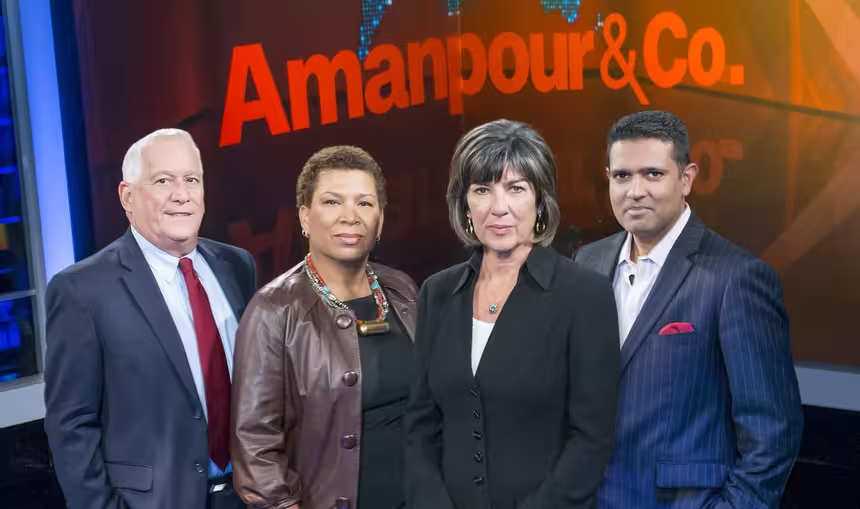
PBS and WNET, in collaboration with CNN, launched Amanpour and Company in September 2018. The series features wide-ranging, in-depth conversations with global thought leaders and cultural influencers on issues impacting the world each day, from politics, business, technology and arts, to science and sports.Providing Support for PBS.org
Learn Moreabout PBS online sponsorshipOur next guest spends a lot of time thinking about moral leadership.
He is the retired Admiral Mike Mullen.
Maybe you'll recognize him in this famous photo in The Situation Room, taken during the raid on Osama bin Laden's compound in 2011.
He served for 43 years in the military, culminating in being chairman of the Joint Chiefs of Staff.
The most senior uniformed role in the US military.
And he sat down with our Walter Isaacson to talk about this issue.
Admiral, thank you for being with us.
Good to be with you.
So we seem to have a lack of courage, political courage in this country.
You're an expert on courage.
What's happened to this country's leadership?
Well, it's I've said for years, I've watched when I was working in Washington, which is almost a decade ago now, and watched it since.
Is there the politics has just become so polarized and polarizing?
And actually, in Washington, I've watched the leadership group get pulled up to the top where we used to have sort of distributed leadership with very strong committee chair, men and women, no longer the case and it's a very small group of people, the speaker, the majority leader, etc., that actually control the agenda the messaging, etc.. And and you are if you want to get reelected, if you want to be supported in the power structure, you have to toe the line.
And what we are desperate for our leaders to stand up and say what we're doing here is wrong.
And the political attacks that then occur.
If you say that our our our our legion right now and.
And therefore, what.
One of the things I don't understand is why we we put all this capital in the bank.
If I'm if I'm a leader, a political leader, and then I never cash it in.
I never stand up.
I never use it for what I believe in.
Well, part of the problem is having to stand up to the president in this day and age.
And it used to be congressional leaders would stand up even to strong ones like Lyndon Johnson or, you know, George Bush.
Why is it that congressional Republicans in particular are afraid to stand up to Donald Trump when they think he's wrong?
At least my Republican friends tell me that with President Trump, there's a lot of things they don't like a lot.
But that's the quote unquote policies, the economy, the border, China, etc., that that they're okay with.
And actually, you know, I think the worst danger to us as a country right now is the lack of moral leadership.
I think, you know, over a period of what could be eight years.
With with President Trump you know, that that the lack of a moral compass, the lack of values which gets reflected in and how he speaks and how he acts it has a great there's a there's a terrific potential to actually just sort of rip us out and the underbelly and that will be a different country after eight years those values and principles, the integrity that we all feel so strongly about have been with us forever.
They are actually being plundered as we speak.
And someone's got to stand up.
So what you would say to them is, are the policy victories, this little victory on tax lowering or something is definitely not worth it when it comes to the hollowing out of our moral fiber?
I would actually completely agree with that.
I think there are short term gains there, short term wins and the long term, which is what leaders are supposed to focus on.
And that's a difficult target in Washington is what we're sacrificing.
And there's a lot that is being sacrificed.
It's our future.
It's our kids, it's our grandkids, it's our financial capability.
You look at the size of the debt that we're in, it's the the unwillingness to come to grips with the health care challenges that we have in the country.
The infrastructure.
Most of us have focused on education as a problem for years.
And we talk and talk and talk.
Yet we have not had the kind of reform in our secondary system, in our public school system that we absolutely need.
And at some point in time, it's really going to jump up and grab us.
You're a man of institutions, the Navy, everything else.
But let's talk about one.
I know that you really care about the FBI.
Are you worried that the president, United States, is undermining integrity of the belief in the FBI?
There was a piece, I think, in the Washington Post two or three weeks ago about the FBI's inability to recruit.
And that has not happened for a long time.
And the reflection of that is in the institutional breakdown, because they have for the FBI or the FBI, because they've been under siege now for two plus years and they've made some mistakes.
The leadership has made some mistakes.
But I do worry that we're crushing that institution.
Also, the same is true injustice.
The same is true in the media.
I worry about the state of the of the CIA, the intelligence community, as well as the State Department.
And we don't have a playbook sitting around saying, here's how you rebuild institutions.
But when this is done, whenever that is, we're going to need to rebuild and we're going to need to rebuild rapidly.
When the military was broken after Vietnam, we rebuilt that.
But it took us about 30 years to do that.
Give me an example of one area where there was something you would do or should do right now.
I think that probably the first thing I would pick would be the whole issue of people Am I recruiting good people into the CIA?
Into the FBI, into the State Department?
Are there good people staying as opposed to leaving?
Are they properly incentivized?
Is it a mission they care about?
And that takes really courageous leadership from inside the agencies as well as the broader institutions or the broader leadership.
So it's something from my perspective I would hope that Congress would focus on, as well as these institutions continue to be under such a siege.
I would center it on how we're doing with our people, but there are other things associated with that.
How are we doing?
How are they doing with the resources to do that?
Not just to recruit and retain people, but to to build or rebuild the institutions that have been broken down as we seem to be?
From an overseas perspective, coming home we are isolating ourselves in a world that I don't think will tolerate isolation, quite frankly, right now and won't forgive isolation very easily when particularly when you have other countries who I now think our adversaries like Russia and China, who will who are filling that vacuum to a fairly well.
One of the things that help protect and be a bulwark for institutions was some of the military people who went into the Trump administration early on.
General Mattis, General Kelly, etc.
They're out.
What do you think of their role there?
And do you worry that they were not able to keep Trump within norms?
Well, I was never I actually was one of the few that I knew that wasn't overly enthused with military leaders being inside the civilian leadership of our government.
It's not what we do.
They're extraordinary people.
They are patriots, and they wanted to to move the country forward.
And all of them wanted to do that in a very constructive way.
But our system isn't based on military leaders.
It's based on civilian leaders.
And each of them now obviously are gone.
And so I don't know I don't know where the checks are.
You'd like to think they would come from from Capitol Hill.
And I think the elections last September were part of the check and balance.
That's that that is that we have in our system.
But that's just to me, that's just a first step.
It's less about the check, which you had to have.
It's more what does the Democratic leadership in the House actually do with it?
And one of my biggest worries is it just turn they just turn it around and play their own version of the Republican playbook, which has been out there for the last couple of years back at the president.
And, you know, so we continue the polarization and we absolutely go nowhere.
So you think the Democrats are at fault, too, for now?
Trying to play Trump's game and become polarizing where we are as a country?
I mean, President Trump was incredibly disruptive and President Trump is not the problem in the country.
President Trump, I thought, was symptomatic of the challenges that we have as a country.
And and there are plenty of elite political leaders in Washington that that brought this to us over a period of years.
And I think it's important for those leaders to change and if they can't change, they need to they need to move out of the way and let the younger people take over.
Yeah, but you've said something just now that's sort of confusing to me.
You think that it's not Trump, but that Trump is a reflection of a larger thing.
You do not think we're a better country than this, that we have more of a moral compass than our leadership.
Absolutely.
Absolutely.
And when I speak publicly, you know, I talk about the challenges and they're significant.
And usually at the in the Q&A part of that, someone said, have you got anything positive to say?
Because we're going through a lot.
We have to we have to address this, the race issue in the country.
We have to address the income inequality and the issue in the country, the income distribution issue in the country, if you will, in ways that we just haven't and we haven't done it over decades.
It's not it's not brand new.
So what's going on right now is focusing on that.
But if all we have from the Democratic side is reaction and let's swing the pendulum is hard to in the other direction as possible, we're not going to answer those questions.
And that, to me is the essence of what some leaders.
And it doesn't take many, but it takes a view from both parties have to recognize to figure out how to move us forward together.
And in the last ten years, it's been how to move us nowhere because we're a part.
And that's fundamentally, I think, the challenge that we have.
So what is the effect, do you think, of America retreating from the world stage?
I believe we live in a world where we are dependent on friends and allies and relationships and engagements.
And I don't think the world is going to just let us walk.
I mean, one of the drivers for that is just like the global aspect of the economy.
We can't we can't not be out there.
We have to be out there.
And these institutions, NATOs an example, and alliances, the alliance we have with Japan, the alliance we have with South Korea, they're coming under question.
The leaders are asking if we're going to be there for them.
And I think there's more damage than we realize.
When I talk to my foreign friends, I ask them, tell me what you see, because we're in the middle of it here.
And I don't think we'll think it's as bad as it is.
And they're pretty devastated pretty quickly.
Pretty devastated.
And they're trying to figure out what they're going to do for themselves.
As we leave the stage, if you will.
And again, back to the vacuum peace as China and Russia and others sort of step in to fill that vacuum.
So it's a huge huge challenge and shift.
That's something else, you know, win, quote unquote.
This is done.
We're going to have to focus on and rebuild very, very rapidly.
You've spoken of China's leader Xi Jinping as being a threat to the global order and world stage.
What?
Leaving aside the economic threat for the moment.
What is the real threat from China?
Are they in expansionist nation?
Are they going to build aircraft carriers to compete with the ones that you commanded?
They're not going to they're not going to build aircraft carriers as as big or competitive from a warfighting standpoint as we have.
But they're building them and they consider that to be a really critical part of their expansionism, if you will.
I actually heard a presentation from Bob Kagan two years ago that talked about what what China was doing in the South China Sea.
And the analysis that he he used was the United States in the Caribbean in the early 1900s.
They were focusing on their near their waters, close by, stabilizing that, getting control of that from which we then started to project power some in World War One and certainly massively in World War Two.
And ever since that they're using that example.
They want to get control.
The South China Sea for the top five economies in the world, you know out there it needs to be stable.
They think they own it.
And I think and they have started to expand and they may say they're not an expansion is power, but in terms of engagement around the world and if you go to any kind in the world, there are a lot of Chinese investments right now.
So and with that will be a requirement to secure them.
And that's going to be an expanded military to do that.
That's natural.
That's what we've done.
And I think the relation I think our relationship, U.S. and China's relationship is the most important relationship in the 21st century between two countries, mostly driven by the economies and the militaries will follow.
I'm also not a fan of Xi Jinping.
I mean, he they've made him, you know, basically the head of the place for life.
He's consolidated power.
He's very, very strong.
He has his own challenges.
He's still got 800 million people that are in need there.
And he's got to figure out a way to bring that up, create more middle class.
It's interesting that that his his future really, I think China's future resides in that middle class.
As we here in the United States continue to hollow out our own middle class.
And I think we've got to reverse that part of who we are and then figure out how to make it work together with China.
And I'm much more hawkish on China than I was a few years ago because we've given Xi Jinping a lot of runway and he's taken advantage of it.
We need to draw a line in the sand, say that's it.
You've painted a somewhat bleak view of America and America and the world.
What should America be doing right now to get it right?
Well, I think we have to, first of all, recognize where we are.
I, as a kid of the sixties and seventies, we've been through tougher times.
I mean, I remember that the the bombings, the race riots, the social revolution, you know, a president to certainly lied and and resigned, if you will, and President Nixon.
So I don't it's different now.
But at the same time, in terms of intensity and where we are in the overall crisis and evolution, I don't think we're close to that.
We're moving in that direction.
And I don't see us on the on the upswing.
I see us in decline, quite frankly.
And I don't it's almost like a failing company.
You can kind of see it happening.
And I think the question for America is, will leaders step up and pull us out of that downward spiral, spiral before we abs before we crash or have some catastrophic event that galvanizes the American people.
And out of that, some leader rises, he or she, that says, okay, here we're going to go and the American people align themselves with that leader.
I think that's really where we are.
The indicators are not positive right now.
Doesn't mean everything's bad we we are we're a country of incredible wealth, incredible resources, incredible innovation and incredible leadership.
We just need to bring all that to bear recognizing where we are right now to get us headed in the right direction.
Admiral Mullen, thank you for being with us.
Thanks.
Well, good to be with you.
A frightening and timely warning from a man who spent his career in the top ranks of America's military.
That is it for our program tonight.
Thank you for watching AMANPOUR and Company on PBS.
And join us again tomorrow night

- News and Public Affairs

Top journalists deliver compelling original analysis of the hour's headlines.

- News and Public Affairs

FRONTLINE is investigative journalism that questions, explains and changes our world.












Support for PBS provided by: