
Millennials & Church
Clip: Season 49 Episode 30 | 13m 56sVideo has Closed Captions
Millennials & Church | Episode 4930/Segment 1
Continuing our yearlong series on the black church in Detroit, produced in partnership with the Ecumenical Theological Seminary and Charles H. Wright Museum of African American history. We’re looking at faith among young African Americans. A study by the pew research center found this group is less religious and less engaged in predominantly Black churches than older generations.
Problems playing video? | Closed Captioning Feedback
Problems playing video? | Closed Captioning Feedback
American Black Journal is a local public television program presented by Detroit PBS
Millennials & Church
Clip: Season 49 Episode 30 | 13m 56sVideo has Closed Captions
Continuing our yearlong series on the black church in Detroit, produced in partnership with the Ecumenical Theological Seminary and Charles H. Wright Museum of African American history. We’re looking at faith among young African Americans. A study by the pew research center found this group is less religious and less engaged in predominantly Black churches than older generations.
Problems playing video? | Closed Captioning Feedback
How to Watch American Black Journal
American Black Journal is available to stream on pbs.org and the free PBS App, available on iPhone, Apple TV, Android TV, Android smartphones, Amazon Fire TV, Amazon Fire Tablet, Roku, Samsung Smart TV, LG TV, and Vizio.
Providing Support for PBS.org
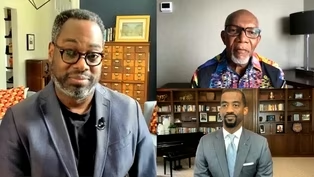
Learn Moreabout PBS online sponsorshipWe are continuing our year-long series on the Black church in Detroit, which is produced in partnership with the Ecumenical Theological Seminary and the Charles H. Wright Museum of African-American History.
Today, we're looking at faith among young African Americans.
A study by the Pew Research Center found this group is less religious and less engaged in predominantly Black churches than older generations were.
We teamed up with BridgeDetroit for this special report.
And joining me now is BridgeDetroit's Engagement Director, Orlando Bailey, Orlando always great to have you here on American Black Journal.
It is indeed always a pleasure.
How you doing Stephen?
I'm good.
So I wanna start with your personal sort of story here.
You are a millennial African-American, you grew up in a church though.
I mean, literally grew up in a church.
So you've had kind of a front row seat to this issue, the whole idea of how millennials will internalize and embrace the history and the legacy of religious practice and religious joy in the African-American community.
Tell me what that's been like for you.
It's really been an experience as someone I would, I would say I'm probably a little bit more of an elder millennial, so I still know, you know, what it means to have gone outside and played all day and drank from the water hose and things like that.
And to see the advent of technology and cell phones and the information aids come into our lives the way that it did it, it brought about, you know, a different kind of feeling for some of my peers who have been younger to whereas I was told that's just the way it is to a lot of my questions, a lot of how, a lot of my rigorous questions and even as a young adult, some of my peers that's just not good enough, right?
And so this trend that we're seeing of young, younger folks being, you know, less religious or even not as involved in the church I think goes to some of those unanswered questions that so many of us have in addition to the access to information that tries to dispel what we're taught in our Christian faith and in the Black church growing up.
And so if the Black church doesn't put out as much information as the detractors, then we may continue to see this trend.
Yeah, so I wonder if you can give us an assessment of how you think young African-Americans are doing embracing the religious history and legacy of our community.
Is the Black church in good hands with millennials?
I think so.
I think that there is a remnant of young folks who came up in church, who are interested in carrying on the mantle.
We talk about the transfer of mantle in the Black church in Christianity between the Prophet Elijah and Elisha.
And we're seeing that transference happen all over the city of Detroit where older pastors are retiring and younger folks are stepping in.
I do think that we are trending in the right direction and I am seeing the Black church sort of return to some of its roots in community, wanting to remain and become, a north star and bedrock in the communities that they are housed in here in the city.
So I do think that we're in good hands, but I do think we're in a transition period and sometimes transition is a little bit difficult.
Yeah, so you had a really interesting conversation about this, I wanna get to that.
Tell us who you talked to and what you talked about.
Yeah, so I talked to Minister Mikiah keener, she is a 23-year-old associate minister on staff at Triumph Church, one of the fastest growing churches in the region headed by Pastor Solomon Kinloch.
She has a whopping 70,000 followers across her social media platforms.
And she is simply doing our best to spread the good news, leveraging technology, social media, and all of the tools that it has to offer to reach as many people as she can.
It was a really, really interesting conversation.
We talked about this question of why younger people aren't as religious or as engaged in the Black church, but I also had the opportunity to talk to her about the patriarchal nature of the Black church and its treatment toward women and how, what her experience has been as a young woman in ministry.
STEPHEN: Well, let's take a look.
We are so amazed by everything that you are doing.
You're a ministry influencer, like I said, with over 70,000 followers.
Whew!
So young, how did you know that church and ministry was what you wanted to do?
Oh my goodness, so first of all, let me just say, when I accepted the call to ministry in my senior year of high school and before that, the church was not my thing, ministry was not my thing at all.
So I'm a first-generation preacher.
This was all new to me, but I had a very, very, very close friend who invited me to try and church one day.
And she wanted me to just come check out the service with Pastor Kinloch and I went, and on the first Sunday I went he was teaching a message about people serving in church and how everyone should make a contribution, not monetary, but you know, with your services, your gift, your time.
And so that message really struck me and it just convicted me to do more and to be a part of something bigger than myself.
And from that moment on, I was able to kind of identify, you know, kind of what my calling was and that was in September of 2015 and ever since then, I said, yes, and I've been doing it, so.
(speaker laughing) So tell us really quickly, how did you manage to get up to 70,000 followers?
What exactly are you doing?
Oh my God, people ask me that question all the time Orlando, and honest to God, the only answer that I'm always able to give is just being authentic.
I just, anytime I go live, anytime I jumped in front of the camera, I just make a vow to be myself.
I don't try to come out portraying someone that I'm not.
And I think that more than anything, people were attracted to my authenticity.
And I think that that's what has been keeping me, you know, able to last for such a long time.
So I'm very grateful.
Yeah, you started so young.
I wanna talk to you a little bit about some findings that the Pew Center found.
They did a study of faith amongst Black Americans and one of the findings is that younger Black Americans are less likely to have grown up in church or particularly the Black church.
You are a minister in one of the blackest cities, in the blackest city (speaker laughing) in America, tell us what you are seeing.
So, I definitely am seeing a lot of people that look like me in church.
Now, I'll be honest, there are people that look like me that are leaving church, but I do wanna come in and highlight those that are sticking to church, those that are coming to church.
And I think the biggest thing behind it is the community that the church is creating to make sure that people that come from different ethnic backgrounds or minorities are able to come in and are able to be able to be themselves and community.
Not only with communities that look like us, but communities that are developing diversity as well.
So I think that that's really important.
Just being able to establish healthy communities for people to be a part of when they come to church.
Absolutely, one of the things that you said though, is that there are people who look like you, Black folks who look like you, who are around your age, or maybe a little bit older or a little bit younger are leaving the church.
Do you have any idea as to why that has happened?
You're not what Orlando, to be honest, I think that, I think that we have mastered church service but we haven't mastered church systems.
So we're doing service really great.
We're killing service, we're killing praise and worship.
We're killing the choir, we're killing music but we have to have systems in place just as any other business, just as McDonald's has a system, just as Starbucks as a system, just as Amazon has a system, I think that the church has to work on implementing good systems and strategies to keep people not only coming back on just Sunday or just Wednesday for Bible study, but to keep them feeling like they're connected on a day-to-day basis.
So I definitely think that that is something that not just the Black church, but that the church as a whole has to work on to make sure that people feel connected every day, rather than just on Sunday.
For anything to last, you do need a strong infrastructure.
Absolutely.
All right, so let me ask you this question.
How are you engaging younger folks in ministry and in your ministry?
Tell me what is working.
Tell me what hasn't been working.
Social media is my favorite tool in the world right now.
I love the fact that I'm able to reach someone on (indistinct) and someone in India in one post.
And I don't take it lightly.
I don't take digital discipleship lightly.
I don't take digital worship lightly.
I think that that is one of the fastest growing tools right now.
And so I've just been trying to strategize with it the best way that I can, whether it's a Facebook post or me going live on Instagram, whether it's me just putting out a few tweets here and there on Twitter, creating a TikTok video, whatever it is that I can, I'm doing texts automation, email lists, everything that I can do to reach people on a national and global basis using social media and the internet.
That's one of the things that I have my hands in right now and that's one of the things that I think that every leader should be doing right now, because it's one thing that almost everyone has in common it's social media.
So I think that social media is playing a big part in church right now.
What hasn't been working?
Whew, what hasn't been working?
That's a great question.
You know, I think that what hasn't been working is not being able to adapt to the change.
I think that the church was already on its way to take over digitally but I think that COVID kind of pushed us into it before we were ready.
And I think that what happened was that a lot of leaders were not able to find the right rhythm and so they're doing it and they're trying to figure out why it's not working, but that goes back to creating those systems, even online systems that we have to be able to build as a church to make sure that people are staying engaged, because I don't know about you, but I know for me, I'm gonna be honest, when church first started online back in March of last year, I was doing good for that first month and in April, I was like, miss one service, miss the second service, looked up and I missed like four different services and you know, that has a lot to do with me on one end but it has a lot to do with systems on another end as well again, to make sure that we are a part of a community, whether it be physical or online, we have to make sure that a community is set in place for us as believers.
Yeah, tell us what you're seeing at Triumph, one of the fastest growing churches in the region, in the blackest city in America.
What is the demographic makeup of Triumph church?
And I hear that there are a lot of young people that attend Triumph.
How are you attracting and retaining them?
Oh my gosh, I think that, let me just say this.
Whenever I hear that young people are leaving church, it's hard for me to believe because when I look at Triumph church and I look around at every service, every campus, and I see so many young people not just coming in, but serving, young people serving on our ministry team, on media, working with our children, working with our youth, working in the offices, it's just a reminder that young people do love God and that young people do wanna be a part of a community.
And one of the things that I love about Pastor Kinloch is that he opens the door for people to come in and be a part of something that is bigger than themselves.
And I think that's something that any great leader has the knowledge of doing it's opening up doors and creating spaces where we can come in and not just consume, but contribute as well.
So that's definitely one of the things that I love about triumph is that young people have a chance at every area of ministry to be a contributor and not just a consumer.
You are a young woman in ministry and women in ministry leadership in Black churches have had a tough go historically 'cause of the patriarchal nature of the Black church.
How are you faring in 2021?
You know what, when I first went into ministry, my pastor used to always talk about exactly what you just said and even though I heard him out, I didn't necessarily believe it all the way until I started facing a challenge, facing challenges or doors that were closed on me because I was a woman in ministry.
And so I didn't know if it was all the way true back then, but I definitely believe it now and one of the things that I really, really hope that the church is able to do not even in the future, but right now, is create spaces for women to be able to optimize in their roles, in their callings in church leadership.
I don't believe that God has asked women to come in and just to sit on the side and be quiet.
That is not my belief.
I believe that every individual man and woman has a unique gift, a unique calling.
And I do believe that women should be able to utilize their gifts in the same way as men in church roles.
Video has Closed Captions
Clip: S49 Ep30 | 9m 5s | Third New Hope | Episode 4930/Segment 2 (9m 5s)
Providing Support for PBS.org
Learn Moreabout PBS online sponsorship
- News and Public Affairs

Top journalists deliver compelling original analysis of the hour's headlines.

- News and Public Affairs

Today's top journalists discuss Washington's current political events and public affairs.










 New Season
Support for PBS provided by:
American Black Journal is a local public television program presented by Detroit PBS