
Mina Guli Ran 62 Marathons in 62 Days for Water Awareness
Clip: 4/2/2019 | 14m 20sVideo has Closed Captions
Mina founded the non-profit “Thirst” and took to the road, running to raise awareness.
The world’s fresh water is disappearing thanks to climate change and growing demand. Mina Guli was a corporate lawyer in a former life, but she quit her job, founded the non-profit “Thirst” and took to the road, running marathons to raise awareness about our dwindling drinking water. She managed to slow down for just a moment to speak with Hari Sreenivasan in New York.
Problems playing video? | Closed Captioning Feedback
Problems playing video? | Closed Captioning Feedback
Mina Guli Ran 62 Marathons in 62 Days for Water Awareness
Clip: 4/2/2019 | 14m 20sVideo has Closed Captions
The world’s fresh water is disappearing thanks to climate change and growing demand. Mina Guli was a corporate lawyer in a former life, but she quit her job, founded the non-profit “Thirst” and took to the road, running marathons to raise awareness about our dwindling drinking water. She managed to slow down for just a moment to speak with Hari Sreenivasan in New York.
Problems playing video? | Closed Captioning Feedback
How to Watch Amanpour and Company
Amanpour and Company is available to stream on pbs.org and the free PBS App, available on iPhone, Apple TV, Android TV, Android smartphones, Amazon Fire TV, Amazon Fire Tablet, Roku, Samsung Smart TV, and Vizio.
Watch Amanpour and Company on PBS
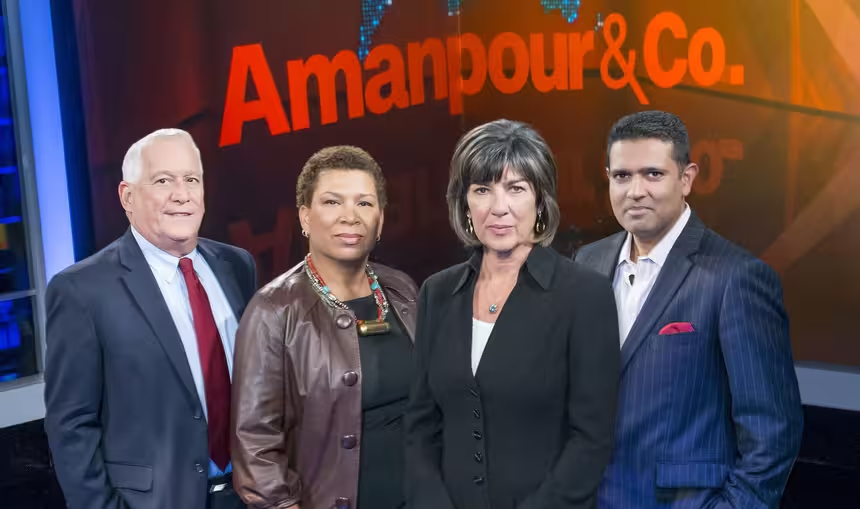
PBS and WNET, in collaboration with CNN, launched Amanpour and Company in September 2018. The series features wide-ranging, in-depth conversations with global thought leaders and cultural influencers on issues impacting the world each day, from politics, business, technology and arts, to science and sports.Providing Support for PBS.org
Learn Moreabout PBS online sponsorshipYou may not realize it, but the world's freshwater is disappearing thanks to climate change and growing demand.
Our next guest, Meena Gooley, was a corporate lawyer in a former life, but she quit that job, founded the nonprofit SOS and took to the road running marathons to raise awareness about our dwindling water that we drink.
She managed to slow down for just a moment to speak to our Hari Sreenivasan.
You've worked as a lawyer, a banker, and investor.
What made you want to pivot towards water?
Water is the most fundamental thing that our societies and our economies and our communities rely on for life.
If we have no water, we have no way of life.
When I discovered how not only important water is for our communities and our economies, but how fast we're running out of usable water.
I couldn't believe that it wasn't higher on the list of topics to talk about.
I couldn't understand why it wasn't the number one thing that newspapers and media outlets were focusing on.
And so I set about trying to change that.
What are the longer term impacts to countries and communities when water becomes more scarce?
So here's the thing about water.
We all think that water is going to be someone else's problem.
If we live in a big city and water comes out of the tap, we think it's not going to affect us.
The reality is when it starts to affect supply chains, when it starts to affect lives and livelihoods, it's our problem, too, because we have to understand every time we take a piece of food off out of the fridge or off the shelf, that's water that we're taking.
And it came from somewhere.
78% of jobs.
78% of jobs.
Are linked to water.
So we have no water.
Jobs will be lost and economies will suffer.
And it's not something that's going to happen.
Many years from now.
It's something that's happening right now.
I've run through these cities.
I've seen it for myself.
I've spoken to these people.
This is a problem that's real.
It's getting worse and it's happening right now.
So let's connect the dots here.
How does the thirst for water connect to running in deserts and along riverbanks?
The thing about the water crisis is that it's about supply and demand for water.
So experts predict that there will be a 40% greater demand for water than the supply of water available by 20, 30.
That's 11 years from now.
So we're going to need that much more water than we have.
Yes, that's right.
So even though we it seems like we're surrounded by water, that there's water everywhere, all across our planet.
Less than 1% of it is available to us to use.
And the problem with that 1% is not only are we demanding more, but we're also we've also got less and less available to us because pollution, groundwater pollution, because climate change is causing changes in weather patterns.
So rainfall is falling in places that we can't catch us or that gets polluted in a flood and gets washed out to see this supply.
Demand pace is absolutely key.
So there are lots of people focused on the supply side figuring out how we can desalinate water more efficiently, figuring out how we can clean water, how we can deliver more clean water to more people.
But there's very few people focused on this demand side.
And the thing that really interests me about the water crisis is how each one of us are not only affected by the problem, but can become part of the solution.
So I decided that I was going to run use my feet to run around the world in some of the places most badly affected by the water crisis to meet people who was suffering from water scarcity or lack of clean water or lack of sanitation and hygiene services to tell their story and also make the solution providers people who are working to solve the crisis.
So I started running, and that's how running and education and thirst all kind of came together.
So you're not a runner by nature?
Oh, no, I'm definitely not a runner.
I mean, you kind of are one now because you have to be I mean, you're you've run or you're in the process of running 100 marathons, right?
In what, 100 days?
Yeah.
When you say that, it makes me sound completely healthy.
Okay.
So so you can't say you're not a runner and then say, yeah, well, I am kind of running a hundred marathons.
You have.
And I don't run because I like to run or because I'm good at it or naturally talented because none of those things are true.
I learned to run because it's a way for me to go with my feet to these places and meet people and tell their stories.
And there's not a story about me.
It's a story about humanity.
You've run in some amazing and exotic places.
What are the what are the kind of stories that stick in your mind of how this really large abstract problem is a personal crisis for people on a daily basis?
One of the places I ran in the first half of my marathons was to a place called Beaufort West.
It's about 4 hours drive north of Cape Town and in Beaufort West.
The people in the community have literally run out of water They turn on the taps and no water comes out, and they rely on bottles of water that are delivered to them daily on the back of a truck and on one of my marathons, I joined the people and the women on the back of this truck, and I took water to the local communities.
We had people running after the truck begging for more water.
We drove along the street and instead of turning left, we turned right and a fight broke out on the street because the people that we didn't deliver water to at that moment was thirsty and they needed water to drink to live.
And I thought to myself, this is really dire consequences, but it paints it into a very real light in South Africa with communities where they've had so little water that there are for sale signs littering the streets.
I met a guy called Christian, who's a 24 year old farmer, and he showed me pictures of his farm, lush and green.
He showed me pictures of his dam, which had nine meters of water in it less than 12 months beforehand.
And half an hour later I ran across that dam.
That dam is so is dry as a barn.
There is not a drop of water in it.
And I said, to Christian, what is your hope for the future?
Remember, he's 24 years old at a time when dreams and ambitions should be everything to him.
And he said, All I do every day is hope for rain, because if it doesn't rain, I have to leave my farm and the farm will be valueless.
I won't have nothing.
And it's not just developing countries.
I mean, we should point out that if United States per capita, we probably consume more water than the average Chinese or Indian citizen, right?
Yes.
Yes, you do.
It's funny because people will say to me sometimes Well, can you come in and teach the immigrant school or a very poor community?
And I say, yes, but the people that know most about water are those people, because a lot of them don't even have access to it.
So they understand the value of every drop.
One of the groups of people we really need to change are those that have everything because they don't understand that they have everything, but one day they're going to have nothing.
You ran across the United States as well.
What did you learn here?
When I went to California, I met farmers in the Imperial Valley, and I heard from them that they have gone through this massive period of drought.
The drought has become so bad that their communities who have been asked to remove 50 year old trees from orange groves, not just one or two, but 70% of their crop because the local communities think that they're using too much water.
You can see sinkholes opening up in California.
You can see the impact that drought is having on farmers but also on economies.
As house prices fall, property prices get devalued.
People literally don't have access to water.
It's it's challenging On the other side, this is not all doom and gloom.
So El Paso, which is a city that sits right on the border, has access to the Rio Grande, which runs straight through it between Juarez and El Paso every day.
People in El Paso communicate directly with the guys in Juarez to work out how are they going to share the water coming out of the Rio Grande.
They do it frequently.
They do it happily.
And they do it in a very collaborative way.
And it seemed to me that one of those examples of just we don't think about how water is critical to our lives every day.
We also don't realize how it ignores boundaries, eating, doing history, eating knows everything.
Water just is or it isn't.
I'm imagining when you don't have something as basic as water, you get up and move.
You leave if you can.
Right.
Right.
Which is what's happening in the displacement of millions and millions of people across the planet who at the moment it's in places like Sudan and Somalia, in the Middle East, where we see in Syria, where we see people who have no access to water, to grow crops, to feed the to feed the cattle that they rely on or the sheep or goats.
And when they have no option but to move in order to be able to drink water and give food to their families, they move and that right now there is displacement of people.
So this is going to get worse.
There will be refugee crises because people have no option but to search for survival.
How did you choose one marathon place over another?
When I started, I created a little filter system, which was it needs to have either a water problem or a water solution on the water problem side.
I have to tell you, there are so many countries and cities and places with water challenges.
So I ran in everywhere from the UK and we told a story about food waste.
Most people don't think about the fact that when you waste food, you waste water.
I met women and children on the edge of the port in Uzbekistan, and we talked about how the fact that the inland ocean has retreated has caused massive problems for the economy and their society.
Fishermen can no longer fish, but the people who used to make things in this town of my neck can no longer put those things onto a boat, to ship it across to Kazakhstan and get access to markets internationally.
So they suddenly become much more isolated, which means that they've lost jobs.
Women came to me begging me to help them to get the money so they could send their kids to school.
I mean, it's just these things the scary and horrifying and extremely confronting, but it's their stories that I wanted to be able to tell.
62 marathons in which I think for most of people on the planet would already be an accomplishment.
But what happened on Marathon 62 or day 62 when I got to day number 62 got to the end of the marathon, and I couldn't take another step to even get into the car.
The my team had to help me get into the car.
They had to help me get out of the car.
And on day 63, when I got ready to run a marathon, my team said, If you can't walk across the room, unaided, we're going to the hospital.
Of course I couldn't.
I mean, I couldn't even put my foot down on the ground by this stage.
So we went to hospital and we did a scan and discovered that I had just a little break, but an absolutely massive break in my leg.
And all I could do was sit there and watch the clock thinking, how can I get out there and do my run?
And I watched as more and more doctors came and more and more people came and told me I wasn't going to be able to get out there.
And I thought my whole world was collapsing around me.
Every thing I could see was dark, bleak.
I felt that I had let down my team, all the people whose messages I wanted to tell, the stories that I wanted to push to the world and most of all, I felt that I'd let down the cause that I was so committed to.
And my team sat down with some of the best people in the world.
And they sat down.
They said, We'll take your runs for you today.
Today we'll go and we'll run your marathon.
And I said, in my wheelchair, and I watched as they did just that.
The next day they went out and ran again.
But this time they were joined by people we didn't know The day after, more people joined.
By the time we got to marathon number 65 and 66 and 67 people were joining from all across the world.
So they were just running their own marathons.
Yeah, running their own distance and donating it so that I didn't have to run.
By the time we got to day 100, we had thousands of people in over 160 cities, in over 50 countries and territories on every single continent of this planet, all running and donating their distance to support one cause.
And that's water.
You started this in New York City at the New York City Marathon.
You finished 100 here in New York as well.
Yeah.
And in the hundredth one, you were being pushed in a wheelchair.
Yes, I was.
And I mean, people don't notice you came in.
You're sitting here but you're still using crutches.
You're still on the road to recovery.
Yeah, right.
So what was it like then?
When I crossed that finish line, it was a mixed bag.
Of emotions.
To be honest, I felt humbled by the community of people that had come around me, humbled, particularly because I was not able to complete this on my own, that I needed the steam and the power of people that I've always said the power of the people I want puts wind beneath my sails when I'm running.
But this gave a whole new meaning to that, because it wasn't just the wind beneath my sails.
It was the power behind my wheelchair.
It was the community of people that helped me to do things when I was on crutches.
And I still am.
But every time when I think I can't get up, every time I think I can't take another stab.
I think about the next generation.
I think about the kids.
I want to have a planet where kids can grow up and do whatever they want to do, fulfill their dreams unfettered by water scarcity.
And I won't stop until that happens.
All right.
Good luck getting back on the road meaningfully.
Thanks so much for joining us.
Thank you.

- News and Public Affairs

Top journalists deliver compelling original analysis of the hour's headlines.

- News and Public Affairs

FRONTLINE is investigative journalism that questions, explains and changes our world.












Support for PBS provided by: