
Minnesota Sustainable Farming
Clip: 6/22/2026 | 5m 2sVideo has Closed Captions
A Minnesota farm family plants a new kind of wheat that restores the soil and saves water.
A Minnesota farm family plants a new kind of wheat that restores the soil and saves water. Now his crop is being used by this company making all kinds of organic foods.
Problems playing video? | Closed Captioning Feedback
Problems playing video? | Closed Captioning Feedback
America's Heartland is presented by your local public television station.
Funding for America’s Heartland is provided by US Soy, Sustainable Agriculture Research and Education, Rural Development Partners, and a Specialty Crop Grant from the California Department of Food and Agriculture.
Minnesota Sustainable Farming
Clip: 6/22/2026 | 5m 2sVideo has Closed Captions
A Minnesota farm family plants a new kind of wheat that restores the soil and saves water. Now his crop is being used by this company making all kinds of organic foods.
Problems playing video? | Closed Captioning Feedback
Where to Watch America's Heartland
America's Heartland is available to stream on pbs.org and the PBS app.
Providing Support for PBS.org
Learn Moreabout PBS online sponsorship- I am growing food for humans that's healthy.
To be able to grow a product that is nutrient dense, that people can feed their families with, brings me a lot of joy.
- Tucked away in West Central Minnesota, you can find the sprawling A-frame Farm stretching 500 acres, where the Peterson family grows various certified organic grains, as well as grass-fed beef.
- We work on mother nature's terms.
There is, you know, kind of a harsh reality that we live in a system that just wants as much as possible as fast as possible.
But mother nature can only give us so much at a time before it can replenish itself.
- Luke Peterson and his family are practicing regenerative farming.
It's a farming method that aims to improve soil health while adapting to challenges posed by extreme weather.
- We regenerate the soil, and not only sustain it, but to actually build it back up.
We're gonna mitigate climate change with deep-rooted plants like the kernza, the alfalfa, the sunflower, the perennial pasture.
- To keep their soil healthy, the Petersons grow cover crops and avoid tilling.
They rotate a diverse set of crops and the grass-fed cattle provide compost.
(cow mooing) - My wife was involved with healthcare and she had a lot of good questions about how that correlates with what she did as a nurse practitioner in human health, and then that got me kind of looking at soil health.
And being a farmer, it was pretty obvious that, in order to kind of maintain the health of people in the land, we'd have to start farming differently.
- Luke's way of farming not only yields healthier crops, but also protects them.
Healthy soil can help reduce the effects of drought and severe rain on crops.
That's because it can absorb and retain more water, keeping the soil in place during heavy rains.
- One thing I've noticed farming is how fragile growing food is.
You know, like, rain events at the wrong time, you know, too much rain or not enough rain, obviously, can just impact how much product there is.
- With increasingly severe and unpredictable weather patterns, Luke leans heavily on diverse crop rotation, as well as a unique grain crop called kernza.
Its roots reach deep into the earth, enriching and stabilizing the soil while capturing and storing carbon dioxide from the atmosphere.
- You know, if I have a catastrophic rain event at certain periods, I can always just move in another crop you know, into that spot.
So, by having options, it makes us more resilient.
And then having healthy soil that holds to itself, that doesn't wash away, um, you know, building up our own nutrients within our soil has resilience.
You know, the more diversity in a system, the better chance it has that survival.
- Luke's farming practices caught the eye of Simple Mills' CEO, Katlin Smith.
Her natural food company was looking for like-minded collaborators.
Before long, a partnership blossomed.
- We love partnering directly with the farmers who make our crops and our ingredients.
Um, Luke is one of those farmers.
So he makes sunflower seeds for us.
And one of the big things that we are passionate about is advancing regenerative agriculture and advancing this transition to regenerative agriculture.
- Simple Mills uses sunflower seeds to make crackers, along with several other products.
- Each year, they come out to the farm and see where the program is headed and can physically see the crop in the ground and learn more about regenerative ag.
- I think coming out here to, to farms like this, it's, it's soul filling.
To see our team, to see some of the members of our community connect with farmers in the way that their food has grown, that's how it was meant to be.
The food industry, we can leave things in a better spot.
We can feed people in a better way.
And so I think both he and I get so excited about the potential of positive impact we can have, and also a sense of responsibility that we have.
- It doesn't take a lot of time to get the soil texture back into condition where you can work with it.
We just need to move in that direction.
Creating a, you know, a healthier environment, you know, growing healthy food, and just being conscious of how we do that.
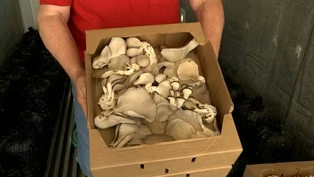
Video has Closed Captions
A California farmer shares easy-to-grow mushrooms with giftable box kits. (5m 43s)
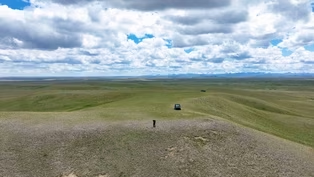
Montana Grasslands Restoration
Video has Closed Captions
A Montana rancher honors his ancestors, and Mother Earth, by restoring native grasses to his land. (5m 33s)
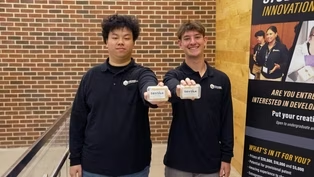
Video has Closed Captions
See how college students are turning soybeans into new products like baby wipes. (6m 5s)
Providing Support for PBS.org
Learn Moreabout PBS online sponsorship
 New Episode
- Food
Christopher Kimball’s Milk Street Television
Transform home cooking with the editors of Christopher Kimball’s Milk Street Magazine.








Support for PBS provided by:
America's Heartland is presented by your local public television station.
Funding for America’s Heartland is provided by US Soy, Sustainable Agriculture Research and Education, Rural Development Partners, and a Specialty Crop Grant from the California Department of Food and Agriculture.