Living St. Louis
Missouri's Forgotten Green Book Stops on Route 66
Clip: Season 2026 Episode 15 | 14m 7sVideo has Closed Captions
The Sara-Lou Cafe is one of the only Green Book locations still standing in our stretch of Route 66.
The Sara-Lou Cafe is one of the only Green Book locations still standing in our stretch of Route 66. The restaurant has a long and vibrant history but has been closed since 2002. There are currently reports circulating about preservation efforts.
Problems playing video? | Closed Captioning Feedback
Problems playing video? | Closed Captioning Feedback
Living St. Louis is a local public television program presented by Nine PBS
Support for Living St. Louis is provided by the Betsy & Thomas Patterson Foundation.
Living St. Louis
Missouri's Forgotten Green Book Stops on Route 66
Clip: Season 2026 Episode 15 | 14m 7sVideo has Closed Captions
The Sara-Lou Cafe is one of the only Green Book locations still standing in our stretch of Route 66. The restaurant has a long and vibrant history but has been closed since 2002. There are currently reports circulating about preservation efforts.
Problems playing video? | Closed Captioning Feedback
Where to Watch Living St. Louis
Living St. Louis is available to stream on pbs.org and the PBS app.
Providing Support for PBS.org
Learn Moreabout PBS online sponsorshipRoute 66 was officially commissioned in 1926 and created a nearly 2,500 mile road that wound its way from Chicago to Los Angeles.
Over the decades, it would become the modern manifestation of the American spirit, promising freedom and adventure for those brave enough to face the unknown.
It was used by hopeful migrants to walk out of the dust bowl and the depression and into a better life, and by post-war families who were enjoying being reunited with loved ones and a new degree of economic mobility.
But this road that was built to create opportunities for Americans didn't treat them all as equal.
Route 66 was seen as this road that was all about adventure, all about freedom, you know, kind of the the open road and being able to explore.
But we know that black travelers didn't necessarily have that same experience and that they had to be very careful.
We got to think about Jim Crow.
We got to think about segregation and a traveler, not necessarily if they hadn't traveled that route before, not necessarily knowing what is up ahead.
Sundown towns, as we know, were towns that literally when the sun went down, if you were black, you should not be occupying any space in that particular town.
Oftentimes by word of mouth, even by signage, billboards and things of that nature, detailing, hey, you need to be out of here.
Jailing, fines, and sometimes even violence would be some of the repercussions that would come if black people were found in some of these sundown towns.
- Since the early 1930s, New York City postal worker, Victor Green, had been thinking about a way to help black travelers navigate around these embarrassing or frightening experiences.
Anti-Semitism was also prevalent, and Green found inspiration in the Jewish Vacation Guide.
First published around 1916, it provided the Jewish community with suggestions for businesses that were welcoming and safe.
Green decided to create a similar handbook for black travelers, and with the help of his wife Alma, published the first edition of the Green Book in Harlem in 1936.
As the popularity of Route 66 and the romance of the Great American Road Trip grew over the next three decades, it would become invaluable.
The Green Book served as a tool, an instrument for Black travelers to be able to explore while also maintaining their safety.
St.
Louis had a number of businesses listed in many editions of the Green Book.
But after the May 16th tornado devastated the popular Harlem Tap Room, which had been open since 1946, there are none that remain operational today.
There is one still standing that's propped up, in part, by its impressive history.
The building, which is on North Sarah and St.
Louis Avenue, was built in 1906, not too long after the World's Fair.
In 1942, a gentleman by the name of Gustav Brinkman, he and his wife, Amelia, started the Sara-Lou Cafe.
The Brinkmans were white, but welcomed everyone into the cafe.
They also employed black workers in highly visible management positions.
And this inclusive atmosphere saw the Sara-Lou listed year after year in the Green Book.
When Gust decided to sell the restaurant in the early 1970s, it was bought by Vashon graduate and entrepreneur, Jimmy Owens.
- So the initial Sara-Lou, they were famous for their frogs, that was up on the sign.
But Jimmy Owens' Sara-Lou was famous for their shrimp.
It was said that Sara-Lou sold more shrimp than any non-chain restaurant in the Midwest.
And it wasn't just because the shrimp were delicious, Jimmy intentionally kept the cost of the famous dish affordable so that everyone could enjoy it.
The Sara-Lou had always been popular, but under his ownership, it became much more.
It was sort of a cultural center for the neighborhood.
Jimmy was sort of a godfather for a lot of the kids in the neighborhood.
He was champion of a lot of children's causes.
Over the years, he employed generations of neighborhood families in the restaurant.
So it was a special place.
Jimmy Owens closed the Sara-Lou in 2002, and the iconic sign disappeared in 2019.
But those I spoke with in the neighborhood still remember it fondly.
But since happy memories can only do so much, structural supports have been placed to preserve what is left of the building, in hopes that someday this historic site can come back to life.
Yeah, maybe one day somebody will be serving frog and shrimp there again.
By the mid-1950s, millions of green books were in circulation.
And as both the popularity of Route 66 and the green books distribution grew, so did the opportunities for black entrepreneurs.
It helped them to identify what types of services were needed in their area and to take advantage of the wide exposure that being advertised or even just listed in the green book provided.
So it's incredible to be able to have a source like this that's building business, building community and ensuring black safety.
One of the standout entrepreneurs was featured in the Missouri History Museum's Route 66 Festival, which marked the 100th year since its construction.
Elizabeth Calvin and Irv Logan were there to share the incredible story of their grandmother, Alberta Northcutt Ellis, who bought the Old City Hospital in Springfield, Missouri at an auction and turned it into an amazing destination on the Mother Road.
Her hotel was right there on Business Route 66.
The hotel had a barbershop, a beauty shop, the rumpus room, you know, for partying, the restaurant.
The Crystal Palace.
Then she had the jazz club, the Crystal Palace.
Alberta also bought a farm about 10 miles outside of Springfield, where families could pull off of Route 66 to take a rest, eat their picnic, or enjoy the fruit trees in the orchard.
She even arranged with the white farmer next door to give pony rides to the children.
Her unique complex of businesses didn't just give black travelers the necessities, it gave them the chance to enjoy their journey with a sense of freedom and community.
The only other way that African Americans in that day would have a place to stay was in someone's home as they passed through.
Graham's Ribs Station was anothe location in town that had little cabins that Mr.
Graham, who was an expert in barbecue, decided, "You know what?
People are coming here to buy a barbecue, and then they're asking me, 'Where do I stay?'"
So over time, he developed these small cabins.
So the hotel was around the corner from it.
They worked together.
Very close.
With each other.
It's like, if somebody came and there was no room in the hotel, she would send them to Graham's.
Graham's would do the same thing Alberta's Hotel also hosted a number of famous black performers who followed Route 66 from gig to gig.
Nat King Cole, Roy Hamilton, even the Harlem Globetrotters.
But all of her businesses, from the Snack Shack to the Jazz Club, were open to everyone.
She never discriminated against anyone based on color.
There were times when the soldiers who were returning from Korea would come into town from Fort Leonard in a group, and they had served in war together and seen some horrible things and been through some terrible experiences together.
And when they got a chance to relax, they wanted to do that together.
So a lot of times, you know, we'd have a mixed group of people staying there at the hotel.
Before moving to St.
Louis, Elizabeth Calvin and Irv Logan grew up in Springfield, watching their grandmother run multiple businesses while also working full-time at the Southwestern Bell Telephone Company.
Everybody in Springfield called her Miss Alberta.
She was all business.
But she was also a very loving grandmother.
I spent a lot of time working with her at the hotel.
I was the gopher.
Go for this, go for that.
Just followed around and saluted and did what I was told.
I learned a lot.
I didn't realize it was going on.
But it really served me well as I became an adult and moved on.
But on the rare occasion that she got a break, Alberta would indulge in one of her passions, traveling.
We were on old 66 all the way from Springfield to to California.
We we traveled with her as the family on the road.
And so we knew about Jim Crow.
At nighttime, we would stop along the road if we saw a vacancy sign at a motel.
Alberta was always the one to go in because she was pretty no-nonsense.
Sometimes she would be told that there was no vacancy and she would usually come back to the car and she'd say, "I told them that I'm gonna write, "I'm gonna write to AAA, I'm gonna let them know "that you denied us service."
And that was back in the early 50s.
She was pretty conscious, I think, of the way things should be and not the way things were.
In 1966, two years after the Civil Rights Act had passed, the final edition of the Green Book was published.
That same year, Alberta Northcutt Ellis passed away at the age of 56, shortly after her iconic hotel on Route 66 had closed.
The grand old building was eventually torn down, a historical marker the only indication it had ever stood there.
But Alberta's legacy lives on thanks in part to her refusal to throw anything away.
She had meticulously documented her life, her family, her business by saving every photo, record, postcard and letter.
There's a picture in the collection of me as a newborn child being held by Elijah Bidel.
Elijah Bidel Crittenden, born into slavery, was still living when Irv was born.
So the history for us is very present.
It doesn't always feel like the past.
Her grandchildren inherited this vast and precious collection and donated it to Missouri State University in Springfield for preservation.
Find out what your history is, find out who your family really was, honor your past because it is also your present.
Just the way that we also were able to live because this woman was on fire.
She was, she was really something.
The Missouri History Museum's Route 66 Green Book panel also featured Marlie and Anthony Love who discussed how the Green Book inspired their digital travel series.
Hey what's up, it's Anthony and Marlie Love.
Welcome to episode three of our Traveling While Black Across America series, volume two, Oregon Coast.
We're in the one of the most famous cities on the Oregon Coast, Cannon Beach, and we cannot wait to show you all the great things that you can experience here.
When the St.
Louis natives moved to Seattle, they embraced exploring the Pacific Northwest, but realized other black travelers might feel hesitant to do the same.
And we thought about the aspect of not really seeing a lot of other black folks up in the Pacific Northwest, not like we were used to growing up in the St.
Louis area.
Then it took my mind back to when I found an original copy of the Green Book back in Marlie's grandparents' house.
Pulling off the road and walking into our lodging, it was really refreshing to see a sister work in the front desk checking us in.
So we are giving two points for black people seen.
Of course, that added to our personal comfort level.
But not only that, walking around the town and dropping into the establishments, we encountered some friendly and welcoming people.
We rate our experiences on three criteria.
The drive or travel to a destination, how much fun we have in that destination, and then how comfortable we feel as a black traveler visiting for the first time.
We create these rating systems to help be a resource to other people, because we thought about the Green Book and how there were places that you knew you'd be comfortable at.
And we also have different type of scales for the different type of destinations we go to.
A great example is the state of Oregon.
So the state of Oregon, historically, because of the black exclusionary laws, it has a black population of less than 1% within the whole state.
But if you've ever been to the Oregon coast, it's like one of the most beautiful places in the country.
So we made its own scale to replace the criteria that we have for amount of black people seen.
This trail is pretty dope because it is a pretty easy trail that takes you to a very beautiful payoff.
Low effort but also gets you right smack in the middle of nature.
Yeah, because you know we say nature loves black people.
It was just good to be able to connect that historical context to the present and how people are still thinking about these things and how it informs the way that we today even see ourselves as travelers.
In all of our travels, we try to find a black owned business or minority owned business and encourage other people to go visit them as well.
Black owned, women owned, LGBTQ+ owned businesses that traditional tourism often overlooks.
And so that is sort of the spirit of the green book that we like to carry on.
We like to build bridges.
You know, a lot of folks, they weren't aware that there's still a need, but you know, more often than not, if it's folks outside of our community, they are willing to be allies and to help that experience be better.
♪♪
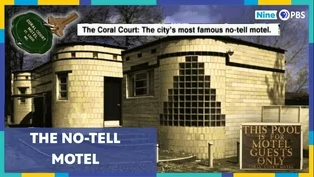
The Infamous Coral Court Motel
Video has Closed Captions
Clip: S2026 Ep15 | 7m 1s | When the Coral Court was built in the 1940s, it was the perfect family-friendly stop on Route 66. (7m 1s)

Vintage Car Race Across Route 66
Video has Closed Captions
Clip: S2026 Ep15 | 4m 39s | As the Great Race made its way across Route 66, drivers of pre-1962 cars stopped in Collinsville, IL (4m 39s)
Providing Support for PBS.org
Learn Moreabout PBS online sponsorship








Support for PBS provided by:
Living St. Louis is a local public television program presented by Nine PBS
Support for Living St. Louis is provided by the Betsy & Thomas Patterson Foundation.