
Mitchell S. Jackson on Changing Paths
Clip: 4/16/2019 | 16m 1sVideo has Closed Captions
Drug dealer turned justice reform advocate Mitchell S. Jackson talks changing paths.
Alicia Menendez sits down with Mitchell S. Jackson, a drug dealer turned author and justice reform advocate, as he discusses the moment he realized he needed to change paths.
Problems playing video? | Closed Captioning Feedback
Problems playing video? | Closed Captioning Feedback
Mitchell S. Jackson on Changing Paths
Clip: 4/16/2019 | 16m 1sVideo has Closed Captions
Alicia Menendez sits down with Mitchell S. Jackson, a drug dealer turned author and justice reform advocate, as he discusses the moment he realized he needed to change paths.
Problems playing video? | Closed Captioning Feedback
How to Watch Amanpour and Company
Amanpour and Company is available to stream on pbs.org and the free PBS App, available on iPhone, Apple TV, Android TV, Android smartphones, Amazon Fire TV, Amazon Fire Tablet, Roku, Samsung Smart TV, and Vizio.
Watch Amanpour and Company on PBS
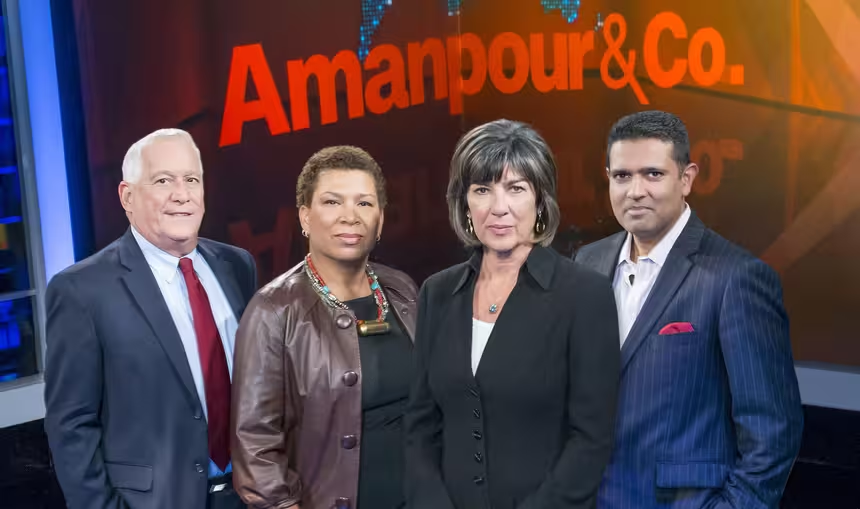
PBS and WNET, in collaboration with CNN, launched Amanpour and Company in September 2018. The series features wide-ranging, in-depth conversations with global thought leaders and cultural influencers on issues impacting the world each day, from politics, business, technology and arts, to science and sports.Providing Support for PBS.org
Learn Moreabout PBS online sponsorshipOur next guest looks back to the he decided to rebuild his life.
Mitchell says Jackson was a teenage drug dealer and ended up behind bars before he was old enough to legally drink.
And today, he's an award winning author and well-known criminal justice reform advocate.
His memoir, Survival Math Notes on an all-American Family, takes us through the calculations he made to overcome his troubled youth as he tells our Alicia Menendez.
A lot of people have described this book as like a black family growing up in Portland.
Yeah, but it's way more complicated than that.
What is?
How would you describe your experience of growing up in Portland?
When people say that this is a black story.
It almost puts all the onus on like being black rather than the circumstances that oppress black people.
And so I really think this is more of like an exploration of the systemic forces that kind of push black people and into these circumstances to have to survive.
Right.
And yet you managed to thread that needle without ever falling into a one dimensional portrayal of the people in your life as victims.
For example, very complicated and fraught relationship with your mother.
Yeah.
You tell us a little bit about her.
Yeah.
Well, my mom struggled with addiction from the time I was about ten years old until I think I was into mine maybe in my thirties or at least into my late twenties.
And there's an essay where I'm trying to kind of reckon with that and that the analogy that I use is that long term addiction is almost like long term marriage, and that while there's all these kind of fallout from it, there's also where she was also committed to something for that long.
So I analogized it to a long term marriage.
I mean, that was me, I guess, trying to figure out a way to kind of just trying to reckon with the kind of disappointments that I was feeling.
But but I also have an old mentor, this editor named Gordon Lish, who used to say, never put yourself above the other in your work.
And so I really do try to do that, right?
Like if you can see critique in someone else, you have to be able to turn that back on yourself.
And so that's really how I look at all of the people that I write about with compassion.
And then like, I'm no better than anyone else on the page.
So I think that really helps me see people who kind of would be subjected to very harsh criticism with the most compassion.
When you look back at your own life, though, what do you see as the moment where it became inevitable for you that your life would intersect with crime?
So I grew up in a neighborhood and there were at this time, there were drug houses kind of popping up in the neighborhood.
So be places where people who were using would congregate, usually some dilapidated house.
And there was some time to be guys outside, like looking out to make sure, you know, other people didn't wander up to the house.
So I remember my mom had been gone I don't know how long, a few days or something.
And she came back and I wanted her to stay, but she didn't stay.
She came back and I got some money and then she left.
But I was looking out of the window and I saw that she had gone to this house that was like a kitty corner from my house.
So like a block or so away from my house, I must have been like maybe 11.
And I watched her go to the house.
And then I when she walked in, I walked out of my house and walked around.
To what now?
Now, I know was a drag house, and there was a guy and he answered the door and he was like, What's up, little man?
And I was like, a man.
Is my mom in there?
He was like, Your mom?
No, no, Shane in here.
And I just remember feeling, like, defeated in that moment because I saw her go in that house.
And I think something in me was like, I got to figure out a way to get on the other side of this.
And the other side of this to me meant I was not going to be victimize which ended up me victimizing other people by selling the same thing that my mom was addicted to.
So I started.
It took me three or four years, but I started selling drugs pretty early.
I mean, I was maybe 14, 15 years old, and by the time I was 21, I ended up in prison.
Would it be the last time your mom's drug use and your drug selling would intersect in the store?
No.
Yeah, right about that moment.
Um, I guess I must have been.
Am I too aunties?
Because I hadn't gone to prison yet, and I had a guy that, um, used to sell drugs for me and called me, I thought to pick up, um, some product, and, uh, my mother was in there and, uh, I mean, I can't imagine how, um, how I guess far she had fallen into her addiction that she, um, had the audacity to ask me for drugs, but she did.
And it was very upsetting to me.
Um, I didn't give them to me.
And I, you know, I yelled at her and, uh, I think that was a moment.
So if I could think of the moment that it started, it was a moment of walking around to that drug house.
The moment that ended it was my mother asking for drugs from me because to me, that confirmed or maybe not confirmed, but it, it kind of implied that a drug dealer had become my identity rather than something that I did.
And I never wanted that to become who I was.
Let's talk about the title of this book.
Yes.
Survival Math.
What does that mean?
Well, it came from a, uh, an incident that happened to me in my early twenties.
I was selling drugs at the time.
And, uh, one morning I woke up and, um, my partner's children were screaming and someone was trying to kick in the back door.
And so I ran downstairs to kind of see who I was.
And luckily, my neighbor scared off the would be assailants.
And then a few weeks later, a week or two later, I was talking to a guy who was like my mentorship and mentor in the community, and he was like, Yeah, I heard it was this guy named Stitches who was a gang member that I act And then so I don't know, a month or so later, I'm coming out of a house very early in the morning.
I see a guy bicycling towards me and all black it's like summertime.
And, uh, by the time I figure out who it is, I'm like at my car searching for my keys, and he jumps off the bike, and he's like, Yeah, I heard you was looking for me.
And I was like, What And then he says, Yeah, you look for me.
And he pulls out a gun, and he pointed at me.
And between his question and my answer, I started to do all of these kind of calculations, like, would you shoot me?
Where would he shoot me?
I had looked down the street.
There were no witnesses that early in the morning.
I had a gun in my car.
I'm like, If I let him go, can I get in my car and chase him down when he where there would be repercussions on my family, all of these things and really in like a few seconds.
And then ultimately I said, no, I'm not looking for you.
And then he he pointed his gun at me and he was like, yeah, yeah.
Because I'm a real killer.
And then he got on his bike and he rode off.
And then, um, I don't know, a year or so later, he actually did kill someone.
And so that really made me start reflecting on that incident years later.
And when I was writing the book and I was like, what do I call those calculations?
And ultimately Christian did survival math, right?
Because those calculations happen in those moments.
But then it's also a larger algorithm.
Any person who lives in a marginalized community makes all the time.
Yeah, there's the kind of immediate survival math, and then there's like long form, you know, kind of algebra you have to keep on.
And I'm trying to perfect, you know, and I know a lot of people that weren't able to do that, but luckily I was one of the ones.
All the photos on the cover are from men in your families.
You also include them in your survival files.
Tell me a little bit about that part of the book.
So when I was reflecting on my kind of incidents, I was like, Oh, I think that's men in my family have gone through, if not something like this, but their own kind of survival incidents.
And so I asked six men in my family to sit for me for a portrait session.
So I shot them.
And then I asked each of them What's the toughest thing you survived?
And then I wrote their survival stories of second person narratives, choosing the second person because I thought that the second person works is like an eye.
So it makes it very intimate.
But then it also works to kind of involve the reader in a more intimate sense, like make you imagine yourself.
So the protagonist and I really wanted to close what I thought might be empathy or experience gaps between reader and the person in the story.
So much of this book is about grappling with America's complicated history.
It's also about grappling with your own complicated history.
No section speaks of that more than your past relationship with women, sometimes incredibly problematic.
Why choose to include that as part of the book?
I challenge myself to critique my own behavior, and because I had it was the last essay that I revise and the other essays I really try to like historia size, whatever the idea is.
So to kind of look frame it in history and culture.
I also knew that I had to do that with what I call the men on the scale, which is really like the kind of degrees of womanizing.
And so I, I ended up doing a lot of research, but I was also the whole time very fearful that what where was the line between like contextualizing his story sizing and like making excuses for myself?
There was only my voice in the essay, so that's when I came up with the idea to offer former partners the chance to speak about our relationships and not to edit it down, but just to present it as they told it to me.
What was the hardest thing to hear?
Um, the hardest thing to hear really was about what my, the way that they felt about themselves while I was doing these things and like the way that they were trying to rationalize my emotional traumas to themselves.
So how would you characterize your own behavior during those relationships?
Um, I mean, I say it, it's very emotionally abusive.
And I had you know, I think in reflecting on it, I had there were, there were like, I guess in that coping mechanisms, but they were ways in which I was trying to cut myself off from intimacy.
Because if this works out, like, I think it's going to work out like I'm really going to be hurt at the end of this or like, how can I both, like, be involved in this and then also prepare myself for this hurt?
Um, no way obviously to be in a relationship right?
We talk about systems and structures.
You write about your personal experience, the criminal justice system.
Yes.
During the time you were dealing drugs also in college, Yes.
Yes.
College student, too.
I was on the dean's list.
That is one hell of a double life.
Yes, it is.
It it but again, it's like the first identity that I really committed to, I think was being a writer.
So before that, I was like, I sell drugs and I go to school you know, like I'm not a student necessarily, but I do well in school because that's important to me.
I'm not a drug dealer because I don't want to commit to all the things that that necessitates.
But I do sell drugs.
And then I guess it was like me trying to figure out what was going to be a purpose in my life before I kind of decided on, okay, this is who I am.
Did being a writer give you cover for selling drugs that you didn't have to think of yourself as being the drug dealer?
If you could think of yourself as being a writer?
No, because I, I I didn't think about writing until after prison.
I wrote the first I guess my first kind of attempt at writing seriously was while I was incarcerated.
Tell me about that.
Guys in prison often like, well, if someone wrote my life story down, like, it would be a bestseller.
So we were all in there, you know, trying to one up each other.
And I actually got on restriction, which is where I was.
I was like the version of we didn't have a whole car.
Um, but I had to stay on my bunk for like a week.
And I was like, and I was also getting ready to go back in to college because I had my scholarship held for me.
And so I was like, well, maybe I should start preparing myself.
I think I'll start writing.
And so initially it was going to be my life story, and I was going to fictionalize it because the stuff, some of the stuff that I was writing about involved people who were still in those activities.
And so I came home with like, I don't know, 50 or 60 loose leaf pages of my fictionalized life story.
And I remember telling my partner at that time very early when I got maybe the first day that I got home, I'm going to be a writer having no idea what that meant.
Years later, I ended up in graduate school at Portland State University, and then I actually moved to New York and went to New York University's MFA program.
All the while I was just working on that same book and luckily I finished it and published it in 2013.
It would be very easy to read your story, but like this is a success story.
He has it all figured out.
Yeah, that feels absolutely not.
Um, I, um, I, I recognized that I was always, I think one of the things that I have in my forties realize is how I was always holding these paradoxes in me.
Like, I'm just like the people from my neighborhood.
And I'm also exceptional in that I have to believe myself exceptional to kind of escape, which seem like booby traps.
But then also, like, I recognize this so many of my paradigms, so many of my characteristics, so many of my experiences in the, the men that I grew up with.
And even in these the generation that I go home and see now.
And so, no, I don't have it figured out, but I'm very happy that I'm a writer in that I can work through some of these things on the page.
Given your fraught relationship with your mom, I think a lot of us want to know where that relationship is now.
My mom was she's the most generous person that I know, and I say that because, you know, I decided to be a writer.
She didn't.
But she has been in both of these books, really the central figure in the books.
She was also the person that I'm that I called most often to like verify family law or to ask about her own experiences.
And I'm like, I cannot imagine what it's like to have to relive those traumas.
Really for no kind of immediate, you know, explicit benefit for yourself other than you want someone else to to to in some way see this.
And for them to be helpful for them.
And this was no more, I guess, evident to me than the day that the book published.
I had an essay that ran in The New Yorker.
And The New Yorker is famous for their fact-checking.
And the essay they ran was on My Mother's Addiction.
So she had to fact check with The New Yorker about her addiction about the first time that she used drugs.
And she called me afterwards and was like, Mitchell, wow.
Like that could have triggered me.
Like, that was traumatizing.
And I thought, I don't know what I mean.
I know when I put in the story, I don't know what questions they asked, but to me, for her to do that for me is the most gracious, loving thing that she can do.
And also knowing that this is going to be published.
So not only am I fact-checking this that like this is going to be in The New Yorker, which I would imagine has a broad reach.
So there were like two levels of like grace, which I think is so much.
Thank you for having me.

- News and Public Affairs

Top journalists deliver compelling original analysis of the hour's headlines.

- News and Public Affairs

FRONTLINE is investigative journalism that questions, explains and changes our world.












Support for PBS provided by: