
MLK's Connection to Kentucky
Clip: Season 2 Episode 163 | 4m 36sVideo has Closed Captions
One of Dr. King's visits to Kentucky became a landmark moment in state history.
One of Dr. King's visits to Kentucky became a landmark moment in state history.
Problems playing video? | Closed Captioning Feedback
Problems playing video? | Closed Captioning Feedback
Kentucky Edition is a local public television program presented by KET
MLK's Connection to Kentucky
Clip: Season 2 Episode 163 | 4m 36sVideo has Closed Captions
One of Dr. King's visits to Kentucky became a landmark moment in state history.
Problems playing video? | Closed Captioning Feedback
How to Watch Kentucky Edition
Kentucky Edition is available to stream on pbs.org and the free PBS App, available on iPhone, Apple TV, Android TV, Android smartphones, Amazon Fire TV, Amazon Fire Tablet, Roku, Samsung Smart TV, and Vizio.
Providing Support for PBS.org
Learn Moreabout PBS online sponsorshipToday, we celebrate the birth and the legacy of Dr. Martin Luther King Jr. King had ties to Kentucky and often visited the state.
One of those visits became a landmark moment in our state's history.
On March 5th, 1964, some 10,000 Kentuckians joined King and the March on Frankfort, calling for an end to discrimination and segregation in the state.
At the Frazier Museum in Louisville, preparations are underway for an event honoring the 60th anniversary of the March on Frankfort.
The curator of the museum says the event will be an opportunity to talk about where we are today with civil rights and race relations and the role we can all play and making things better.
It may be true that morality cannot be legislated, but behavior can be regulated.
I feel like Dr. King seems like this big national figure, and we don't often think about the impact that he had in Kentucky.
Maybe true that the law cannot make a man love me, but it can keep him from lynching me.
And I think that's.
What he was really active in our civil rights movement here in Kentucky.
And his brother, Reverend Addie King, was actually a reverend here in Louisville for several years.
So he came not only on business to help with the civil rights movement, but he came here a lot to visit his brother as well.
Probably the biggest event that Martin Luther King was known for doing here in Kentucky was the March on Frankfort in 1964.
And that was in favor of a fair housing ordinance that they were hoping to pass here in Kentucky.
So people like Martin Luther King, Jackie Robinson, Georgia, Davis Powers, Peter, Paul and Mary, the folk group, all of these famous civil rights leaders led this march.
And Frankfort.
And over 10,000 Kentuckians came to that march.
And it was the biggest civil rig This year for the 60th anniversary.
We're really hoping to honor that, that huge event.
So we're having a panel in February, on February 22nd, that's going to feature some of the people that attended that March.
Some civil rights leaders from from today.
And so we're we're really talking and hearing about the experiences of people that were there while we still have those people around.
We feel like we have a really great responsibility to share diverse stories from all kinds of Kentuckians.
I really want anybody that comes to the Frazier to be able to see themselves in Kentucky's history and relate to it in that way.
So I think that that is part of Dr. King's legacy of equality and, you know, bringing light to these stories that we don't usually hear.
And so getting to show those, you know, really the Kentucky side of that civil rights story is so important to us.
And, you know, I just feel really lucky that we have the chance to share all of these stories in a permanent place in our museum.
I think what resonates to me about his work is the idea of hope and, you know, always striving to make things better.
You know, Dr. King wasn't that long ago.
I've met people that talked to him, that participated in the civil rights protests so that they could have equal space at restaurants and stores and Louisville like this.
History is not that long ago and that we've come a long way.
We still have a long way to go.
So I think what Dr. King really teaches us is that we should always believe and strive for that.
You know, that next step, that next ideal of where we want to be.
Ain't going to let nobody turn me around.
I'm going to keep on on my chin, keep on talking my chin up That Freedomland.
The Frazier History Museum, will present Bridging the Divide March on Frankfort, the 60th anniversary on Thursday, February 22nd at 6 p.m. Eastern Time.
The event is free, but registration is required.
You can check out the Frazier History Museum's website for more information.
Video has Closed Captions
Clip: S2 Ep163 | 2m 51s | Two sisters in Louisville are doing their part to combat racism. (2m 51s)
Video has Closed Captions
Clip: S2 Ep163 | 3m | A Louisville man is using beats to build community. (3m)
Farmer Discrimination Assistance
Video has Closed Captions
Clip: S2 Ep163 | 5m 23s | Group helps Kentucky farmers who experienced discrimination by the USDA. (5m 23s)
Video has Closed Captions
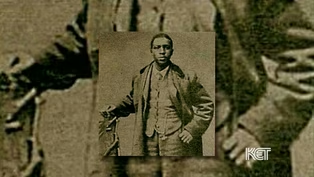
Clip: S2 Ep163 | 3m 42s | Oliver Lewis, winner of the first Kentucky Derby, was inducted into the LAAS Hall of Fame. (3m 42s)
Providing Support for PBS.org
Learn Moreabout PBS online sponsorship
- News and Public Affairs

Top journalists deliver compelling original analysis of the hour's headlines.

- News and Public Affairs

FRONTLINE is investigative journalism that questions, explains and changes our world.












Support for PBS provided by:
Kentucky Edition is a local public television program presented by KET