
Modesto Agriculture Collectors
4/14/2022 | 28mVideo has Closed Captions
Mark McDonald revisits the Jim & Phyllis Moffet near Modesto, Illinois.
Mark McDonald revisits the Jim & Phyllis Moffet near Modesto, Illinois. Collectors of antique agriculture tools and equipment; furniture caning & woodworking.
Problems playing video? | Closed Captioning Feedback
Problems playing video? | Closed Captioning Feedback
Illinois Stories is a local public television program presented by WSIU
Illinois Stories is sponsored by CPB, Illinois Arts Council Agency, and Viewers like You. Illinois Stories is a production of WSIU Public Broadcasting.
Support provided by:


Modesto Agriculture Collectors
4/14/2022 | 28mVideo has Closed Captions
Mark McDonald revisits the Jim & Phyllis Moffet near Modesto, Illinois. Collectors of antique agriculture tools and equipment; furniture caning & woodworking.
Problems playing video? | Closed Captioning Feedback
How to Watch Illinois Stories
Illinois Stories is available to stream on pbs.org and the free PBS App, available on iPhone, Apple TV, Android TV, Android smartphones, Amazon Fire TV, Amazon Fire Tablet, Roku, Samsung Smart TV, and Vizio.
Illinois Stories
Join Mark McDonald as he explores the people, places, and events in Central Illinois. From the Decatur Celebration; from Lincoln’s footsteps in Springfield and New Salem to the historic barns of the Macomb area; from the river heritage of Quincy & Hannibal to the bounty of the richest farmland on earth.Providing Support for PBS.org
Learn Moreabout PBS online sponsorship(upbeat music) - [Announcer] "Illinois Stories" is brought to you by the Corporation for Public Broadcasting, Illinois Arts Council Agency, and by the support of viewers like you.
Thank you.
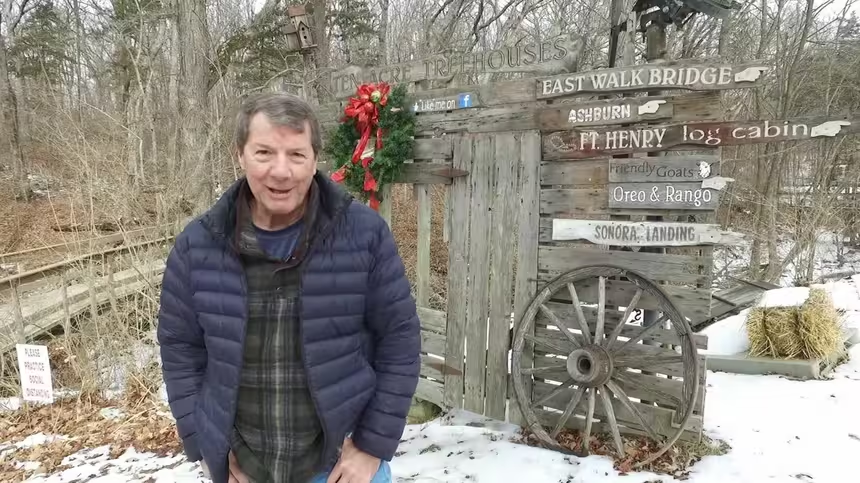
- Hello, welcome to "Illinois Stories" I'm Mark McDonald near Modesto at the Moffet home, and if it looks familiar to you with all these corn shellers surrounding us it's because we were here recently with Mr. Moffet.
And turns out while we were here we learned that Mr. and Mrs. Moffet have an enormous collection of historic agricultural home items.
And Phyllis I couldn't resist shooting a second program because there was just too much for one program.
How did you and Jim get involved in all this collection?
- Oh, when we got married I knew nothing of antiques, never saw one or anything.
And I'd buy little things to go in our small house.
Well then our house got full and we had to build a, but I, now I have stripped furniture since I was 14.
I started it for a project.
So I was doing that and he wanted to do something, I can't remember and I said, "if you've got money, build me someplace to strip my furniture."
So I did, this is the building I got so I could do furniture.
- So is it full of his stuff or your stuff?
- Our stuff.
- Our stuff.
- It's all ours.
We've done it together and you know, I think that's probably one of the best blessings.
So many couples do not do something together.
You know, somebody likes it and somebody doesn't, and they just didn't know.
- Or he's off playing golf and she's off doing something else and they're not together.
- But we have traveled, and purchased, and well hoarded and- - We're just gonna take a quick look around here because those who saw the earlier program know that we, these are just a sample of the corn shellers that Jim has in his collection, but he had to travel all over the country to acquire these, and not just these but everything else that's in this building and you went with him most of the time huh?
- [Phyllis] Oh yes, definitely.
- [Mark] Yup.
- And so we've been married 69 years, so we've done it over that period of time.
- Built a, this building to house the collection and give you your shop, there's also another barn up the way that's full of historic stuff.
We may get a chance to go up there, it all depends on time.
- Yup.
- But thank you so much for doing this.
Now when we go in here, you're gonna do a couple things for us, you're gonna show us where your shop was, where you were doing your furniture work, but you also have taken on a hobby of caning chairs and for some people who are not of a certain age they might not know what caning a chair is.
- I learned this probably 50 years ago through the home extension.
And I used to do it for people.
And at one time it was 10 cents a hole, now it's over $3 I think and you count the holes around the chair and that's how you tell how much it's gonna cost somebody.
- Yeah.
- Now I'll teach anybody that wants to know, but I won't cane chairs for people anymore.
- Yeah.
- Not that I can't, I just don't want to.
- Well, I don't blame you, I don't blame you.
But you will help others to do it.
- Oh yeah.
- Yeah.
- And I know where to get supplies so if they have chairs they wanna cane I'll help them do it.
- Well let's go inside and take a look at this place.
After you.
Well, okay Phyllis, you built this with Jim to house your collection, no, your caning, your caning collection and your woodworking collection.
- Right.
- And his ag collection right?
- Okay.
- Corn shellers, apple peelers, all, well, it's enormous, it's enormous.
- Whatever.
- Yeah, one of the things you like are, is your cane collection.
- Yes.
- Show us a little bit of that.
- These are what they're called cap canes.
- Why do they?
- And this was like a carnival one, they just gave them out and so it doesn't amount to too much, but it does the same thing as some of these others.
- [Mark] What do you mean does the same thing?
- Well, if you were walking down the street behind somebody and you wanted to get their attention, are you ready for noise too yet?
- I think we, I think our microphone can handle, what- - I don't know.
- What you got?
- But anyway, I'd be walking behind you and just carrying a cane, you know, like I'm crippled and then I'd go like that.
(Mark laughing) - You'd probably be the old one left on the street.
Everybody would be diving for cover.
- And like I said you should put one in but six or seven make more noise so.
- Good for you, how many was that?
- 10.
- 10.
- I have- - Just for us huh?
- I have no idea.
- Okay, let's look around this place and we, no, it's okay everybody, you can all stay you're all family.
We have a, we have some of your family members here and we could just kinda get a look at what you've built here, those of us who, those who saw the other program with Jim know that he has an enormous collection of all kinds of things and this is just part of it.
But I asked you to bring me in here so we could see your chairs.
- I like, and I- - Yeah go ahead.
- Chairs, but I like Steiff animals and a lot of, most of those are Steiff animals.
- [Mark] And what what's special about those?
- [Phyllis] They're made in Germany and they're made out of mohair.
- [Mark] Mohair.
- And- - [Mark] So they're real soft.
- But they're well made stuffed animals.
- [Mark] Oh they, sure they have the German tags still on them, yeah.
- [Phyllis] And some of them are old.
- [Mark] Oh, they're Steiff, I thought you said you stuffed, you like Steiff, that's the brand name.
Yeah they are cute.
- [Phyllis] And that's a puppet.
- [Mark] They are, yeah it is a puppet.
Put your hand up, put your hand in there.
- I've got cardboard in there.
- [Mark] Yeah, that's for kids, neat.
Here, let me hand these back to you, there you go.
- And some of them I ordered right from Germany years ago, a friend of mine and did, and these are showing toys, and they're wooden circus toys, and there's clowns and- - [Mark] Those look old.
- [Phyllis] They're, the glass eyes, they used glass eyes until 1909.
And so these are before that.
- Yeah, okay let's take a look at your chairs because I can't imagine how much time it must take to cane a chair.
And you'll have to explain to some of our viewers what caning is too because many of them may not have seen much of this, come on over Phyllis.
- I've got a chair over here that isn't caned.
So you can probably understand it a little bit.
And part of the process was probably saving wood rather than a whole plank.
And so these are the holes, and the cane has to come up and down through each hole.
- [Mark] Okay, so it's sort of like shoelaces sort of in and out huh?
- So you want, you got this wet, and usually I don't get, but I've just ordered this lately and it ends up that I, they have really long, long strips.
But I'll go down one and up another, and then you have to make sure you come straight this way and there's a right and a wrong to the cane.
- [Mark] Sure.
- [Phyllis] So you have to- - [Mark] You don't wanna twist it.
- [Phyllis] Nope.
- [Mark] Yeah.
- [Phyllis] And so you just go up and down, and up and down, and there's six steps to it.
You go one way and then another way.
- [Mark] Okay, there's getting the twist out.
- [Phyllis] Then you, and then you go this way, you go this way, you go this way, and then you weave this way in and out, then you weave this way and you weave this way to do that pattern.
- [Mark] So you end up with a pattern.
- [Phyllis] Like that.
- [Mark] Like this and that's, now, do you have any idea how many times you've gone back and forth by the time you're finished?
You don't do you?
- [Phyllis] Well, you have to go six times.
- [Mark] Wow.
- [Phyllis] With every.
- [Mark] And that's pretty sturdy too isn't it?
- Yes, they last forever.
I just did one in the house that I had written on the, that he uses all the time 17 years.
- [Mark] They don't deteriorate at all, that's wonderful.
And you'll be glad to show this to other people too even though you don't wanna do it anymore right?
- Yeah.
- It's kinda tedious isn't it?
- I would teach.
- [Mark] Yeah.
- But I can do it watching TV or something.
- [Mark] Yup.
- So it's, in this one I have to get some more paint off and I'll strip it and I'll.
- [Mark] That's an nice old piece.
- Yup, but I haven't cleaned it yet.
I bought it just the way it is.
Not because I needed it.
- No, Phyllis I don't even know how many rooms you have in this building that you built to house your collections, but it goes on and on.
- Too many.
- Too many.
- Too many.
- It goes on and on.
We're gonna start with what came first the chicken or the egg?
And I think the egg did.
But you got a lot of egg items here.
Of course eggs were huge because they fed the family year round.
- [Phyllis] Right, right.
- What are these?
- We had a hatchery locally, and when it closed, when they were selling things, but these were actually stapled in the bottom of a nest and then the chicken couldn't scratch it out, and so they would go back to that nest and lay their eggs because lots of times chickens laid out in a straw pile or some other place they could- - Where you'd never find them then right?
- And you didn't find them.
- So this was the power of suggestion.
the chicken saw this and knew that's where to lay the egg huh?
- And chickens had a tendency to peck each other.
And once they drew blood, they, it, so they would, had glasses for chickens.
- [Mark] They did?
- [Phyllis] And this would go through the nose, there was a place right up there that was very thin.
And you peg that through there and then.
- [Mark] Protected their eyes, is that what it did?
- [Phyllis] Well, it would make it so the chicken couldn't tell what it was doing and this went on the beak to help so it didn't peck.
- Wow, I didn't know they were that mean, I'll put that back for you, wow.
Pretty brutal life on the farm.
Hey, you know, nutmeg was used, is still used a lot, but was used all the time wasn't it?
Out on the farm?
- Right.
- And I'm just gonna show, this is what a nutmeg looks, I don't know what tree that comes from but that's ground up is what nutmeg is right?
Okay.
Why was it so important?
- Back in the olden days, they had a lot of trouble with food spoiling and it would smell and people didn't wanna eat it.
- Yeah.
- So they would grind nutmeg on it and you'd get that smell rather than the rotten food.
- Oh man, you've got a whole, this whole wall is nutmeg grinders right?
Show us one, just pick one that you like.
How many do you, well, I'm not gonna ask how many you don't know how many you have.
- [Phyllis] I don't know.
But you put your nutmeg right in there, and then you just grind that.
- [Mark] You could carry that with you anywhere you go, you could carry the nut with you anywhere you go right?
And you're good to go, all right.
- But all of those are nutmeg graters.
- [Mark] It's like fine there 'cause that goes.
- And they, these are called jerkouts.
- Boy there's a lot of gear work going on there for one simple turn isn't there?
Yup.
Now these are, on this table here, just to show you how intricate things can get, how specific things can get.
Is this all for cherry pitters?
Are these all cherry pitters?
- [Phyllis] That isn't but this, this, this, this, this, this, this, this, this is plums.
- [Mark] Plums, okay.
- [Phyllis] And so you put them in there and you just push them down, it works good.
It's cherry too.
- That's cherry?
Okay.
And even for something as tiny as raisins, you've got them for this too 'cause.
- [Phyllis] And nobody wanted to bite into a seed.
- [Mark] Yup.
- [Phyllis] So all of these are raisin seeders- - [Mark] Raisin seeders.
- [Phyllis] And they also had the crank kind.
- [Mark] They have tiny little raisins don't they?
That strains them out.
- [Phyllis] So.
- Hey, I'm gonna, come on in here I'm gonna show you something, I want you to describe what we got here.
A glass ball full of wood chips.
Hold that for us.
- This is called a target ball.
And they used them for target practicing, and this is a target ball thrower, and this had a wire netting in there so that this wouldn't fall through.
- [Mark] Yeah.
- And it's spring-loaded, and they'd throw these up in the air, and the reason this is in there is that if it broke, then they knew when this stuff floated down.
- [Mark] They knew if they hit the target.
- [Phyllis] Right.
- This is like for skeet shooting or something like that okay, okay.
So the, so this propels the thing up in the air.
- Right.
- Boom, you hit it with your shotgun and if you see the, all the wood chips floating down, or whatever you put in their feathers or whatever, okay.
- Right.
- Amazing, and you have a bunch of them.
I, here hand it to me I'll put it back.
Aren't they kinda rare?
- Yes, they are rare.
- I'm not surprised, I'm not surprised.
Okay don't trip over this here.
Now we're gonna go in the other room.
Let's go this way.
Oh before we do, I'm gonna sit in this chair because this is ingenious.
This is just a simple wooden chair that would've been sitting on somebody's porch, but somebody had the idea to put springs on the bottom, makes it a rocker doesn't it?
Pretty nice, pretty smart, pretty smart.
- [Phyllis] And I guess I need to brag a little bit.
- [Mark] All right.
- My uncle was an artist and he painted for "Saturday Evening Post," but he also did different ones and this is for "The Western."
What was, but anyway, down in Alton, and they have the original of this, but a few years ago reproduced my uncle's painting in tins.
And of course I couldn't help but buy some.
- [Mark] Yeah, of course, he's gifted, that's really good.
He's really good.
- But he did- - [Mark] He was your uncle huh?
- 28 Post covers, and I have all the magazines.
(Mark laughing) - I bet you do.
Okay, you've also got a family room here, and this is not the family room that most people think of when they think of the family room.
But these are a lot of things that have been in your family.
Actually maybe you should bring those tins in here because that's part of your family room too isn't it?
But I particularly wanna show from here, I wanna show this wall that you and your husband put together because this, I don't know if you knew this when you were building this building but- - No.
- But, you didn't know it?
But you wanted a sample of every Illinois wood.
- So anyway, we were buying wood from this company down by St. Louis, and they had all these boards on display, and so we'd just buy them not knowing what we wanted to do with them, and then when we built, this used to be part of that built room and we put this wall up later, and so we have put them in there and they're all loose, and so we can just pick them up and take them out, so if we wanna add or subtract for anything we can.
- But look how perfectly they fit in there.
- And they all are, they're all labeled.
- They sure are.
Yellow birch, curly birch, boxwood, this is mahogany, this is the only one that's not native huh?
- [Phyllis] Right.
- Okay, basswood here, this is fascinating.
I didn't know they all looked that different but they sure do.
- And back in the East, the story goes that there was a tornado, and it twisted the woods, the big trees enough so they separated the deader wood and the live wood and they, this is the barrel from one tree.
- [Mark] Wow.
- Just, and we bought that out East years ago.
- [Mark] Just look at that, look at how that's, look at that.
- And sometimes they're actually just scooped out.
But this one has a false bottom in it.
(wood smacking) - What in the heck was that?
You got me.
(Mark laughing) - What is this thing?
- Well that's a, for, you've heard of clay pigeons, well, before we had clay pigeons we had live pigeons for target practice, and that is what you would've found on the range out there and you had your pigeon in there and you were all set to go and they had a long rope that you could stand way back from the scene, and release the pigeon and they would, the shooter would take his- - Shooter says pull and bang and a way that pigeon goes and there you are- - And it's designed so that it makes a noise, if you happen to have a sleepy pigeon why it's gonna take off and fly away so.
- Okay, or Phyllis could use her cap cane, right?
- Yes, yes, you could do that too.
- This display over here is interesting because it really ties in with Modesto and Jim your place here is real close to Modesto, and you remember as a kid in 19, I think it was 1938.
- [Jim] 1938 yes.
- [Mark] When tens of thousands of people came to Modesto for the corn husking championships of the state.
- [Jim] Right.
- [Mark] Must have been a big deal.
- Well, it was the Super Bowl of the day is what it was.
Well, it really, I mean, to get to 85,000 people or that was an estimation that came out in a headline of a Chicago paper, 85,000 then, the husking contest and of course they closed this route 111 out here on about three miles each way, and we just had one-way traffic so that the people could get here and there would be no oncoming traffic.
And we had, there was about 14 churches represented that served, they all served the same food, the same price, and so it was an interesting day and- - This, okay people came from all over, of course this was before television and during the depression so people didn't have a lot of entertainment, did they?
- No.
- But this was, watching people husk corn was, well, it was a huge thing.
- Absolutely.
- Because most people had grown up on a farm and these people, these folks were special.
- That's right.
- Yeah.
- Yes, you're very correct on that.
I mean, an interesting thing is that the Macoupin County sheriff deputized 500 men with horses to patrol the grounds because they, there were people, evil people in those days too, and they would go in and stomp down the corn that you were gonna have to husk on because I had a buddy I wanted to win and I didn't want you to win because, so I made, so anyway then we had the deputies all over.
- Yeah, and you remember it as a nine-year-old isn't that something, isn't that something.
Okay, I want you to show me a few things.
And I particularly find this very interesting.
Why would a person on a farm use these?
- Well, these are for a person that had handicapped hands, but he still had to make a living or provide milk for his family, and this, these things were, if you see how they work here, they, if you squeeze them, while stick your thumb down in there, finger down in there and you can, but that is the milking action and so he can, the cow's tit would be- - Oh, okay for a dairy farmer who has arthritis or just painful hands, the tit goes in there and then you're just able to, with the leverage you're able to just be able to- - And these are patented, I can show you the patent for these things.
- Well and I believe you because you're big on patents.
You've gotten out a patent item here for us, and you're big on them and I get it, yeah I get it.
Okay, and this, if you wanted to measure the distance, I'm not sure how to open this, but I think it just pulls out doesn't it?
- That's right, just pull it out.
- Show us how that works.
- Well, this is, this swings around, you can see it like that, but it's, in use it'll actually, is stapled or is tied to the wagon wheel, to a spoke in the wagon wheel, and it's, this way and as it goes around the 360-degree circle, it winds this one turn, and then the second turn, so you know the circumference of the wheel, we'll say 16 foot around all the way around the buggy wheel or whatever.
- Yeah.
- And you would, as you started why you would make notation because there's no reset here, and you would write down what the figure is right now, and then after you made your trip and you got to the quarter of a mile or what you wanted to be a quarter of a mile or land survey or whatever, or if you were just measuring the distance between this town and that town, or what farm the next farm, then you multiplied 16 with the number of revolutions- - This would be particularly useful for a surveyor.
- Yes.
- Who needed, who with a wagon could measure a tract of land or something like that.
- That's correct, yes.
- Well fascinating, fascinating.
And one other quick thing, you, this is before that we all were aware of it, of how you can help blind people with their reading skills, but this is what it used to look like when you would be, would make a braille copy right?
- That's correct, yes.
You'd lie, let your paper lay in here, and there's little tiny grooves here for the stylus to poke down.
But anyway the paper would be in here and then you could write three lines and then you would have to remove the paper out a little farther down, but you'd have the rough paper that they read the braille with would be on the back side of that sheet of paper.
- You, are you finished collecting?
- Pretty much so, yes, we're very much filled with just.
- You like to share it with people though don't you?
- Oh I love to share it, we love to share it I mean, we've, we think we've educated a lot of people on lots of things and because we like to know exactly what we're talking about when we're showing, demonstrating, or exhibiting, or whatever so, not that we don't make mistakes and have made mistakes but, anyway it's been a lifetime of a grand experience, we've met many, many people, and made friends, and we're very happy that they have all this.
- Yeah, well, I wanna tell you I think our viewers sure have learned something today so I wanna thank you for that.
- Well, you're more than welcome.
You've been a, it's been an honor to have you here.
- Well thank you Jim.
You may have seen the last program we did before with Jim and Phyllis and their collection and this here today with Phyllis and Jim somewhat.
But they, like they say, they enjoy sharing it, they invite people out to take a look at their building after building, and room after room of collection and they're still collecting on the internet.
With another Illinois story near Modesto, I'm Mark McDonald.
Thanks for watching.
(upbeat music) - [Announcer] Illinois Stories is brought to you by the Corporation for Public Broadcasting, Illinois Arts Council Agency, and by the support of viewers like you, thank you.
(upbeat music)

- Arts and Music
The Best of the Joy of Painting with Bob Ross
A pop icon, Bob Ross offers soothing words of wisdom as he paints captivating landscapes.














Support for PBS provided by:
Illinois Stories is a local public television program presented by WSIU
Illinois Stories is sponsored by CPB, Illinois Arts Council Agency, and Viewers like You. Illinois Stories is a production of WSIU Public Broadcasting.