
Mont Allen, Southern Illinois University Carbondale
2/9/2023 | 26m 53sVideo has Closed Captions
Mont Allen, Southern Illinois University Carbondale
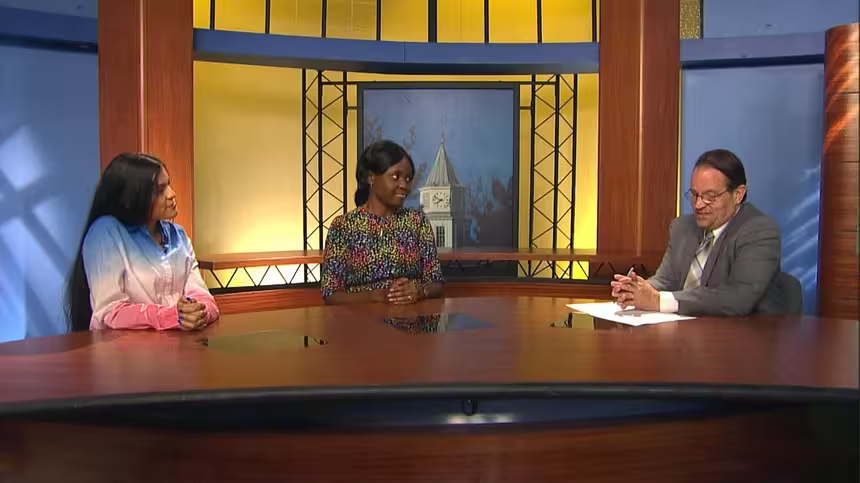
On “Saluki Sleuths,” a fascinating look at the steam tunnels that heat and cool campus buildings at Southern Illinois University-Carbondale. Fred Martino talks with Mont Allen, Ancient Practices Program Director at Southern Illinois University-Carbondale. Allen is author of the book “The Death of Myth on Roman Sarcophagi,” published by Cambridge University Press.
Problems playing video? | Closed Captioning Feedback
Problems playing video? | Closed Captioning Feedback
Eye on Education is a local public television program presented by WSIU
Mont Allen, Southern Illinois University Carbondale
2/9/2023 | 26m 53sVideo has Closed Captions
On “Saluki Sleuths,” a fascinating look at the steam tunnels that heat and cool campus buildings at Southern Illinois University-Carbondale. Fred Martino talks with Mont Allen, Ancient Practices Program Director at Southern Illinois University-Carbondale. Allen is author of the book “The Death of Myth on Roman Sarcophagi,” published by Cambridge University Press.
Problems playing video? | Closed Captioning Feedback
Where to Watch Eye on Education
Eye on Education is available to stream on pbs.org and the PBS app.
Eye on Education
Eye on Education features interviews with people making a difference in all facets of learning. From Pre-K through higher education, we highlight efforts to prepare students to become the world's future leaders in every discipline.Providing Support for PBS.org
Learn Moreabout PBS online sponsorship(inspirational music) (camera clicking) (captivating music) - Eye On Education.
I'm Fred Martino.
Coming up, we'll meet the director of the Ancient Practices Program at Southern Illinois University Carbondale.
But first, let's travel underground at that campus for a look at a vital and very old way to heat and cool buildings.
Here's Anna Twomey from the SIU Alumni Association.
- [Anna] Underneath the streets Salukis cross and the buildings where they attend class, is another world many have no idea exists.
- You know, obviously I think we'll go under this as opposed to over.
So watch your head as you go under.
- [Anna] Tall enough and wide enough for a person to walk through, the steam tunnels are the skeleton of Southern Illinois University.
They've heated and cooled classrooms, offices, and dorm rooms since the 1950s.
The tunnels also carry phone lines and electricity through campus.
- There was a lot of rumors and things about the tunnels even for me growing up in the area and being on campus.
So it was definitely one of those unique opportunities that I had, as part of the facilities department, to get in and view the tunnels and really learn how they work.
- [Anna] Mark Owens will be our tour guide on this adventure underground.
- This is a unique and special opportunity.
We often don't take people down into the steam tunnels.
- [Anna] He says there are roughly four miles of steam tunnels servicing SIU, all reinforced by concrete.
- The steam tunnel system was built as a district system to supply steam to buildings across campus, and also to provide condensate return back to the power plant.
The power plant is the heart of the steam system.
And so our power plant produces the steam through our boiler system, pumps it to roughly 70 buildings across campus.
So we're always producing steam, even in the Summer.
- [Anna] The tunnels are very difficult to access and are usually hidden in locations only maintenance crews know about.
- And the access points, they're quite discreet, in areas that are in mechanical rooms and things like that, that student and the public wouldn't have access to.
- [Anna] We start our journey underneath the engineering building near Banterra Center.
- But this is an example of steam pipes that are going through the tunnel.
And so this is an area where the tunnel was built and intersected into another tunnel.
And so, as you can see, we can go left, we can go right.
If we went right here, we'd go to the arena.
- [Anna] We checked the maps, which organized the steam tunnels by color, indicating how long ago they were built.
- So we do have some steam tunnels that have an unknown date as far as when they were constructed.
But the power plant itself was constructed in the late 40s.
And so the first steam tunnels were constructed in the late 40s.
And then as we added buildings to the system we would put in the tunnels and connect those buildings to that district heat system.
- [Anna] The tunnels have been able to expand as the university expands.
This section underneath the engineering building was more difficult to pass through.
So we headed to our next stop, the tunnels underneath the communications building.
- This tunnel, this one was built 1979, and it's somewhat unique because of the circular shape of the concrete forms that they used.
So this is where you see the steam pipe.
It's the top, it's the larger pipe.
Below is the condensate and then a water line below that.
So this is part of what you find when you walk in the tunnel.
- [Anna] This portion of the tunnels could take you to the outermost part of the whole system.
- If we go left, that would connect to the Lesar Law Building, so west-most portion.
And if we go straight, then this goes in and connects to some other tunnels that service some of the residence halls.
- [Anna] We come across a hole in the wall that opens up to the surface.
Mark says this hole helps give the steam somewhere to go.
- So this is a cold air return.
So this is venting the heat out of the tunnel as you feel, it's quite cool.
As the cold air comes in, a few leaves have escaped down here.
- Most of the tunnels are at least six feet tall, some of them 6'6".
So it's easy to walk through here and easy for maintenance to get in and make repairs.
Other parts of the tunnel are a little bit trickier to navigate, where you would actually have to crawl under the pipes to get there.
When a repair is needed, such as a leak, maintenance crews carefully plan out how to get both the supplies and the equipment down into the tunnels to make that repair.
- An example of one of the valves is high pressure steam line itself.
What they would shut off if they were to repair a piece of pipe, do maintenance, segregate a section of the the pipe.
- [Gray-haired Man] And how do they flag a problem for repairing?
How do you find it?
- So if there's a, you know, maintenance run through and they find something that needs to repair, a lot of times there's labeling on the tunnel, and so they can reference the map and say, "Okay this is the exact section of tunnel where the repair needs to be done."
- [Anna] Although many sections of the steam tunnels are much older than the students and staff who walk above them, Mark says the system is extremely efficient and can conserve 85% of the water it initially puts out to heat and cool campus.
It's a process called condensate return.
- So as steam goes out, and that's domestic water that we use in our boiler to create the steam, it goes out and it hits our coils and things like that, that heat.
And so eventually that reaches a temperature where that steam turns back to water.
And so that goes back into the system, so it's a looped system, and that condensate return goes back into the power plant to be heated again.
- [Anna] Mark says the facilities department tracks how much steam is going to which building.
- So this steam as it goes to different buildings it's meter just like any other utility.
- Oh.
- So we might know how much heat, how much steam say one of the towers is using.
Don't worry, I'm getting all the cobwebs for you guys.
- [Gray-haired Man] Alright.
- [Anna] Okay.
That's why we put you first.
- (Mark laughs) I see now.
- [Anna] When we asked Mark if there's any way to start at one steam tunnel entrance and end up back at the SIU Alumni Association headquarters in Woody Hall.
It's possible, but Mark has never explored that passage before.
We start under Quigley Hall.
- Right now we're just leaving Quigley Hall and we are heading west.
We have a nice way-finding, this way to Woody and Shryok.
Behind me is Woody Hall.
And so we'd be on the south side of Woody Hall right now, six feet under.
(Gray-haired Man chuckles) (pipes clang) Approximately four miles of tunnels.
And so I guess do the math as far as how fast you wanna walk.
Here's another air intake.
So it's kind of hard to see, but we're really just from here to ground level.
Probably four or five feet.
I've actually never been beyond this point in the tunnel.
So, not sure what's in store, but should be an adventure.
- [Anna] Mark and the rest of us had no idea what would be around each corner.
There's just enough light in the steam tunnels to navigate without a flashlight in most areas.
- I think we can make it.
I mean, you want me to check first?
- [Anna] I think it's- (Anna laughs) - And see?
Before you crawl over?
- [Anna] We're going for it.
Gotta do some crawling a little bit.
Woah.
Here we go.
It's pretty warm down in the tunnels, but not unbearable.
- I don't know exact temperatures, but it can reach temperatures over 100 degrees.
Has anyone checked to see if they got cell signal down here?
- [Gray-haired Man] I doubt it.
This is probably the best part here, the unknown.
I gotta reference my- Oh, watch your head!
It's official, we're lost.
No, I'm kidding.
(Anna and Gray-haired Man laugh) - But there is a ladder over here.
- [Anna] You're our only way out.
(Mark laughs) - There is a ladder here that we're gonna have to navigate down.
- [Anna] Mark says tunnels had to be built around the steam pipes for two very important reasons.
- Place.
The reason that you have a tunnel instead of direct bury is because there's expansion with steam in the pipes.
And obviously, as the pipes age, you need to maintain them, You need to visually inspect them.
And so you need a tunnel so someone can walk through and visually inspect how your pipes are doing and maintain them.
It's like maybe a little bit slippery.
Let me see where we're going here, I guess, and make sure.
- [Gray-haired Man] I see light at the end of the tunnel.
- It is a little wet, so watch your head and watch your step.
- [Gray-haired Man] Ow.
Are we under Woody yet?
- Yes.
- [Mark] I'm guessing that's our way out.
(Mark laughs) - Did we make it?
Already?
- [Mark] Well we're getting closer.
- [Anna] Getting closer.
- Looks like one more ladder.
(pipes humming) This is a little hot but it's just 'cause of the heat in here.
- [Anna] Okay.
We ended our adventure through the tunnels right at our front doorstep in Woody Hall.
- Hey, I'm in my office.
Look at this.
- [Mark] How about that?
- [Anna] Wow.
Because the tunnels are only a few feet underground, our coworker, Tibretta, could hear us from the ground level as we walked right under her feet.
- And I thought that the voices were coming from the stairwell that goes outside, and they actually were coming from the floor.
So it was kind of weird that I came out, and then I saw everyone.
- [Anna] The steam tunnels have been part of campus folklore for decades.
Throughout the 80s and 90s many students attempted to gain access and explore, despite the danger.
Photos and firsthand accounts have been posted online for those curious.
According to an Egyptian newspaper article from 1961, an SIU Civil Defense expert discusses the steam tunnels as a potential safe space, if an H-bomb were to hit Southern Illinois, or somewhere nearby, because the concrete surrounding the tunnels is a foot thick.
- I don't know if it's the first place I would go, just because it's a confined space, but it certainly is, you know, at least through my walks through the tunnel and, and going in, I don't feel unsafe.
The concrete is quite thick.
- [Anna] SIU grad, Todd Sigler, was the chief of SIU campus police from 2004 to 2013.
But he encountered the tunnels long before then - As a police officer working on the midnight shift for many, many years, that was probably my first introduction to the steam tunnels and the interest in the student body with the steam tunnels.
For me, the first time down there was the first time I'd ever been in that kind of an environment.
And so it was very small, very claustrophobic; a lot of items just hanging right at head level.
As I moved through the ranks and into the chief of police position, it was more about, "Okay, what can we do about this?"
This is a safety concern, obviously.
Both from the standpoint of the steam pressure, the steam pipes that are down there, along with high voltage connections which was also something that we were quite concerned about.
- [Anna] Todd says, if a student got in somehow, it was difficult to determine where they were or how they found a way in.
It would tie up a lot of public safety resources to respond.
- The challenge was being able to close it off, secure it.
Doing that in a way that that wasn't gonna be excessively expensive either.
Because it's a large area to be able to put cameras and alarm notifications, things like that, was probably impractical.
- [Anna] The condition of the steam tunnels, given how old they are, has always been top of mind for the facilities department.
Mark says maintenance happens frequently and there are several big repairs scheduled for the next few years.
- Great.
There is a plan to replace and reinforce some of the older tunnels that need a little work.
And so that's a project that we have that will be coming up in the next few years.
(footsteps sloshing) And the replacement of these brackets, that these have been replaced.
Those aren't original, but that's also something that we check and maintain and make sure that those brackets are in good shape, 'cause that's what's holding up our pipes.
Watch your head here.
- [Anna] Mark says The tunnels are prepared to carry on heating and cooling generations of Salukis.
Our journey underneath SIU exposed us to another world and gave us new appreciation for a system that never stops keeping Salukis comfortable.
- Thanks to Anna Twomey from the SIU Alumni Association for that report.
I will never look at the campus the same way again.
Well, now another fascinating topic.
The Ancient Practices Program at Southern Illinois University Carbondale, Mont Allen leads the program and I am pleased to welcome him to Eye On Education.
You have a new book as well, and we're gonna be talking about that.
Mont, thank you for being here.
- Thank you for the invitation, Fred.
I'm delighted to be here.
- It is great to have you here today.
You know, I wanna start with your book.
It was published by Cambridge University Press.
- [Mont] That's right.
- And this is about an ancient burial practice.
And I want to hear more about this topic and the book.
We'll see some photos of what the book is all about too.
- Fantastic, yes.
So the book's topic is on Roman sarcophagi, which is a tongue twister of a term, but it just means coffins.
I study ancient Roman funerary art, specifically ancient Roman coffins.
And- - [Fred] And these are large stone coffins, right?
- Yes, they're massive.
They're carved outta stone, sometimes limestone, but usually out of hugely expensive, single blocks of marble.
And they're some of the most impressive, jaw-droppingly beautiful monuments to survive from the ancient world.
- And was that your interest?
Was the beauty, in terms of this subject?
- That's part of it.
I mean, just the sheer aesthetic power of these gorgeously, lavishly carved objects.
That's certainly part of it.
But part of it too is that funerary art has always intrigued me.
And that's because, well, for several reasons.
A part of it is that if you want to learn what a culture holds most dear, the fastest and easiest way to do that is to look at their funerary art.
You want to know what a culture holds most important in life, look at how they commemorate the lives and the deaths of people from that culture.
- Hmm.
- And since the ancient Romans are without a doubt the single-most important civilization in the history of the West, and can probably tie with the ancient Chinese civilization for being the most important ancient civilizations ever, - [Fred] Hmm.
- That gives this project a kind of special power.
- And what did you learn about why the Romans chose Greek images for their coffins?
- Oh, that's a great question.
So huge numbers of these sarcophagi are covered, not with Roman myths, which is what you might expect, but Greek ones.
And the answer is kind of twofold.
I learned that Romans steered away from Roman myths for their sarcophagi because Roman myths had already been used for decades, for centuries.
But in a very particular fashion.
Romans used them when they wanted to talk about public virtues, their public persona to the world, their nationalism or their patriotism.
But these sarcophagi were not meant for public display.
They're meant to speak solely to the viewing family, to the bereaved family members and future generations.
And so they chose Greek myths because Greek myths to the Roman minds had not already been too heavily loaded down with these nationalistic, patriotic, civic identities.
Greek myth allowed Romans a way to talk about their own personal emotions, - [Fred] Mm.
- Their private persona, not their public ones.
- And this changed though?
- No, they stuck with Greek myths for as long as they use myths on Sarcophagi.
- [Fred] Okay.
- But what changed is that after about a 100 and 150 years, they stopped using myths on their sarcophagi entirely.
- Entirely.
- Yes.
So the imagery just drops out.
- And what did you learn about why that happened?
- Because the problem with using myth as a way to imagine your dearly beloved, which always works by kind of metaphorical comparison, you're choosing these myths for the coffins, - [Fred] mm-hmm.
- Because they serve as a lens for you to imagine, or to reimagine, your dearly beloved through the mythic characters.
But the problem with that kind of comparison is that it always introduces a certain distance - [Fred] Mm.
- from the dearly beloved.
Because you're comparing them to a mythic character who's imagined to have lived centuries earlier.
- Mm.
- And so that comparison kind of takes someone who is already deceased or dead to you, but by comparing them to someone who's even further dead from the deep past, it makes them in some sense seem even more remote.
- [Fred] mm-hmm.
- And so Romans at some point begin wanting a more direct connection to their dead, and they therefore drop mythological imagery.
- And what was the change like?
How did they then honor their- - It's a darn good question.
Imagery that looks in some ways far less attractive to us because of course we're drawn to epic myth.
- [Fred] Yeah.
- But it tends to be replaced by scenes of Romans simply showing themselves portrayed as they might have stood in real life.
- [Fred] Mm.
- Perhaps with a husband and wife beside each other, shaking hands, which was the Roman equivalent of giving the kiss and exchanging rings to seal a marriage ceremony.
- [Fred] Mm!
- Or by showing them hunting lions to kind of proclaim their manly virtue.
Or to show themselves reading scrolls as men of learning.
Because that carried a prestige in their society that sadly doesn't quite carry as much prestige on our own.
(Fred chuckles) So the imagery tended to drop mythological comparisons and focus more on what you might call kind of accessible everyday scenes.
- So, but we do, through this, learn a lot about the culture.
- [Mont] We do, we do.
- And you do that is probably a large part of your interest in this research?
- It is.
I mean, again, the Romans are more important to world history than any other people on the planet.
But funerary art is uniquely positioned to give you insight into what a culture holds most dear.
- mm-hmm.
- I mean, I put it another way, and I tell my students this all the time, the only reason life has meaning is because of death.
- Mm.
- If we'd never died, none of our decisions would matter whatsoever, because there'd be no permanent long-term repercussions of our decisions.
We'd have all the time in the world to simply do something else or to learn something else.
So death is what gives life meaning.
But that's something that our society tends to ignore sadly, Fred.
We don't pay much attention to our dead or to death.
When we see people die they don't die in the public view, they don't die at home, they die universally in hospitals behind curtains.
The family doesn't prepare the corpse for the funeral, funeral homes do that.
So our society keeps death and the dead bodies at kind of arms length.
The Romans don't do that.
- [Fred] Mm.
- Death is present to them in a way it's not to us.
It's more common, they're more likely to die in the home, they're prepared for by the family.
So the Romans are forced, in a way that we're not, to stare death in the face, - [Fred] Mm.
- And to grapple with it.
And so I think that that's helpful because I think in some sense, it's a corrective to our sanitized and kind of disembodied notion of death that allows us to pretend it doesn't exist, and that it doesn't affect us.
- [Fred] Interesting.
- The Romans don't do that.
- Well I know this is only one of the ancient practices that you study.
Tell me about your newest research project.
- I'd love to, I'd love to because it's kind of ghoulishly macabre and yet fascinating.
So a certain number of these ancient Romans sarcophagi have rounded ends, and they were intended to imitate the shape of a wine vat.
- Hmm!
- So your question might be, and of course this is my question, why would large numbers of rich prestigious Romans want to imagine that they're dearly beloved departed are forever resting in a wine vat?
- Hmm.
- In a wine trough?
These were huge, massive vats in which Romans would press the grapes, - [Fred] mm-hmm.
- And then let the juice ferment, and then turn into wine, and they would later serve the wine out of these same containers.
And at some point I realized the allure of this is that it gives the bereaved family members the invitation to imagine that their corpse, that the corpse of their dearly beloved, which is undergoing decomposition and putrescence, is not actually decomposing but is actually fermenting.
- [Fred] Hmm!
- Just like grapes that are being pressed for their juice being fermented into wine.
It gives you the fantasy of imagining that the decomposition of your dearly beloved's corpse is actually a transubstantiation into this intoxicating liquid.
Something elevated and almost divine.
- I oddly like that.
(Mont laughing) I don't know why, but I do.
- [Mont] Isn't that a fantastic thought?
- Yeah.
But as I mentioned earlier, this is all part of a much larger thing and that is the Ancient Practices Program, - [Mont] Yes.
- At SIU which you lead.
- [Mont] Yes.
- Tell me about the program.
- So I was approached a few years ago by my dear colleague here, an incredible man, Ken Anderson over in the geology department.
Ken is a renaissance man.
And he had recently seen an announcement by the National Endowment for the Humanities, advertising a generous new fellowship that would be given to faculty, who could devise programs designed to lure students in the STEM disciplines and the science, technology, engineering, and maths.
Students who normally don't study the humanities much and particularly not the ancient world.
A fellowship that would support programs that would forge programs designed to lure STEM students into the ancient world.
So he and I put together an application, submitted it, and we were delighted to be granted this prestigious and rather generous amount of money.
So what we've done with it is construct a program that entices students to take courses that are designed to teach them how the ancient Greeks and Romans, but other ancient peoples too, Egyptians, Chinese, Vikings, how they did things in an everyday fashion, their technologies.
So for example, how did Greeks and Romans make wine?
How did they take grains and ferment them into beer?
How did Vikings use certain types of stones as navigational tools when sailing across the Atlantic?
For example.
How did they make the world's first analog computers?
How did Romans build catapults and other machines of war?
So the program gives students the opportunity to study these things and then through some kind of senior project actually experientially recreate these.
- [Fred] mm-hmm.
- So every year on this campus, some engineering students, for example, in mechanical engineering will recreate some real Roman machine.
A catapult, which they might use to hurl pumpkins across corn fields in winter.
Water powered mills that grind grain in the ancient Roman manor and so on.
- So, and you have many students who, this is their minor, - [Mont] Yes we do.
- the ancient practices.
- And delightfully we're growing.
- That is fabulous.
- Which is fantastic.
- Very much so, 'cause we need that, and we need - [Mont] We do.
- the exploration of history which this is so important, an important part of history in many different ways.
- Yes.
- More than that we can cover in about 15 minutes.
So that's very, very interesting.
Well thank you for beginning this process of educating folks about this program.
And about your new book.
- [Mont] Thank you - Good luck with that.
- [Mont] I'm delighted.
Thanks for being here and inviting me on.
- [Fred] Thank you so much for being with us.
- [Mont] Bye-bye Now.
- My guest was Mont Allen.
He is associate professor and director of the Ancient Practices Program at Southern Illinois University Carbondale.
That's Eye On Education, I'm Fred Martino.
Thank you for being here and have a great week.
(captivating music ends)














Support for PBS provided by:
Eye on Education is a local public television program presented by WSIU