
More Americans Under 50 Getting Colon Cancer
Clip: Season 4 Episode 338 | 4m 50sVideo has Closed Captions
Colorectal cancer deadliest cancer among those under 50.
Physicians have seen an increase in colorectal cancer in younger patients in recent years. According to the American Cancer Society, colorectal cancer is now the deadliest cancer in adults under the age of 50. Our Christie Dutton spoke with a gastroenterologist about what could be causing this unsettling trend.
Problems playing video? | Closed Captioning Feedback
Problems playing video? | Closed Captioning Feedback
Kentucky Edition is a local public television program presented by KET
More Americans Under 50 Getting Colon Cancer
Clip: Season 4 Episode 338 | 4m 50sVideo has Closed Captions
Physicians have seen an increase in colorectal cancer in younger patients in recent years. According to the American Cancer Society, colorectal cancer is now the deadliest cancer in adults under the age of 50. Our Christie Dutton spoke with a gastroenterologist about what could be causing this unsettling trend.
Problems playing video? | Closed Captioning Feedback
How to Watch Kentucky Edition
Kentucky Edition is available to stream on pbs.org and the free PBS App, available on iPhone, Apple TV, Android TV, Android smartphones, Amazon Fire TV, Amazon Fire Tablet, Roku, Samsung Smart TV, and Vizio.
Providing Support for PBS.org
Learn Moreabout PBS online sponsorshipPhysicians have seen an increase in colorectal cancer in younger patients in recent years.
According to the American Cancer Society.
Colorectal cancer is now the deadliest cancer in adults under the age of 50.
Our Christy Denton spoke with a gastroenterologist about what could be causing this unsettling trend.
Doctor William Evans from Norton Health Care is here.
Okay, doctor Evans research has shown that people are getting colorectal cancer at younger ages before the age of 50.
Why might that be?
That's a great question.
Nobody's, 100% sure about this, but the Journal of American Medical Association came out with an article since the 1990s.
All cancer related deaths have decreased by 44%, except for colon cancer, which is increased by 1%.
We're seeing colon cancer in a younger age.
In 2018, we decreased the age to start colon cancer screening from 50 to 45.
But now research is showing that it is happening in folks that are younger.
A lot of the things that are coming up are lifestyle of younger folks and folks growing up, more obesity.
Decreased fiber in their diet, more alcohol consumption, less exercise and physical activity.
And then there are some environmental factors that play into that.
But this is what most suspect as of now.
Okay.
And so in your practice when you're seeing these patients come in that are of this younger age group which is below 50 years old, and you're seeing this type of cancer, colorectal cancer, is it more aggressive?
Is it deadlier?
Is it the same kind that you see in older patients?
It's going to be the same kind that we see in older patients, but again, affecting a younger generation.
And the most important thing is that colon cancer is preventable with identifying those who are at high risk and doing screening.
Screening is effective to decrease the chance of getting colon cancer and dying of colon cancer by up to 30%.
So having patients know their family history and know if their mom, dad, brothers or sisters had colon cancer or more importantly, colon polyps.
Knowing when they were diagnosed.
And then they can talk to their primary care physician or do some research and and get screened earlier before the age of 45.
Okay, so if I get screened and, it and polyps are found, I need to tell my siblings, my brothers, my sister, I need to tell my parents, everybody related to me.
Right?
I would yes, and that's what we recommend or I recommend to my patients is telling them, make sure you talk to your brothers and sisters, even talk to your cousins, aunts and uncles.
Let them know.
Talk about colon cancer.
Ask them, have you been screened or are you keeping up with that?
Because I think there's a lot of misconception about colon cancer and how important it is to be screened.
I think a lot of patients think the only way to get screened for colon cancer is a colonoscopy, right.
And colonoscopy, patients are a little bit fearful that embarrassed that they have to do that procedure.
That procedure requires sedation.
It requires this preparation.
The patients have to drink, which is difficult and challenging, but doable.
But it requires you to take off time from work and so it can to try to overcome those things.
I think patients need to know there are other methods of screening.
Okay.
Like what?
Stool based testing.
Okay.
There are stool based tests that are done.
Is that the male in there?
Yes.
They're both male in, stool based test.
One checks for blood in the stool.
The other one checks for DNA markers from precancerous colon polyps.
Those are a two step screening test.
Meaning if you do a stool test, you have.
If it comes back positive, you have to follow up with the colonoscopy.
The other important thing about a stool test is if it's negative, one has to be repeated annually.
The other one has to be repeated every three years okay.
So the disadvantage you have to do more of them.
The advantage is you don't have to take time off from work and etc.
that's needed for a colonoscopy.
That is good to know.
Thank you so much for your time.
Welcome.
Thanks for having me.
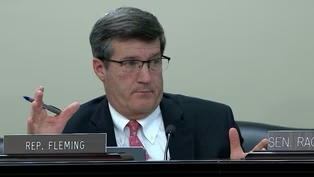
Changes Could Be Coming to Medicaid in Kentucky
Video has Closed Captions
Clip: S4 Ep338 | 3m 55s | Bill would tighten Medicaid reporting requirements. (3m 55s)
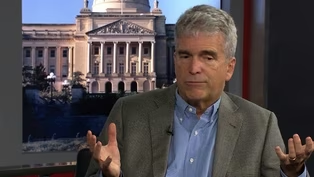
Changing Landscape of Local TV News
Video has Closed Captions
Clip: S4 Ep338 | 8m 5s | Discussion on the pros and cons of consolidation of local television news stations. (8m 5s)

First Vetoed Bill of 2026 Session Overturned
Video has Closed Captions
Clip: S4 Ep338 | 1m 1s | Lawmakers overturn the first vetoed bill of the 2026 Kentucky General Assembly. (1m 1s)
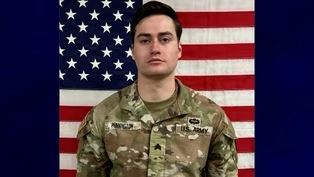
Kentucky Soldier Killed in Iran War
Video has Closed Captions
Clip: S4 Ep338 | 1m 6s | Kentucky soldier the seventh U.S. soldier to die in Iran war. (1m 6s)

Search for Solutions to Rural Physician Shortage
Video has Closed Captions
Clip: S4 Ep338 | 1m 23s | Senate president wants universities to come up with solutions to rural physician shortage. (1m 23s)
Providing Support for PBS.org
Learn Moreabout PBS online sponsorship
- News and Public Affairs

Top journalists deliver compelling original analysis of the hour's headlines.

- News and Public Affairs

FRONTLINE is investigative journalism that questions, explains and changes our world.












Support for PBS provided by:
Kentucky Edition is a local public television program presented by KET