
More Than Art
Season 4 Episode 5 | 24m 1sVideo has Closed Captions
ART inc. explores how are can raise awareness, create community, and provide therapy.
ART inc. explores how art can raise awareness, create community, and provide therapy. The history of Japanese American Incarceration is reexamined by a Rhode Island artist, a glass artist creates a community in Chepachet, and the immersive experience of a sound bath provides a therapeutic experience.
Problems playing video? | Closed Captioning Feedback
Problems playing video? | Closed Captioning Feedback
Art Inc. is a local public television program presented by Ocean State Media
More Than Art
Season 4 Episode 5 | 24m 1sVideo has Closed Captions
ART inc. explores how art can raise awareness, create community, and provide therapy. The history of Japanese American Incarceration is reexamined by a Rhode Island artist, a glass artist creates a community in Chepachet, and the immersive experience of a sound bath provides a therapeutic experience.
Problems playing video? | Closed Captioning Feedback
How to Watch Art Inc.
Art Inc. is available to stream on pbs.org and the free PBS App, available on iPhone, Apple TV, Android TV, Android smartphones, Amazon Fire TV, Amazon Fire Tablet, Roku, Samsung Smart TV, and Vizio.
Providing Support for PBS.org
Learn Moreabout PBS online sponsorship(high-spirited music) - [Presenter] Coming up on "ART inc." (high-spirited music) (static crackling) Lois Harada: Echoes, (high-spirited music) (static crackling) More Than Glass, (high-spirited music) (static crackling) and In The Studio: Carlin Danner.
(static crackling) - [Milton] If you want to know what's going on... (upbeat music) (upbeat music continues) (upbeat music continues) (static crackling) (high-spirited music) (static crackling) (high-spirited music) (film rolling) (dramatic music) - When the Japanese attacked Pearl Harbor, our West Coast became a potential combat zone.
Living in that zone were more than 100,000 persons of Japanese ancestors.
No one knew what would happen among this concentrated population if Japanese forces should try to invade our shores.
- [Lois] This is 1942.
So, after the attack on Pearl Harbor, and this was a direct governmental response to that.
- Military authorities therefore determined that all of them, citizens and aliens alike, would have to move.
- Executive Order 9066 announced the start of Japanese-American incarceration.
- [Milton] Notices were posted, all persons of Japanese descent were required to register.
- So, the idea was that everyone would be moved from the coast where they could possibly be sending information to Japan and moved to one of these sites.
- [Milton] They gathered in their own churches and schools and the Japanese themselves cheerfully handled the enormous paperwork involved in the migration.
- [Lois] My paternal grandmother's family was forcibly removed from their home outside of San Diego to an incarceration site in Poston, Arizona.
- [Milton] Naturally, the newcomers looked about with some curiosity.
They were in a new area on land that was raw, untamed, but full of opportunity.
(dramatic music) - All persons of Japanese ancestry, both alien and non-alien, will be evacuated from the above area by 12 o'clock noon Pacific Western Time, Wednesday, June 3rd, 1942.
This is a piece of printed propaganda from 1942 announcing the start of Japanese-American incarceration.
No Japanese person will be permitted to move into or out of the above area after 5:00 AM.
I was really lucky to receive this physical copy about two years ago from my uncle who was also incarcerated with my grandmother.
(gentle music) So, a lot of the work that I make is about my family's history of Japanese-American incarceration.
And for me, it was a way to explore an area of my family's history that wasn't that well-known to myself.
(gentle music) So, this is a body of work from 2022 called Wish You Were Here.
And it's a combination of large silkscreen posters, as well as a custom penny press.
(coin clinks) (machine cranks) (coin clanks) With a lot of the Japanese-American incarceration sites, or for instance a battle site or a large graveyard, there's often an element of dark tourism that brings people to those sites.
And I thought, what better way to think about that idea than something you'd normally see at a tourist destination or a zoo, or an amusement park.
(coin clinks) (gentle music) So, the penny press represents four Japanese-American incarceration sites and the posters represent the remaining six.
I've always been really interested in government propaganda and printed materials, and these posters were inspired by Works Progress or WPA style posters.
They're big, bright travel posters, that say see the West, maybe advertise a national park.
But instead of using those bright destinations, I wanted to use the sites of Japanese-American incarceration to sort of, again, invite people in with these bright posters, but with a slightly darker subject matter.
(dramatic music) As an artist, I'm always interested in thinking about propaganda and using that as the genesis for work.
- [Milton] They opened advanced Americanization classes for college students who in turn would instruct other groups.
- In the incarceration sites, everyone would've had a role or a job.
There was really no infrastructure.
So, some people worked in the kitchen, some people worked in the medical facility, and my grandmother's role was as a teacher.
And she would've graduated from high school while at the site.
So, I can only imagine how strange it then must have been fulfilling that teaching role.
I think it's very common in folks my generation to have a grandparent who's a survivor of the camps, to say, "Oh, I don't want to talk about it.
We've moved on.
We've Americanized."
And my dad even learned about the history of Japanese-American incarceration in middle school.
(dramatic music) When my dad had gone home to tell my grandmother, "You are never gonna believe what they did to Japanese people," she said, "Yes, it was terrible."
And that was really the first time that my dad had realized that that was part of her history because it was something that she never really talked about.
(dramatic music) I can't remember the first time that I learned, I know that we studied it in history, but the version that you learn in school, if you learn it all, is usually a very rosy portrait.
So, using the language of camp.
There's usually folks who were allowed to garden, people played baseball, people had jobs.
- [Milton] Their parents, most of whom are American citizens, and their grandparents who are aliens, immediately wanted to go to work.
- And I'm somebody who values storytelling.
And a lot of the work that I do is thinking about what's presented in an archive, and thinking, who made this?
Whose perspective is this for?
And adapting it to match my story.
(object thuds) (soft upbeat music) (shoe scrapes) (soft upbeat music) (lid clinks) (soft upbeat music) (tool scrapes) (cloth rubbing) (soft upbeat music) This is a brand new body of work called 221 Stones.
And they're all intaglio monoprints.
So, it's a version of printmaking that uses etching or intaglio techniques.
But a monoprint means that each print is individual.
So, in this case, I'm using a series of 221-shaped copper etching plates that are getting inked up and printed in different orientations and different compositions for each print.
(machine cranking) (upbeat music) The number 221 is based on the government statistic of reported deaths at Poston, Arizona where my grandmother's family was.
So, each of those rocks is meant to represent one of those figures.
(soft upbeat music) (subdued music) The history of Japanese-American incarceration is just as relevant today as we think about detention centers, ICE centers.
The feeling of anti-immigrant sentiment is even higher than I feel like when I first started to make Wish You Were Here in 2020.
(dramatic music) There's not necessarily a stop gap to it happening again.
So, trying to raise awareness through my work that things really don't change unless we don't make the same mistakes again.
(dramatic music) And so, I wanted to say, this is something that I'm looking at and I invite you all to look at it with me.
(film rolling) (static crackling) (high-spirited music) (static crackling) (high-spirited music) (tool hissing) - When I first scored a piece of glass, I ran the score, and realized, (glass clinks) I just cut glass.
There's something about it.
Glass is energy, okay?
'Cause it's made out of sand, (water ripples) the energy from the earth.
There's so much energy in here 'cause it's here.
It's almost, (chuckles) it's almost alive with energy.
(gentle music) (gentle music continues) (gentle music continues) Good morning, everyone.
- Good morning.
- It's a beautiful day.
- I go Saturday night, and I'm like, where's she (faintly speaks) - Come to told (faintly speaks) - Because I have big boots on.
(laughs) - Right.
- Did you bring three projects to do?
- Camera.
- Three?
- Yeah, yeah.
- Oh, I got two.
- You have two.
- So, it's Saturday.
We are in Chepachet, Rhode Island at my studio, Holidaze Stained Glass-My Free Spirit.
(upbeat music) The music's on.
We're vibing, we're jamming.
I feel everyone's positive energy.
And if you didn't feel that today, you gotta be dead.
Are you still gonna do the nose ring?
- Oh yeah.
- Yeah.
- I didn't- - We are a big glass family.
We really are.
So, we're gonna black patina your lead lines.
We're gonna make this baby pop.
- We all become friends and family, even the instructors, everybody.
She may need a little piece of glass, I think I have some of that pink at home.
Somebody gave me some of their orange.
(tool whirring) - In my heart, that makes me fall, because I have created a space for people to come and enjoy each other's company to create.
(students chattering) - You got it.
I know you do.
There you go.
Good job.
- I think Karyn is a free spirit.
She's very thoughtful, she's very caring.
You know that she truly loves her work and she truly loves us as people.
And we just have a lot of support for one another, a lot of friendships.
- You asked if your braided wire would take that copper patina, - Yeah.
- and it sure is.
- Looks great.
- Everybody's working on something different.
Everybody's creativity comes out and you learn a lot about your creativity.
(glass clinks) - [Student] 'Cause Beyonce is from Australia- - It's running there.
See?
So, I teach, I do, (glass clinks) we do, you do.
It works.
(dramatic music) They are in eureka moments because people are, "We're cutting glass," it's a big deal.
(glass clinks) We are puzzle makers, I tell people.
We are makers, so we are going to put the puzzle together, and then we're gonna pull it apart and we're gonna put it back together again.
(students chattering) (glass scraping) - What are your colors going to be?
Where do you want them?
They're gonna solder.
That's like the glory.
- Yeah.
- I call it the glory because you've done all of these steps, and weeks have gone by now and you're coming to the point where your piece is gonna come together as a whole.
And it's just been pieces.
So, here comes the puzzle again.
So, the puzzle's gonna be put together.
- [Student 2] And I would be- - [Student 3] That's why we're breaking it up.
- Black patina is going to turn your zinc and your lead lines black, and it's gonna highlight all of those beautiful colors you have.
(lively music) (students chattering) - Here you go.
Pretty generous?
- Oh, very generous.
(lively music) And then, we polish.
Polish is vital.
- And the polish will help make it so that it doesn't oxidize anymore.
So, that way, the finish will stay really like pretty.
(lively music) - People don't polish things, and it looks like it's been sitting under the sea for 500 years.
Mm-hmm.
Oh.
- This is for my younger one.
- Aw.
- He said, "I want a blue, nana," so.
- You're always making things for other people, Barbara.
- Huh?
Oh, I'm making this for my granddaughter.
I made one for one, and then the other one said, "Well, I'd like to have a blue one."
I said, well, I'll give you the one I made.
"No, I want you to make me one."
So, that's what I'm doing.
- Yeah, Barbara, she's a love.
She and Nancy, her daughter, come together every Saturday since I have owned Holidaze Stained Glass, and that's been 11 and a half years.
- We never got to sit at the same table.
They separated us for whatever reasons.
So, I don't always, I'm not working with her per se, but we choose colors together.
- She picks me up early and we come here, we talk a little bit, not much, but we're separate.
I'm at one table, she's in another.
I have all these people there.
I just love everyone.
- Get up on it.
Even amount of pressure all the way through.
I try really hard to set the table in here, (soft upbeat music) to remain in a very sacred space.
And when people walk into my studio, this is my second home.
- I'm relaxed when I come here.
I'm happy when I come here.
This is my happy place.
It's about so much more than just the glass, 'cause it's about the friendships, the relationships, and everything good that you feel when you come here.
I can tune out a lot of whatever's going on that's not good when I'm here.
- Sometimes I'm exhausted because it's such a high level of energy.
And that's okay though, 'cause it's a good exhausted.
It is.
Because I did what I set out to.
It was purposeful.
You have to set your mind space, your third eye, like just, you know what?
This is gonna be a great day.
I get up in the morning, this is gonna be a great day.
(soft upbeat music) So, I'm creating this energy within this space.
I believe in the law of attraction.
So, the energy that you put out will come back to you threefold.
And you know what?
It's working.
(gentle music) (static crackling) (high-spirited music) (static crackling) (high-spirited music) (static crackling) (high-spirited music) - Sometimes we arrive in a space of our bodies first, followed by our minds, and then our hearts.
So, we're gonna take some time to get them all here.
Knowing that this is your anchor throughout this experience and that there's no other way to be than how you are right now in this moment.
(singing bowl humming) (singing bowl humming continues) (singing bowl humming continues) Reality is, is that not a lot of studies have been done on sound bathing in particular, but it's kind of like the cross section of benefits of meditation and music therapy.
So, combining those two things really makes a good outcome for a person.
(singing bowl humming) (singing bowl humming continues) (singing bowl humming continues) The history of sound bathing is a little precarious just because there are a lot of different cultures that have integrated sound into their healing exercises.
Native Americans definitely use drums and like flutes, all sorts of other instruments.
Whereas Asian cultures, we see the singing crystal bowls, we start seeing the Tibetan metal bowls.
(singing bowl humming) Pythagoras was actually the first person to prescribe music as medicine.
All of these cultures kind of integrated sound from their own experience at their own time.
(singing bowl humming) (singing bowl humming continues) (singing bowl humming continues) The actual experience for people have been vastly different depending on how you enter the sound bath and just the mind frame that you're in.
Our minds are racing of what happened right before, what happened throughout the day, or you're thinking about in that problem you're trying to solve.
The real goal of a sound bath is to quiet all of that and to really make meditation approachable.
(singing bowl humming) (singing bowl humming continues) One thing that I think about as I'm going through my bath is just like creating a natural experience.
And sometimes I'm thinking about like a trip to a beach.
When I grew up next to the Sakonnet River, I would hear the buoys while I woke up and they sound similar, to me, like the bowls that I'm chiming my mallet against.
(tuning fork clinks) (singing bowl humming) (singing bowl humming continues) (tuning fork clinks) I use ocean drums at times, ocean drums for a lot of people, especially in Rhode Island, they feel comforted by other people, feel like they're a little pellets of stress (chuckles) that they're listening to instead of an ocean drum.
So, everybody is really experiencing the sound in a different way, which is very interesting and part of the human experience.
(gong clanging) (gong clanging continues) Sound is like one of the first senses that we have as children.
And then, they're one of the last senses to go when we're passing away.
So, it's kind of ingrained in our experience.
And when we're sound-bathing, literally, there is a potential to change you at a molecular level.
(gong clanging) (gong clanging continues) (gong clanging continues) (xylophone chiming) (xylophone chiming continues) Sound bathing itself can feel like a very individual experience.
And the reality is, is when you come to a sound bath, it is about community too.
(xylophone chiming) (xylophone chiming continues) (xylophone chiming continues) (instrument humming) (instrument humming continues) (instrument humming continues) (instrument humming continues) (singing bowl humming) When you go to an art class, you come back with something obtainable.
You go to a welding class, again, you do something obtainable.
We don't have like an actual permanent product when we do sound bathing.
However, that permanent product is right here (pounds chest) (singing bowl humming) (singing bowl humming continues) (singing bowl humming continues) (singing bowl humming continues) Place your hands over your heart.
(inhales) We are taking residence in this moment as you are right now.
Thank you so much for joining me for this sound bath.
(static crackling) - [Presenter] Thanks for watching and we'll see you next time on "ART inc." (high-spirited music) (static feedbacks) (static crackling) (high-spirited music) (high-spirited music continues) (high-spirited music continues) (high-spirited music continues) (high-spirited music continues) (high-spirited music continues) (high-spirited music continues) (high-spirited music continues) (high-spirited music continues) (high-spirited music continues) (high-spirited music continues) Watch more "ART inc.", a Rhode Island PBS original series now streaming at ripbs.org/artinc.
Video has Closed Captions
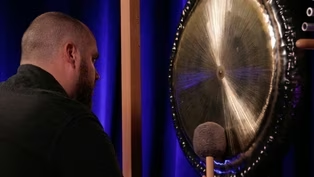
Clip: S4 Ep5 | 7m 23s | Carlin Danner performs a sound bath in the studio on ART inc. (7m 23s)
Video has Closed Captions
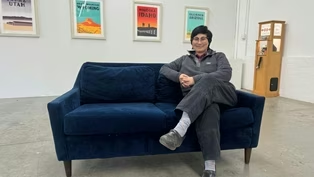
Clip: S4 Ep5 | 8m 17s | A local artist sees echoes of her Japanese-American family's past in recent news. (8m 17s)
Video has Closed Captions
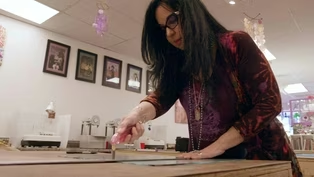
Clip: S4 Ep5 | 6m 59s | Art and community intersect at Holidaze Stained Glass-My Free Spirit. (6m 59s)
Providing Support for PBS.org
Learn Moreabout PBS online sponsorship

- Arts and Music
The Best of the Joy of Painting with Bob Ross
A pop icon, Bob Ross offers soothing words of wisdom as he paints captivating landscapes.













Support for PBS provided by:
Art Inc. is a local public television program presented by Ocean State Media