Florida Road Trip
Mount Dora
Season 2026 Episode 1 | 26m 46sVideo has Closed Captions
Explore the lakeside town where history, art and community thrive.
Join the ride to Mount Dora, where rolling hills and lake views shaped a charming Central Florida town. Explore citrus roots, a preserved downtown, and stories of resilience from early settlers to East Town. From a landmark inn to a celebrated art festival, Florida Road Trip reveals the people, places, and traditions that keep Mount Dora’s spirit alive.
Problems playing video? | Closed Captioning Feedback
Problems playing video? | Closed Captioning Feedback
Florida Road Trip is a local public television program presented by WUCF
Watch additional episodes of Florida Road Trip at https://video.wucftv.org/show/central-florida-roadtrip/
Florida Road Trip
Mount Dora
Season 2026 Episode 1 | 26m 46sVideo has Closed Captions
Join the ride to Mount Dora, where rolling hills and lake views shaped a charming Central Florida town. Explore citrus roots, a preserved downtown, and stories of resilience from early settlers to East Town. From a landmark inn to a celebrated art festival, Florida Road Trip reveals the people, places, and traditions that keep Mount Dora’s spirit alive.
Problems playing video? | Closed Captioning Feedback
Where to Watch Florida Road Trip
Florida Road Trip is available to stream on pbs.org and the PBS app.
Providing Support for PBS.org
Learn Moreabout PBS online sponsorship>>This program is brought to you in part by the Paul B. Hunter and Constance D. Hunter Charitable Foundation, a proud partner of WUCF and the Central Florida community.
>>On this edition of Florida Road Trip, we're headed to Mount Dora, a lakefront city where rolling hills shaped one of Central Florida's most charming communities.
>>They came over a rise in a hill, and they saw Lake Dora, and it was like, that's it.
>>And where a small town art scene turned into a national festival.
>>They are not funded by some huge corporate organization.
It's all about community spirit.
>>Plus, along the shores of Lake Dora, one historic inn has grown right along with the city itself.
>>If the hotel's doing well, the city seems to really be doing well.
>>From early settlers to artists.
This is a growing community that hasn't lost its charm.
Buckle up.
Florida Roa Trip is taking the scenic route through Mount Dora.
♪♪ Hi there, and welcome to Florida Road Trip.
I'm Scott Fais.
When folks think of Mount Dora, Florida, images of the city's renowne art festival may come to mind.
Along with its postcard perfect downtown.
But like much of Florida, Mount Dora's history is rooted in citrus.
>>Earliest settlers in the area.
If you go way back, you're goin back to the indigenous people.
Later on, you had local homesteaders in the area.
There was a Homestead Act in 1840s that was unique to Florida.
It had to do with the Seminole Wars.
So that brought some homesteaders to the area as well because they could get 160 acres if they were going to be ready to defend those acres.
>>The earliest settler was a guy named David Simpson.
His father, Milton, had a plantation up in North Florida.
But after the Civil War, h pretty much lost the plantation.
He had to fre all the enslaved people he had.
And his son, David, when he's about 22 years old in 1874, it's like, I need to make my own way.
So he and a buddy from Sanford, they started working their way in this direction and they came over a rise in the hill, and they saw Lake Dora.
And it was like, that's it.
So he was able to buy 160 acres for about $300.
>>Like many Florida towns, Mount Dora's name comes with a story and a little mystery.
The story that everybody hears is that the town drew its name from an early settler named Dora Drawdy.
She came here in the 1850s sometime.
When the surveyors came up after Florida became a state, they spent time in her place.
She helped feed them.
And with all that support they named the lake after her.
It's a great story and it makes a lot of sense.
But she's on the Georgia census in 1850.
>>What we do know is the town took its name from the lak and the rolling hills around it.
>>How the lake got its name?
We're not entirely sure.
There's a lot of local legends about that.
>>Early industries included citrus and timber.
Yet what really defined Mount Dora was the determination to stay, even when the economy an the weather made it difficult.
The freezes impacted many of the families growing citrus in the area.
>>I think it was perseverance.
These people came here to start a new life.
They were used to working hard, they're pretty smart folk.
They knew how to take care of business.
They kne how to take care of themselves.
So I think they just went through.
>>By the late 1800s, local leaders began thinking beyond agriculture and looked for ways to bring people here and to shape a community.
>>They heard of something called Chautauqua, which, Chautauqua, New York.
They were these social, spiritual, educational camps that would roam around the country.
>>It's not an official Chautauqua, but it was founded to bring people in from Central Florida and surrounding areas, and it brought people from much further.
>>They set it all up and within, I think about 9 or 10 months, they were able to attract 10,000 people to this town.
>>The lake connected Mount Dora to the rest of Florida and helped make a town a destination long before highways existed.
>>Lake Dora is connected vi Dora Canal to a connecting lake all the way to Saint Augustine, via the Saint Johns River.
People would travel down the Saint Johns River to Lake Dora Canal, into Lake Dora an the other lakes in Lake County.
>>As the years passed and the historic buildings across the regio gave way to modern development, this city chose a different path.
>>Most o those buildings in the downtown corridor between Fourth and Fifth on Donnelly Street, are original to the founding of the city.
>>This is what makes the town, this historic commercial district.
And then when you go down McDonald Stree or Tremaine or Baker and you see these cool little houses, you see this beautiful lake.
Basically the foundation that was here when David Simpson comes over the hill and he sees it.
>>The city's historic core became a gathering place for longtime residents, including a growing black community that found stability and built their lives in the downtown area.
>>Nancy Moss had escaped slavery three times when she walked into downtown Mount Dora, and when she saw people, black people, walking around carefree, she was amazed and she stayed because what she perceived was safety.
No fear, no confrontations.
So she stayed.
I think that was what life was like.
People were busy.
They had employment of some kind or another, and they had a place to live.
The redevelopment project was a project that John Donnelly started.
The purpose was to bring people from the North to see Mount Dora as a tourist location.
They settled on the area of Mount Dora that is now called Downtown Mount Dora.
The problem that African-Americans faced was that this was the area where they lived.
So Donnelly then uprooted the African-American who lived in downtown Mount Dora through his redevelopment project.
>>As families resettled, East Town emerged as a plac where they rebuilt their lives and strengthened their community.
>>I look at East Tow as being fairly self-sufficient.
You had probably everything that they needed.
There was a grocery store, fish market, all the food supplies, the restaurants.
Because of the way that East Town is physically situated, because there were woods.
Some people might call it a forest, but it bordered where Donnelly Street is all the way to 441, and that forest end was really like a a fortress.
It it protected people from coming in.
>>What makes Mount Dora unique is the generations of people who chose to invest in this place, keeping its charm alive.
>>People are so passionate about this town and it's been that way since the 1880s.
What are we going to do to build Mount Dora?
And you get different opinions, and you can fight and you can battle.
Ultimately, the best ideas win out and then you get something like, you see today.
♪♪ >>In the heart of Mount Dora awaits a home that looks like it stepped out of an era gone by.
Built in the late 1800s, the Donnelly House is one of Mount Dora's most recognizable landmarks.
And for more than 100 years, this home has connected the community.
>>The Donnelly House was built in 1893 by Mr.
Donnelly, who moved down here from Pennsylvania and married Anne Stone, who is a prominent real estate of interest in Lake County area.
Then he built the Donnelly House for her, which is a Queen Anne Victorian house which are pretty rare.
>>From the start the Donnelly House stood apart.
Its design choices reflected its uniqueness.
Even today, the exterior hints on what's inside is more than just ordinary.
>>It' like a gingerbread style house.
Normally there are spikes o decorative designs on the top.
Each room and those style houses have its own personality.
>>Walking through the house feels like stepping through a series of personal spaces.
>>There's stained glass windows, wood flooring.
All of it dates back to the late 1800s.
The steeple's pretty unusual.
Palmetto board was use for the majority of the house, so it's very hearty and rigorous.
And I mean, you'll see we've updated and modernized some of the house with paint and things like that.
Still holds pretty true to its original design.
Still has a knob and tube wiring, which we have since replaced with modern wiring, but that wiring attachments are still in place.
>>The layers of history are part of the reason why the house feels so closely tied to Mount Dora today.
>>The cit actually made it their emblem, so the city have that on their vehicles.
It's a very unique house.
Most people come to the area to see the house.
So we're happy that we can provide historic tours for people who can come in and see it, check it out.
It is just an unusual house.
>>For visitors, the Donnelly House is a stop o learning Mount Dora's history.
For the community, it reflects the history and how the city has grown.
♪♪ Mount Dora's arts scene is always abuzz with new creations.
The city's annual arts festiva is one big, colorful spotlight, allowing artist to shine on the national stage.
>>Art is more than just a visual or something that somebody does on the street.
It's not just an expression of individuals, but it's also a way to bring community together.
>>Well before it rose to national prominence, the Mount Dora Art Festival consisted of a small group of artists trying to create a sense of community.
>>So the Mount Dora Arts Festival did start off with a bunch of local artists that wanted to support each other and the local art scene in the town, and also bring some people into the downtown area because it was slo and a small town during the 70s.
>>During the era of bellbottom and disco, the community began preparing for the first art festival, a massive effort they took on together without realizing just how successful it would become for Mount Dora.
>>The first show was in 75.
The people that were involved in it used to go almost door to door to the businesses of Mount Dora to get money so we could put the show on.
We also had to ask the state to close one of the roads.
That was the beginning of it.
We probably had maybe about 200 or so artists, including some of us who were local in that show, and it started to grow from there.
>>As the festival grew, so did the excitement.
Today, artists from every corner of the country line up for the chance to bring their art to Mount Dora's streets.
>>We only have about 300 spots so we have a growing waitlist, so to speak, of a lot of artists that would like to be here in the show, but we always have an incredible number of people who come.
>>While the festival expande and gained national notoriety, it stayed true to its original mission: bringing people together.
>>These festivals, they don't just happen, they are not funded by some huge corporate organization.
It's all about community spirit.
>>Today, Mount Dora's art spills out of its galleries and onto the streets.
>>One of the pieces of artwork that has kind of given the city of Mount Dora a little bit of notoriety, I guess, is the Starry Night House which is along the waterfront.
The City of Mount Dora has a public art advisory committee, and they use funds and purchase pieces.
And they started a Mount Dor art walk along the waterfront.
It's beautiful and it's growing.
♪♪ >>While Mount Dora developed a reputation as an arts town, its cultural crossroads began inside an old ice plant right on the shores of Lake Dora.
Today, volunteers prov that this small town can still put on quite a big show.
>>In September 1948, John and Bill Barker, Jr.
arous the interest of a small group.
>>These early newspaper articles capture the momen when Mount Dora began to imagine what a community theater could be.
But behind the headlines, find the people ready to turn an idea into something everlasting.
>>There were some people here in 1948 who had a lot of arts background.
From being up north, from living in major cities.
And one of the guys sons was at school in Rollins, and he had gotten involved in their theater department there, Annie Russell Theater, and came back to talking to hi parents in Mount Dora and said, you really need to start a community theater up here.
That'd be a great thing.
>>The idea began to shine during the post-Worl War Two little theater movement, when communities across the country began crafting their own stages to bring people together through the arts.
>>Post-war, people had more time on their hands.
They had they were raising young families in little towns, and people who were interested in the arts weren't going to go to New York and see a show, bu they wanted to shows themselves.
>>In Mount Dora, that meant transforming an abandoned building into a performance space built almost entirely by hand.
>>They found this old ic plant on the shore of Lake Dora.
It wasn't being used for ice anymore.
They took it over and they gutted it.
And they got seats that were donated from various high school, had some seats in their basement.
So they donated those and they built a stage and during the process of renovating this building took about six months.
They had to break down all the interior walls because they were storing ice in Florida.
The walls were like 22 inches thick, and they were breaking them down with pickaxes and sledgehammers and everything.
>>When that work reached its limits, a little creativity took over.
>>Somebody said, oh, I know how to use TNT.
So some guy knew how to do that.
So he came in and they blew up the inside of the building, which is, that's skill to not knock down the whole building.
So they broke up the floor that way.
It was all just really hard manual labor.
All the volunteers in town, everybody in Mount Dora got involved.
It was only about 2,500 people living here at the time.
And then they opened in February 1949.
>>Over time, the group gre and found a new permanent home.
The theater was right across the street from the train tracks so every time a train went by, the play had to stop because it was so loud that everybody would just hold still.
And then the train would go by.
Then they'd pick up again.
Keep doing the play.
The Icehouse Players were they incorporated that way.
They said we've got to get out of this location.
It's too loud here.
City of Mount Dora donated this corner.
Corner of 11th and Unser, which was way in the outskirts of town at that poin and started the building in '57.
And they opened in the fall of '58.
>>The theater's become a living archive where history is not only performed, but it's passed along.
>>Because of this theater, it's allowed me to learn more about all the people who have ever lived here and ever done a show here.
And, how important it is to the people who come and tell me these stories.
So it's it's a it's neat that it's still very much embedded in the town and a part of the history of the town.
♪♪ >>In Mount Dora, history invite you to pull up a rocking chair.
Have a seat and just stay a while.
Along the shores of Lake Dora sits a place that's rooted in history since the very beginning.
>>Lakeside Inn has really always been a part of the history of Moun Dora, and their growth has kind of been in sync since the beginning.
>>The facade of the building looked much different all those years ago compare to how visitors find it today.
>>When Lakeside Inn first opened in 1883, it was owned by two gentlemen, two investors.
At that time it was just a ten room hotel and it was called the Alexander House.
>>Soon after, ownership shifted in a way that still feels remarkable for the time period.
>>Emma Boone was actually the first woman owner of the hotel, and she was actually just the second owner overall.
So she ran the inn for at least a decade.
And then after she was married, it was her and her husband that owned it.
It was a neat thing to know that in the 1800s, there was a woman who owned the Lakeside Inn, and she actually changed the name to the Lake House, which was the second name before it finally ended up Lakeside Inn in the early 1900s.
As Mount Dora changed, the hotel changed right along with it.
>>They've always kind of had this symbiotic relationship where if the hotel's doing well, the cit seems to really be doing well, and if you ask locals, they'll tell you, you know, whenever Lakeside Inn is thriving, that's really when the community has been thriving.
>>What visitors don't always expect?
How much of the original building has endured.
>>One of the things that is unique about the hotel, I don't know that I woul necessarily say it's innovative, but that it is a wooden structure and that it has remained a wooden structure.
With growth of stucc and all of that look in Florida, to have the hotel remain in the way that it is, is something very unique.
There were many times where people, because it was an original structure and it was older, they wanted to just level it and build apartments or build a restaurant and the community, as they always have really fought to protect the hotel.
And I think that is just a testament to how special it is to the community.
The fact that it is here, after celebrating our 140th anniversary in 2023, it's pretty remarkable to just see how much support this inn has had throughout the years.
>>The halls of the inn welcome people from all walks of life.
>>One of our most notable guests was actually President Calvin Coolidge and his wife, Grace, which was right after they got out of office and they stayed here for an entire month.
>>For many people, the Lakeside Inn is where Mount Dora slows down.
Grab a seat by the lake, take it all in, and realize you're sitting in a place that's welcomed people for generations.
♪♪ In a town known for its lakefront vistas, there's one place that's quietly anchored Mount Dora's story for well more than a century.
The Mount Dora Yacht Club is the place that brings the community together.
>>Founded in 1913, a gentleman named Henry Fuller retired here from New York, and he was a member of the New York Yacht Club.
And he thought it would be a fine idea to have a yacht club in Mount Dora.
So he met with a handful of the prominent businessmen, and they agreed with him.
They purchased the land and off we went.
>>From the start, the clu anchored its identity and life on the water.
>>Back in the day, it was all about power boats.
There was the powerboat association and the grapefruit circuit was all over Florida.
And the Mount Dora regatt was one of the key stops there.
It's hard to believe, but there were actually world speed records set on Lake Dora.
>>Those races sent ripples o recognition across the country.
>>People came from all over, and they would actually close off Old 441 so that people could park and watch the races.
In 1953 we switched to sailboat racing.
>>During World War Two, the clubhouse took an important role in the community.
>>There were two main things that happened here.
First, the clubhouse itself was used as a USO and thousands of serviceme were fed and entertained here.
And the second thing was there was a group of club members that took their boats out sunup to sundown every day.
There was, I think, 11 of them.
And they patrolled the whole chain of lakes.
And that was to watch for any accidents that had happened from the fighter planes that left out of Leesburg airport.
>>For those who spent their lives here, the club is closely connected to what makes Mount Dora feel like home.
>>I always ask people when they move here, why did you come to Mount Dora?
And it's surprising how many people say they just drove into town and said, this is where I want to live.
It is really special and unique, and I think there's a real hometown feel about it.
>>For more than a century, the Mount Dora Yacht Club has shaped daily life on Lake Dora alongside the people who call this place home.
♪♪ Along the shore of Lake Dora, you'll find the lawn bowling lanes.
Here, players roll through their mornings, generating not only skills but also a sense of community.
>>In 1928, we had some snowbirds that were down in Florida, and they were staying across the street here at the Lakeside Inn, and they were looking for something to do.
And in the wintertime, they go tired of doing golf every day.
And they had lawn bowling in New England, where they were at the time.
They founded the Lawn Bowling Club.
We had two rings.
We are rolling bowls, not "balls," but bowls to a little white ball called the Jack.
And our rinks are forever changing.
The conditions are always different, so it is a challenge to master.
>>Lawn bowling keeps its classic feel.
Yet, the game continues to gro well past its 1920s traditions.
>>Originally lawn bowls were made of wood and now they're composite plastic.
That came about after World War Two, and they developed all the plastic stuff.
>>There you go.
>>Right there.
>>When you're out here bowling every day, you gotta keep the competition interesting.
>>Pill bowlin is something we do on the daily bowling schedules, and it is designed to avoid people bowlin with the same people every day.
For a new bowler, that's intimidating.
We invite all the bowlers up here to sign in on our sheets.
We determined how many rinks we're going to need for that day.
We put little pills into a bag and we draw them out one at a time, and they go to their assigned rinks.
That way, new bowlers can bowl with the more experienced bowlers and they learn quicker and the friendships form.
It's a camaraderie.
It's not just lawn bowling, it's friendships.
♪♪ >>Fro lake views to historic streets, the people who built their lives here shaped the Mount Dora of today.
This city continues to grow thanks to the traditions that make this par of Lake County feel like home.
Well, that's going to wrap it up for this edition of Florida Road Trip.
Thanks for joining us.
I'm Scott Fais.
We'll see you down the road.
And until then, safe travels, everyone.
♪♪ >>This program is brought to you in part by the Paul B. Hunter and Constance D. Hunter Charitable Foundation, a proud partner of WUCF and the Central Florida community.
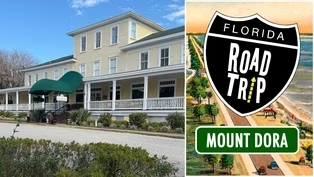
Preview: S2026 Ep1 | 30s | Watch a preview of the 2026 Premiere of Florida Road Trip. (30s)
Providing Support for PBS.org
Learn Moreabout PBS online sponsorship












Support for PBS provided by:
Florida Road Trip is a local public television program presented by WUCF
Watch additional episodes of Florida Road Trip at https://video.wucftv.org/show/central-florida-roadtrip/