If You Lived Here
Mount Pleasant
Season 2 Episode 7 | 28m 14sVideo has Closed Captions
Explore Mount Pleasant, where architectural beauty blends with a deep sense of community.
Guided by resident & realtor Megan Conway, Christine & John visit Northwest D.C.’s Mount Pleasant neighborhood to guess listing prices for a condo in a striking Beaux-Arts building; a mid-century modern townhouse with an oasis out back; and a renovated 1882 Victorian home. Plus, stories of historical preservation, Central American migration, and how mom & pop businesses help shape the community.
Problems playing video? | Closed Captioning Feedback
Problems playing video? | Closed Captioning Feedback
If You Lived Here is a local public television program presented by WETA
If You Lived Here
Mount Pleasant
Season 2 Episode 7 | 28m 14sVideo has Closed Captions
Guided by resident & realtor Megan Conway, Christine & John visit Northwest D.C.’s Mount Pleasant neighborhood to guess listing prices for a condo in a striking Beaux-Arts building; a mid-century modern townhouse with an oasis out back; and a renovated 1882 Victorian home. Plus, stories of historical preservation, Central American migration, and how mom & pop businesses help shape the community.
Problems playing video? | Closed Captioning Feedback
How to Watch If You Lived Here
If You Lived Here is available to stream on pbs.org and the free PBS App, available on iPhone, Apple TV, Android TV, Android smartphones, Amazon Fire TV, Amazon Fire Tablet, Roku, Samsung Smart TV, and Vizio.
Providing Support for PBS.org
Learn Moreabout PBS online sponsorshipWOMAN: Support for If You Lived Here comes from... NARRATOR: The Yuen Foundation, committed to bridging cultural differences within the greater Washington DC community.
JOHN: Hi, I'm John Begeny.
CHRISTINE: I'm Christine Louise.
We're producers at WETA and longtime besties.
JOHN: We love living in the DC area but finding a place to live here can be tough.
But, it could also be a pleasant experience.
CHRISTINE: Join us as we tour three homes at three price points.
JOHN: And try to guess the listing price without going over.
And find out what it would be like...
BOTH: If You Lived Here.
JOHN: Hey, I think a parking space is opening.
CHRISTINE: Let's go.
JOHN: Let's go.
CHRISTINE: Hi, Megan.
MEGAN: Hey guys.
JOHN: Hi, Megan.
MEGAN: John, Christine, welcome to Mount Pleasant.
JOHN: Wow.
This is a beautiful neighborhood and I know very little about Mount Pleasant.
MEGAN: Well, I'm excited to help you explore what we call our village in the city.
I personally have lived in the neighborhood for about ten years.
But my husband, who is also my high school sweetheart, grew up here.
His family has owned a home on Park Road that they've restored over the course of 45 years.
And, my mother-in-law was part of a group of people that fought to make this a historic district and has been really involved in keeping Mount Pleasant, Mount Pleasant.
CHRISTINE: So Megan, when did this area become a historic district?
MEGAN: It officially became a historic district in 1978.
So, these row homes are really representative of what you'll see a lot through the neighborhood.
These were mostly built in the early 1900's.
CHRISTINE: How far back do these go?
MEGAN: These are deceptively large homes.
They're going to go, you know, almost a half a block to the alley behind here.
CHRISTINE: Oh, that is a good size.
MEGAN: A lot of people have apartments, like English basements or in-law suites.
JOHN: They're beautiful.
MEGAN: Yeah.
You probably have over 3,500 square feet of living space, really.
JOHN: They have each their own identity, block to block.
CHRISTINE: But, I have to ask, so the historic district, they're cool with this?
MEGAN: So, you can paint your home.
But, if they said, "We want to rip out all our windows and take down these columns and totally change the front of the house," that wouldn't fly.
JOHN: They'd be like, "No."
MEGAN: Yeah.
JOHN: But there's nowhere in the guidelines that says you cannot put a tricycle on the front of your facade.
CHRISTINE: It's really a neighborhood institution, this home.
JOHN: Yeah, I love it.
MEGAN: Yeah.
JOHN: All right.
16th Street.
Well, I have passed this building so many times in my lifetime, Megan, and I've always wanted to see what's inside.
MEGAN: And now you're going to get to see it as property number one today.
JOHN: Super excited about that.
MEGAN: So, this building is a Harry Wardman.
It was built in 1917 and it's very beaux-arts.
CHRISTINE: So, what makes it a beaux-arts style building?
MEGAN: Just looking from the outside, there are some amazing details, these arched windows.
The units have these great balconies and all of them have these beautiful French doors to the outdoor space.
JOHN: And they don't make them like this now.
CHRISTINE: No, and you know I'm just looking at the architectural detail on the windows.
Isn't that lovely?
MEGAN: And, this has always been featured as one of the best addresses in DC.
JOHN: Oh, that's double cool.
CHRISTINE: All right.
MEGAN: Should we take a look inside?
JOHN: Yes, lead the way.
CHRISTINE: All right.
JOHN: Wow.
This does not disappoint.
CHRISTINE: I did not expect it to be so open.
JOHN: Yeah, me neither.
And it's shocking because as a Wardman building, this is like open concept before there was open concept.
CHRISTINE: You know what also makes it feel so much more expansive, are the high ceilings.
JOHN: Let's start in the kitchen.
CHRISTINE: Okay, naturally.
JOHN: Well, this is interesting.
CHRISTINE: I love how they've extended the kitchen kind of out into this area.
JOHN: They sure have.
They bumped out the counter a little bit and added this cabinet.
CHRISTINE: All right.
A good space.
JOHN: Yeah, nice kitchen.
CHRISTINE: You know, it's not a huge kitchen, but you certainly don't feel cramped.
Plus, plenty of cabinet space.
JOHN: Yes, and they've put these nice little pulls all over the place.
Nice little touch.
You know that glass tile really pulls your eye.
CHRISTINE: It's a pop.
JOHN: It is for this kitchen.
How about those counters?
Huh?
CHRISTINE: You know these are the butcher block countertops and I've always liked them.
And they're really a cost effective way of putting in a counter.
JOHN: Are they hard to maintain?
CHRISTINE: As long as they're sealed right from the beginning, and you can condition them throughout the years.
JOHN: Sounds like a lot of work.
CHRISTINE: It's not.
JOHN: Okay.
Let's go see the rest of this great place.
And here we have a bedroom.
CHRISTINE: Oh.
But not just a bedroom.
Look how big it is.
JOHN: This is huge.
CHRISTINE: And it has a full bath.
So I'm guessing there's another full bedroom with an en suite.
JOHN: Well, let's go find it.
CHRISTINE: Ooh, but not before we check out the balcony.
JOHN: Ah, look at this.
A room with a view.
CHRISTINE: Okay.
Wow, what a view.
JOHN: Oh, this is nice.
CHRISTINE: But also, when you're this high up, you really see the architectural details of this amazing building.
JOHN: And the concrete work.
These balconies are sturdy.
I'm am telling... CHRISTINE: They are sturdy.
JOHN: They're rock sturdy and ornate and beautiful.
CHRISTINE: I would be happy to enjoy my coffee out here every morning.
JOHN: Yeah, me too.
CHRISTINE: Okay.
But I think it's time to head on in.
JOHN: All right.
CHRISTINE: Okay.
It's hard to come in from such a nice spot.
JOHN: I know there's even a breeze out there, beautiful.
CHRISTINE: But, this is an even nicer spot.
JOHN: Yeah.
CHRISTINE: What a nice living area.
JOHN: Well, there's so much living space and this placement.
Yes.
Very nice TV area.
But, it's the owner suite we're looking for right?
CHRISTINE: It is.
And it's just as big.
It has its own bathroom.
JOHN: Well, my favorite part is this window with those views.
CHRISTINE: That is amazing.
You know, with the windows, obviously they've been updated, so you know they're cost efficient, but I love it that you can just open them and let the breeze come in.
JOHN: So nice, I want to live here.
CHRISTINE: I wouldn't mind living here.
Let's check out the bathroom.
JOHN: Oh, this is nice.
CHRISTINE: Spacious enough.
Does have a single sink.
JOHN: Sure does.
CHRISTINE: But you have two bathrooms.
JOHN: We've got two bathrooms.
It's move-in ready and... CHRISTINE: You know, move-in ready is a good thing.
JOHN: Yes.
MEGAN: Okay guys.
So this was your first home tour in Mount Pleasant.
How was it?
JOHN: It's a great place.
I love this open concept.
CHRISTINE: And the windows, the natural light coming in is spectacular.
Now the big question, is there any parking?
MEGAN: So there's unassigned parking in the lot.
CHRISTINE: Well, that's good.
JOHN: There's not just five spots outside that you have to battle for?
MEGAN: There's not five.
There's more than that.
JOHN: And the Metro is so close too, right?
MEGAN: It's just a few blocks from the Columbia Heights Metro.
So green and yellow line, just a few blocks away.
This unit is about 1300 square feet.
JOHN: Ah.
CHRISTINE: Okay.
MEGAN: Two bedrooms that are both very spacious as you saw.
JOHN: Yes, very... MEGAN: Two baths.
Any other questions you have?
CHRISTINE: Condo fees?
JOHN: Yeah.
MEGAN: Condo fees for this unit are $692 a month.
CHRISTINE: All right.
JOHN: All right, Megan.
Got a price.
In my head, the price is $640,000 on the nose.
It's a good poker face, Megan.
Not going to lie.
CHRISTINE: I was trying to read a little bit.
You're not really helping.
MEGAN: Lots of poker practice.
Lots, lots.
CHRISTINE: All right, I'm going to go high.
I'll probably regret it, but I'm going to go on the high end.
Okay?
Yeah, okay.
Thank you for your support.
I'm going to go in at $725,000.
MEGAN: So the list price for this unit was... $665,000.
So John, you were very close to the list price.
JOHN: That was lucky.
MEGAN: I can't wait to show you the next properties.
They're both very different, but both in this wonderful neighborhood in Mount Pleasant.
CHRISTINE: Let's go, we'll follow you.
JOHN: Onward, after you.
MEGAN: Let's go.
CHRISTINE: Thank you.
RYU: What I love about Mount Pleasant is I feel like I get the best of both worlds.
So this is an amazing, beautiful neighborhood.
It's very kid friendly.
You got the city right there within walking distance.
But then also if I go that way, then I'm in the woods.
JULIAN: I would describe it as a little haven in the middle of a city.
It's a very, very neighborhood, quiet vibe.
DARRYL: Somewhere along the line, people realized the historic value of Mount Pleasant.
And I think that's a good thing.
SHARON: I was literally just driving around, checking out neighborhoods and I found Mount Pleasant.
And I was just blown away at the beauty of it.
So at the turn of the century, people were looking to move out of the row houses downtown into an area that had a little bit more space and more trees, and this filled the ticket.
The architects who did the majority of buildings in Mount Pleasant are some of the most well-known architects in DC in the late 19th and 20th century.
When my husband and I first moved here in the late 70's, it was not a desirable neighborhood.
It had gone through the fairly typical waves of urban ups and downs, and it was after the assassination of Martin Luther King.
So there was a lot of white flight and a lot of, especially these bigger homes, were either abandoned or turned into halfway houses.
And within a year of moving in here, there were demolition permits where some of the biggest houses in Mount Pleasant to put up very, very dense apartment buildings.
And it became obvious that unless you fight for it, it's not going to be there.
And that's kind of what the preservation is.
This neighborhood is just very desirable.
If we had not had the historic district, I really think this neighborhood would not bear any resemblance to what it is today.
CATALINA: So the folks from the 70's really opened up, I think, doors for the community that really came in mass during 80's.
So in the 80's, while we had a huge growth of Central Americans, Salvadorians, Guatemalans in this area.
And, Mount Pleasant was very much a village feeling.
If it were, it's like a pueblo.
Many people in our home countries come from smaller communities and Mount Pleasant had that feeling of being a small community.
LILO: In the 1980s, you know, I was an elementary school teacher in my country.
And during the Civil War at that time like 300, uh teacher had been killed.
I had to leave.
This is really to me, the heart of el barrio, you know, and for the Salvadorian, this was a colony.
You can still see people that have been here for many years.
We didn't have internet.
So this was the place where we get the news.
This was the place when we knew about family or what's going on.
That was very important.
So to me, that was my pedacito from El Salvador, right in the capital of the United States.
CATALINA: The story of the Central American migration is really a story of being invisible and not having the reasons that have propelled us to this country even recognized for a decade.
And therefore, provided no support.
La Clinica was born as a response to those health needs during the Mount Pleasant uprising, back then known as the riots, now reclaimed as the uprising.
There was a new generation who were protesting the shooting of a person here on the street.
It was a huge moment for us as a community, painful as it was, because finally people started to say, "Who are all these people?
Why are they so mad?
Why are they here?"
This is really like the heart of the Latino neighborhood.
The little El Salvador is a name that I know some of us are trying to claim, right, for this area.
And it really is very much an important benchmark, you know, for coming to this country.
There's no denying that the changes that started to happen in Washington DC in 1990s, pushed a lot of people out who could no longer afford to live here.
I do think there's been a lot of efforts in Mount Pleasant, through a number of different associations, to preserve the neighborhood for the people that had claimed it in the 80s.
Think it's going to take a lot of us making sure that not just culturally, but economically Mount Pleasant maintains the diversity that people enjoy about the neighborhood.
MEGAN: All right, guys, welcome to your second property in Mount Pleasant.
CHRISTINE: I feel like we're in a whole different part of town.
And literally we are just blocks from house number one.
MEGAN: So we are across the street from the trails of Rock Creek Park.
As someone who lives in this neighborhood, I am in there every day.
We call it our urban backyard.
JOHN: You know, we have a lot of different styles up and down this road.
MEGAN: So this is a unique block.
It was designed by a prominent architect and built in 1938.
CHRISTINE: I was thinking more 60's for some reason.
MEGAN: And I can see how you would think that because it's very mid-century.
Well, why don't you guys go ahead, take a peek inside and I'll wait for you out here.
CHRISTINE: Sounds good.
JOHN: Sounds good.
CHRISTINE: Okay, ready?
All right.
JOHN: Well hello, little charmer.
CHRISTINE: Okay.
You have to admit that the focal point of this room is this corner window.
JOHN: Oh yeah.
That's really nice.
But, you know, this house has a lot of nice details like that arch to the dining room and this traditional staircase.
CHRISTINE: I guess I wasn't quite expecting such a traditional staircase with the outside.
JOHN: No, there's a contradiction, you know, from the outside to the inside.
The inside's a little eclectic.
CHRISTINE: It is, but, you know, it's really cozy.
JOHN: It is.
And here we are in what looks like the dining room and the kitchen.
CHRISTINE: And the kitchen.
So it's an eat in kitchen and really the only dining space in the house.
JOHN: Tight space.
Little space, but nicely done.
CHRISTINE: Yeah.
I like the marble countertops.
JOHN: Yes.
CHRISTINE: They kept it light and bright with the white cabinets.
JOHN: Yep.
I mean, it's a cute little kitchen.
Is it a cook's kitchen?
I don't know about that.
CHRISTINE: I don't know, but you know what's missing?
JOHN: What?
CHRISTINE: A dishwasher.
JOHN: Oh no.
CHRISTINE: No dishwasher.
JOHN: No dishwasher?
CHRISTINE: I have to have a dishwasher.
JOHN: Well, I'll tell you what makes up for the lack of a dishwasher and that's this garden out back.
CHRISTINE: I agree with you 100%.
This is like a whole other addition to this home.
JOHN: Oh, for sure.
I mean, you know, this is so great because this is like a multi-tiered garden.
It feels like an extension of the park, which is just blocks away.
CHRISTINE: And that's what makes this house such a dream.
JOHN: Yeah.
CHRISTINE: All right.
So this is a nice, additional living space.
JOHN: Well, you know, it's a small space.
It's a little cold.
It's a basement.
CHRISTINE: I think it's kind of nice.
I do like the ceramic tile down here.
It gives it a different feel and look, and it's perfect for a basement.
JOHN: Yep.
And utility room.
CHRISTINE: Okay.
It's actually a good size utility room.
JOHN: Is it a quarterback?
I think that's a quarterback.
CHRISTINE: I think that's a quarterback.
JOHN: All right.
Well, there you go.
Utility room, washer, dryer and door to the outside.
CHRISTINE: Okay.
So second level.
And we have bedroom number one.
JOHN: Yes.
CHRISTINE: Okay, you know, it's not the biggest bedroom.
JOHN: No.
CHRISTINE: But when you look at this outdoor space, it doesn't feel cramped.
JOHN: No, you can see the garden in the back.
CHRISTINE: And closet space.
JOHN: Closets, check.
CHRISTINE: Okay, shall we go up?
JOHN: We shall.
CHRISTINE: Okay.
Here we have the bathroom.
JOHN: Okay.
CHRISTINE: This is nice.
This has been remodeled.
JOHN: Well, it's the only bathroom up here, but they did a really nice job remodeling this.
CHRISTINE: I know.
There's a lot of features we like.
We love the honeycomb tile.
JOHN: Yes.
Done in marble.
And I like the subway tile.
And it goes with the skylight, which is... CHRISTINE: Your favorite.
JOHN: Yeah.
That's one of those old features and it kind of all goes together.
CHRISTINE: Wait, I've got to check something out.
So I so want to turn the it on, but I'm not sure how.
Let me see.
It looks a little... Oh, there we go.
That's nice.
JOHN: You know what's nice about that?
It has that old look.
CHRISTINE: Yeah.
JOHN: The hardware, which goes with the subway tile.
It's good looking and I love the mirror and the sconces.
Okay, bedroom number two.
CHRISTINE: Okay.
Again, not a huge bedroom.
JOHN: Nope.
CHRISTINE: But it's that corner window that makes this room so expansive.
But, you know, there is only one bathroom on this floor.
JOHN: True.
But two bedrooms up here.
One bathroom, that's okay.
CHRISTINE: Oh yeah.
It's manageable, it's manageable.
JOHN: Okay, let's head downstairs.
CHRISTINE: Sounds good.
JOHN: All right.
CHRISTINE: Hey Megan.
MEGAN: Hi guys.
How was your tour?
CHRISTINE: You know, I don't want to speak for you, but I think I can speak for both of us when I say, you know, the outdoors was not lost when you stepped inside this home.
JOHN: There's a saying the good things come in small packages, and that would be this.
MEGAN: I like that saying.
So let me give you a little rundown.
So we have two bedrooms and one and a half baths, a little bit over 1200 square feet total, no parking space for this row home.
And of course you have just all of this fabulous outdoor space and access to Rock Creek Park.
CHRISTINE: I did go a little high on the last one.
So I think I'm going to be a little more conservative.
I'm going to come in a listing price of $825,000.
MEGAN: Okay, final answer?
CHRISTINE: Yes.
MEGAN: Okay.
JOHN: I think that's a very good guess... CHRISTINE: Oh, thank you.
JOHN: Tina Louise.
But I'm going to...
I don't know if I should go high or low, but I'm going to go for $800,000 the nose.
CHRISTINE: So you wanted lower?
MEGAN: Okay.
All right.
Well the final list price for this row home was... $845,000.
So I'm really excited to show you the next home in Mount Pleasant.
And there's some really neat history associated with the home.
CHRISTINE: Okay, well, we love history.
JOHN: Yeah.
And I want to learn more about Mount Pleasant.
So... MEGAN: Absolutely, well let's walk around the neighborhood.
JOHN: Let's hit the streets.
MEGAN: All right.
DARRYL: One of the big assets of Mount Pleasant is its neighborliness.
ALICIA: I feel like I feel hope in this community.
A lot of people that care a lot here.
I like to say that the residents of Mount Pleasant are quietly changing the world.
They're not going to tell you they're doing that, but they're doing that in ways small and big.
JAN: My husband, Phil always tells the story that I sent him to look at Mount Pleasant, because I knew that's where I wanted to live.
Well, when we moved here, it was so diverse.
So it was just fabulous to have African Americans, have Whites and Hispanics.
It was really a great community to raise our kids in.
So the neighborhood in the last ten years has become very White.
Yeah.
So the diversity now is on Mount Pleasant Street because it has diminished within the neighborhoods.
One of the main things that I'm involved in is this program called Meet the Street.
The businesses here on Mount Pleasant Street are mainly mom and pop, and so about once a month, we'll come up to Mount Pleasant Street.
We'll organize a dinner at a restaurant, we'll meet the owner, the owner will tell us how long they've been on Mount Pleasant Street, where they came from, why they chose Mount Pleasant to have their business in.
And it's just such a good feeling to bring people up here because this is their community as well as ours.
JEAN LOUISE: We're in the best neighborhood in Washington, DC, Mount Pleasant.
My partner, Emily, and I, we wanted to create a place that we wanted to shop in.
That kind of had that farmer's markets seven day a week vibe.
So we try and have a story behind every single product that's in this store.
The story may be, this is a very cool honey that's made here in DC.
So we really like to know who's making the things that we are selling, and the story behind that as well.
MURIEL: I live a block from here, so it was so nice to have a place like this in the neighborhood.
But it's also a place where you could make an average inexpensive meal.
It's not as shi-shi a place as people think it is.
So I think it still serves the whole neighborhood, not just a select part of it.
MEGAN: So this neighborhood is really majority row homes, but I'm going to show you something special today, which is one of the only handful of detached homes in the neighborhood.
CHRISTINE: So tell us about the history of this home.
MEGAN: When 16th street was built to come all the way up to Mount Pleasant, they had to move 32 homes along 16th street, and that happened in 1903.
CHRISTINE: All right, let me get this straight.
So this house, they physically picked up and moved.
MEGAN: However they did it back in the day.
And apparently the weather was not great.
So it actually sat in the middle of the street for a few days until people complained about it.
And I heard it got a ticket.
JOHN: Well, you know how they hand out tickets in DC.
So wait, that was 1903.
MEGAN: So, things don't change.
JOHN: But back then, that ticket probably was 37 cents.
That was a lot of money back then.
Yeah.
MEGAN: Take a look and I'll meet you outside.
JOHN: Okay, see you in a minute.
MEGAN: All right.
CHRISTINE: Look at the foyer in this home.
JOHN: Wow, what a beauty.
CHRISTINE: Okay.
Now this has been renovated.
JOHN: Yeah, you think?
CHRISTINE: Okay.
This is the tough part.
Where does your eye take you first?
JOHN: Well, this is a grand foyer here.
CHRISTINE: Mine takes me right to these windows because it's almost like an architectural design in itself.
JOHN: That lovely old brick.
That texture through the window.
It's art unto itself.
CHRISTINE: Okay.
So we have living space.
JOHN: Yep, very nice.
CHRISTINE: Nice fireplace.
JOHN: Nice fireplace.
CHRISTINE: Okay, so... JOHN: Nice details, woodwork.
Lovely, really good looking.
CHRISTINE: Keep moving this way.
JOHN: Yeah.
Wow!
Look at this room.
CHRISTINE: Wow.
JOHN: This is a stunning dining room.
CHRISTINE: Oh, and you know the features that I like?
JOHN: Yep.
CHRISTINE: The paneled wainscoting.
JOHN: For sure.
CHRISTINE: And you know what I'm also noticing?
These corner pieces, they add a great architectural element, but at the same time, if you've ever put crown molding up, sometimes it's really hard to get those cuts perfect.
JOHN: It is hard, I've done it before.
Then is this another pantry?
CHRISTINE: Storage?
No.
It's the laundry room.
Well I guess you take your dirty napkins and just toss them in there.
JOHN: And then, swoop.
CHRISTINE: All right.
So I guess my eye is drawing me here now.
JOHN: This house just doesn't stop.
CHRISTINE: Oh, wow.
JOHN: Yeah, this is nice.
CHRISTINE: And it's screened in.
JOHN: All these trees outside.
CHRISTINE: I'd probably eat every meal out here during the summer.
JOHN: Very nice feature.
CHRISTINE: Okay.
So let's continue in to the kitchen.
Oh, Look at the light coming through.
JOHN: This is a good size kitchen.
Not too big, not too small.
CHRISTINE: But it's a lot of that mix of new features and embracing some of the original details of this home.
We've got the exposed brick.
JOHN: Sure do.
CHRISTINE: And... JOHN: Look up.
That ceiling with the exposed beams is really nice.
And you feel the age of the house.
CHRISTINE: Yeah.
But did you notice the numbers?
JOHN: No.
CHRISTINE: Okay.
So you see, you go from 300 to 301.
I bet that's 302.
I wonder if that's marking feet.
JOHN: Oh, very smart.
And take a look out the window at the backyard.
CHRISTINE: Well, that's the beauty of the detached home too.
JOHN: Wow.
CHRISTINE: Okay, so let's continue the tour.
JOHN: All right.
CHRISTINE: All right.
So we have a half bath and... oh, we got a small basement.
JOHN: Basement.
CHRISTINE: Okay.
JOHN: Up we go.
CHRISTINE: Sounds good.
JOHN: This is nice to have a staircase in the back of the house, right?
CHRISTINE: Yeah, it is.
It's narrow, but you know, it's your second staircase.
JOHN: So, first full bath up here.
CHRISTINE: You know, it's nicely done.
JOHN: Yeah.
CHRISTINE: You know, nicely remodeled.
Clean, white.
JOHN: Love it, nice update.
CHRISTINE: Oh now this... What a fun kids room.
JOHN: It's a great kids room.
CHRISTINE: Obviously you can use it for a guest room.
JOHN: Oh sure.
CHRISTINE: Or for when your kids get older, but really cute.
All right.
So we have another bedroom.
JOHN: Aw, look how cute this is.
CHRISTINE: Little smaller, but still good size room, actually.
So... Ooh.
JOHN: Well I think we have arrived in the owner's suite.
CHRISTINE: I think this is the owner's suite.
Yes.
JOHN: This does not disappoint.
CHRISTINE: No.
JOHN: What a space.
CHRISTINE: I mean, obviously we love our natural light, but boy, your eyes are just drawn to the beams.
JOHN: Yeah, very grand.
CHRISTINE: Okay.
So, I noticed the barn doors and I love the blue.
JOHN: Yes, good pop a color.
It's a luxury bath.
CHRISTINE: Oh what a nice bathroom.
We got the double vanities, nice size shower and I do love the tile work.
JOHN: I think there must be... Yep, look at this.
Talk about an owner's suite that has everything.
The park is literally right there beyond those homes.
CHRISTINE: You know, as much as I'd like to just stay up here and chill for a while... JOHN: I know.
CHRISTINE: Think we better go meet Megan.
JOHN: This was a special one.
Let's do it.
CHRISTINE: Okay.
MEGAN: Hi.
CHRISTINE: What a great backyard.
And the sun came out.
JOHN: You made the sun come out.
MEGAN: I do my best, what can I say?
JOHN: Job well done.
CHRISTINE: Well, you did do your best because this home was wonderful.
JOHN: Yeah, so much to love about this house.
So many features, where do we start?
CHRISTINE: Well, you know, I think being a detached home, you obviously have more windows and the light that comes in through those windows just can make a room.
JOHN: Yeah, that was one of my favorite things.
CHRISTINE: And how can we forget the bedroom?
Drama.
MEGAN: Doors were actually found in an alley by the owner.
JOHN: No.
MEGAN: Lovingly restored, painted.
They replaced every individual piece of glass.
CHRISTINE: Yeah, I love stories like that.
JOHN: We love that.
That's the type of people we are.
MEGAN: There is a kitchenette area in the lower level.
There is a wood shop workshop in the lower level.
BOTH: A wood shop?
MEGAN: I know.
CHRISTINE: How'd I miss that?
JOHN: You're speaking her language right here.
CHRISTINE: I'm going to have to go back in there.
MEGAN: Okay, so let me give you the details of the house.
JOHN: Yep.
MEGAN: Three bedrooms, two and a half baths.
So, about 3,700 square feet overall.
And the home was technically built in 1882.
As we discussed, it was moved to this location in 1903, and then there have been many iterations and improvements done to the home over the years.
JOHN: Okay, based on everything you said... MEGAN: I got to get the game face on.
JOHN: Put your game face on.
MEGAN: All right.
JOHN: My number is very straightforward.
It's $1,750,000.
MEGAN: Okay.
CHRISTINE: I'm going to go in at $1.9 million.
MEGAN: Okay, so the actual list price for this home was $1,775,000.
JOHN: Yes!
CHRISTINE: Oh no!
MEGAN: You are pretty much spot on.
I have one question.
JOHN: Yes?
MEGAN: Will you help me price my next listing?
JOHN: Absolutely.
MEGAN: Okay.
Well, if you have time, maybe we can grab a coffee from Elle, our local coffee shop.
CHRISTINE: We always have time for coffee.
JOHN: You're speaking our language, Megan.
MEGAN: All right?
Let's do it.
JOHN: After you.
CHRISTINE: So, while we're there, do you think you give me some pointers on guessing?
JOHN: Oh, you don't need pointers, you're a pro.
MEGAN: That's true.
CHRISTINE: Really?
MEGAN: That's true.
JOHN: Yes.
We win some, we lose some.
ALICIA: Honestly I'm so smitten with this neighborhood.
There's nothing I could say that I don't love.
JAN: So if you lived here, you would definitely want to go to the Raven Grill if you haven't.
DARRYL: Yeah, the Raven is a, is a... fixture in this neighborhood.
RYU: Raven is a great dive bar.
I don't want advertise it too much, because it's going to get packed but.
SHARON: If you lived in Mount Pleasant during the summer, when your windows are open, you can wake up to the sound of gibbons calling to each other in the National Zoo to the point where they wake you up.
CATALINA: If you lived here, you have to go to Ercilia's for the pupusas.
They're the best pupusas here, and I think anywhere, and you have to be prepared to wait and it will be worth the wait.
WOMAN: To find out more about living in the Washington Metro area, visit weta.org/ifyoulivedhere.
Support for If You Lived Here comes from... NARRATOR: The Yuen Foundation, committed to bridging cultural differences within the greater Washington DC community.
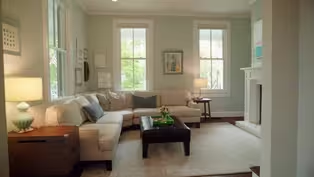
A Detached Home in Mount Pleasant -- In More Ways Than One
Video has Closed Captions
Clip: S2 Ep7 | 6m 50s | A beautiful blend of historic charm and modern luxury -- and a quirky backstory. (6m 50s)
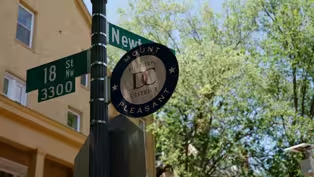
The Heart of Washington's Latino Community
Video has Closed Captions
Clip: S2 Ep7 | 4m 48s | Mount Pleasant's small community feel helped attract thousands of immigrants in the 1980s. (4m 48s)
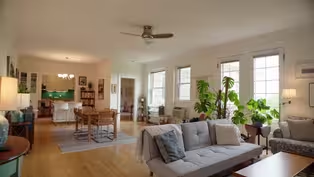
"Open Concept Before There Was Open Concept"
Video has Closed Captions
Clip: S2 Ep7 | 5m 23s | This 2 bedroom condo on 16th St, NW was "open concept before there was open concept." (5m 23s)
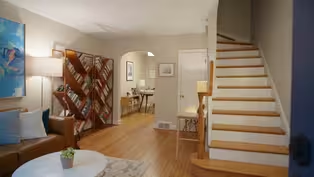
The Outdoors Are Not Lost When You Come Inside
Video has Closed Captions
Clip: S2 Ep7 | 5m 41s | Windows open up the cozy space, and a back garden back feels like part of Rock Creek Park. (5m 41s)
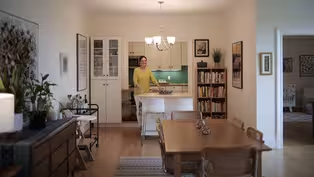
Preview: S2 Ep7 | 30s | Explore Mount Pleasant, where architectural beauty blends with a deep sense of community. (30s)
Providing Support for PBS.org
Learn Moreabout PBS online sponsorship













Support for PBS provided by:
If You Lived Here is a local public television program presented by WETA