
Mountain Dulcimer, Verna Mae Slone, Kentucky Is Cave Country
Season 31 Episode 15 | 26mVideo has Closed Captions
Learn about the history of the mountain dulcimer, Verna Mae Slone and Kentucky's karst system.
Learn about the history of the mountain dulcimer and its origins in Hindman, Kentucky; Verna Mae Slone led the charge for cultural preservation through Eastern Kentucky; and beneath Kentucky's rolling hills lies a vast and fragile world of caves and karst systems.
Problems playing video? | Closed Captioning Feedback
Problems playing video? | Closed Captioning Feedback
Kentucky Life is a local public television program presented by KET
You give every Kentuckian the opportunity to explore new ideas and new worlds through KET. Visit the Kentucky Life website.
Mountain Dulcimer, Verna Mae Slone, Kentucky Is Cave Country
Season 31 Episode 15 | 26mVideo has Closed Captions
Learn about the history of the mountain dulcimer and its origins in Hindman, Kentucky; Verna Mae Slone led the charge for cultural preservation through Eastern Kentucky; and beneath Kentucky's rolling hills lies a vast and fragile world of caves and karst systems.
Problems playing video? | Closed Captioning Feedback
Where to Watch Kentucky Life
Kentucky Life is available to stream on pbs.org and the PBS app.
Providing Support for PBS.org
Learn Moreabout PBS online sponsorshipProduction of Kentucky Life is made possible in part by the KET Millennium Fund.
Coming up on Kentucky Life, we'll look at the official state music instrument, the dulcimer, and how it so perfectly captures the sounds of Appalachia.
We'll introduce you to Verna Mae Slone, a writer known as the Grandmother Moses of the Mountains.
We'll show you around the setting for this week's show, Fort Boonesborough in Richmond.
And we'll explore the hidden underground world of the bluegrass that could be right under your own feet.
All that's next on Kentucky Life.
[music playing] Hey folks, and welcome to Kentucky Life.
I'm your host, Chip Polston.
It's good to see you again.
Welcome to Fort Boonesborough State Park, just outside Richmond, Kentucky.
Now, we're here in the offseason, but from April through October every year, you can visit to get a sense of what life was like on the frontier that came to be our state.
The original site of the fort was about a half mile from here, closer to the Kentucky River.
There, in the summer of 1775, Boonesborough consisted of 26 one-story log cabins laid out in a rectangle.
At each of the four corners was a blockhouse with a second story on top, used to fire down on anyone who may attack.
It really is quite a story, and we look forward to exploring more of the fort a little later in our show.
But first, the sweet sound of the Appalachian dulcimer is so ingrained in Kentucky's history that in 2001 it was officially recognized as our state musical instrument.
Now, it came to the bluegrass as an adaptation of stringed instruments used by German, French, and Swedish immigrants.
And the music it's used to make does indeed capture the sweet sounds of Kentucky.
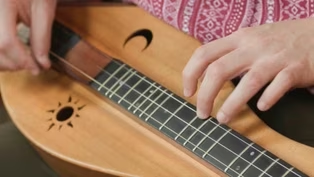
[dulcimer playing] [dulcimer playing] So the mountain dulcimer was born of the melding of different cultures here in the Appalachian Mountains.
And so when folks started immigrating to the mountains and settling the region, moving westward through the Cumberland Gap, they didn't necessarily bring these instruments with them, but they brought the ideas of these instruments and the knowledge of how to build them.
[dulcimer playing] So the dulcimer was born from recreating these more complex European instruments with the tools that immigrants had at the time.
So, early dulcimers were made just from scrap wood, wood that wasn't going to be used for anything else, and fence staples, old wire and things people had laying around.
[dulcimer playing] As people started to get settled and they got households established, here on the frontier, several makers started to develop more articulated musical instruments.
Ed Thomas was an innovator, and he developed this dulcimer that was very much like a violin in the way it was constructed, whereas most of the things that were made on the frontier were pretty bulky.
People just knocked together boards and said, “Oh, here's a dulcimer.
You can play this.” But Ed defined this lovely, long, elegant shape, which we reproduce today.
So he traveled and sold his instrument, and either he would put them on a string on his back and cross the mountains, or he had a little cart that he would push along and sell, and he'd stop and play for people.
Some people would buy them in installments, $8 a dulcimer, and $1 installments, [chuckles] $1 a month.
One of the people who bought one was the Ritchie family, and Jean Ritchie was one of the children.
And Jean Ritchie is pivotal in almost every story we tell about the history of the mountain dulcimer, because she took instruments that were made right here by the people that we talked about and went to New York to teach at a settlement school in New York in the late 1940s.
With these songs from the mountains, these instruments from the mountains, and of course, her sweet personality, she just took the folk music scene up there by storm.
Ever since the folk revival in the ‘60s and '70s, the dulcimer has experienced a boom in popularity, and there's more people playing the mountain dulcimer today than there ever has been.
And I think the accessibility of it makes it so popular.
It's an easy instrument for people to come to that have never played music ever before in their life.
[playing dulcimer together] It's a really exciting time to be a dulcimer player because it's such a new instrument.
It's truly an American instrument.
It was born in America, and America as a nation is pretty young in terms of the vast scale of musical history.
So we do have a rich well of tradition to draw from, but that tradition is not as long as fiddle playing or guitar playing or banjo playing.
So the history just isn't as long.
And so part of the joy of playing dulcimer is innovating it into new directions and new spaces.
So there's all kinds of people doing amazing things with the instrument, playing electric dulcimers, playing chromatic dulcimers, sort of exploring everything that this little instrument can do.
♪ If I had no horse to ride ♪ I█d be soon found a crawlin' ♪ Up and down this rocky road ♪ Lookin' for my darlin' ♪ Swing and turn, Jubilee ♪ Live and learn, Jubilee ♪ Swing and turn, Jubilee ♪ Live and learn, Jubilee It's been well said that no people are truly lost who have not lost the story of themselves.
And in the telling of the story of ourselves, the mountain dulcimer is key.
And the story of who the mountain people are is wrapped up in the mountain dulcimer and the music that's been played in it.
It's the soundtrack for the lives of many of our ancestors, generation and generations of people who know and play the dulcimer, as they call it down here.
And it's part of home.
♪ Swing and turn, Jubilee ♪ Live and learn, Jubilee ♪ Swing and turn, Jubilee ♪ Live and learn, Jubilee [dulcimer playing] ♪ Swing and turn, Jubilee ♪ Live and learn, Jubilee ♪ Swing and turn, Jubilee ♪ Live and learn, Jubilee In many Appalachian communities, history lives beyond textbooks, in kitchens, on front porches, and community gatherings.
In eastern Kentucky, one woman led the charge for cultural preservation, earning the nickname Grandmother Moses of the Mountains.
Let's meet Verna Mae Slone.
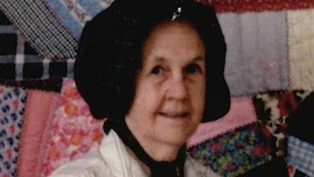
[music playing] [music playing] [music playing] Born in Knott County in 1914, Verna Mae Slone was raised by her father in a one-room log house.
After losing her mother to illness as an infant, her world became one of devotion and responsibility.
She left school in the eighth grade to care for her younger siblings while her father worked at the local post office.
From these humble beginnings grew a story of resilience and love, one that would become a lasting memento of Appalachian culture.
She grew up hard.
She grew up in a simpler time.
She grew up very close to her family.
And you would be close to your family if you lived in such a small quarter.
A lot of the people here struggled to survive.
People didn't have a lot of hope.
And so they had to find their joy wherever they could.
And that's where she enters the building.
In 1979, at the age of 65, she published her first book, What My Heart Wants to Tell, a collection of essays shaped by her experiences in the hills around Caney Creek, Kentucky.
The book offered a deeply personal account of Appalachian life.
A lot of it is just passed down memories of her father, of her sisters, of their parents, everything that she could tell to her kids and her grandkids because she wanted to have that living narrative.
I think she had great pride in being a great storyteller, which she was.
And so when she originally made the book, she made 100 copies of that book.
And one of them so happened to make its way out of Caney Creek.
She wanted to just write a memoir of her dad to leave for actually her grandkids.
Her life was around family, being proud of your family and where you came from, and that hard work never killed you.
Because I didn't want them to read what has been written about us mountain people, and believe that that was the way it was really wrong because it wasn't like that at all.
They've just written so many lies about us and told so many things that were not true.
And so I thought I'd write this and write the history of my father's life and the way the folks really did live.
And they didn't have very much money because they didn't need money.
When a publisher heard an excerpt of her book being read on local radio, she became one of Appalachia's most widely read voices, putting out an additional five books.
She quickly gained national attention for her portrayal of mountain life and was given the nickname the Grandmother Moses of the Mountains.
Her books have been embraced by scholars and educators all over the world for their historical significance and contribution to Appalachian studies, they are still being studied in universities today.
For Verna, writing was an act of resistance, but also an act of love for her community.
She was a rebel.
She was a trailblazer.
She was a renegade.
She did not care what other people thought.
And a true artist or a true folk artist does not care what other people think.
They just want to get what's inside of them out of them, and art is an expression of that.
She wanted to dispel the hillbilly image, and she had a wit about her that she could poke fun with her writing and get by with it.
So many lies and half-truths have been written about us, the mountain people, that folks from other states have formed an image of a gun-toting, backer-spitting, whiskey-drinking, barefooted, foolish hillbilly that never existed, but was conceived and born in the minds of the people who have written such things as Stay on, Stranger!
and Beverly Hillbillies.
[laughs] And they were not like that at all.
A lot of her inspiration was the kinship and the community of Caney Creek.
It was a small community, and she was really close-knit with a lot of the people located there.
She captured the richness of Appalachian English, documenting expressions and meanings that she grew up hearing on front porches.
One of her books is about just the meaning of our slang words, and I got a kick out of it.
She would give, like, 18 different ways to use the word mind in a sentence.
Mind your manners, mind your business, I have no mind, you know.
She wanted to preserve that dialect.
One thing the outsiders did not seem to realize was that they sounded just as different to us as we do to them.
We could understand them better than they could us because we have so many quaint expressions that are meaningless to anyone else but ourselves.
She played a part in preserving the dialect as a cultural record.
She also created a cultural record of her family.
Once I started reading, I couldn't lay it down because it's my family and it was my heritage.
She didn't realize, and I don't think any of us realized that she was so gifted, an author.
Long before her words were bound into books, her hands were already at work.
Throughout her life, she hand-sewed and stitched thousands of quilts and dolls, honoring the people and traditions that shaped her life.
They would have to make things their self.
So she started making her quilts, and she had a lot to say.
And one way that she could get her point across or to tell a story was through her quilting.
So every quilt told a story.
She said once you were born, you were given a group of scraps.
So those scraps you'd piece together, and that's how she would make her quilts.
Her deep belief in the arts and education were her tools for bringing joy to others.
She wanted to be the one to bring the light, and she expressed that through her dolls because she said that she would always put a smiley face on the dolls because she wanted kids to feel happy.
She wanted people to feel happy when they saw them.
Verna Mae believed that everyday lives were worth honoring.
Her book, What My Heart Wants to Tell, put those lives on the page.
That is what makes her books stand out from anybody because they give you a strength that you have inside, but you didn't know how to bring it out.
She knew that we had intelligent people here and people that were worth listening to, but they only needed a voice, and I think she wanted to be that voice.
She instilled in us the fact that we were as good as anybody, but better than nobody.
In the book, I said God knew that it would take brave and sturdy people to survive in these beautiful but rugged hills, and so He sent us His very strongest men and women, people who could endure life and search out the few pleasures that were contained in a life of hard work and toil.
They were enduring people who did not whimper and complain because their burdens were heavy, but they loved each other and lived closer to God and nature than any folks anywhere.
[music playing] Kentucky is known around the world as the Bluegrass State, but it can also be known as cave country.
Beneath our feet stretches a vast network of limestone passages, carved by water over millions of years.
Let's explore the hidden world of Kentucky's caves and karst landscapes and why protecting them matters to us all.
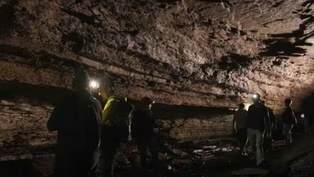
[music playing] [music playing] Kentucky is cave country.
It is one of the most famous cave regions in the world.
It hosts Mammoth Cave, for example, the longest cave in the world.
[music playing] There's roughly about 5,000 named and documented caves throughout the state of Kentucky.
I'm actually expecting there to be about 10,000 caves throughout the state that aren't known about.
[music playing] And I think coming into these caves really puts in perspective, “Oh, this is what's underneath most of Kentucky.
This is what I'm living on top of, and I'm not aware of it.” It's invisible to most people.
The cave country is known as karst to geologists because it has certain characteristics that distinguish it from other types of landscapes.
These would be the presence, for example, of sinkholes, sinking streams, natural springs bursting out of the ground, and, of course, the caves that people love to explore.
This is built up limestone from roughly the Mississippian era, so about 300 to 360 million years ago.
And what happened was there was a very warm, shallow ocean that was throughout this part of Kentucky.
And with those warm temperatures and the shallow marine conditions, this was a perfect environment for the precipitation of calcium carbonate out of the seawater and deposition as limestone bedrock.
And this is the material that the caves of Kentucky have formed in.
[music playing] Karstification is whenever rainwater outside mixes with carbon dioxide (CO2) and makes something called carbonic acid.
It goes through the limestone that's underneath us, and limestone's pretty unique because it has little pores in it.
So, that carbonic acid travels through the limestone, goes down underneath us, and expands upon these caves that we have.
And so these crevices over time get wider and wider, creating a network of groundwater flow pathways that take water from the surface, move it through the bedrock, and discharge at springs later.
[birds chirping] When you go to McConnell Springs, you have the Blue Hole, which is this gorgeous blue pond.
And what you don't know about it, you can't tell just looking at it, but underneath it, there's a hidden passage, a sinking spring, that goes into it.
And that's why it has that unique blue color to it.
You walk a little further up the trails on McConnell Springs, you'll actually see a karst window.
So there's a little opening in the limestone that kind of gives you an example of what it looks like normally underground.
You'll see the water going through it, and then it goes back underground and comes up at the boils, where you'll see boiling water in this creek bed.
McConnell Springs educates people really wonderfully on these karst systems, especially in the bluegrass.
[music playing] Now, the presence of karst across Kentucky is really dependent upon the geology, and Kentucky has a rather interesting geologic pattern.
Right in the center, which is the inner Bluegrass region, we have the oldest bedrock in the state.
And if we move outward from that and into what's called the Mississippian Plateau or the Pennyroyal region, that is a limestone that is much younger, as much as 150 million years younger than the Ordovician-era limestones of the Bluegrass.
The bedrock tends to be rather thinly bedded.
And so the caves that form here don't get as large as they do out in the Mississippian Plateau region, where the limestones are very massive, very thickly bedded, and have very extensive sequences.
So that's where we find gigantic caves like Mammoth Cave forming in limestones of that type in the Mississippi area.
Slack's Cave, which is located in Scott County, is one of the longest caves in the inner Bluegrass region.
Since the limestones are thinner here, caves don't tend to get as big as they do elsewhere in the state, but this is one of the biggest caves, and it's certainly one of the ones that's been known the longest.
[music playing] The Bluegrass Grotto is a chapter of the National Speleological Society that was founded back in the early 1960s by a group of biologists at the University of Kentucky.
So, among the priorities in the grotto has always been the study of the organisms, and in particular, to find ways to minimize the ecological impact upon these very fragile systems.
In some of the larger cave systems, you're going to find a lot of organisms that are very specialized to live in a cave environment.
So I always love to talk about bats.
They're my favorite.
There are 16 native bats to the state of Kentucky, and they rely on these cave systems for their hibernation or their torpor periods, which is similar to hibernation.
But they're going into these caves and utilizing them to sleep for several months in the wintertime and protect them from these harsh winter conditions.
You have crayfish, or what some people call crawdads.
They have no pigmentation to them and no eyes whatsoever because caves are total natural darkness.
You don't need these adaptations over time.
They develop their other senses more acutely.
They may have long antennae that are sensitive to vibrations.
So we find many, many unique and fascinating organisms that live in caves and are able to survive in this relatively harsh environment.
Now, one of the reasons that we map caves, such as we did with Slack's Cave, is to understand how the passages relate to the surface.
And we do this for a number of reasons.
One is that it may help us discover other caves that might be hydrologically connected.
We also use groundwater tracing using nontoxic dyes to help determine those same patterns.
And all those are actions that are beneficial in a karst area to protect the quality of the water in a system.
[water flowing] The water supplies in karst are extremely vulnerable because there's no filtration, there's no purification of the water between the surface and what comes out of the spring somewhere.
Water goes into a sinkhole, and it carries anything that happens to be with it, goes right into the ground, follows the conduits underground, and discharges from a spring.
[birds chirping] [water flowing] You're going to find chemicals, pesticides, metals of various kinds; all of these can get into groundwater, whether we're talking about water flow in karst or in some other type of aquifer.
And all this does is put that material in somebody's water supply elsewhere.
[water dripping] Probably the best thing that casual visitors to any cave can do is to follow the basic mantra for cavers, which is to take nothing but pictures, leave nothing but footprints, and kill nothing but time.
It's such a unique experience.
You're walking through, and you're seeing millions of years of history built up in front of you.
And you don't get to see that all the time, but we're lucky enough to be in Kentucky, where you're probably within a two-hour drive of a commercial cave toward any point.
It really is one of the last frontiers of human endeavor.
[music playing] We hope you've enjoyed exploring Fort Boonesborough State Park with us on this week's show.
If you ever want to get a sense of what it was like to be a pioneer in Kentucky, this is the place to see.
It's amazing how our state grew from such humble beginnings.
And if you've never been here before, you really need to check it out.
Now, if you've enjoyed our show, be sure to like the Kentucky Life Facebook page and subscribe to the KET YouTube channel for more of what we like to call Kentucky Life Extras, where you'll have access to lots of other great videos.
Until next time, I'll leave you with this moment.
I'm Chip Polston, cherishing this Kentucky life.
[music playing] [music playing] [water dripping] [water dripping] [music playing] [music playing]
Video has Closed Captions
Clip: S31 Ep15 | 6m 3s | Learn about the history of the mountain dulcimer and its birthplace in Hindman, Kentucky. (6m 3s)
Video has Closed Captions
Clip: S31 Ep15 | 8m 24s | Follow cavers as they explore Kentucky’s karst terrain and work to protect its fragile ecosystems. (8m 24s)
The Life and Legacy of Verna Mae Slone
Video has Closed Captions
Clip: S31 Ep15 | 7m 59s | Meet the woman whom Eastern Kentuckians call the “Grandmother Moses of the Mountains”. (7m 59s)
Providing Support for PBS.org
Learn Moreabout PBS online sponsorship













Support for PBS provided by:
Kentucky Life is a local public television program presented by KET
You give every Kentuckian the opportunity to explore new ideas and new worlds through KET. Visit the Kentucky Life website.