
Mountain Journeys
Season 21 Episode 2 | 26m 46sVideo has Closed Captions
Explore popular mountain towns and destinations, including a renewable-energy art studio.
Explore popular mountain destinations, including a renewable-energy art studio in Dillsboro and a historic house museum in Haywood County. Also check out The Bluffs, the newly restored, home-style restaurant that first opened its doors on the Blue Ridge Parkway in 1949.
Problems playing video? | Closed Captioning Feedback
Problems playing video? | Closed Captioning Feedback
North Carolina Weekend is a local public television program presented by PBS NC
Mountain Journeys
Season 21 Episode 2 | 26m 46sVideo has Closed Captions
Explore popular mountain destinations, including a renewable-energy art studio in Dillsboro and a historic house museum in Haywood County. Also check out The Bluffs, the newly restored, home-style restaurant that first opened its doors on the Blue Ridge Parkway in 1949.
Problems playing video? | Closed Captioning Feedback
How to Watch North Carolina Weekend
North Carolina Weekend is available to stream on pbs.org and the free PBS App, available on iPhone, Apple TV, Android TV, Android smartphones, Amazon Fire TV, Amazon Fire Tablet, Roku, Samsung Smart TV, and Vizio.
Providing Support for PBS.org
Learn Moreabout PBS online sponsorship[upbeat music] - Next on "North Carolina Weekend," we'll go on some mountain journeys with an alpine coaster in Banner Elk, a green energy park in Jackson County, and a popular restaurant on the Blue Ridge Parkway.
Coming up next.
- [Commentator] Funding for North Carolina weekend is provided in part by Visit Nevada, dedicated to highlighting our state's natural scenic beauty, unique history, and diverse cultural attractions.
From the Blue Ridge and the Great Smoky Mountains, across the Piedmont ,to 300 miles of barrier island beaches, you're invited to experience all the adventure and charm our state has to offer.
[upbeat music] ♪ [upbeat music continues] - Welcome to "North Carolina Weekend," everyone.
I'm Deborah Holt Noel and this week we're taking some journeys through the mountains of North Carolina.
I'm in West Jefferson, a charming town in Ash County, that's a great place to explore.
It's got murals, a brewery, a vibrant downtown, and a legendary cheese factory.
We'll explore more of West Jefferson throughout the show, but first, let's head even farther west to Jackson County where an innovative group of creators and artists have developed a green energy park.
[light music] - All the pieces in here are made using renewable energy resources.
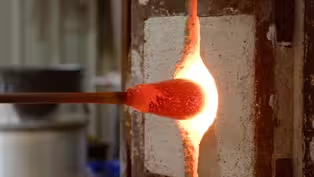
The Jackson County Green Energy Park is a count-led initiative to use various renewable energy resources to bring additional economic development to our community and then also to be able to offer very unique educational opportunities for everyone that wants to come out.
Our blacksmithing forges and our metal foundry are the only ones in the world that run on landfill gas.
Our glass furnaces are the only ones in the U.S. that run on landfill gas.
We destroy about 7,000 tons of methane a year.
It's equivalent to about taking a thousand cars off the road each and every year.
If we were burning propane here instead, we would probably go through $2,000 worth of propane a month just in the glass shop.
We have some amazing artists here at the Green Energy Park.
One young man, Cole Johnson, he was able to go over to study at the JamFactory in Adelaide Australia for two years there.
They only take four people a year out of the world for that scholarship.
He won that two years running.
- When I'm in the hot shop making my work, I'm in a way making a canvas, a blank canvas that I can take into the cold shop.
In Australia I did learn about how to use this specific piece of equipment.
The wheel spins and I hold the piece and I'm almost drawing on the piece with the carving wheel and carving through those layers of color to create pattern and design.
Brock's been on forge and fire.
Brock's an amazing blacksmith.
- Having this facility really allowed me to make a career of it.
The forging process is very gratifying 'cause you know, you're watching that whole thing take each hit, you can see what it's doing.
I've just always been fascinated by arms and armor.
My dad always drew these really elaborate like fantasy scenes with dragons and lawyers.
Just to be able to like create it and not just see it on paper is really cool.
[light music] - The first Saturday of every month at the Green Energy Park we have an open house and we have classes.
- Today is an ax making class, so they'll come in and learn how to make a traditional ax.
- Today I'm gonna just be having a class with people can just come and make a bud vase.
- You come in, it's one-on-one instruction with a professional glass blower.
Us as the instructors, we will do the gathering of the glass from the furnace, but the rest of the class is very hands-on.
You're doing blowing, you're doing shaping.
You're sitting at the bench working the glass with the hand tools.
You look at the numbers up there you can see just how hot this hole is.
- Is that 2100?
- Yeah.
- Both of the instructors, Judy and Josh were amazing, very calm voices and they were right there.
So I knew that I couldn't mess up because they were gonna be right there and fix anything that I was doing wrong.
- We need to really support the Jackson County Green Energy Park because of the way it operates.
- Initially the county here was told by several different entities that they could never do anything here.
That there wasn't enough gas to do anything with, that it wouldn't be profitable, that the gas was too poor quality, and we proved all of those things wrong.
You don't need to be limited by other people or other organizations telling you what will and won't work.
Everyone is welcome to come out here to the Green Energy Park, watch artists work, perhaps take a class, maybe buy a beautiful piece of artwork, or just come out here and learn something new.
- Jackson County Green Energy Park is at 100 Green Energy Park Road, in Dillsboro, and they're typically open Wednesday through Friday from 10:00 AM to 3:00 PM, but they do have special events on certain weekends.
To find out more, visit their website at jcgep.org.
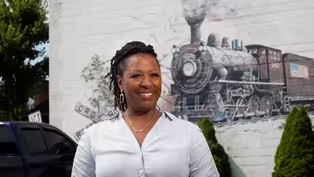
West Jefferson got its start as a train hub for the lumber industry and this old mural here really captures the spirit of that bygone era.
If you wanna move through the mountains at a higher rate of speed, I think we have just the vehicle for you.
Rob Holliday visited a mountain roller coaster in Banner Elk and he said it's quite the ride.
[rock music] - [Rob] There's a new way to make your way down the North Carolina mountains and this one doesn't involve skis, snowboards, or tires.
- Our track is 3,160 feet long, so a little over half a mile.
Pretty fast and lots of twists and turns.
Even though it's a quick ride, people have a great time doing it 'cause it's just, it's thrilling.
- [Rob] It is the Wilderness Run Alpine Coaster where sleds slide down a set of tracks built into the side of a mountain near Banner Elk.
Eric Bechard and his family opened Wilderness Run in 2020.
- [Eric] We wanted to build something that was good for the community, something that would be fun to come to work to, and it is, it's a joy, it's fun.
It's awesome to hear people laughing and kids having a great time.
- [Rob] The Alpine in the name is a nod to where the idea for the coaster came from.
Eric and his wife saw an alpine coaster during their travels in Europe and dreamed of building a version here in the States.
- By March, 2019, we were dragging steel up this hill and putting concrete in and started constructing our Wilderness Run Alpine Coaster here in the mountains of North Carolina.
- [Rob] The tracks are custom designed for the specific terrain where the coaster operates.
Accommodating the half mile of track on the Wilderness Run course comes with a real benefit.
- [Eric] To be able to squeeze that amount of track on this particular piece of property, we had to put in the 540 circle and then we have two 360s and a whole bunch of twists and turns.
- [Rob] It all begins at the bottom where a ski lift like cable pulls each sled up more than 200 feet to the top of the mountain.
- I liked the ride at the very top, the getting ready to go.
It's that buildup, the anticipation.
- That was my experience also.
The trip up to the top is not for the faint of heart, but the views are incredible and I think it's gonna be a pretty epic ride.
A ride powered by gravity which takes over when the cable releases from each sled at the top of the mountain.
Woo!
- [Eric] The speed is we're set at around 26, 27 miles an hour, give or take.
- One of the nice things about this is that you actually can control your own coaster.
You push forward to go faster.
You pull back if you need to pull the brakes up, but you are in control of your own ride and that is nice.
- [Eric] Being able to control your own speed allows the person to have a whole different experience than when you're on a a roller coaster.
- And that may include a chance to take in both speed and scenery.
- I definitely like the wilderness surrounding, you're kind of in the woods, off the beaten path.
It's like nothing I've ever done before.
It's not like your big theme park rides.
- [Eric] We ask people not to stop unless there's an emergency because there are people coming around behind them.
There are safety mechanisms designed so people don't bump into each other.
- [Rob] A safety feature that helps make it possible for young riders to take to the tracks.
- If you got a little one, the little one can ride with the parent or you know, if you got older children they get to drive it on their own, enjoy it, and be able to go the speed they want, you know, as fast as they want.
It's just a really good place for the, you know, a family to share a time together and have fun.
- [Rob] To help spread crowds evenly, Wilderness Run asks visitors to sign up for a check-in time online before they come to ride.
- Most people will get their three ride bundle and ride all three rides consecutively.
They just stay on the sleds.
We don't make people get off the sleds and get back in line.
They can just stay on the sled and ride all three rides if they choose.
- [Rob] And when those rides are done, there will soon be another activity available.
Wilderness Run is building an adventure course next door to the coaster.
- It's very fulfilling to know that we built something that people will enjoy.
We want people, families, individuals, couples to come up here and enjoy the mountains more than once.
There are a lot of wonderful things to do in this part of North Carolina.
- The Wilderness Run Alpine Coaster is at 3265 Tynecastle Highway in Banner Elk and it's open every day.
For more information, visit their website at wildernessrunalpinecoaster.com.
If you're a history buff, we've got just the mountain destination for you.
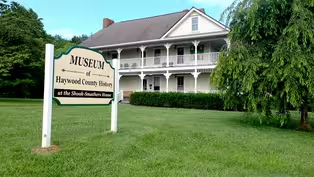
The Shook-Smathers House is the oldest standing frame house in the mountains.
Theresa Linsky paid it a visit and discovered lots of other treasures in Haywood County too.
[light music] - Welcome to the Museum of Haywood County history at the Shook-Smathers House.
- [Theresa] It's a home whose story is a lesson in much of our nation's late 18th and 19th century history.
- It is the oldest frame house in all of western North Carolina - [Theresa] Built by a man named Jacob Shook from Burke County in 1795.
- Jacob Shook was my third great-grandfather on my dad's side.
- [Theresa] Where the home was built in Haywood County was crucial to our victory over the British.
- If you go to the Revolutionary War, it was the western front.
- [Theresa] That campaign was called Rutherford Trace where Patriots like Jacob fought against Native Americans who had sided with the British, but it didn't stop him from returning when the war was over.
- Was familiar with the territory and came back and settled here.
- So this is the Shook Room, it's the oldest room of the house.
We profile in this room various members of the Shook family and their contributions.
- [Theresa] That would involve their support of Methodism.
By all accounts, shook was a religious man which made it fitting that a traveling circuit writer by the name of Bishop Francis Asbury, widely considered the father of American Methodism, spent the night here.
- In Francis Asbury's journals in November 30th, 1810, he wrote, "After crossing many streams and losing ourselves in the woods we finally arrived about nine o'clock to Vater Shuck's.
What an awful day."
- [Theresa] Asbury most likely spent the night in a third story room of the home, which Jacob then dedicated as a chapel.
- And that's where the Louisa Chapel, which is one of the first Methodist churches in the area was actually formed in 1798.
Here in this house.
- [Theresa] Jacob Shook died in the 1830s.
The house set empty until Levi Smathers bought it in 1851, and along with his children enlarged the home and brought about other changes.
We call this the Smathers room.
It was originally a dining room and all the embellishments were done by Levi Smather's son, Doc Smathers.
- [Theresa] And it was Levi Smathers who brought slaves here and their story is also a part of the home.
- Well, my great-great-grandmother, second great-grandmother Dorcas Smathers, was a slave in this house.
- [Theresa] Descendants of Dorcas and her husband, Henry, were drawn to the house and to finally learn about their ancestors and their history in this country.
- And I thought when I walked through the door, I could hear my grandmother say, "Child, you found me."
- Whatever part they play needs to be recognized and brought to light so that they get as much notoriety as they can get.
- And we need to know our history so we don't repeat our history.
- [Theresa] The last Smothers descendant to live in the home passed away in the 1980s.
After that, the house set empty for decades until a Shook descendant purchased, restored, and donated it to the Historical Society in 2011.
Today, the home's more than two century history, as well as that of the entire area, is on full display.
- [Francis] It's been known as the pride of Clyde.
For example, you'll see the military room and the quilting room.
- Where we feature women's work.
We have a Smathers' family spinning wheel.
- You'll see the industry room and a community's room that we have.
So it en captures more of the history of the entire county.
- [Gwen] And I said, well, when that happens I wanna be a part of it.
And told them I wanted to be a docent here.
And they asked me why.
I said, "Because my great-great-grandmother was a slave here."
- [Theresa] This one house touched the lives of many people throughout Western North Carolina and hopefully will continue to tell their collective stories for centuries to come.
- And that's good.
And we want the world to know.
[light music] - The Museum of Haywood County history at the Shook Smathers house is at 178 Morgan Street in Clyde.
For information and tours give the Haywood County Historical and Genealogical Society a call at 828-564-1044.
Check out this beautiful new mural here in West Jefferson.
It's by artist Whitney Landerman and it's truly inspirational.
And if art is your inspiration come along with Julia Carpenter as she explores Asheville's glass art scene.
[light music] - [Julia] Is that really glass?
It can make your head spin.
The Asheville Arts Glass and Craft scene is extensive and fun to explore.
- And go.
- [Julia] with over 100 glass artists in the area, Asheville has one of the South's largest glass and craft galleries.
A studio where you can sit back and watch the glass artists create right before your eyes and a studio where you can try glass blowing for yourself.
There are so many fascinating, beautiful, and fun ways to explore, looking, watching, and playing with glass in Asheville.
[light music] - People travel to the Asheville area just to see glass.
It's kind of a hotbed for the glass world.
The Studio Glass Movement started here several decades ago and so many of the artists that were involved with that effort settled in the Blue Ridge Mountains.
- [Julia] With 15,000 feet of exhibit space spanning three levels, the Blue Spiral 1 Gallery is one of the largest galleries of fine crafts in North Carolina.
They represent predominantly artists from the southeast of the United States.
- People come to Blue Spiral because they wanna see work.
A lot of times people treat this gallery as a museum.
They come just to stroll and to see things.
Here at Blue Spiral, we have several different kinds of glass methods, so you'll see work that is blown, you'll see work that is cast, you'll see work that is molded and carved, and you'll see work that is flame worked.
So every two months, the whole entire gallery space turns over and everything looks new.
And so we have a lot of returning clients and friends of the gallery that come every couple of months just to see what's new in the gallery or just to see a work of art that's changed place and is in different lighting in a new environment.
- We represent about every medium in art.
Everything from wood, ceramics, glass, metal, fiber, and paper.
We are a destination as an art gallery, especially in the Southeast.
We carry some of the most prolific and known artists in the region.
- [Julia] About a block away, you can watch glass artists at work.
[upbeat music] Here they create objects in every color of glass imaginable, from utilitarian bowls and vessels to light coverings and sculptures.
- Well, the Lexington Glassworks is one of downtown's only glassblowing studios.
In one location, you're able to witness and experience the arts, you're able to purchase and support the arts, and you're also able to try some of the local drops of Asheville that we have here.
- [Julia] In Asheville's River Arts District, there's a special open studio where you can just walk in off the street and try your hand at blowing glass.
- We're a collective community of artists.
We serve around 20 to 30 artists on a weekly basis who make work out of our studio.
We also offer educationn instructional classes everywhere from 30 minutes up to eight weeks.
But often, like this afternoon, you can come in and see somebody making something, fall in love with the material and try it for yourself.
- [Julia] Just three venues and infinite possibilities in our city of glass, Asheville.
- For a list of all the glass studios we visited and even more places, go to exploreasheville.com and look under stories.
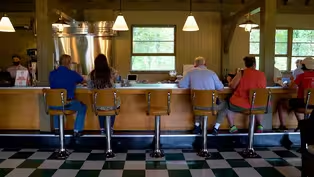
About 25 miles north of West Jefferson, the Bluffs became the first dining establishment to open on the Blue Ridge Parkway way back in 1949.
It closed in 2010, but with generous contributions, upgrades, and repairs, it's been restored to its historic glory plus delicious homestyle cooking.
[birds chirping] [light music] - The Bluffs is one of the crowning jewels of the Blue Ridge Parkway.
[light music] It opened in 1949 with a gas station next door which is now the Visitor's Center and Gift Shop.
The work project that the government created in the aftermath of the Great Depression with a slight delay during World War II.
Once it was completed, The Bluffs was the first restaurant to open on the Parkway.
My name is Cal Ledbetter and I'm the operator of The Bluffs restaurant.
[light music] - Tell me the significance of The Bluffs to you three sisters.
What is the significance?
- Our mother worked here in the sixties and seventies.
[light music] - Our parents would come to the park, especially on Sunday evening and have lunch under the trees.
[light music] - It's just a great way to get away from the city, the hustle bustle, and see a little bit about the country and the nature that is thriving up here and take pride in this magnificent Parkway.
469 miles and we're almost in the dead center, mile marker 241 in Dalton Park.
[light music] - My name is Merrick Francis and I'm one of the chefs here.
We produce a lot of very good authentic food for The Bluffs.
- [Cal] We have a fried chicken, which has been very popular.
It is the same fried chicken that's always been served here.
- No, the fried chicken can be a long process.
I use lemon juice to make sure I clean off all of that excess.
Then I use all my spices and marinate them for the next day.
And then when you fry it actually all the spice just combine.
See people enjoying food is a satisfaction to me.
[light music] - When the restaurant and the lodge closed at the end of the 2010 season, people were really disappointed.
[upbeat music] - Well, we knew it had been closed because they had closed the Parkway.
- [Cal] There was an outpouring of interest in the community to bring back the restaurant and the lodge and the Blue Ridge Parkway Foundation led the call to raise money in the community.
- There started to be a groundswell of interest of trying to find some other way of reopening that citizen activation helped get a funding grant from the Appalachian Regional Commission, as well as the North Carolina General Assembly.
Altogether, the foundation and all the partners and communities have raised about a million dollars.
- I remember when this place wasn't occupied and when they started fixing it up, it was really exciting.
We'd stop by just to look in the windows and see how pretty it was turning out.
Whenever we get company or anything we always bring them up here and they always love it.
- You feel that sense of the people who in many cases built the building, you know their great-grandfather or their grandfather had a hand in building the trails and the steps that were standing on.
It wasn't just a physical restoration.
I've had more people comment on the fried chicken or the biscuits because we're not only serving the people who remember it as it was, but we're trying to recreate those memories for people who are here for their very first time.
- It's great to see people just enjoying themselves and going back in time or making new memories because here there's nothing but beauty around you everywhere you look.
- The Bluffs is at 45338 Blue Ridge Parkway in Laurel Springs and they're open Wednesday through Sunday.
For more information, give them a call at 336-372-7875 or visit them online at bluffsrestaurant.org.
People have flocked to Ash County Cheese for more than 75 years so we thought it would be the perfect place to wrap our mountain journey.
We've had a wonderful time here in West Jefferson.
It's truly a charming town.
Well worth the visit.
And if you've missed anything in today's show just remember you can always watch us again online at pbsnc.org or on our YouTube channel.
Have a great "North Carolina Weekend," everyone.
[light music] [light music continues] [light music continues] [light music continues] [light music continues] [light music continues] - [Commentator] Funding for "North Carolina Weekend" is provided in part by Visit NC, dedicated to highlighting our state's natural scenic beauty, unique history, and diverse cultural attractions.
From the Blue Ridge and the Great Smoky Mountains, across the Piedmont, to 300 miles of barrier island beaches, you're invited to experience all the adventure and charm our state has to offer.
[light music]
Video has Closed Captions
Clip: S21 Ep2 | 4m 44s | The Bluffs, the first restaurant on the Blue Ridge Parkway, has re-opened. (4m 44s)
Jackson County Green Energy Park
Video has Closed Captions
Clip: S21 Ep2 | 4m 33s | Check out an energy park that uses captured methane gas to create art. (4m 33s)
Preview: S21 Ep2 | 20s | Explore popular mountain towns and destinations, including a renewable energy art studio. (20s)
Video has Closed Captions
Clip: S21 Ep2 | 4m 48s | Built around 1795, the Shook-Smathers House is the oldest frame-built house in WNC. (4m 48s)
Providing Support for PBS.org
Learn Moreabout PBS online sponsorship













Support for PBS provided by:
North Carolina Weekend is a local public television program presented by PBS NC