
MPC 2024, AI in the workforce, Memorial Day, Weekend events
Season 8 Episode 47 | 26m 46sVideo has Closed Captions
2024 Mackinac Policy Conference, AI in the workforce, Memorial Day and upcoming events.
Detroit Regional Chamber President and CEO Sandy Baruah and conference chair Suzanne Shank preview the 2024 Mackinac Policy Conference. Workforce Intelligence Network Senior Economic Research Analyst Kevin Cranick talks about AI’s impact on Michigan’s workforce. Local veterans share what Memorial Day means to them and how they honor it. Plus, upcoming events on “One Detroit Weekend.”
Problems playing video? | Closed Captioning Feedback
Problems playing video? | Closed Captioning Feedback
One Detroit is a local public television program presented by Detroit PBS
MPC 2024, AI in the workforce, Memorial Day, Weekend events
Season 8 Episode 47 | 26m 46sVideo has Closed Captions
Detroit Regional Chamber President and CEO Sandy Baruah and conference chair Suzanne Shank preview the 2024 Mackinac Policy Conference. Workforce Intelligence Network Senior Economic Research Analyst Kevin Cranick talks about AI’s impact on Michigan’s workforce. Local veterans share what Memorial Day means to them and how they honor it. Plus, upcoming events on “One Detroit Weekend.”
Problems playing video? | Closed Captioning Feedback
How to Watch One Detroit
One Detroit is available to stream on pbs.org and the free PBS App, available on iPhone, Apple TV, Android TV, Android smartphones, Amazon Fire TV, Amazon Fire Tablet, Roku, Samsung Smart TV, and Vizio.
Providing Support for PBS.org
Learn Moreabout PBS online sponsorship- [Will] Coming up on "One Detroit," we'll get a preview of this year's Mackinac Policy Conference from Detroit Regional Chamber CEO Sandy Baruah and Conference Chair Suzanne Shank.
Plus, we'll have a Future of Work report on what to expect as artificial intelligence begins to show up in the workplace.
Also ahead, three US military veterans talk about the importance of Memorial Day.
And we'll tell you all about the events in Metro Detroit over the holiday weekend.
It's all coming up next on "One Detroit."
- [Announcer] From Delta faucets to Behr paint, Masco Corporation is proud to deliver products that enhance the way consumers all over the world experience and enjoy their living spaces.
Masco, serving Michigan communities since 1929.
Support also provided by the Cynthia and Edsel Ford Fund for Journalism at Detroit PBS.
- [Announcer] DTE Foundation is a proud sponsor of Detroit PBS.
Among the state's largest foundations committed to Michigan-focused giving, we support organizations that are doing exceptional work in our state.
Learn more at dtefoundation.com.
- [Announcer] Nissan Foundation, and viewers like you.
(upbeat music) - [Will] Just ahead on "One Detroit", our Future of Work initiative looks at how artificial intelligence may affect employees in the workplace.
Plus, in honor of Memorial Day, a group of veterans talk about their military experiences and honoring their fallen comrades.
And Cecelia Sharpe and Dave Wagner of 90.9 WRCJ share some ideas on how you can spend the long holiday weekend.
But first up, the Detroit Regional Chamber's annual Mackinac Policy Conference takes place next week.
Hundreds of business, policy, and community leaders will gather on Mackinac Island for important conversations on issues facing the state.
This year's focus is on bridging the Future together.
"One Detroit" contributor Zoe Clark from Michigan Public got a preview from Chamber President and CEO Sandy Baruah And conference chair Suzanne Shank, president and CEO of Siebert Williams Shank and Company.
(upbeat music) - For those who are unfamiliar about the conference, Sandy, I'm gonna start with you, what's it all about?
- So the Mackinac Policy Conference is a 40 plus year tradition, and the Detroit Regional Chamber just happens to be the stewards of this wonderful statewide convening.
It is Michigan's center stage.
It is Michigan's annual and largest convening of leaders, not just corporate, but political, civic, and philanthropic.
And the whole concept from day one of the conference has always been to take a look at where Michigan needs to go.
And over the years, a lot of big things have happened there, including the Gordy Howe International Crossing, the signing of auto reform.
So a lot of big things have happened there, and we're excited to see what happens this year.
- So Suzanne, as Chair of the conference, you are fundamentally a part of the theme, which of course is bridging the future together this year.
What does that mean to you?
What does that look like?
- For me, I started my first career as a civil engineer.
Many people don't know that.
And so I've always loved bridges, but I also love what they represent, and it really means collaboration, working together towards a common goal.
I think you have to build bridges to really spur innovation and results.
So for me it means it's the foundation of our ability to move the state forward.
- 2024 of course is a presidential election year.
I'm curious what it means to be able to bridge community together and what feels like such polarizing times.
- That was a big part of why I really wanted to pitch that theme as well.
Because it's an election year, we're gonna have lots of politicians on the island.
So I'm hoping they're gonna really lean in and hear how business leaders, philanthropic leaders, and others are thinking about working together.
I mean, look at our state.
We have so many fabulous examples of different parties and groups coming together to make big things happen.
Henry Ford Health System development, Michigan Central Station, even Bedrock and GM coming together to keep GM downtown.
I mean, these are perfect examples that we need our legislative body and politicians to recognize we have to do it together.
We can't be divisive.
- In Michigan, as we talk about moving the state forward, leaning into moving the state forward.
Last year we talked a lot about population growth.
I'm curious what you think that kind of resonating topic is going to be coming out of the conference after everyone leaves.
The sort of goal that you want people to take away from Mackinac Island, Suzanne, once they're back downstate.
- I want them to realize that we have more in common than we disagree upon.
We all want great schools.
We all want safe communities.
We want our businesses to prosper.
We want talent that is ready to work and move our businesses forward.
I'm hoping they realize that and then we focus on solutions.
That's really my hope, I hope everybody comes back energized and motivated to work together.
- And Sandy, how might that motivation affect folks in southeast Michigan particularly when they get back?
- Well really, just to expand on what Suzanne said, this is really about answering the question, what is it going to take to grow our population and retain, especially our young high flying talent.
And if you frame the question that way, and not in a political sense, there's some pretty obvious solutions about innovation and entrepreneurship, educational achievement, the value of a two year degree, four year degree, or even a skilled certificate.
I mean, these are the kinds of things that Democrats and Republicans should be rallying around.
These are the things that the civic community, the business community, and the philanthropic community should be rallying around.
And what we need to do is once we recognize that these are the solutions, let's get aligned.
Because there's too much of this happening here and this happening here.
The conference brings people together.
- So folks at home can watch the conference via Detroit PBS and all the "One Detroit" coverage.
So not to miss anything, but Suzanne, of course, as Chair, I have to ask you, what are you most looking forward to?
- That's a tough question because we have so much rich content, but I hope everyone will tune in for Secretary Raimondo, the Commerce Secretary will be speaking, and the Commerce Department's mission is to spur good-paying jobs, empower entrepreneurs, and make American businesses more competitive.
Well we need all of that right here in Michigan.
So I think that will be a key session.
- Sandy, you gonna choose a favorite?
- Yeah, so just very quickly, I would say Secretary Raimondo is a highlight for me as well.
I served as the Assistant Secretary of Commerce under President Bush and I've had the chance to spend the time with the current secretary, excited to welcome her to the conference.
Suzanne Clark, who serves as the CEO of the US Chamber.
Very excited to to have her.
Paul Ryan, who's gonna be interviewed by our friend Harold Ford Jr. And my personal favorite probably is gonna be Chuck Todd from NBC News.
- [Will] And you can watch live coverage of the Mackinac Policy Conference at onedetroitpbs.org beginning Tuesday, May 28th.
Plu, look for a special one hour episode of "One Detroit" from the conference on May 30th at 7:00 PM.
Let's turn now to our continuing coverage of the impact of artificial intelligence on the future of work.
There are a lot of questions about AI and its potential effect on employees, workplace productivity, and job loss.
I pose some of these questions about generative AI to Kevin Crannick, a Senior Research Analyst at the Workforce Intelligence Network.
(upbeat music) - Just to familiarize people, what is WIN?
What is the Workforce Intelligence Network?
- Yeah, the Workforce Intelligence Network is a collaborative between many community colleges and Michigan works agencies, primarily focused in southeast Michigan.
The current WIN coverage map includes 19 counties in Michigan, which I believe comprise around 65% of the total labor force in the state of Michigan.
So we have a lot of eyes and ears on the ground in terms of what's happening with workforce development, what opportunities there are in terms of training workers, upskilling workers, and getting people ready for not only the current jobs that are out there, but also the jobs that are on the horizon.
- Give us little insight into why WIN decided to start looking seriously at artificial intelligence and how that's gonna be impacting the workforce.
- When you look at the rate of adoption for generative AI, and in particular, for this example, ChatGPT, I think it was just a matter of nobody wants to be last.
So we had some discussions internally at the Workforce Intelligence Network about how we can leverage AI, how we can best start to learn and understand and be able to utilize those outputs and the tool itself.
- Take us through what the findings were when it comes to whether or not layoffs should be a real concern or how that's going to work.
- When researchers start to measure the impact of AI, the challenge is going to be how do you differentiate the job losses due to AI compared with job losses that would have occurred anyways due to other economic indicators.
But in terms of whether people should expect layoffs due to generative AI, I think there's actually very little reason for concern for layoffs due specifically to generative AI tools.
And going back to the research that Goldman Sachs published, a lot of these programs are going to influence occupations in terms of net productivity, but they're incapable, they're not purpose-built to replace an employee.
What I think should also be part of the conversation is how many of these businesses will take those productivity gains and re-leverage the freed employee time to create new revenue streams or enhance revenue opportunities.
- Explain a little bit about why DEI would be an important thing to keep in mind as time grows, as AI becomes more ubiquitous.
- So when we looked at the diversity, equity, and inclusion outcomes of generative AI, and keeping in mind that this is all still very, very new.
I mean, generative AI itself has only been publicly available en masse less than 24 months.
One of the very early findings already is when researchers started to look at what is the demographic makeup of these occupation groups and these industries that are going to be most impacted by generative AI, they are disproportionately women-dominant.
So when you consider that generative AI is going to most heavily impact white collar jobs, extrapolating those two facts, that generative AI will disproportionately impact white collar jobs, and that white collar jobs are predominantly female, then you start to see that there's going to be a disparate impact on women due to generative AI.
Employers can try and get in front of this and begin instituting policies at the individual employer level to just try and maintain some semblance of fairness in the workplace and representativeness in the workplace, such that generative AI doesn't displace workers en masse from any particular demographic.
- If you're someone in a white collar job who might feel like they might be impacted by AI in the coming five to 10 years, from your perspective, from the data that you guys are seeing, how should they approach this wave of technological advancement we're going through?
- I think just starting to dip your toes in the water of generative AI.
Feel free to play around with one of the programs, one of the many free programs that are available to the public.
Google has one now, it's Google Gemini.
Meta just announced that they have one that's publicly available.
There's still ChatGPT.
The Workforce Intelligence Network is currently using Microsoft Copilot and learning how to use integrated AI tools.
So there's so much that you can learn, but it's a matter of taking that first step.
- If you're a student, if you're either starting college and you're looking at what you might want to go into, if you are exiting college and you're entering the workforce, or if you're just a young person who's getting started in the workforce, what advice would you give to them?
Maybe somebody who doesn't have a decade's worth of experience under their belt already.
- When I started using ChatGPT myself, I thought, well let's play around with this.
Let's see what it's capable of producing when I prompt it to give me an SEO-optimized blog post and I hand feed it some of these keywords, it was able to do so.
But it's because I knew what SEO optimized meant.
So I knew what the end goal was.
I knew that keywords was a very important part of producing content that would get clicks.
So having that domain-level knowledge is imperative for being able to even meet the entry cost for utilizing generative AI to any meaningful degree.
Generative AI should take a backseat to the career aspirations that you have in terms of subject matter.
If you have subject matter expertise first, generative AI will enhance that.
But subject matter has to come first.
- [Will] You can see more of our coverage on AI and the future of work at onedetroitpbs.org.
The Memorial Day holiday is coming up on Monday.
It's a time to recognize the men and women who gave their lives while serving our country.
"One Detroit" contributor Bryce Huffman sat down with three military veterans for a frank conversation about what the holiday means to them.
(upbeat music) - Since 1868, Memorial Day has been a time to honor fallen soldiers from every branch of the US military.
At the VFW or Veterans of Foreign Wars Post in Royal Oak, we sat down with three veterans to talk about how each of them commemorates the holiday.
So Houston, tell me again, how did you begin serving?
- How did you begin serving in the Army?
- I began to serve in the Army in 1943 when they drafted me.
- This is Houston Pritchett, a 103-year-old World War II veteran, and his daughter, Deborah.
Pritchett is hard of hearing.
So his daughter helped relay my questions.
To his left are Mike Sand and Phillip Smith.
Both are Vietnam veterans.
And Mike, how did you begin serving?
- I was drafted, and rather than be drafted, I enlisted in the Air Force for four years as opposed to two.
- All right, how about you, Phil?
- The draft was going on.
My neighbor or friend of mine came to my door, knocked on it and said, "What are you doing?"
I says, "We're going to work."
He said, "No you're not.
Let's go down to the Marine Corps and join."
And I did.
- So tell me, when you first joined, how did friends and relatives respond to that?
- Friends and relatives didn't respond too good when I first went in the Army.
They were kind of upset.
- Why is that?
- I never did get around to figuring that out because I was scared about going.
- And when you joined, what did people think in your life?
- Well, of course the '60s was a difficult time.
You had the Peaceniks and the Patriots.
And my father was World War II.
My uncles were Korea.
And I felt it was my obligation to serve.
And I figured if I was gonna serve, I'd gain something out of it.
So the Air Force was kind enough to accept me and a lot of my friends.
I was kind of drafted when the war was really picking up, 1967.
And I had been dating my high school sweetheart for two and a half years.
And rather than be drafted, I joined.
So I said, "I won't be back for four years.
Do you think we should get married?"
And before I said married, she said yes.
So we married right out of high school and spent four years together in the military.
- Nice.
And how about you, Phil?
How did people in your life respond?
- It's kind of funny because the recruiter thought I wasn't old enough, I wasn't 18 and I was, and he told me I had to get a signature from my parents to go in.
I said I'm already 18.
It doesn't matter, you don't look old enough.
So I got my stepfather to sign the paperwork.
My dad was already in the Army.
He was still in the Army.
He was a POW prior World War II, and he was proud.
He didn't think I would ever make it in the Marine Corps because of how they are.
But I got through the basic and went on.
But everybody was proud.
- Tell me about a friend you served with who unfortunately didn't get to make it back home.
- I was involved in the air war, spent time in Thailand, and we did the bombings of North Vietnam, Laos, Cambodia, Operation Rolling Thunder.
We lost many pilots, many pilots.
We had two reconnaissance aircraft crash.
One had 19 guys on board, the other one had 21 guys on board.
So there's a lot of folks on the wall that I didn't have personal contact with, but they're with me today.
So I can just say that I'm sad about it.
- [Bryce] Veterans are sometimes filled with survivor's guilt, feeling bad that they came home while others did not.
Smith says instead of feeling guilty, he just remembers those who didn't come home.
- And well, you continue on.
And I dealt with a lot of veterans.
The job I had, I was a veterans service rep. And you deal with those all the time.
And you still remember some, a lot of them, especially members in the organizations that have passed on.
- All right.
And how about you, Mike?
Did you ever deal with survivor's guilt?
- Well, I'm glad to be here and I feel for those who haven't.
I've been to the wall twice in Washington DC.
We named my VFW post after World War I guy and a World War II hero.
And I guess you could say we feel guilty because we're here and they're not.
But we did what we had to do, and that's why we served the manner that we do.
- Did you ever experience that and how did you process that?
- Did you experience survivor's guilt?
And if you did, how did you handle it?
- No, nothing to be feel guilty about.
I didn't figure.
I was doing the best I could, get the job done, and come home with my family.
I didn't feel guilty about it at all.
- How do you honor your fallen comrades and other veterans in your everyday life?
- Just to get down to it, I just let the everyday life go on, nothing I could do about it.
I've done the best I could.
And I'm glad it is over and hope nothing like that don't happen again.
- And I just have one more question.
How do you personally celebrate Memorial Day and why is it important?
- Memorial Day is a day of remembrance of those who have went before us, the ones who have fallen.
I celebrate it, I guess I go to Memorial Day parade in Dearborn, I'm part of that, probably the last, I don't know, 10, 12 years or more.
- I encourage people to go out and celebrate Memorial, not just shopping at the store, not just having picnics, not just get together, but appreciate what we call the Guardians.
And I don't care if the Guardians are your police and fire, your National Guard, Homeland Security, our military people, they put their lives on the line, and we're gonna be participating in the St. Clair Shores 70th parade.
They honor veterans like you wouldn't believe.
There's 14 conflicts that Detroiters have served in over the years, and were not appreciated.
We have the Montfort Point Marines, we have the Tuskegee Airmen, we have the Triple Nickel Airborne Fellas.
We have 1,500 junior ROTC cadets march in our Veteran's Day parade.
Why aren't they being recognized?
And I'm asking the City of Detroit to help us provide a Veteran's Memorial in the city in a prominent place so we can recognize all these people and encourage our young junior ROTC cadets and our young Marines and our Air Force Cadets.
Because the service, I will tell you, the service probably saved my life and I've gained so much from that and I'm giving it back.
- [Will] The Memorial Day holiday means a long weekend for most people.
It also marks the unofficial start of the summer.
Here are several outdoor events and activities taking place to welcome the warmer weather and to honor the holiday.
Cecelia Sharpe and Dave Wagner from 90.9 WRCJ have the details in today's One Detroit Weekend.
- Cecelia, here we are.
The unofficial start of summer is almost upon us.
We've got the Memorial Day weekend.
What's going on in Detroit?
- Yes, Memorial Day is upon us.
And what's better than Memorial Day and Barbecue?
The Novi Barbecue Fest: Ribs and Whiskey starts up Friday, May 24th, and runs through Memorial Day at Twelve Mile Crossing at Fountain Walk.
The event will feature barbecue from around the area and whiskey tastings, plus more than 30 live music performances and kids' activities throughout the weekend.
- [Dave] Well that sounds tasty and fun.
Also starting Friday through the holiday is the Ya'ssoo Greek Festival at St. George Orthodox Church in Bloomfield Hills.
There will be Greek music, dancing, magic shows, and of course, Greek cuisine.
There will be a ton of activities for the family as well.
- Mm, I love Greek food and music.
Well, speaking of music, I think I already hear the beats coming from Hart Plaza for the annual Movement Music Festival.
The beats actually start pumping on Saturday, May 25th, and will run through Memorial Day.
- [Dave] And for those in the Ann Arbor area, the Kylyn APIA Arts and Culture Festival is having a special concert called "To Heal."
The afternoon will be filled with song, poetry, and prose readings, and electronic soundscapes from Asian-American artists.
- [Cecelia] And to honor our veterans, St. Clair Shores is hosting its 71st annual Memorial Day Parade on Sunday, May 26th.
The parade runs along Harper Avenue from Nine Mile to Eleven Mile Road.
- And of course there's so much more for you to do.
Here are a few more events.
Enjoy the long weekend.
(upbeat music) - [Will] That'll do it for this week's "One Detroit."
Thanks for watching.
Head to the "One Detroit" website for all the stories we're working on.
Follow us on social media and sign up for our weekly newsletter.
We're going to leave you now with a performance by this year's Detroit Jazz Festival Artist-in-Residence, Brian Blade and the Fellowship Band.
(soft jazz music) - [Announcer] From Delta faucets to Behr paint, Masco Corporation is proud to deliver products that enhance the way consumers all over the world experience and enjoy their living spaces.
Masco, serving Michigan communities since 1929.
Support also provided by the Cynthia and Edsel Ford Fund for Journalism at Detroit PBS.
- [Announcer] DTE Foundation is a proud sponsor of Detroit PBS.
Among the state's largest foundations committed to Michigan-focused giving, we support organizations that are doing exceptional work in our state.
Learn more at dtefoundation.com.
- [Announcer] Nissan Foundation, and viewers like you.
(upbeat music) (bright music)

AI’s impact on jobs with the Workforce Intelligence Network
Video has Closed Captions
Clip: S8 Ep47 | 6m 25s | Workforce Intelligence Network’s Kevin Cranick discusses generative AI in the workplace. (6m 25s)
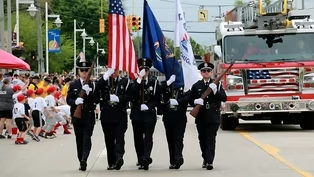
Michigan veterans commemorate Memorial Day
Video has Closed Captions
Clip: S8 Ep47 | 5m 35s | Michigan veterans commemorate Memorial Day with reflection and remembrance. (5m 35s)

One Detroit Weekend: May 24, 2024
Video has Closed Captions
Clip: S8 Ep47 | 2m 3s | Memorial Day events, Movement Music Festival and more coming up around town this weekend. (2m 3s)
Providing Support for PBS.org
Learn Moreabout PBS online sponsorship
- News and Public Affairs

Top journalists deliver compelling original analysis of the hour's headlines.

- News and Public Affairs

FRONTLINE is investigative journalism that questions, explains and changes our world.












Support for PBS provided by:
One Detroit is a local public television program presented by Detroit PBS