
Detroit Boxing/The Downtown Boxing Gym
Season 49 Episode 37 | 26m 46sVideo has Closed Captions
Detroit Boxing/The Downtown Boxing Gym | Episode 4937
A special show on the life and legacy of Muhammad Ali and the sport of boxing in Detroit. We’ll talk about the life lessons taught here at the downtown boxing gym, and we’ll look at Detroit’s historic boxing roots. Plus, a preview of ken burns’ new PBS documentary on Muhammad Ali. Episode 4937
Problems playing video? | Closed Captioning Feedback
Problems playing video? | Closed Captioning Feedback
American Black Journal is a local public television program presented by Detroit PBS
Detroit Boxing/The Downtown Boxing Gym
Season 49 Episode 37 | 26m 46sVideo has Closed Captions
A special show on the life and legacy of Muhammad Ali and the sport of boxing in Detroit. We’ll talk about the life lessons taught here at the downtown boxing gym, and we’ll look at Detroit’s historic boxing roots. Plus, a preview of ken burns’ new PBS documentary on Muhammad Ali. Episode 4937
Problems playing video? | Closed Captioning Feedback
How to Watch American Black Journal
American Black Journal is available to stream on pbs.org and the free PBS App, available on iPhone, Apple TV, Android TV, Android smartphones, Amazon Fire TV, Amazon Fire Tablet, Roku, Samsung Smart TV, and Vizio.
Providing Support for PBS.org
Learn Moreabout PBS online sponsorshipJust ahead on "American Black Journal", we have a special show for you on the life and legacy of Muhammad Ali and the sport of boxing here in Detroit.
We're gonna talk about the life lessons taught here at the Downtown Boxing Gym, and we'll look at Detroit's historic boxing roots.
Plus a preview of Ken Burns' new PBS documentary on Muhammad Ali.
Look at us back out in the world.
You don't wanna miss this show.
Stay right there.
"American Black Journal" starts now.
ANNOUNCER: From Delta faucets to Behr paint, Masco Corporation is proud to deliver products that enhance the way consumers all over the world experience and enjoy their living spaces.
Masco, serving Michigan communities since 1929.
NARRATOR: Support also provided by the Cynthia and Edsel Ford Fund for Journalism at Detroit Public TV.
ANNOUNCER: The DTE Foundation proudly supports 50 years of "American Black Journal" in covering African-American history, culture and politics.
The DTE Foundation and "American Black Journal," partners in presenting African-American perspectives about our communities and in our world.
ANNOUNCER: Also brought to you by AAA, Nissan Foundation, INPACT at Home, UAW, Solidarity Forever, and viewers like you.
Thank you.
(upbeat music) Welcome to "American Black Journal".
I'm Stephen Henderson, and as always, thanks for joining us.
We're coming to you from the Downtown Boxing Gym in Detroit.
And today, we are devoting our entire show to the sport of boxing and to the legacy of the man who was one of the most celebrated athletes of all time, Muhammad Ali.
It's been five years since we lost the world heavyweight boxing champion, who famously called himself The Greatest.
Ali's life is the subject of a new four-part PBS documentary series, which begins on September 19th by award-winning filmmaker, Ken Burns.
NARRATOR: Muhammad Ali was an activist who fought to move America in a certain way.
I have too much to fight for, a cause to fight for.
There was going to be an enormous price to pay for that.
(tense music) Boxing was this much of his evolution.
The person he is today is way bigger.
The price of freedom comes high.
I have paid but I am free.
(tense music) NARRATOR: Muhammad Ali, only on PBS.
Of course, Detroit has its own rich history in the sport of boxing.
The city has produced numerous champions: Joe Lewis, Thomas Hearns, and Hilmer Kenty, just to name a few.
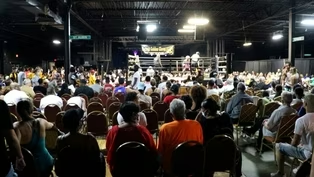
From the famous Kronk Gym to the city's Golden Gloves tournament, Detroit has always been a training ground for some of the best amateur and professional boxers around.
Producer Marcus Green reports on the city's celebrated boxing scene.
(crowd cheers) It made me very happy to be from Detroit, because Detroit support me so well.
I couldn't do no other way, because I love the feel, I love the emotion that Detroit put into everything for me.
They showed me how to, what it was like to be a champion in Detroit, and what it's like to be a champion in Detroit, it's just a wonderful thing, a great feeling.
See, I didn't really know that much about boxing except for Muhammad Ali.
Because when I started high school, he won the Olympics.
He got the gold medal in 1960.
So that's what got me aware of boxing as a sport.
I followed his career because I thought he was so interesting, and then when I got involved with myself in boxing, working with Tommy Hearns and the Kronk Gym in 1978, I was impressed at how much I thought Thomas Hearns reminded me of Muhammad Ali, his slick moves, his dominance in the ring, his personality.
Although he wasn't making up poems and rhymes, I could see a similarity in their greatness.
You just see greatness in certain people.
And so, as it turned out, unbeknownst to me, we would all be coming together in the early '80s because Muhammad Ali owned a company called MAPS, which was Muhammad Ali Professional Sports, and they ended up promoting some of Tommy Hearns' fights, his title fights, and so, I finally got to meet this amazing man.
I was writing for a daily paper as a journalist, and I did an interview with Thomas Hearns very early on in his career, and as I did with Muhammad Ali, I fell in love with this fighter who was so gracious and so humble, but so great in the ring and I admired that so much.
And then when I had the opportunity to work with him and learn the sport from a different angle, not just as a fan, but actually spending time in a gym and watching what it takes to become a professional fighter.
You don't play boxing.
It is a sport, but it's a hard sport, one-on-one and you have to put so much into it, and I have so much respect for the people that do that, men or women that take that sport on.
I was watching TV one day, and Muhammad Ali came on TV, and he started boxing, and he went in, with just saying, I don't know, something, and beating this man, beating his opponent up, and I thought that was nice, that was special, that was different, becoming the first man in boxing history to win titles in seven different division, that's a big achievement myself, and then, winning all the titles I won, that was, winning titles was not an easy thing to do.
The state of Michigan, that's our bragging rights.
Other than you know, baseball and anything, we won more championships in all sports, and boxing, you know?
And everybody, you know they knows Tommy Heard.
That's all?
There was more champions than Tommy Heard.
And I know in the '80s, with Kronk, with Tommy Hearns, Harold McKinney, you know, we, I thought we was, we were rougher than a lot.
I mean, the six that come, we was rougher than a lot of people.
When you fought somebody from Kronk, you knew they came to fight.
And from Detroit Kronk, they came to fight.
Well, my great-uncle boxed, my uncles boxed, my brother boxed.
So by the age of four, I was introduced to boxing just early at the age.
Now that's early age, right?
So I know boxing.
I remember for my brother doing a hundred pushups, me working out with my brothers, 5, 6, 7, my uncle, he was involved with the Kronk Gym and around that era was Thomas Hearns, Milt McCrory, Steve McCrory, part of the whole Kronk Escot Team.
It was just like normal, you know, but stepping outside of Detroit, it's a big thing, it's a huge thing.
I think here in the Detroit area, we've produced more world champions than any other state.
All you have to do, wherever you're traveling in the world, it doesn't matter whether you're in boxing or you're on vacation or whatever and you sit down and have a sandwich or a drink, and someone sits next to you and strikes up a conversation and they say, "Where are you from?"
I'm from Detroit.
The next question that comes out of their mouth, "Oh, man, can you tell me about Detroit boxing?
"Can you tell me about the Kronk Gym?
"Can you tell me about James Tony?"
You know, that's the first thing people from out of town will ask you once you tell them that you're from Detroit.
I mean, we all boxed each other hard.
We got Dirrell, Tommy, Elmore, everybody that was in that area, yeah, we all boxed each other hard, but nobody got bragging rights on it.
For me, having guys in my camp at the same time I was in the gym, well, it was the best thing for me because them guys helped me become who I am.
Them guys put the hard work in as well as I put the work in.
Detroit gonna keep coming, like Detroit is not gonna like, bag up, sit down, none of that.
Detroit, if they fight the best, they gonna work for it, you know what I'm saying?
They ain't gonna, oh, I'm fighting the best.
I don't want to.
Like whatever you put in front of them, that's what they gonna do, you know what I'm saying?
They gonna fight whoever, even win, lost or draw, they gonna fight 'em.
It don't matter who it is.
When Detroit boxers box, they box.
They passionate, you know?
Literally we go hard.
Like being from Detroit, I noticed this about myself.
I go hard at everything I do, my work, my professional, it's something about that Detroit spirit.
So it's not a negative, it's a positive.
I think Detroit boxers are tough just because of the way they come up.
It's an industrial city, it's a blue collar city, and I think there's a lot of young talent here.
There always has been, and I think that these kids today that go into the gyms that want to fight, it's a great way to get them off the streets and it teaches them discipline, self-defense.
You certainly have to be on your game if you're gonna fight.
You're not a team.
It's just one against one.
And Detroit's been known to have tremendous talent.
Being involved with the Metro Detroit Golden Gloves, I was able to see on a national level, Detroit and boxing.
Detroit is just a whole, we have a whole different vibe.
It's different.
So it's unexplainable.
I can't explain it.
I think it's just the spirit of Detroit.
MAN: It was very uplifting to come to the Golden Gloves this year and see how that, how much the new officers have brought up the organization over the last few years.
I'm very, very proud of the work that they've done.
And I see in the future, if this is going to happen, that we're gonna go back to the old days where we used to have two or three rings with two or three bouts going on at the same time.
One of the things back, you go back to the '70s and the '80s were Detroit boxing was dominant in the world.
And the reason for that was we had a great amateur program, and from the amateurs, they were going into the pros.
And I see a rejuvenation of that happening.
I see a great amateur program that's going on right now.
And it's just a matter of time before they go into the pros.
And I think in the next five years, Detroit boxing will be dominant on the world boxing scene again.
Boxing is what made Muhammad Ali famous and he used his stature in sports to speak out against injustice, racial inequality, and religious bias.
When his career ended, Ali became an international symbol of freedom and courage.
It took hard work, discipline, persistence, and talent for Ali to achieve everything that he did, both in and out of the boxing ring.
And these are some of the same attributes that young people learn here at the Downtown Boxing Gym.
The nonprofit organization combines athletics and academics in a free afterschool program for kids ages eight to 18.
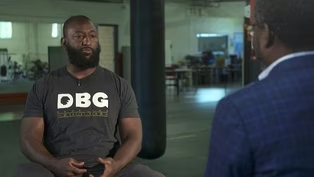
I sat down with the founder, Khalil Sweeney, to talk about how the Downtown Boxing Gym provides kids with the tools they need to succeed in life.
Khalil Sweeney, it is always good to see you.
Welcome back to "American Black Journal."
Thanks for having me back.
Yeah.
So let's start for people who may not know anything about the Downtown Boxing Gym, with you explaining what goes on here.
So we pick up the kids from school or home at no cost.
We have our own transportation.
We bring them to the gym.
They come in and they go to the designated area, which may be reading, which may be math, computer or whatever we may have going on.
It could be something, like a financial literacy course may be going on, or it could be a cooking class going on.
So they find the designated areas where they should be, and they go to those areas.
Our science class, our homeroom class and stuff like that, and after they get finished with that, they go into our sports and wellness part of the program, which is, you know, boxing, basketball- Boxing, right.
Lacrosse, hockey, whatever the sport may be for the day.
Yeah.
And so, that's pretty much how it goes.
Yeah, and talk about that link between the work that the kids do here and the play, the activity.
That's a big part of what makes this a special place.
So here, the motto is books before boxing.
That's our motto, books before boxing and that's before anything.
Education has to be plan A, not plan B.
You know, education is your plan A.
It's not your backup plan.
So, you know, we take pride in making sure that our academic thing is first and foremost.
So you have to, we test our youth quarterly to make sure where they are, make sure they're not behind grade level, make sure they're where they should be or above, and we make sure they go through those sections, like I said before, reading, math, anything else they might need help with and from that point on, now it's about having a healthy body.
Now your mind is strong, now we need to make your body strong to go along with that mind.
And so, we do a sport sampling exercise, you know, just regular, general push-ups, sit-ups and the whole calisthenics routine.
Yeah.
And of course, we got a couple of boxers.
Right, a couple.
A couple.
Just a couple.
A couple boxers.
I've always thought that this was such a personal project for you and something that grew out of your own experiences.
Talk about what led you to the idea that this is what the city's young people needed.
It was my own experience.
You know, I went through Detroit Public School, I never learned how to read and write, but I was still passed from grade to grade.
And throughout my years, I found out that a lot of guys that I grew up with and young women could not read or write, yet they made it to the 12th grade and graduated.
And you know, some people went off to college and came back home from, of course they couldn't keep up, but I ended up dropping out early on because I realized that like, I can't read and write.
I need to do something, 'cause nobody was inspiring me.
Nobody was telling me anything positive.
It was always you're gonna be dead in jail before you're 21.
Nobody said, Hey man, what's really going on?
What's the reason why you can't focus in class?
What's the reason that you're acting out?
And from the third grade on it's like, you know, I was just being kicked out of school or passed along.
And so, when I made the choice to change my life, after my brother pointed out to me there is nothing but death and destruction in your neighborhood, there's no resources in your community, I decided to make a choice.
And I was like, man, you know, what is it that I wanna do?
'Cause he asked me, he said, what you wanna do with your life?
And I had to answer that simple question, I was like, man, what do I wanna do?
And the only thing that I could think of was I wanted to learn how to read.
You know, just not knowing how to read, you're always hiding in the shadows.
You're always behind, hoping somebody don't find you out and so, I went back to school and tried my best to learn in school, but it was a hard road.
It was tough.
Yeah.
When you see the kids who come here today, do you think of yourself?
Of course.
Of course.
I see myself in every kid that walks through the door.
I mean, you know, a lot of guys are dealing with issues nobody know, and through sports, we can actually find out what's going on, 'cause in that hour of play, you can find out more about a person than a lifetime of questions.
So when you playing and laughing and joking and having fun, you can ask some of the critical questions and they'll be willing to answer you 'cause you're here every single day.
Yeah.
And I make sure that I'm here every single day.
I make sure that these doors are open every day that we're supposed to be open and the kids come here and they feel home, they feel welcome.
They feel like a part of a family, and we mentor by giving our testimony and what happened through our lives and how they can avoid some of the pitfalls that we fell into.
Yeah, yeah.
When you started this, where were the kids before?
What were they doing before there was the Downtown Boxing Gym?
Well, in the community where I first started the gym, I mean, it was roughly around 30% of the kids in that neighborhood was graduating from high school and about 70% were dropping out.
And so, I mean, you can just understand, you know what's going on.
You know, if there's nothing for a kid to do, he will find something to do.
Right.
Or it'll find him.
Right.
Or it'll find him or her, and so I've picked the neighborhood and the location and and I moved, I came into that location and I let it be known clear right out the bat that it was my way or no way.
You know, it's books before everything.
And so, when kids came in that program, they understood that and they started getting the results and then it just was word of mouth and it started spreading.
And, so we get kids from all over.
So we've just experienced this incredible disruption for a year and a half during the pandemic and I am asking everybody how they managed that.
I'm particularly curious about the kids here and how you were able to maybe help them get through what was a difficult time for everybody.
Yeah.
You know, we heard the news about the shutdown Friday, I can't think of what exact date, but it was on a Friday, and by Monday we were back up and running.
We were actually going virtual.
We were completely virtual.
We sent home computers.
We sent home PPE.
Our staff started developing curriculum and we started sending the curriculum home to the children because I mean, you know, we didn't want them to have any backslide.
You know, you get summer slide, but you don't wanna have a whole year of slide.
A whole year.
You'll get so far behind, and so, we found out that a lot of kids just had access to cellphones and cellphones couldn't access a lot of the apps that they needed to do for school, and so we made sure that we, through our partners and our team, we got together to make sure all the kids had computers, and we, like I said, we not only dealt with the kids in our program.
It would seem like a no brainer if you're sending food home to a kid that's in the program, he has three or four brothers and sisters who may be too young for the program or too old, you have to send food home for the whole family.
So we gathered our resources and we sent food home to the whole family.
Wow, and the physical part of it had to go on hiatus- Oh, yeah- For a time.
(laughs) No, it- It didn't, right?
No, no, it did not.
And so, we had virtual workouts.
We were doing virtual workouts.
I was like, kinda like a infomercial.
We were doing workouts online.
But talk about the first time you were able to bring people back together, physically.
Yeah.
So, yeah, that was good to see people's faces.
You know?
Looking at people on a TV screen is one thing, but to have 'em here in the facility, it felt like a little bit normal for me.
You know what I mean?
'Cause we've been doing this since 2007.
And so, you know, since 2007, that's a long time.
Yeah.
And so, I wasn't used to them being physically in the building, so.
So it felt good to have the kids back in the building.
Yeah.
And so there's this new documentary coming out about Muhammad Ali.
Okay.
And the legacy that he leaves, not just in sport, but of course, in civil rights and other kinds of activist issues.
I really would love to know what he meant to you.
I mean, as a young person growing up who has been interested in boxing.
So, I'm not necessarily a boxing fan.
I don't necessarily follow the sport itself.
I love the discipline of the sport.
I love what it brings to a person's character.
It builds character.
It's one of those sports where you have to show character, you have to show restraint, you have to be focused.
You have to have a level of dedication to even be semi good at it.
Yeah.
And so, I love that aspect of it, so I didn't really follow boxing too much, but when I did have the opportunity to see boxing and I would see somebody like Ali, he was an inspiration to people.
He was an inspiration, not just to people in my community, but to people around the world, you know?
And then to hear his personal story and to hear some of the things that he did behind the scenes, he became the greatest in my eyes for his work outside of the ring.
You know, that's the stuff that I like to hear.
I like to hear those stories about what happens when the cameras go off.
And he was a true example of what a person, a human being should do when the camera's off.
He inspired a generation, the youth, the old, the disenfranchised, he inspired a lot of people.
So, I mean, he leaves a great legacy behind.
Yeah.
Well, and I feel like the Detroit, the Downtown Boxing Gym is part of that legacy, right?
I mean, you are not just inspiring kids to get in the ring or other physical activities.
It's out, it's what they do and who they are outside of that that really matters here.
KHALIL: Yeah, to me, it's like, you know, of course you're gonna come across some standout kids who may be athletically gifted, and that's cool.
But the vast majority of people are never gonna throw a professional punch in their life.
Right.
You know what I'm saying?
To be totally honest, and so we have to prepare the kids for life, and so what we do here is we train kids for life.
We don't train kids to fight.
We train kids for life.
We give them all the tools they need to be successful as human beings, so they can give back to the community in ways that's beneficial for the whole of humanity.
Yeah.
You guys have also developed incredible partnerships with all kinds of organizations across the city.
Talk about how important that is, that this is not just an outpost here on the East Side.
It's connected all over the city.
KHALIL: Yeah.
You know, I tell guys this all the time, you know, when I was doing this by myself, it was a heavy lift.
It was really heavy.
It was heavy, it almost broke me.
I mean, I ended up homeless.
I went from 215, 218, solid muscle, to about 130, 40 pounds, roughly, somewhere around there.
It was a mentally draining, physically draining.
But when I decided to open up my heart and open up my mind to, I'm saying it's a community thing, but I'm trying to do it by myself, and once the community was allowed to be a part of it, a lot of hands made the lifting lighter.
And so we made partnerships with a lot of people that's doing a lot of great work out here in the community, not just in the community, but nationwide, some worldwide.
And so it's part, it's good to be a part of that global community.
Yeah.
Did you ever believe when things were at their worst, that you would be sitting in the middle of this really impressive organization that you are now?
KHALIL: To be honest and transparent, if I didn't, I wouldn't be here.
Yeah?
I would've gave up.
Yeah.
I've always saw a light at the end of the tunnel and we're not at the end of the tunnel yet.
And so, I don't do any victory dances.
I don't do any victory laps because there's a lot of work to be done.
And so, I wanna still live in this truth and keep doing what we gotta do.
Yeah, yeah.
Get it done.
What does the future look like around here?
The future around here?
Mm-hmm.
We're in the process of trying to replicate this program.
You know, we wanna replicate this program.
We wanna actually spread what we're doing, because we have a track record.
We have 100% graduation rate.
And we wanna spread that.
You know, it's a lot of communities who call us all the time who ask for us to help them do this in their communities, and so, now we're at a point where we believe that we're ready to do that.
Yeah, yeah.
I wanna go back and have you say that again.
You have 100% graduation rate.
That's just an unbelievable number, in a city where we struggle so hard to get kids- Yeah, and you know, I'm glad that we're able to do that with our staff.
We have a great staff.
You know, they don't mind if you're in the 12th grade and they need to take you back to the 2nd grade level and work on things that you didn't get in the 2nd grade.
Mm-hmm.
KHALIL: There's no sense in pushing you forward when you don't know the basics of math or you don't even understand basic reading and writing techniques.
So we, by us being, we having that freedom, we can gear our curriculum around that child.
We can go back.
The schools can't do that, to my knowledge.
I'm not trying to down the school, but they can't do that.
They can't start you back at kindergarten, but we can.
Right.
And we have a staff that's willing to do that.
Yeah.
And you know, you say that the schools can't do that, but it seems to me there's a lesson there for them, too, that you don't ever give up on a child, that no matter how bad things get, or how far behind they are, there's always an opportunity.
KHALIL: I don't even know if the kids, I don't even know if the schools are giving up on them.
It's just like, you know, you have a lot of restraints, a lot of red tape, a lot of politics involved, a lot of things that go along with that.
We don't have that here.
Yeah.
KHALIL: We know that a kid needs help with math.
So be it, we're gonna help them with math, you know, whatever that looks like.
That's gonna do it for us this week.
Make sure you tune in to the Ken Burns documentary, "Muhammad Ali," right here on Detroit Public Television, September 19th through the 22nd at eight o'clock each night.
We wanna thank the Downtown Boxing Gymn for having us.
You can find out more about our guests at americanblackjournal.org.
And as always, you can connect with us on Facebook and on Twitter.
Take care and we'll see you next time.
(upbeat music) ANNOUNCER: From Delta faucets to Behr paint, Masco Corporation is proud to deliver products that enhance the way consumers all over the world experience and enjoy their living spaces.
Masco, serving Michigan communities since 1929.
NARRATOR: Support also provided by the Cynthia and Edsel Ford Fund for Journalism at Detroit Public TV.
ANNOUNCER: The DTE Foundation proudly supports 50 years of "American Black Journal" in covering African-American history, culture and politics.
The DTE Foundation and "American Black Journal," partners in presenting African-American perspectives about our communities and in our world.
ANNOUNCER: Also brought to you by AAA, Nissan Foundation, INPACT at Home, UAW, Solidarity Forever, and viewers like you.
Thank you.
(light music)
Video has Closed Captions
Clip: S49 Ep37 | 7m 49s | Detroit Boxing | Episode 4937/Segment 1 (7m 49s)
Video has Closed Captions
Clip: S49 Ep37 | 13m 39s | The Downtown Boxing Gym | Episode 4937/Segment 2 (13m 39s)
Providing Support for PBS.org
Learn Moreabout PBS online sponsorship
- News and Public Affairs

Top journalists deliver compelling original analysis of the hour's headlines.

- News and Public Affairs

FRONTLINE is investigative journalism that questions, explains and changes our world.












Support for PBS provided by:
American Black Journal is a local public television program presented by Detroit PBS