
Muriel Anderson
Season 5 Episode 4 | 24m 41sVideo has Closed Captions
Virtuoso instrumentalist Muriel Anderson demonstrates the harp guitar.
Virtuoso instrumentalist Muriel Anderson visits with David and demonstrates the harp guitar as conversation ranges from John Philip Souza to Chet Atkins.
Problems playing video? | Closed Captioning Feedback
Problems playing video? | Closed Captioning Feedback
Muriel Anderson
Season 5 Episode 4 | 24m 41sVideo has Closed Captions
Virtuoso instrumentalist Muriel Anderson visits with David and demonstrates the harp guitar as conversation ranges from John Philip Souza to Chet Atkins.
Problems playing video? | Closed Captioning Feedback
How to Watch David Holt's State of Music
David Holt's State of Music is available to stream on pbs.org and the free PBS App, available on iPhone, Apple TV, Android TV, Android smartphones, Amazon Fire TV, Amazon Fire Tablet, Roku, Samsung Smart TV, and Vizio.
Buy Now
Providing Support for PBS.org
Learn Moreabout PBS online sponsorship(banjo music) - Years ago, my friend Chet Atkins told me to watch out for a wonderful fingerstyle guitar player named Muriel Anderson.
Now, coming from Chet that was a high compliment.
Over the years, Muriel has enchanted audiences with her compelling technique on the acoustic guitar and the unusual sound of the harp guitar.
She was the first woman to win the National Fingerstyle Guitar Championship.
Guitar Player magazine said "Muriel is one of America's premier solo acoustic guitarists."
Where did you grow up?
Where were you born?
- I grew up in Downers Grove, 20 miles West of Chicago.
- Musical family?
- Yes.
We still play music when we get together.
- Professionally?
- No, no, no.
Just for fun.
You know, and I grew up thinking that playing music was just something that human beings did you know, just when we want to have fun, get together with people, butcher Christmas carols, you know.
And it was just part of life.
So the idea of not playing music just never occurred to me.
- Wow, that's so great.
How did you get interested in guitar then?
- Well, a friend of the family was throwing a guitar away and I tightened up the three strings that were remaining on it and picked the garbage out of the sound whole and started figuring out melodies right away.
And she said, "Oh, you can have that guitar."
- How old were you?
- I was about eight years old.
- Man.
- Yeah, so it just made sense.
Yeah, we went to the Jones School of Folk Music in Lombard, Illinois, not too far from Downers Grove.
And that was in the Old Town School of Folk Music tradition.
So just strumming and playing with people and having fun with the music.
- Who were some of your influences when you were coming up?
- Well, I think the biggest influence of all was Doc Watson, right from North Carolina.
And it was because I was in my early teens and for Christmas one year, my parents got me a Doc Watson album at my teacher's suggestion.
And when I put it on the turntable, I could not believe it.
I was in love.
I had never heard anything like this.
- I'll ask you what people always ask me and that's what made Doc so great?
- You know, I think when I heard his music, I couldn't believe the character, the depth of character that I could hear in every note.
I said, "Wow, I can hear his whole person in that and this warm tone."
And I just felt I knew him once I heard that and I'd never heard anything like that.
I was just completely entranced and I would run home from school every day to try to learn every song on that album.
It was something that drew me to Southern music.
You know my family was all Northern.
- Oh yeah.
- Yeah.
So we were in Illinois-- - No Southern music in the family?
- No Southern music.
No they came from Scandinavian immigrants, Finnish heritage in New England.
But it was the music that spoke to me.
I started a bluegrass band in high school.
And so it was just something I was doing for fun and making some money on weekends.
And then-- - And you were playing with a pick or fingerstyle?
- I was playing with a pick, but I figured that a pick and fingerstyle were you know, two parts of being a guitar player.
- True, yeah.
- And so I never thought of separating the two.
So I always did flat picking and fingerstyle.
- You play a great piece called the Bluegrass Medley.
- Yeah.
- And you know, you're playing in a finger style, which is very unusual.
- Sometimes I have to go back to my roots and play some of that bluegrass, but without the whole band.
I have to imitate all the instruments on the guitar.
So you'll hear first the clawhammer banjo, much like what you play.
And then you'll hear a little five string banjo then some mandolin and some fiddle.
The string bass comes in and then you'll hear the whole band.
- It's an incredible piece.
(guitar playing) So then you went away to college and?
So then you went away to college and?
- Since I couldn't study bluegrass in college at that time, now you can, it's pretty cool yeah.
I took four years at DePaul University and really learned a lot about phrasing, a lot about honing the tone and I heard the music of Christopher Parkening.
- Oh really?
- Yeah, and so that kind of tone, I went after that.
And I found that I could take that attention to detail and apply it to other styles of music.
- You had a teacher that said something about tone, what was that?
- When I first came in from my very first guitar lesson in college, my teacher who was Leon Borkowski, he was a great teacher for me.
He said, "You have a terrible tone.
Come back when you've got a better tone and don't come back before that."
- What did you do?
- I practiced one note the entire week.
- Wow.
- I'd practice it this way and this way.
And I sanded my nails a certain way.
I stroked across this way and that way.
And finally I found it, I found that tone.
That was the best week of practice I had in my entire life.
- Wow, that is remarkable.
I'm sure that there's a lot of guitar players watching.
They'd like to know what you're talking about.
- Sure, Well, I'll show you here.
- On a classical guitar.
- Yeah, well with the nylon strings you can hear the difference more.
And so you've got a bigger range of tone on it.
So I think that's why I've, you know, I started with the steel string and I still play steel string sometimes, but a lot of tunes you can just really get into with a nylon string.
Because here I've found that the most lush tone was slicing across towards my left shoulders.
So relaxing the hand.
(guitar thrumming) And slicing in this way.
As opposed to straight up and down, you can hear the difference in tone.
(guitar thrumming, boldly) And.
(guitar thrumming, softened) - Oh my goodness, yeah.
- So, and then I can use all those different tones.
I use them for different things writing the same song so I can kind of merge the tone this way, merge the tone that way.
And so I can show you in one of the tunes that I wrote.
I actually wrote it for the album I recorded for Doc.
- What's it called?
- It's called Two Shores.
- That's incredible technique at the end of that.
What is that about?
- It's a harmonic technique that I had figured out based on something that Chet Atkins showed me.
We were in his kitchen and he was showing me Mr. Bojangles.
And at the end he did this.
(guitar playing) And I went, "Whoa, what was that?"
I'd never seen anything like that.
And he showed me, it's one harmonic and one note.
(guitar playing) Like this.
And then I took that idea and I said, "Well, I wonder if you could do one harmonic and two notes and you get something like this."
(guitar playing) And that's what turned into the technique for the Two Shores.
- Beautiful.
How did you meet Chet Atkins?
- Actually, I was taking mandolin lessons from Jethro Burns and I played this tune that I'd arranged called Nola, and Jethro said, "Well, you got to meet my brother-in-law Chet Atkins."
They married, you probably know this, they married identical twin sisters when they were all working in the National Barn Dance in Chicago.
- So Muriel, you're one of the few people in the country that play the harp guitar.
- Yes.
- Show us this thing.
It's gorgeous.
- It's an interesting instrument.
And I started playing it when I just was writing tunes that just required extra low resonating bass strings.
(low notes playing) And they just go down the scale or tune them to whatever notes I need in the piece.
And then since 11 strings wasn't really enough, and then 13 strings wasn't enough.
So this one has 13.
(high notes playing) This is an attachable unit here.
And I asked Luke Brunner in Switzerland to make me one.
And now he's selling them and calling them Muriel Trebles.
- How cool.
Well, I know back in the 1890s, there was a movement of people playing these things.
How many people would you say are playing them now?
There's more and more.
So I think we are really starting to see a second renaissance of the harp guitar.
You know, there was a period of time between 1890 and 1910, where they were played with the mandolin orchestras.
And now we're starting to see more people.
So there's a harp guitar gathering that typically has about 45 people from all over-- - People who like to tune?
- Now we're starting to see that number pickup.
(guitar music) ♪ Starry starry night ♪ Paint your palette blue and gray ♪ ♪ Look out on a summer's day ♪ With eyes that know the darkness in my soul ♪ ♪ Shadows on the hills ♪ Sketch the trees and the daffodils ♪ ♪ Catch the breeze, the winter chills ♪ ♪ In colors on the snowy linen land ♪ ♪ Now I understand ♪ What you tried to say to me ♪ How you suffered for your sanity ♪ ♪ How you tried to set them free ♪ ♪ They would not listen, they did not know how ♪ ♪ Perhaps they'll listen now ♪ For they could not love you ♪ Still your love was true ♪ But when no hope was left in sight ♪ ♪ On one starry starry night ♪ You took your life as lovers often do ♪ ♪ But I could have told you Vincent ♪ ♪ This world was never meant for one as beautiful ♪ ♪ as you - It reminds me of a orchestra almost.
- Yeah.
I found that you can get a lot of different range in there.
- Yeah.
Speaking of that, you had a grandfather who played with John Philip Sousa?
- Yes.
So he played saxophone.
- Was that a professional gig?
- Yes, it was.
He was the youngest member of the band.
And I wanted to learn a tune as a tribute to my grandfather 'cause I thought that being a professional musician was the coolest thing anyone could do.
- And you were right.
- That's right.
So I learned, and this one has special meaning for me because it was also the theme song for Monty Python's Flying Circus.
And so I try to imitate all the sounds in the marching band on this.
- Wow.
- Yeah, The Liberty Bell.
(guitar playing) - Do you practice a lot or do you have any tips for people who are trying to learn?
- Well, I try to start off with something that really inspires me, 'cause the biggest thing is to keep the inspiration and that love alive.
- True.
- Yes.
And I've gone through-- - You have to entertain yourself first.
- Yes, I've gone through a lot of different styles.
And then when I find that thing, I want to discover what it is that makes that music come alive, the detail in it.
Is it the phrasing?
Is it the tone?
Is it the approach to the beat?
And what is it that makes that music magical?
And that's what I work on.
And by focusing on that, then I come up with a technique that I needed to accomplish that.
So it's the reverse way.
It's finding the heart of the music first and then you have to get the technique to make it happen.
(guitar playing) (electronic whistle, boing boing, digital glow)
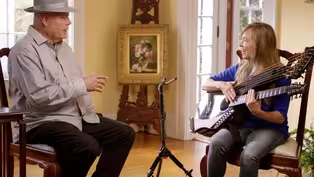
Episode 4 Preview | Muriel Anderson
Video has Closed Captions
Preview: S5 Ep4 | 30s | Virtuoso instrumentalist Muriel Anderson demonstrates the harp guitar. (30s)
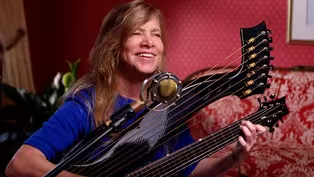
Muriel Anderson Performs on the Harp Guitar
Video has Closed Captions
Clip: S5 Ep4 | 2m 2s | Guitarist Muriel Anderson talks to David Holt about inspiration and plays harp guitar. (2m 2s)
Providing Support for PBS.org
Learn Moreabout PBS online sponsorship

- Arts and Music
The Best of the Joy of Painting with Bob Ross
A pop icon, Bob Ross offers soothing words of wisdom as he paints captivating landscapes.













Support for PBS provided by: