
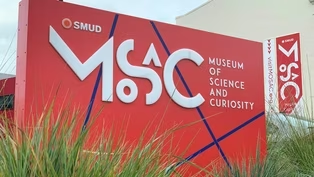
Museum of Science and Curiosity
Season 11 Episode 11 | 26m 1sVideo has Closed Captions
Explore Sacramento’s new science center, the SMUD Museum of Science and Curiosity.
Explore Sacramento’s new science center, the SMUD Museum of Science and Curiosity, home to immersive exhibits and an unforgettable journey inside the planetarium. Immerse yourself in the paradise of Park Winters, one of Northern California’s top spots for creating memorable moments. And go inside the home of artist Tony Natsoulas, one of Northern California’s most celebrated ceramicists.
Problems playing video? | Closed Captioning Feedback
Problems playing video? | Closed Captioning Feedback
Rob on the Road is a local public television program presented by KVIE
Sports Leisure Vacations is a proud sponsor of Rob on the Road.
Museum of Science and Curiosity
Season 11 Episode 11 | 26m 1sVideo has Closed Captions
Explore Sacramento’s new science center, the SMUD Museum of Science and Curiosity, home to immersive exhibits and an unforgettable journey inside the planetarium. Immerse yourself in the paradise of Park Winters, one of Northern California’s top spots for creating memorable moments. And go inside the home of artist Tony Natsoulas, one of Northern California’s most celebrated ceramicists.
Problems playing video? | Closed Captioning Feedback
How to Watch Rob on the Road
Rob on the Road is available to stream on pbs.org and the free PBS App, available on iPhone, Apple TV, Android TV, Android smartphones, Amazon Fire TV, Amazon Fire Tablet, Roku, Samsung Smart TV, and Vizio.
Providing Support for PBS.org
Learn Moreabout PBS online sponsorshipIt'’s Rob on the Road.
Taking you from Sacramento to outer space!
Inside the SMUD Museum of Science and Curiosity.
Shahnaz: I want you to open your eyes and tell me what you see.
Rob: All right, hold on.
I already feel amazing but hold on wow.
Oh my gosh.
We'll explore this state-of-the-art museum, filled with hundreds of exhibits and offering endless curiosity.
Plus, a peek at a paradise you can experience at Park Winters found paradise at Park Winters ... one of Northern California'’s most memorable mansions rich in history and dedicated to a better future for the planet.
Rafael: The whole ethos of our farm is that everything here is recycled repurposed and reused.
Discover 10 acres filled with nature, nostalgia and new ways to celebrate life's special moments.
And...
Inside a home and heart of artist Tony Natsoulas...
Rob: I can't wait to see your studio.
Holy cow!
Tony, wow!
Beauty and creativity surround you inside this home from Tony and dozens of other artists.
Rob on the Road starts now!
Annc: And now Rob on the Road.
Exploring Northern California.
♪♪ Rob: Welcome to the SMUD Museum of Science and Curiosity.
This is so exciting to be here.
We are thrilled to take you on a private tour.
And today Shanaz Van Devanter is going to show us so many fascinating exhibits that are open and here for you to enjoy.
Good to see you Shahnaz.
Shanaz: Thanks so much Rob.
Great to have you here.
Rob: Thank you.
We're starting in Nature Detectives.
Shanaz: And this gallery experience has been designed for our littlest scientists.
So where do kids first learn about things?
Uh, it's through their five senses.
And where is that curiosity?
This is what this gallery experience is made to do.
It's to just inspire that little scientist by using their five senses.
So, they're going to smell things, touch things, see things, do things.
So, I invite you to come on in.
Rob: This is amazing.
I see these are very interactive, which is great, especially for kids.
And I also want to point out it's great for all ages, because I learned so much in this room when we walked through.
That I did not know or did not remember.
Shanaz: Well, it's bringing out that curiosity and that kid in you, Rob.
Rob: Right.
And we always need to be learning lifelong.
Shanaz: Exactly.
♪♪ Shanaz: So, this entire institution, it was made to look at global issues that are affecting the world.
Right.
But bringing them back down, making it approachable, making it bite size and locally relevant.
Rob: This is so beautiful.
What a wow spot.
My goodness.
You've got water challenge, an entire massive exhibit on water, which makes a lot of sense to have here.
So, this is a visually stunning exhibit.
Shanaz: It tells the story of how California has had to come up with a very complex infrastructure to move water from where we get it, which is north of Sacramento down to the Southern part of the state.
Shanaz: We're looking at things from a sustainability perspective, from a conservation perspective, and knowing where does the water come from?
How it'’s used and what can we do to conserve it.
Rob: This shows in gallons, how much water goes into making something?
I had no clue.
Shahnaz: Me neither.
Rob: Alright, a pair of leather shoes.
Shahnaz: Yeah.
Rob: I'm going to guess, 50?
No way.
Shahnaz: Keep going.
Rob: It's going to the very top?
Shahnaz: Is it going to ring the bell?
Rob: 3,626 gallons to make a pair of shoes.
Rob: That sounds almost awful.
I mean, I now.
It sounds terrible.
And yet it's so good to know because it makes me think.
Before I buy a new phone, a pair of shoes and even a t-shirt.
Rob: And this is just one little exhibit, there are hundreds of exhibits in here that you've got to come check out yourself because without being in here and touching them and doing them, you have to experience it.
Shanaz: It's all Hands-on Rob: it's hands on work.
Rob: We're in the Powering Change Gallery and the things that you will learn in here are incredibly impactful.
They, they stay with me, show us about what we can just do with even transportation, electricity, clean electricity.
It has it all here.
Shanaz: This really, uh, shows the choice points that we make.
Right.
Uh, and the impacts, right.
We want to use cleaner energy.
Rob: Stories from around the world.
Take it away Shanaz: This may be one of my favorite exhibits at MOSAC.
Yeah.
So, this, um, really is a series of vignettes of kids from around the world telling us how climate has impacted their lives and their communities and what they are empowered to do.
Uh, just because they think that they can make a change that is going to change something else that's going to inspire.
So, let's take a trip.
Shall we?
"Right now, drought.
There have been droughts.
We don't have the crops that we used to plant.
Rob: Wow.
Shahnaz: One 16-year-old in Nairobi, Kenya making a global difference Shanaz: Rob, Welcome to Destination Space.
Rob: So, tell me about this huge exhibit.
Shanaz: Oh my gosh.
So, you know, we are now a space fairing race, right?
So many efforts that are going on, whether it's to go back to the moon or go to Mars.
So, we are actually going to look at all the things that it took to get us to the moon.
Right.
So that's this piece of the gallery.
And then we're going to ask the question, what is it going to take to get us beyond the moon and maybe Mars?
Alright Rob, keep your eyes closed because we are in the UC Davis multi-verse theater at MOSAC.
And I want you to open your eyes and tell me what you see.
Rob: All right, hold on.
I already feel amazing, but hold on.
(laughing) Wow!
Oh my gosh.
Shanaz: Do you feel infinitesimal?
Rob: I feel like I am lost in space, but not lost at all.
I feel like I'm just floating through the universe.
I've never seen something quite so special.
Rob: I really don't even have any words.
I just am blown away by the, the peace and how small we all are, but yet how our, every action impacts what we're looking at.
And we learned that downstairs that we come up here and we see a greater why than I ever dreamed.
Shanaz: You know, when we think about unleashing the imagination, this is what I think about.
Think about when we stare up at the sky.
When we think about things like destination space, where we're going to even get beyond that visual range of what we see on earth.
And we come into something like this, you have the greater appreciation of where we are at this point in time and what the possibilities could be.
Rob: And what we learned downstairs is that it's a choice.
You know, our actions do harm it and we learn ways and better ways so that they don't.
Shanaz: There's only one planet.
What are we going to do to protect the tomorrow and the future?
♪♪ Rob: Welcome to a year-round "“Winters"” wonderland.
Nestled amidst the lush farmlands of Northern California is Park Winters, a ten-acre estate filled with glorious gardens, a charming Victorian Inn, beautiful barns -rustic to refined - a swimming pool, an opera house for hens and an organic farm.
Couple Rafael Galiano and John Martin are the masterminds of Park Winters, who bought and re-built this award-winning attraction in 2010.
John Martin: Even though it wasn't like this, when we got here, we saw the potential and we saw the beauty and we felt the beauty of it.
And so, for me, I just feel like I'm just grateful every day.
Rafael: So, this is the original foreman's quarters and we decided to preserve it because it's a snapshot to the past.
And inside are dry bouquets from previous weddings.
Rob: Dried wedding bouquets line the ceiling .... some shabby, some chic.
This time capsule gives a glimpse into what this place is all about ... the "why" of Park Winters.
This room illustrates the wide range of weddings that have been celebrated here over the years.
Rafael: The whole ethos of our farm is that everything here is recycled repurposed and reused.
And some people thought we were going to demolish it because it was literally shaking, and instead we gave it a new foundation and froze it.
Rob: I love this, this makes such a - in my opinion - a statement about Park Winters because it clings to the past and the roots here, but it gives hints of any direction you want to go.
And it shows you've already done it.
John Martin: Well, we oftentimes say that Park Winters has two flavors.
We have the farm side and then we have the more ornate garden side.
And so, the farm side is that great creativity, um, space that Rafael does thrive in.
And then the more ornate gardens side does tend to be very private event focused where we have a weddings, birthdays, anniversaries, farm dinners, farm brunches.
We have the historic in where we accommodate overnight guests.
We have the pool scene where people can have day passes, where they come enjoy the pool during the summer.
Um, so it's, uh, yeah, I would say it has exploded in the way that, um, people can come here and get really whatever flavor they want.
Rafael Galiano: So, let me show you something here.
These are the three stages of this flower.
These are called blanket flowers.
So here you have the flower and then you have these cool globes.
So, you can use them for like when you're doing your vases.
Right.
Rob: It's still, yeah.
You could put it in an arrangement, and the dried.
Rafael Galiano: Yep.
And then.
When it goes from this stage, then it goes to this, and then see these give your hands.
So, I can show you, you deconstruct it like this, and they start to fall apart.
Rob: Oh, these are the seeds.
Rafael: And these are the seeds.
Rob: The guys have gone all in to connect anyone with the earth.
The weekend experiences offer everything from pick your own flowers, to classes in flower arranging, drying, wreath making, and seed harvesting.
♪♪ Rob: And what do you call this?
Rafael: This is the Flower Barn.
And I have been really excited to show you.
Rob: Oh my gosh it really is a flower barn.
How in the heck did you do this?
Wow, Rafael this is beautiful.
Rafael: Isn't it fun?
Rob: It's more than fun.
This has really grown into, I, I see what you mean about the five acres and the five acres.
This is an event space.
And then over here is all about education, entertainment, inspiration.
All from the land.
Rafael Galiano: Yes.
Yeah, thank you for seeing that.
And I appreciate you getting that because that's exactly it.
Our ethos is to inspire.
We aspire to inspire people to, um, work with plants, work with food because the things that we're working with are very reachable.
We're not talking about something that's like esoteric.
Everyone can bake a pie.
They can grow an apple tree.
They can walk in the park; they can sleep well.
And, and so this good old, basic living is just really the recipe to a happy life.
Rafael Galiano: To be very specific.
My garden saved my life.
So when.
Uh, I was younger in my mid-twenties, and I was just coming to terms with who I am, um, personally, professionally.
And, um, I had a lot of pressure, and it was my garden that literally held me together.
And I transformed myself as I transformed the garden.
And I learned from other gardeners.
Rob: That is part of the secret here at Park Winters, one they are glad to share freely.
They bring things from the past, adapt them to future, and together, their creations become timeless.
John Martin: I see it all the time.
And um, sometimes I don't even know if he understands how.
Um, the impact that he has on people with the creative, um, items that he has here.
But yes.
Um, I mean, from the event side, of course, you know, these, the weddings and the, and the special occasions are just so special.
Um, and we take them so seriously, you know, everyone who works here realizes the, the, the importance of these, these onetime occasions, whether it's a wedding or a celebration of life or anything in between, we really.
We, we take them as, as they're sacred to us.
And then, but also on the, on the other side of the property, on the farm, the picking of the flowers and the, and when, when Raf takes them around and less than smell the herbs.
And it's just, it is really amazing.
Well, how, um, how people tell us that they are leaving, feeling, feeling fed.
it's, It's great.
Rafael: Garden, cook, walk.
Good old basic living is the only thing that has brought me true joy and the material things are wonderful, but the things that really hold me together is, is nature and sharing nature with people and giving people that, um, inspiration.
Really brings back a lot of joy to me.
And, um, it's what I want to do the rest of my life.
♪♪ Rob: I can't wait to see your studio.
Holy cow!
Tony, wow!
Tony: Just a little something I did.
Every sculpture tells a story for artist Tony Natsoulas.
Tony Natsoulas: So, this a man named Rube Goldberg.
He was very famous in the twenties, thirties, forties, and fifties.
He was an illustrator.
Rob: Tony says it'’s a challenge making life-sized clay creations like this Rube Goldberg sculpture.
It weighs 200 pounds, has 30 individual pieces that can all come apart, and took 2 months to make here in his garage turned art studio with a splash of school.
Each sculpture offers a history lesson of the person it portrays.
Tony: He did these machines that emphasized a simple task that he made as complex as possible.
So, he thought that us humans made everything difficult.
And what I did was I constructed a machine where each piece has something to do with his life.
Rob: I had chill bumps when I saw that face and I don't know why?
Tony: Well, thank you, I appreciate that, that's what I'm trying to go for, some emotion for each piece.
♪♪ Each "“person"” is created in small 4-to-5-inch increments that must dry for 24 hours.
The next day, another 4-to-5 inches, until the piece is the perfect size to enter this kiln, firing at 2000 degrees.
SOT: Rob: What do you feel?
You mentioned this man was a muse of yours.
Tony: Yeah.
Rob: Creating a piece that reminds you of so much love.
Tony: Well, it's, you know, pictures are flat, and you can look at them all day, but I, you know, I'm hoping his spirit like gone in here so that he's here with me all the time.
And also try to make him real.
Now that he's gone for everyone else.
I'm trying to make these pieces feel like they could come alive at any moment.
Rob: Tony is in the middle of building 9 of these massive models within 3 months as well as lots of these large ceramic eyes.
Rob: I've never seen detail in eyes when it comes to sculptures like this, ever.
Tony: Well, I've studied a lot of them.
Tony has been working as a professional artist specializing in ceramic sculpture since receiving his master'’s degree in Fine Art at UC Davis in 1985.
His flair for "“camp"” began as an undergrad student working with world-renowned funk art professor Robert Arneson.
♪♪ Donna: Oh, that looks really nice.
Tony: Thanks.
Together, Tony and his wife Donna have created this work... a 400-page book chronicling Tony'’s sculpting career captured in this large coffee table sized book.
Inside, and throughout their Sacramento home - are some of the Natsoulas'’ favorite artistic expressions.
Donna: I have a lot of different things that I'd like to show you.
Rob: I don't even know where you begin!
Oh, my goodness.
Donna: So, this is our living room, but.
Rob: Wow.
Laughter.
Donna: This is a piece by, um, Shawn Henry.
He lives in England, and he wanted to come and visit Tony in his studio.
He had read about Tony and so he came, and he worked with Tony and his studio for a long time and made this piece at UC Davis and met Arneson through Tony.
Rob: Donna and Tony have lived here since 1990, and this home is their happy place.
Art is everywhere.
Donna is the designer.
Almost every piece was made by a friend.
Donna: So over here is, um, Lee Kavaljian and he taught at SAC State for like 60 plus years.
And he's been a good friend of ours for many, many years.
And, um, he and Tony were collaborating, um, on glaze techniques and things like that.
And so, I just find him fascinating.
He's like one of the best people we've ever known.
Donna: So, this piece is by our late friend, um, Fred Babb.
He used to own a company in Cambria, California, which was called "What Is Art?"
So, we have his sign.
But this is, um, I loved what it says, and it says "I passed by a homeless man today.
And I was suddenly struck by the fact that at one time he was extremely precious to somebody."
Rob: Aw.
Donna: Once a treasure, always a treasure it's called.
Rob: Wow.
Donna: So that is really meaningful.
Donna: Okay.
Rob, there's a little bit more back here too.
Rob: A little bit?
I could just spend days, weeks in here looking at everything.
Look at that!
Donna: So, this is called goat peddler and it's made all out of bicycle parts.
So, um, pedals - it weighs a ton.
Pedals and all different parts of the bicycle.
This piece is made by Paul de Pasqua and he lives in, um, Nelson, which is near Chico, California.
And I love this because it reminded me of an Indian Kachina doll.
Um, and just the movement out of such frigid material is metal.
It dances.
It's just beautiful.
Rob: As I look around and see all of this beauty, it would take days and days, hours, so much time to tell the story of each piece altogether.
Cumulatively.
How would you describe your husband's story?
Donna: He works really, really hard, very hard.
He's the hardest working person I know.
Takes it very, very seriously, even though some people think, oh, it's just a fun piece of art, you know, how can anybody do that and make a living off of it, but he takes it very seriously and I take it very seriously.
Um, it's a good life.
♪♪ Rob: When I was preparing for this interview and I asked people about you, universally I heard "Tony Natsoulas promotes other artists more than he promotes himself."
Tony: Well, there's a lot of great artists out there that are brilliant, that are not being recognized.
And I think it's a shame.
So, I always loved to put people forward that deserve it.
Rob: What would you feel most compelled to share and to say what, what must be shared by you?
Tony: Um, basically three things.
The first thing is to be humble, work as hard as you can and do not, uh, do not, uh, think that everything you do is precious.
Each thing is an experiment to see if you can get your idea into it, and don't be afraid to throw it away.
If it's just junk, even though you've, you've worked on it for a month.
Uh, the third thing is, is don't do it for money.
I am making it because my overhead is teeny.
Why we don't buy brand new cars all the time.
We don't do a huge amount; we don't buy a new TV all the time.
We just keep it as low as possible so I can sell work and still make a living.
Rob: What is it that matters most to you?
Tony: That my friends and family are happy and that, you know, I'm able to make art and that my wife and I can live a nice life that we have been.
♪♪ ♪♪

Video has Closed Captions
Clip: S11 Ep11 | 9m | Go inside the home and the heart of Northern California artist Tony Natsoulas. (9m)
Museum of Science and Curiosity
Video has Closed Captions
Clip: S11 Ep11 | 8m 26s | Go inside the SMUD Museum of Science and Curiosity. (8m 26s)

Museum of Science and Curiosity Preview
Preview: S11 Ep11 | 30s | Explore Sacramento’s new science center, the SMUD Museum of Science and Curiosity. (30s)

Video has Closed Captions
Clip: S11 Ep11 | 6m 59s | Immerse yourself in the paradise of Park Winters. (6m 59s)
Providing Support for PBS.org
Learn Moreabout PBS online sponsorship













Support for PBS provided by:
Rob on the Road is a local public television program presented by KVIE
Sports Leisure Vacations is a proud sponsor of Rob on the Road.