
Movement and Motion
Season 3 Episode 3 | 25m 46sVideo has Closed Captions
Donna Weng Friedman’s short film, “Never Fade Away," and inside “Revolve Dance Project” rehearsals
Pianist and filmmaker Donna Weng Friedman shares her parents’ love story through her original musical score and choreographed ballet in her short film “Never Fade Away.” Then, the ART inc. team talks with members of Revolve Dance Project, a collaborative performing arts nonprofit exploring the intrinsic connection between music and dance.
Problems playing video? | Closed Captioning Feedback
Problems playing video? | Closed Captioning Feedback
Art Inc. is a local public television program presented by Ocean State Media
Movement and Motion
Season 3 Episode 3 | 25m 46sVideo has Closed Captions
Pianist and filmmaker Donna Weng Friedman shares her parents’ love story through her original musical score and choreographed ballet in her short film “Never Fade Away.” Then, the ART inc. team talks with members of Revolve Dance Project, a collaborative performing arts nonprofit exploring the intrinsic connection between music and dance.
Problems playing video? | Closed Captioning Feedback
How to Watch Art Inc.
Art Inc. is available to stream on pbs.org and the free PBS App, available on iPhone, Apple TV, Android TV, Android smartphones, Amazon Fire TV, Amazon Fire Tablet, Roku, Samsung Smart TV, and Vizio.
Providing Support for PBS.org
Learn Moreabout PBS online sponsorship(bright music) - [Announcer] Coming up on "Art Inc." The Love Letter.
The Art of Rehearsal.
And the short film "Never Fade Away."
(static buzzing) - [Announcer] If you want to know what's going on.
(upbeat music) (upbeat music continues) (birds chirping) (static buzzing) (upbeat music continues) (static buzzing) - (sighs) Hi.
Okay, we're gonna make some beautiful music together and we're gonna start with little Chopin, okay?
All right.
(gentle piano music) (gentle piano music continues) (gentle piano music continues) Transition is a more black and white term.
For me, everything I do, there's a lot more grays, a lot more, you know, color.
(gentle piano music continues) You know, I'm not a filmmaker.
I'm a musician.
I look at myself more as a storyteller, and that's really why I did this movie.
I do have a very close connection with how to tell a story through music.
Every time I perform a piece, I see it in my mind's eye.
It's just a lot of overlap, with many, many, many layers.
As one fades away, the other one comes up to the surface.
It is like waves.
It's like waves.
(gentle piano music continues) I am so happy to be in Rhode Island to give my film one of the last screenings at the end of this incredible year, celebrating the one-year anniversary, and to be able to share this story with this community at the Jamestown Art Center.
(gentle piano music continues) My father's story, the story that you're about to see in "Never Fade Away," is about how he escaped his homeland, China, during the Japanese occupation to come here and build a new life, that second time around.
But we are all second-time-arounders.
Every single one of us has a story and these really are the stories that connect us.
(paper rustling) (Donna sighs) (gentle piano music) In early March, 2020, when rumors of the coronavirus were spreading like wildfire, I was walking my dog at 1:00 PM Central Park, and out of nowhere, this very large man lunges towards me and starts screaming and blaming me for the coronavirus.
I ran home, and I literally did not walk out of my apartment for seven months after that, and I didn't even go out to walk my dog.
But then all of a sudden, it kind of dawned on me that at least what happened to me might have actually been caused by ignorance and fear, fear of the unknown.
I decided that maybe the best thing to do would be to share our stories to bring people closer together.
I went home and I thought about it, and I said, okay, yeah, sure.
A four-minute film with a dance.
When I asked the great dancer, Chen Wai Chan, history-making dancer, the first ever Chinese principal dancer for the New York City Ballet, if he would dance the role of my father.
And he asked me to send him the script, which I did, and he called me and said, "This is my story too."
(birds chirping) (birds chirping continues) (gentle piano music) (gentle piano music continues) (gentle piano music continues) Last night, my brother, Steve, called me.
I guess I've been so busy that I didn't think about the date.
And it turns out it was the anniversary of my mom's passing, and for me to have the screening of my short film about their story on that weekend, just all of a sudden it opened up a whole new meaning for me.
But I feel so grateful and blessed to have had this opportunity to bring them home again with me.
And I know that they're with me always, and I will continue to talk to them and pray to them and connect with them, but it's going to be quite different (laughs) and I have to prepare myself for that.
(water splashing) (birds chirping) (gentle piano music) Looking back on all these years and how my life has taken different turns, I think it was all meant to be, whatever happened, if it was, you know, good or bad, and I'd have to pivot, I'd have to turn the corner, I found my way, somehow.
And I think life is never a straight line, and we have to embrace those turns.
(gentle piano music continues) (gentle piano music continues) Art is a universal language.
I can listen to a piece that was composed in the Ukraine and I could feel the pain, I could feel the emotion.
We don't have to be linguists, we don't have to know languages, we just have to share art.
(gentle piano music continues) (static buzzes) (bright music) (bright music continues) - What is Revolve?
Revolve is a collaborative performing arts nonprofit company that's dedicated to bringing musicians and dancers together to form working relationships between the artists.
- I almost feel like in rehearsals, I have, like, so much fun.
Like, I love when people are watching, and I feel like I'm just, I dunno, I feel less nervous in rehearsals, but before the show time, I definitely feel myself get nerves before stepping on stage.
(gentle piano music) - So I think every process, every, like, set of rehearsals gets to a point where it's like we're running things over and over, your body's getting fatigued.
- You know, there's the old saying, practice and then you can kind of forget about it once you get on stage, 'cause if you get on stage and you're still too consumed with, you know, for me, it's this which stick goes where when?
If you're still in that head space, you're probably going to fall on your face.
(players chattering faintly) The first rehearsal was great.
Most of us have played music together.
We kind of know how we operate.
(bright music) - Ugh, the worst part of rehearsal is the pain, sometimes, the injuries, the repetition of the same thing over and over, sometimes.
I'm still sort of dealing with an injury.
So we think that I had a series of subluxations in my left lower rib.
Subluxation, from what I understand, means that the rib went out of place and then back in, so it's kind of like a dislocation that pops right back into place quickly.
(dancers chattering faintly) - But I think rehearsals, it's just, be flexible, but come prepared.
And then when you perform, don't forget to have fun.
- In rehearsal, you kind of discover what the piece actually is because you know, everything in theory that I try to put on the page might change when the real sounds are happening in the room, when real people are playing the various parts.
- Musicians and dancers don't often get to collaborate, because it usually takes two different organizations coming together and getting their schedules aligned and you know, finding the funding to make that sort of thing happen, so this is really the only company of its kind that I know of in Rhode Island that's really focused on dance and music equally.
(gentle cello music) - Dance and music, and particularly drumming, used to have a much more intrinsic connection.
(bright music) 'Cause for me as a drummer, you know, how it fits into the historical context with dance and, you know, culture.
- We always have to be aware that we're writing for dance.
(performers chattering faintly) - I would say we start composing a few months ahead of time and send it to the choreographers.
(bright music) Then they, you know, mold the clay, so to speak, and start thinking about how it's gonna pair with the music.
- Okay, well we just changed that, so I think we maybe just do it a few times.
- The artists of Revolver are able to, like, grow so much in their own artistry, just from collaborating with a different type of artist.
- Like, it's sort of like important, and not about this as much as nothing.
- And I think because we all kind of are interconnected and we see each other's lives, we have a bit more appreciation for what it takes to come here and do this.
And when you get to the performance, it's really all about letting that, like, (bright music) muscle memory show out, and actually feeling the moment in the lights and feeling the energy from the audience and allowing that to really amplify your voice.
- Another thing with Revolve that's great is that everybody is very, you know, they're super fun to work with and they're very positive, but they're also pro.
So there's a lot of laughs and it's pretty light.
But then we get together and play, and it's ready.
(audience applauds and cheers) (static buzzes) (slide clicks) (gentle piano music) - [Donna] Every year, right before Thanksgiving, my mom would hang a couple of raw ducks on our terrace to dry out for three days.
That was the magic number, she said, and the secret to the crispiest Peking duck skin.
My mom was an amazing cook and a very wise woman.
(mother and camera person speak faintly) Why is it blinking?
- The battery's running out.
- [Donna] My dad, who was talented, brilliant, but stubborn and quirky, said turkey meat was too dry, hence the Peking ducks.
My dad also enjoyed a good laugh, sometimes at my mom's expense.
So one Thanksgiving morning, he woke me up at 6:00 AM and barely able to contain his laughter, he whispered, "Mom forgot to hang up the ducks.
Come see what she's been doing for the last two hours."
We quietly tiptoe to the bathroom.
The door was left slightly ajar, so we were able to peek inside.
(hairdryers blowing) And there she was, in her nightgown, frantically blow drying two raw ducks.
That night, we feasted on delicious roast duck, not Peking duck, (kitchen staff shouting) much to my mom's disappointment, but my dad had a ball telling that story.
To the park.
- Let's go.
- To anyone who would listen.
Okay?
(laughs) All right.
This is very exciting.
(children shouting) I'll never forget a very special summer evening when I was 12 years old.
I was practicing piano, playing the Chopin Waltz in C sharp minor for the very first time.
My mom was in the kitchen making dinner, and at 6:00 PM, like always, my dad came home from work.
But this time, he stands there for a moment, just listening to me play, then races off to the kitchen.
And before too long, my parents come out dancing, twirling and waltzing around the room to my music.
There was so much joy and love in that room, and in my heart, I didn't want that feeling to end.
But when I finished playing, my dad looked at me with tears in his eyes and told me his story.
(boat rumbling) (gentle piano music) He grew up in Ningbo, China, in a very poor family.
He was the oldest of 13 kids, but only five survived childhood.
In the 1940s during the Japanese occupation, (explosions blasting) all the Chinese schools were shut down, and Japanese schools were set up to teach the Chinese students Japanese history, language, and culture.
My dad did not think that was right.
(people shouting) He believed that Chinese children should grow up knowing about the own history, culture, and language, so he set up an underground school for Chinese students.
All the families in Ningbo would secretly bring their kids to his school, and it went very well for a while, until it was discovered by Japanese soldiers.
The school was destroyed, and my dad was arrested and imprisoned.
A few weeks later, a Japanese prison guard came to him in the middle of the night.
It turns out the guard was married to a Chinese woman and their son was one of my dad's students.
The guard set my dad free, but told him that he had to leave the country and never come back.
(people chattering) And that's when my dad left his homeland.
(gentle piano music continues) He came to this country with nothing, (car horns honking) nothing but his hopes and dreams.
(traffic humming) After a while, he got a job, a lousy job, as he put it.
Long hours, very little pay.
He found a cheap, dingy little room in a basement where he slept at night.
He ate one meal a day, peanut butter with sesame oil and rice, and soon he became pretty depressed.
But after a few months of saving his pennies, he bought himself a very precious gift, a radio.
(radio static buzzes) (radio announcer speaks indistinctly) (gentle piano music) And that changed his life, because from that day on, after a long day at work, he'd go back to his dark and dingy little room, eat his peanut butter and rice, turn on his radio, and enter a world of glorious music.
(gentle piano music continues) (gentle piano music continues) (gentle piano music continues) (gentle piano music continues) (gentle piano music continues) My dad told me it was on his precious radio that he first heard my Chopin waltz.
So when he came home on that special summer evening and listened to his daughter play the very same waltz that he heard on his beloved radio all those years ago, he realized that his hopes and dreams had come true.
(gentle piano music continues) (gentle piano music continues) (gentle piano music continues) (gentle piano music continues) (gentle piano music continues) (gentle piano music continues) (gentle piano music continues) (gentle piano music continues) (gentle piano music continues) (gentle piano music continues) (gentle piano music continues) (gentle piano music continues) (gentle piano music continues) (gentle piano music continues) (gentle piano music continues) (gentle piano music continues) (gentle piano music continues) (gentle piano music continues) (no audio) (no audio) (gentle piano music) (gentle piano music continues) (gentle piano music continues) (gentle piano music continues) (gentle piano music continues) (gentle piano music continues) (gentle piano music continues) (gentle piano music continues) (gentle piano music continues) (gentle piano music continues) (gentle piano music continues) (gentle piano music continues) (gentle piano music continues) (gentle piano music continues) (no audio) (bright music) - [Announcer] Thanks for watching, and we'll see you next time on "Art Inc." (static buzzes) (bright music) (bright music continues) (bright music continues) (bright music continues) (bright music continues) (bright music continues) Watch more "Art Inc," a Rhode Island PBS original series now streaming at ripbs.org/artinc.
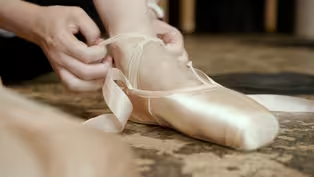
Video has Closed Captions
Clip: S3 Ep3 | 5m 1s | Revolve Dance Project revives ballet and live music in this behind the scenes look. (5m 1s)
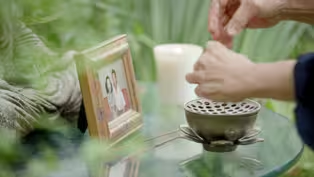
Video has Closed Captions
Clip: S3 Ep3 | 7m 44s | Donna Weng Friedman talks with us about the process of her award-winning short film. (7m 44s)
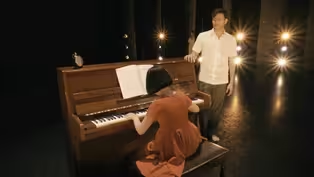
Video has Closed Captions
Clip: S3 Ep3 | 12m 3s | Donna Weng Friedman shares her parents’ story of immigration to the United States in a short film. (12m 3s)
Providing Support for PBS.org
Learn Moreabout PBS online sponsorship

- Arts and Music
The Best of the Joy of Painting with Bob Ross
A pop icon, Bob Ross offers soothing words of wisdom as he paints captivating landscapes.












Support for PBS provided by:
Art Inc. is a local public television program presented by Ocean State Media