
My Omaha
Season 28 Episode 2 | 1h 26mVideo has Audio Description
A filmmaker confronts injustice in his hometown as he reconnects with his conservative father.
As Omaha is shaken by protests and a death that becomes a movement flashpoint, filmmaker Nick Beaulieu navigates family conflict, personal reckoning, and the lived realities of racial justice activists. What begins as an investigation into division becomes an intimate exploration of what it takes to stay connected when our deepest beliefs pull us apart.
See all videos with Audio DescriptionADProblems playing video? | Closed Captioning Feedback
Problems playing video? | Closed Captioning Feedback
My Omaha
Season 28 Episode 2 | 1h 26mVideo has Audio Description
As Omaha is shaken by protests and a death that becomes a movement flashpoint, filmmaker Nick Beaulieu navigates family conflict, personal reckoning, and the lived realities of racial justice activists. What begins as an investigation into division becomes an intimate exploration of what it takes to stay connected when our deepest beliefs pull us apart.
See all videos with Audio DescriptionADProblems playing video? | Closed Captioning Feedback
Where to Watch Independent Lens
Independent Lens is available to stream on pbs.org and the PBS app.
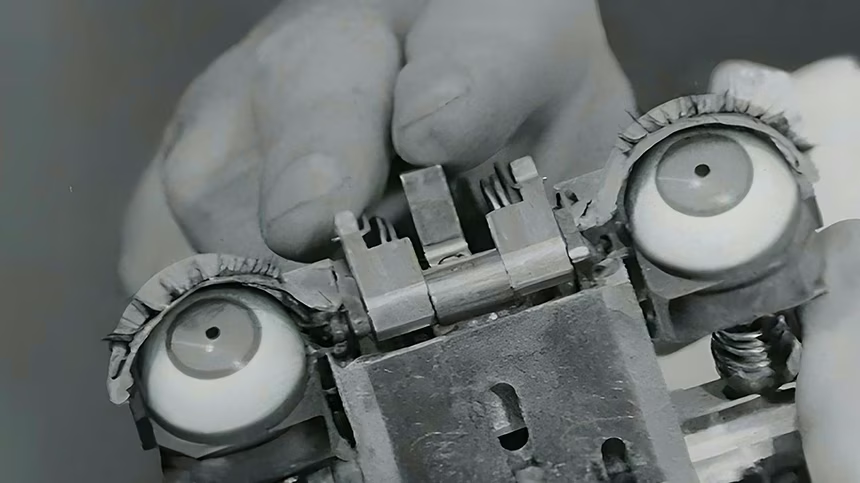
Aesthetics and Unraveling the AI Hype
Ghost in the Machine seeks to unravel the AI hype to find the untold origins of “artificial intelligence.”Providing Support for PBS.org
Learn Moreabout PBS online sponsorshipMore from This Collection
The faces, places, and experiences that shape our local communities.
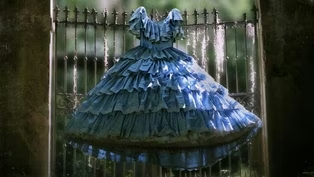
Video has Audio Description
Natchez, Mississippi, is famous for its antebellum homes, but what’s left out of the tours? (1h 25m 40s)
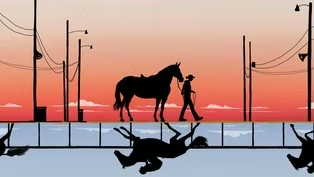
BACKSIDE: The Unseen Hands of Horse Racing
Video has Audio Description
Behind the Kentucky Derby's glamour, unseen workers keep racing’s biggest stage running. (55m 40s)
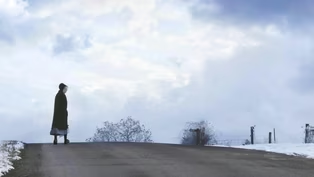
Video has Audio Description
An Amish sexual assault survivor breaks her silence, sparking a movement for justice and reform. (1h 25m 11s)
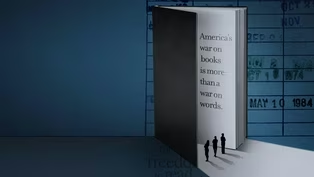
Video has Audio Description
Librarians across the U.S. examine how restrictions on library content are shaping communities. (1h 25m 43s)

Free For All: The Public Library
Video has Audio Description
How public libraries shaped a nation and remain a beloved sanctuary for Americans today. (1h 24m 21s)
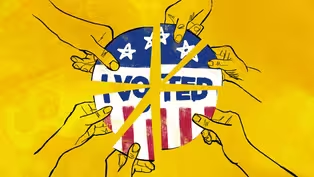
Video has Audio Description
Unravel the complexities of the Electoral College through four 2020 presidential electors. (1h 16m 37s)

Video has Audio Description
Women and LGBTQ+ journalists launch startup The 19th* to buck a broken news media system. (1h 24m 13s)
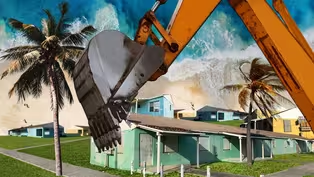
Video has Audio Description
A public housing community in Miami becomes ground zero for climate gentrification. (1h 23m 30s)
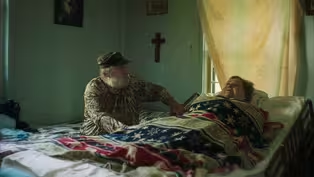
If Dreams Were Lightning: Rural Healthcare Crisis
Video has Audio Description
With rural hospitals closing, meet the people trying to get help in healthcare deserts. (25m 43s)
Providing Support for PBS.org
Learn Moreabout PBS online sponsorship♪ Dad?
Randy: Yeah, buddy.
When are we gonna be done?
Randy: [Chuckles] Well, we're just kind of getting started, honey.
Young Nick: Hi.
This is Nicholas Beaulieu, "Ten-Six News."
Randy: Thank you, Nicholas.
Check it out.
You're on camera.
Cheese.
Randy: Come out of the shade so I can see you.
Cheese.
OK, that's enough cheeses.
Nick, voice-over: This is me when I was four years old.
Are you gonna get cooled off?
Randy: Oh, I don't know.
I don't have the right clothes on for it.
[Young Nick speaking indistinctly on video] Nick, voice-over: And that's my dad, my hero.
I got you.
[Young Nick laughs] Nick, voice-over: It's painful to watch these tapes now, not because anything bad happened back then.
I guess it's just hard to be reminded of the way things once were and how it's all changed.
[Contemplative music] ♪ No justice, no peace!
No justice, no peace!
[Vehicle horns honking] ♪ All lives matter, not just Black, not just white.
Not just Hispanics, not just Asians.
All lives matter.
[Vehicle horns honking, protesters cheer] Don't shoot!
Hands up!
Don't shoot!
Hands up!
Don't shoot!
Hands up!
Nick, voice-over: I've just finished journalism school, and I'm here in my hometown of Omaha, Nebraska.
Ever since I've graduated, everyone's been talking about how America has become more divided than ever before.
But to me, Omaha has been divided for a really long time.
It's just, nobody talks about it.
On one hand, we're home to Warren Buffett and a thriving middle class.
And on the other, we're extremely segregated and have one of the highest homicide rates in America for African Americans.
Newscaster: We begin with breaking news out of North Omaha this morning.
And already, four Omaha shooting victims in one weekend, and no one has come forward.
Nick, voice-over: People often refer to Omaha as a tale of two cities, and since I'm from here, I feel like I'm the guy to tell this story.
But to do it right, I need to go back home and better understand the world I come from.
Nick, off-camera: Sorry.
I've gotta adjust for the-- it's getting dark.
This is so dumb.
This is such a dumb idea.
I should have done this sooner.
Nick, voice-over: The problem is I'm still learning how to work this camera.
Nick: Nothing?
Nope.
Nothing.
Why?
Because I'm not having this conversation on video.
Nick, voice-over: And I'm not instilling a whole lot of confidence either.
[Imitates key clanking in lock] All right, is everything green still?
Like, do we look blurry or in focus?
Mom: I'm thinking you need to start over.
All right, we're live.
Um... Nick, voice-over: Lucky for me, my dad gives me another shot.
Nick: I guess to start with, how would you identify yourself politically?
Conservative.
Uh-huh.
I would say, you know, very conservative.
How do you think I identify politically?
I think that you identify on the Democratic side of things, but I think you're basing your viewpoints on much of what the media has to say and what their opinions are and not necessarily on digging into the facts.
Because I guarantee you, as your dad-- and I hope that you take this to heart-- as your dad, I want you to know the truth.
You like President Trump, correct?
I like the job that he's doing, yes.
Do I like everything about him?
No.
But, you know, from the very beginning, it made me very angry that an outsider, a person like you and I, other than the fact that he's a billionaire-- That's a pretty big part of it.
[Laughs] Randy: Well... You really think he's just kind of like your average guy?
Well, I guess I should start asking some questions back.
What's your view of President Trump?
My honest belief?
Mm-hmm.
I think he's a fraud that duped a lot of Americans.
And I'm not saying that you have been duped, but what I'm trying to say is that I think he's played on sects of the population.
For example, he panders to Christians.
I don't think he's a Christian in his heart.
That's your opinion.
Yeah, it's my opinion, but I think it's not hard to deduct that it could be true.
Nick: Do you disagree?
I do disagree.
He didn't need this job.
He's a billionaire.
He didn't need the power.
He didn't need the notoriety.
Nick: Well-- Randy: He wanted-- You know, it's amazing, the job that he's done.
He's done everything or tried to do everything that he said he was gonna do.
And that's why he was elected by the majority of this country.
I don't think he's done a lot of good.
Well, I can give you a list as long as my arm.
And you're just not learning about it because of the media outlets that you listen to.
You have to admit, Trump and Fox News are like.
No, they're not.
Yes.
Yeah, they are.
No, they're not.
You have a whole different set of facts than I do.
And one of us is wrong.
One of us is right, one of us is wrong.
Nick, voice-over: It's so hard to talk with Dad without getting into an argument.
It feels like we're living in two separate realities.
But it wasn't always like this.
[Young Nick singing, indistinct] Nick, voice-over: I grew up in the suburbs of Omaha, and I was the first child born into our middle-class Midwestern family.
My dad filmed almost everything.
Randy: Yay!
Take a bow.
Young Nick: I'm reading.
Randy: Who said you could read in our bed?
I did.
Uh-huh?
And who are you?
Nicholas.
Nick, voice-over: I had two great parents who loved me, my brother, and my sister.
Randy: There's my whole crew-- Mama, Liv, Sam, and Nick.
Nick, voice-over: We had a great family, but my dad and I had a special bond.
I'm gonna stay until I catch one.
Randy: OK.
That's what I like to hear.
Nick, voice-over: And he was in the stands for every one of my games.
Randy: Way to go, Nick.
Nick, voice-over: My dad followed the news closely, and he cared a lot about politics.
His passion rubbed off on me, and I became a proud member of the Republican Party, even though I wasn't old enough to vote yet.
Randy: Did you see your sign on the garage, Clauser?
Oh, your sister made you a sign.
That's nice of her wasn't it?
Nick, voice-over: But as I got older, my relationship with my dad began to change.
Randy: I know.
Nick, voice-over: Over the years, my dad's feelings about politics and America grew more intense.
He was trying more than ever to keep me in his corner.
"Dear Nicholas, I thought I would start a tradition of Christmas letters for each of you since during the year, things are busy and hectic and we seldom stop to really talk with each other.
Say a prayer every day that Americans wake up and take back their country, as Obama is on track in his first year to destroy everything that our Constitution stands for.
Sometimes, you and I are a little rough around the edges, but I hope that you understand that I need to be your dad first and a friend second.
Eventually, as you and I get older, those two things will blend together as one.
I love you very much.
Dad."
Nick, voice-over: I know my dad just thought he was helping, but I needed to break free and think on my own.
In college, I discovered this Oscar-nominated documentary about racism in Omaha, "A Time for Burning."
And it changed everything for me politically.
Man in film: I think the Christian community has a great opportunity today to really help change the climate.
You know the myth that the white man is inherently superior to the Black man?
This myth has plagued us for such a long time by what we say, by how we act, we teach.
Nick, voice-over: It was radical for its time in its blunt and unflinching depiction of the struggle for racial justice.
Barber in film: I can't solve the problem.
You guys pull the strings that close schools.
You guys draw the boundaries that keep our kids restricted to the ghetto.
You guys write up the restrictive covenants that keep us out of houses.
So it's up to you to talk to your brothers and your sisters and persuade them that they have a responsibility.
We've assumed ours for over 400 years.
Nick.
voice-over: I became obsessed with this movie and I looked up to the director, Bill Jersey, who is a documentary legend.
In 2009, he did this interview for the Documentary Channel and spoke about truth in a way that has always stuck with me.
I think you have a real obligation to get at the essence of the truth.
And the truth in this, in fact, wasn't even about Ernie Chambers and Bill Youngdahl.
It was about how difficult it is to bring about change when situations, beliefs, attitudes, values, opinions are entrenched.
♪ Nick, voice-over: I was inspired to document how things have changed from then to now-- the tale of two Omahas.
And so I start to explore a part of town that I hardly know.
[Indistinct police radio transmission] [Radio beeps] 42nd and Newport.
Man on radio: Yes.
Correct.
Over.
Did they give a description?
Nick.
voice-over: One of the first people I get to know in North Omaha is Robert Wagner.
Robert patrols the streets, trying to defuse situations before they become violent.
You know, I lost my cousin May 29, 2011.
That incident is the reason why there's a Project K.N.O.S.E.
Keep North Omaha Safe for Everyone.
When we've been on patrol, there's never been a shooting.
You know, it takes normal, everyday citizens to say, "Hey, you know, we don't want any more shootings."
I think a lot of times, it's hard for me to measure the impact we're having.
I feel hopeless at times.
There's been a lot of violence up here, too.
I mean, in this small area, 14 murders.
Four blocks, 14 murders.
Another area that lives in fear.
Murders, kids see 'em and nobody talks.
So you tell me, where's the hope?
♪ Nick, voice-over: I haven't driven on these streets since I was in high school, when we considered it a game to drive around North Omaha.
I'm embarrassed to admit that.
But this night I've spent with Robert, it makes me wanna dig deeper.
I wanna hear what city leaders and others from the community have to say.
So I decide to attend the annual state of North Omaha meeting.
Schmaderer: Morning, everyone.
Let's talk about the data and where the numbers take us.
We can go to the first slide.
Schmaderer: Right.
What I'm saying is this, is how many-- and I'm not disrespecting you-- but what I'm asking you is, put yourself in my shoes.
I'm a parent, OK?
My daughter was shot in her head.
I have not heard from a detective.
I have not heard from anybody.
I don't get the decency of knowing that the person that took my child and other people's children is off the street.
There were guns found in my daughter--the house that my daughter was killed in four months later.
And they weren't found by police.
What kind of police work was that?
It's not OK, and it hurts.
Barney: And if you feel uneasy, that's OK.
Because this is an uneasy time.
We are here to focus on solutions.
Solutions.
And we have created an environment over the last nine years to make sure that anybody that wants to be a part of the solution can be at the table.
Leo: Wait.
No.
We ain't doing this.
[Audience applauding] Woman: Whoo!
We're gonna stand today.
OK.
We're here.
I appreciate it.
I'm hoping that you guys will stay and participate.
Nick, voice-over: I couldn't stop thinking about this guy afterwards.
I have a sense that this is someone I need to meet.
Leo: You want the nooks and crannies or you just want the overview?
Nick, voice-over: His name is Leo Louis, and he invites me over to the Malcolm X Memorial Foundation.
It's where Malcolm X was born, and it's a hub for community organizing in North Omaha.
Leo: Whenever I do a tour, I bring everybody out here first.
Eventually, the next phase of build out will be the five pillars of Faith Islam and the Reflection Pond.
That'll be our next phase of major construction.
Leo: We ordered a lot of seeds, and we gave them all to the community.
They get to choose what they wanna grow.
For me, it's a organizing thing.
We build it, we grow it, we harvest it.
As long as we all have a hand in it, then we'll take care of it.
And that's important to me.
And it's a part of building community.
When we was little, we called it the woods.
Really?
So, I grew up over here.
I didn't know that Malcolm X was even over here.
Nick, voice-over: I have to admit, I haven't given enough thought to what it means to be a white person filming in the Black community.
But the more time I spend in North Omaha, the more I realize it's something I have to consider.
I never thought about that.
There's limitations I have being a white person making something like this.
And like, I just wonder if that, if you have any reservations or kind of fears about that?
My relationship with you isn't because we went to high school together.
I didn't grow up with you, didn't ride in a car with you, didn't hang with you, never played golf with you, never spent the night at your house or ate Cheerios in the morning.
Nothing like that.
How I met you is you're the guy that wants to do a documentary about Omaha and the two different versions of Omaha.
And this is the version that I live in.
This is the version I exist in.
Do you think that there's an inherent problem in that of itself that I am... Oh, of course.
getting educated from you?
Of course, of course, of course.
Because in humankind, we gotta spend time together.
To really be educated, the best way we possibly can is to have a shared experience.
That's what really changes the world.
Nick: You know, how much did Malcolm X actually talk about the role white people play?
Leo: In '64, he was asked that question during an interview.
You might be able to go back and pull it up.
They asked him, "What role do you think white people should play in the liberation or the assistance of Black people?"
And he said, "Well, whites should go educate other whites about their racism.
Blacks don't need to hear about it.
Other whites need to go tell other whites, and Blacks don't need to tell whites about it.
Whites need to tell other whites 'cause there's people in their families, their cultures who are actually perpetuating it.
So they need to educate each other."
That's what Malcolm actually said.
Nick, voice-over: Talking about racism with my dad is not something we usually do, but sometimes it would come up in subtle ways.
Nick: What do you think it means to be an American?
It means that you're free... free to be all that you can be, um... free to achieve what you want to achieve.
Um, and the possibilities are boundless.
Nick: And you think everyone who lives in America has that opportunity?
I do.
Don't get me wrong.
I mean, I think we have a less than desirable start to our country with the things that were allowed and the things that went on.
Um... Mistakes are--are made.
And that was probably our biggest error, the biggest mistake ever.
Um... I think it's been learned from.
And, uh, we need to move on.
But, um... yeah.
Nick, voice-over: It feels a bit hollow talking like this, when my dad is holding back on some of his most honest feelings.
I know this because I see them online where my dad removes his filter and fires away.
♪ I can't stand this version of my dad, and I don't quite have the guts to call him out on it, so I just unfollow him.
But I can't sit back and ignore it forever.
I come across this church that's holding the kind of conversations I've been looking for.
It's led by this pastor, Cynthia Lindenmeyer.
Cynthia Lindenmeyer, voice-over: When I was hired at First United Methodist Church, I just got, like, this fire in me to begin understanding how Omaha could allow itself to be so segregated.
One thing I kept hearing over and over when I reached out to people, I began to know in North Omaha is like, "You need to do your work.
White people need to do their work."
To me, I was really focusing on creating a safe space where people could have these difficult conversations.
Just, we've been on this journey talking about white privilege, white fragility.
And so not only to be on our own journey of awakening, but also advocating for change and helping educate others who probably are, without even knowing it, are perpetuating the myth of that everything is great and equal.
Do you recall or can you articulate the time you got drama or feedback from a white person when you challenged race issues?
With the people that are closer to me, I've kind of tried to figure out where they're at, and then I just do little... Snippets.
Snippets... hoping that it comes around.
But I don't know how much of that is being not courageous enough and how much of it is realizing that it does take the baby steps to get there.
Different woman: A group of ladies that I was with, one of the women brought up that her husband had been in the Old Market at a restaurant.
And a lot of-- I don't know--a lot, some Black young men came in and sat down, and she said, "And they were gang members, and my husband wanted to call the police."
Some of the other women started, "Oh, yes, the gangs are just taking over the Old Market.
What are they gonna do about that?"
And I didn't know what to say and I probably didn't say the right thing, but I just said, "I don't understand.
How did your husband know they were gang members?"
And she said, "Oh, you can just tell.
You can just tell."
And then I was like, "Did they do something scary or threatening?"
"Well, no, no, but you can just tell."
And then some of the other ladies were like, "Well, yeah, how can you tell?"
And, you know, that was probably kind of as far as it went, you know.
The question on the table is, do we really care if we do nothing?
And so one of the things that Nick and I talked about is that we have different levels, and I learned a long time ago, try not to get judgmental, A'Jamal, when someone's at the beginning versus someone's at the end.
Because at some point, we all grow.
And so, how do we help others who have not experienced what we've experienced in this room if they wanna do something because white folks sometimes have the luxury and the privilege not to do anything.
So that's the question I throw out to us collectively, is what helps us to make it to the next level.
Or are we OK with the level we're at?
Is that a fair question, y'all, or did I stir the pot a little bit?
Nick, voice-over: It makes me wonder what would happen if I try to have this conversation back at home?
And then I get some news that totally changes everything.
Dad's been losing weight and isn't feeling like himself.
Soon enough, our worst fears were confirmed.
Randy: Well, um, diagnosis, I believe, came in late April, early May.
It's, uh, pancreatic cancer stage four, which means it's spread to other organs, which in this case is my liver.
And, uh, so, uh, in addition to that, had some other complicating factors that have caused a lot of weight loss.
Nick: Right.
You know when I learned about the diagnosis, we were in this room, and I remember hugging you, and I just started sobbing.
Well, you're gonna catch me probably breaking down here... Nick: It's OK.
during part of this, 'cause even though I'm at peace with this, a lot of emotions run high.
So, um, you know, at that point it was, [Clears throat] I gotta tell you, it was horrifying for me to tell you that, you know, um, I'm possibly gonna die.
So, um, it was more, to me, it was at that first moment, it was more about that than, you know, you.
And I didn't expect for you to, you know, to accept it well.
Um, I just knew it wasn't gonna be easy.
I'm in for a battle.
Odds are not in my favor, but, um, I believe in miracles, and I think a lot of other people do, too, and there's lots of prayers being said, so... Yeah, I'm sure, uh, at some level, you're probably still processing some of the shock from the news.
Surprisingly enough, you would think when you get a diagnosis like that, the immediate thought is fear, and I didn't feel that.
Uh, I seemed to have some sort of calmness that I can't explain.
So, you know, it's crazy.
Even though this seems like some sort of curse, to me, in many cases, seems like a blessing at the same time.
♪ Priest: Through this holy anointing, may the Lord in his love and mercy help you by the grace of the Holy Spirit.
Heavenly Father, we ask your blessing on Randy for the healing he desires of his body, of his mind, and most importantly, his soul.
We ask Your blessing upon Randy in the name of the Father and of the Son and of the Holy Spirit.
Amen.
♪ Man: We are just humbly asking our daddy to heal our brother, to take this cancer that's in him and remove it from him, grant him strength, Lord, and keep the pain from him.
But we choose to hope.
♪ ♪ Leo: So I gotta try to catch my receptionist today, who's been helping me with my moving business.
Gotta talk to my business partner for a moment.
Gotta pick up keys from one of my drivers in the moving business because he's got some personal things he's gonna try to deal with.
Gonna try to get that done in the next two hours real quick while I still have a phone call I gotta make.
Calvin, what up?
Nick, voice-over: When I'm around Leo, it feels like I'm with the people's mayor of Omaha.
He knows everybody and is always on the move.
Leo: Nothing much.
[Chuckling] Like I said, we'll be meeting next week about that.
Leo, voice-over: So growing up in North Omaha, like, me and a lot of my friends, we grew up poor.
We grew up trying to get by.
Woman: Brother Leo.
Leo: What's up, Sister Erin?
How you doin'?
I'm doing all right.
Yourself?
Hello.
How you doing?
I'm good.
Oh, that's Nick.
Don't mind him.
He just following me around for the day.
Erin: OK.
Leo, voice-over: Growing up in a place where people have died from shootings, where people have been murdered, it became a cumulative thing.
It became something that added up, that stacked up.
"I have this experience, I have this experience, I have this experience."
So I get angry.
There's a bottled-up anger and I watched some of my peers give up.
Did Knowledge come down here and bring you the keys for the truck?
No.
OK.
Leo, voice-over: He's supposed to bring some keys down here.
What that means is you join a gang, you start rapping, you drop out of school, you start selling drugs, you do something that says, "I'm going to be opposite of this system 'cause the system doesn't want me in it."
And I didn't like any of those options.
I did try doing music.
I did try rapping.
I did flirt with being in a street gang for a while.
It wasn't until I got much older and I started to meet people in the nonprofit space, where I started to see where I had an avenue and an outlet to change the things that were going on in my community.
So the question is, who woke you up to consciousness?
Who woke you up to the idea that America ain't all it seems?
By the time I hit fourth grade, I'd already realized that something was tremendously wrong with the status of Black people in the social landscape.
And so I wanted to write my paper about that.
Instead, what I ended up doing--How you doing, Alicia?
What I ended up doing was writing my paper about overpopulation in the world.
So I was afraid in the fourth grade of actually speaking out on issues that affected people that look like me.
So my fourth grade teacher is the one who woke me up.
I love myself, I love my community.
I'll see y'all later.
Peace.
Nick: I wanna ask you, just from your perspective.
How do you, you know, how do you try and overcome an impasse with someone, yourself?
Leo: Communication is the only way to work through it.
And that includes empathy, that includes sympathy, that includes the seeing it from another person's perspective.
So part of that philosophy is doing the work that it takes to build proper communication.
Nick: You wanna tell us where we're headed?
Um, we're, uh, hopefully headed for Mount Rushmore, but we're counting on GPS, and GPS is not exactly, uh, accountable.
Nick: Where are we right now?
I have no clue.
But that's what it's all about out here, right?
Nick, voice-over: Dad's chemo treatment is working and most days, he's feeling pretty healthy.
Nick: Dad, how long have you wanted to go to Mount Rushmore for?
Oh, it always crossed my mind a million times and just never got around to it.
So here we are.
Nick, voice-over: We're all just trying to get back to normal.
Nick: What do you think?
I'm not nearly as interesting as a waterfall.
I already got the waterfall.
Oh, OK.
Randy: Day three--snowstorm in the Black Hills.
Nick: Do you think this trip, does it feel different given the circumstances to you?
No.
Not really because I don't feel bad.
I feel perfectly normal.
Nick, voice-over: Since Dad's feeling better, I ask if he wants to attend one of the meetings I'm filming at the church.
To my surprise, he says yes.
So, folks, my name is A'Jamal Byndon.
I'm the director of Cultural Humility at First United Methodist Church.
We're gonna be dealing with ideals and issues, for some, that can be very controversial, for some of us, part of our norms of dealing with this topic.
But want you to feel welcome and also able to participate.
Speaker: My dad, he didn't wanna think that his success-- and he ended up being very successful-- had anything to do except with his own skills.
You know, he would never, ever-- and we had this conversation many times--ever admit that because he was a GI, he was an athlete, he was white that doors just opened up for him.
But he would not admit that his whiteness had anything to do with his success.
So the question is how to open up these conversations without appearing to, you know, undercut that fundamental belief that they've got, that somehow, they've built their own success.
I don't know the answer, but that's the problem.
Different speaker: The conversation historically goes in circles because the people that are participating on both sides of the fence don't want to deal with the reality because the reality calls for change.
And persons like myself, um... know there's not going to be a change.
Different speaker: It's nice to have these conversations, but we never get to the part where I haven't met one person that's willing to move out of West Omaha, willing to take their kids out of private school, willing to do all of their "downgrading" in order to live a more egalitarian life so that they can be, uh, more about the people, if you will.
I haven't met one.
Different speaker: What person in power is really trying to come off the power?
The answer is none.
These talks make you "feel good."
I'm not here to make you feel good.
I'm here to make you feel insanely uncomfortable, insanely uncomfortable.
Because other than that, what will change?
I'm not mad at no one.
I'm just saying, be honest with yourself.
If you got it, you really ain't trying to come off of it 'cause if you were, your ass wouldn't be here, you'd be out there getting it off to somebody.
Right now, you here with me, talking.
You ain't doing nothing.
You just wanna feel good.
That's what you wanna do.
A'Jamal Byndon: So, folks, thanks for being here tonight.
Very insightful and wonderful conversation.
Nick: Do you mind if could I ask you some questions about it?
Randy: Nah, I don't want to.
Nick: Why not?
I just don't.
I just don't want-- I don't wanna be recorded on all this stuff.
Nick: Well, part of the film, I was trying to kind of involve families talking about stuff, you know?
That's kind of why I wanted you to go to be able to get your thoughts on stuff.
It may, yeah, but are you recording right now?
Nick: Do you want me to stop?
Yeah, I do.
I wanted this--I just want-- Nick, voice-over: I wonder if it's even possible to work through our differences.
But to his credit, Dad is willing to keep the conversation going.
Nick: You talked about you didn't have a college education, that you worked extremely hard to get to where you did.
And I don't discredit that at all.
But like I talked about the fact that you are white and in Omaha and in Nebraska and in the Midwest.
Why did that dictate how hard I worked?
It didn't, but I'm saying it gives you advantages that I don't think you consider.
Impossible to say that you can deny that you have privilege as a white person.
I don't--you know what?
I am so sick of hearing the term "white privilege."
I think that is the most-- the biggest garbage term that's ever been coined.
You know, from witnessing the meeting that I came to with you, there's just people that just don't like white people.
And I don't know how you change that attitude.
I believe that everybody has the same opportunity because in my eyes, they are not discounted to a level of somebody that is not as good as a white person.
Yeah, it's not as black and white as that.
Why?
Because of all of these things in life that you could be born into or that play a role-- Right, but we didn't create that.
So why is that white privilege?
We did.
Nick: You know, when you have a father-son relationship like this and we have the political difference like this, how do you reckon with that?
How does it make you feel?
Well, it-- [Exhales] as a father, I, a lot of times, feel that you don't respect my intelligence because you believe that I'm wrong.
It bothers me that you think that I don't find you intelligent because I disagree with you politically.
Is it because you think I don't trust you?
Yeah.
You don't trust that I know the truth.
You don't think that I can have a different opinion than you and I still think you're smart and I still trust you as a dad?
There's nothing I want more than a good relationship with you and to have earned your respect and your love.
But when I'm dead and gone someday, if I didn't try to show you the truth and you dig for it someday and you find the truth... I don't want you to think to yourself, "Why the hell didn't my dad try to tell me this?
Why didn't he tell me that I was going down the wrong path, that I was listening to the wrong people?"
That's what I'm fearful of.
You think I'm following a set of lies and that it's difficult for you to sit with that.
I'm not saying that everything that we discussed tonight, but I believe that in some cases, you've been lied to.
I can't not say that, Nick.
I know that to be true.
I don't take offense to it because I think the same way about where you're coming from and we both think we're just being misled, right?
Yeah.
That's what it is.
Yeah, yeah.
And it breaks my heart.
Well, um... is there anything else tonight before we wrap that you wanted to say?
No, just that I love you.
Love you, too.
♪ ♪ Nick, voice-over: I feel like I'm going crazy, looking for some kind of answer that doesn't seem to be there.
These two worlds I keep going back and forth in have never felt more apart.
James Wilcox: And the breaking news this morning from the Old Market as Omaha police investigate a deadly shooting.
Chinh Doan: Omaha's police chief says, along this sidewalk, near 11th and Farnam Saturday night, at least two rival gang members shot at each other.
Gunfire hit seven people nearby.
20-year-old Jasmine Harris was shot in the back and died at the hospital.
Nick, voice-over: Another tragic shooting has happened, but this time, it's in Downtown Omaha.
And I'm curious to see how people will respond when the violence that's usually confined to North Omaha happens in their own backyard.
We wanna make sure while we're all reacting and we're all sad and we're all scared that this happened, that we're remembering that this is a one-off and that this doesn't happen and that Omaha is one of the safest cities in the entire country.
Nick, voice-over: An emergency meeting has been organized for business owners and residents who live downtown.
As soon as this came out, I had phone calls literally from all over the United States.
"Oh, God.
Do I come in for the College World Series?
What am I gonna do?"
I've got a party that's due in from Texas on Monday.
They called and, "Should we cancel our party?"
Different speaker: I am not a victim, and I'm not scared.
I'm not gonna let other elements scare me in my own neighborhood.
Different speaker: In the past, we've had more of a visible police presence.
I would wish that we could bring that back.
Different speaker: Is it possible to get a list with the gang members that have committed recent-- anything recent that's violent crimes so we know about this?
Yeah.
Man: I have gang unit officers that work at the Hive, and they tell me who not to let in.
Barrett: No, they-- Man: "I wouldn't suggest dealing with these project gangster Crips tonight, if you would like a peaceful evening in your establishment."
Barrett: Those kinds of systemic issues, those are much, much bigger picture, and we absolutely agree that they're the root of the problem.
The Downtown Improvement District is in business to take care of public spaces, not necessarily to be working with social issues.
I should say we don't have the resources to go in and do all of the things that we would like to do.
So we focus on the physical environment, and then we advocate for the community to take care of the spiritual environment.
Man: So we're all on the same page?
The police department has been--I don't know the word I wanna use that's PC right now for the way that they've been treated by society over the last 48 months to where they're not allowed to do their job.
They're not allowed to tell these kids to disperse.
And so taking the leash off, so to speak, is probably a good option.
I don't know where we vote on that, but I'm getting pretty exhausted by the leash that you're put under.
If I'm three gang members pulling off a drive-by and I have a 14-year-old with me to give the gun to so he goes to juvie and I don't go... ♪ Nick, voice-over: It's hard for me not to get cynical about Omaha and this collective culture of convincing ourselves that everything's fine.
But where I see the most hope is in North Omaha.
[Kids singing indistinctly] [Cheering] All right, keep it moving.
Keep it tight.
Keep it tight.
Hey, good morning, North Omaha.
Good morning.
Good morning.
Good morning, North Omaha.
Nick: How would you explain to someone what North Omaha's really like who never comes down here?
Good place to raise your kids... We got a lot of stuff to do.
Nick, voice-over: As I get to know North Omaha, I'm understanding what the word community really means and what it looks like to be proud of the place you call home in spite of the perceptions and the stereotypes that exist.
Resident: The community is better.
It's better now.
Nick: Is it better than when you were a kid?
Do you think it's improved?
Yeah, it's way better than when I was a kid.
Nick: What do you think has gotten better?
Violence.
Whoa.
Whoa.
Whoa.
Nick: One of the things I'm trying to combat is so many people down here just think North Omaha is poverty, violence.
Do you think that that's a misconception?
Well it's a misconception and a reality.
And, honestly, I tell people, Omaha's the most segregated city I've ever been in.
I love it.
I mean, I live here.
It's great, but it is the way it is.
Separate but unequal, it still exists here.
Successful Black smart people leave this plantation and go on to other cities and make it big.
♪ [Indistinct chatter] Ooh!
Man: There we go.
Resident: Things have changed over the years because once they built the freeway, the freeway came through and cut right through the whole Black community.
Then you had the influx of crack and then the gangs.
We're the ones that have to change 24th Street.
Nobody's going to come down out of the damn sky or come up out of the ground to do a damn thing for North Omaha.
The people, we gotta do it for ourself and we gotta stop howling to the damn moon because really, the moon is there all the time anyway.
The moon stays where it's at.
Nick: Yeah.
[Indistinct conversations] That's my song, girl.
I'm going to go pass out flyers.
I will be back.
OK.
Nick: How have you guys seen North Omaha change over the years that you've been involved in your activism?
I have seen negative, and I have seen positive.
I have lived through two riots right here in North Omaha.
The riot was in 1967.
And 1968.
We had two riots back to back.
In 67' and '68.
And nothing's been put on 24th Street since the riot.
And I know if they can build up everywhere else, they can build up North Omaha.
Although a lot of negative things have taken place in Omaha, God is still with us, and His people will not perish.
And we have came back.
We've came from a mighty long way.
♪ Different resident: We come together as a community.
And that's you coming out, reaching out from the west side... And look how you can walk here from a different race And we're the north side.
and we volunteer to do this for you.
Man: And have a good time.
Nick: Yeah.
Why we can't get along out in West Omaha and do the same thing?
Right.
Nick: Exactly.
We not no violent person.
Nick: Yeah.
And you're so friendly, I would take you to a North Omaha bar, and you're cute.
Put that on your documentary.
Nick: Thank you.
[Laughs] You wasn't afraid to come from your shell from the west side to come to the north side.
And we appreciate you coming down here, exploiting us and letting us know, showing us the different way.
'Cause we can show you all a different way.
Amen?
♪ ♪ You ever heard the word [bleep] wagon?
Nick: In what context?
Well, if you look in the dictionary, they'd have a picture of this thing.
[Nick chuckles] [Laughs] [Laughs] I may just fall right through the middle of it.
Nick: Oh!
[Laughing] Um, you've had the opportunity to interview me.
And I thought it'd be interesting to maybe get your point of view on some things as well.
So... Sure.
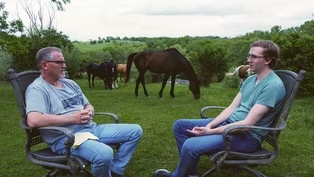
Randy: Yeah, I guess we should mention the horses are creeping up on us here.
[Laughs] We're hoping that they don't knock the cameras over.
Oh.
Don't do that.
No, you can't knock the cameras over, dude.
Do you feel that my example as a dad will be a benefit for you and your own family someday?
I think you've provided a lot of great lessons to me about being a dad that I'm excited to exercise when I am one.
And I think it's been in the good things you've done, and I also think it's in the mistakes that I've seen you make.
You know, we didn't have a very consistent livelihood, right?
Randy: Sure.
We had peaks and valleys.
It's embarrassing for an adult, you know, when you see all of your peers, as an adult, securely in their homes, securely being able to pay their bills, um, not having to eat the last can of peas that you saved from three years ago out of the pantry to have dinner.
And I would scream and yell and then feel like a complete imbecile after doing it, but then how are you supposed to then express that to a 5-year-old or a 6-year-old that you didn't mean it, "I'm very sorry"?
Yeah, I mean there was certainly a lot of yelling in our childhood.
There was.
No doubt.
Well, I've expressed it before, but I'll express it again.
I'm very sorry.
You know, I don't think-- I don't feel that it's something you have to be sorry for.
It's like, you can't be apologetic for the way you lived your life-- and doing--and you can't be apologetic for trying the best that you can, which you always did.
How did you come up with the idea of wanting to interview me?
Well, because it's easy to ask questions.
You know, I mean, it's not real easy to ask questions, I guess.
You know, it can get confrontational.
But I think by us doing that, it kind of shows what you're after here.
And that is, we can exist happily together with differing opinions because I don't think anything less of you right now than I did a week ago.
Thanks for leaving that for us.
Yeah, appreciate it.
Are you a good boy?
Randy: How do you like yours, Clausey?
Nick: With a little char.
Oh, oh.
♪ [Blowing] [Laughter] ♪ Randy, voice-over: Until you're a parent, I'm not sure that you'll entirely be able to wrap your arms around this, but each and every one of you is a part of me.
And how do you not love your own flesh and blood?
[Kids speaking excitedly] Speaker: It's the Pied Piper!
Randy, voice-over: I just, I look forward to the day that you'll get to experience those things for yourself because I know in my heart that you'll-- you'll be a fabulous dad.
♪ Nick, voice-over: I've been thinking a lot about where Dad and I stand, and Cynthia has become someone I go to when I'm trying to make sense of things.
[Phone line connecting] Cynthia: Hey, how's it going?
Nick: Well, I just was calling 'cause, you know, I spent today, I watched, like, an hour of all the highlights from my dad and I's interviews, you know.
He heard me out on everything and really listened.
And when I put myself in his shoes, I could easily see how you could just be like, "Why am I listening to this?," you know?
But yet he did it.
Randy: Nick, what are we doing today?
Going back home.
Randy: Where?
Going back home.
Randy on video: How do you feel today, mister?
You feel older?
Young Nick on video: Yes.
How much older?
Four.
Four?
Well, happy birthday.
Thank you.
Are you excited for all the kids to come?
Young Nick: Yeah.
All right.
What are you gonna do today?
Young Nick: Play golfing.
Randy on video: Play golfing?
Headed for the evil poison infusion this morning, once a month, whether I like it or not.
Nick: What number is this one?
This would be...16 or 17.
I'm losing track here.
Health worker: Hi.
This is Jenn calling from the Village Point Cancer Clinic I need to schedule a CT for a patient... Health worker: How you feeling today?
Randy: Uh, feeling OK.
Feeling OK?
Yeah.
It's the anticipation of this anymore.
I know.
It makes me nauseous just thinking about it.
Oh, I'm sorry.
That's all right.
Well, hopefully, once we get the nausea medications and whatnot going, that'll help a little bit.
Randy: Yeah.
Health worker: So, yeah.
OK.
♪ [Device clicks] Randy: I should not be [sniffs] nauseous... yet I am.
[Exhales] Nick: Do you just think the Ativan helped out?
Randy: I don't think so.
I feel extremely hot, too, like my face feels like it's, like, flushing.
Nick: This one seems to be rougher than normal.
Yeah.
I would have to agree.
[Sighs] ♪ ♪ Speaker: Is there an area in your life that God may be nudging you to take a leap of faith in?
Randy: I'm considering whether or not to-- whether I want to continue with treatments for cancer.
They've been very difficult.
They get more difficult each time.
[Sighs] But at the same time, I've made what I consider to be miraculous progress with this thing.
You said May marks something for you.
Yeah, May will be my one-year anniversary of my diagnosis of stage four pancreatic cancer.
And they gave me about three to five months at the time.
And so I guess I have to think, when do I hand it over to God, and kind of take it from there.
So that's a decision I've been wrestling with a little bit.
So... Randy: I think He's telling me to let Him handle it.
♪ Protesters: George Floyd!
Say his name!
George Floyd!
Say his name!
George Floyd!
Say his name!
George Floyd!
Say his name!
George Floyd!
Say his name!
George Floyd!
Say his name!
George Floyd!
Say his name!
George Floyd!
Say his name!
[Flash-bangs popping] George Floyd!
Say his name!
[Indistinct chatter] [Siren pulsing] Leo: There were protests that went from 72nd and Dodge to move downtown.
I got a phone call from one of my buddies who said, "We gotta go protect Mixins.
It's the Black-owned business down there."
So I called a couple of guys, and we stood outside of Mixins, doing patrol.
Protesters: ... the police.
... the police.
Speaker: So I'm downtown right now, Downtown Omaha.
As soon as I get here, it's already lit up.
[Flash-bangs popping] So we got some brothers lined up over here.
What's up, y'all?
It's Leo on the front lines in front of Mixins, making sure that we protect Black-owned businesses.
There's a whole bunch of clowns around here, pretending like they from Omaha, starting mess.
And it's a whole bunch of young people don't know what they doing.
Look, get organized.
After tonight, tomorrow morning, you better be doing some push-ups and strategize on what the rest of the day look like.
If you ain't organized, don't even go outside.
You don't deserve to be on the streets.
Leo, voice-over: We heard gunshots earlier that night.
Maybe 10 minutes later, two young men run up the street, and they say, "Hey, we just saw a man get killed."
And they showed us the video.
Speaker: Are you kidding?
Speaker 2: Yeah, bro.
Shot.
Speaker 3: In the black shirt right here.
He got gunned?
Yeah, he died.
[Speaker 1 gasps] Speaker: Ooh!
Leo, voice-over: We seen James Scurlock getting shot on the cell phone.
Newscaster: A protester is shot and killed in Downtown Omaha last night, with the shooter in police custody, as the investigation is ongoing.
Reporter: James Scurlock.
The 22-year-old was shot and killed outside the Gatsby bar, formerly known as the Hive, at 12th and Harney last night.
Nick, voice-over: As the news starts to spread, I see that the shooter is Jake Gardner, the bar owner from that meeting downtown.
He's been released without charges on account of self-defense.
People are furious.
Everyone's on edge and bracing for the unexpected.
What's up, world?
It's Leo.
Real quick, y'all see this behind me?
This is Downtown Omaha.
We don't do this.
We don't do this.
So if you really wanna get down with something serious that's about action, that's not about foolishness, come to the Malcolm X Center, 6:00, 3448 Evans, and don't bring none of this with you.
This ain't what we about.
Speaker: Say his name.
Protesters: James Scurlock!
Say his name.
Protesters: James Scurlock!
Say his name.
Protesters: James Scurlock!
My name is Leo Louis.
And please understand today, we are here for peace.
Find somebody you do not know, and you look them in the eye for the next whole minute and see the soul of that person.
I know y'all uncomfortable.
This ain't grade school, though.
It's real life.
[Applause] Leo: Look at all that pain that we walking around with.
That is our pain.
You ain't struggling with it alone.
Too many people run around here talking about Black Lives Matter.
I did this five years ago.
I know.
We were here.
We were kneeling, we were chanting.
Put them signs up in the air.
Let me see 'em.
We did that!
Protester: Come on!
Yeah!
[Applause] Beautiful.
Beautiful.
But do you know why you made that sign again?
Because the system didn't change.
You didn't change.
Nothing changed.
You all walk around here playing!
Protester: Come on, Leo!
[Indistinct chatter] 'Cause you don't do your homework.
You watch TV.
You flip up and down TikTok, and then when Black stuff happens, you wanna go protest and say, "I'm down with the Black people."
But you do know about Black people.
Get some education.
Protester: That's it.
You wanna fight for Black lives, learn about Black people from Black people.
[Applause] I'm not shaming you for not knowing, though, 'cause I didn't know either.
I was like, "Malcolm X, nah.
Too Black for me, dawg."
But when I realized that my Blackness had marked me for something, I went on a mission, like most Black people do, when we find our identity.
And guess what it takes for us to find our identity.
Some of us dying!
Protester: Right, that's right.
That's how lost we are.
You gotta kill one of ours for us to understand what to do.
[Applause] So if you wanna be a revolutionary, raise your fist right now.
Protester: Come on, now.
These are the ones who committed to study.
These are the ones.
So if your hand is up, you have committed yourself to getting educated about this struggle.
Much love to the reactionaries, but more love to the revolutionaries.
[Protesters cheering] [Applause] Leo, voice-over: I think that what happened here, the moment that happened here saved the city.
[Music] Leo, voice-over: We had two nights of violence, and then we have this huge peaceful rally at the Malcolm X birth site.
All of the activists, all of the out-of-towners getting educated and getting the opportunity to see Black folks in a space that they control and doing it well and showing them how to organize.
Speaker: Black lives matter!
Protesters: Black lives matter!
Black lives matter!
Black lives matter!
Hands up, don't shoot.
Hands up, don't shoot.
Hands up, don't shoot.
Hands up, don't shoot.
Hands up, don't shoot... ♪ [Cheering and applause] Nick, voice-over: Following the death of James Scurlock, a grand jury was called in the case against Jake Gardner.
He's been charged with manslaughter and three other felonies.
But before he could turn himself in, he took a gun and killed himself.
And now we will never know the full story of what happened.
What's left behind are the two sides-- the people rallying for James Scurlock... and those defending Jake Gardner.
He committed the crime of defending himself while white.
Speaker: We need justice for Jake Gardner.
You know how to get it?
Speaker 2: The mob drove Jake to suicide.
Stuart J. Dornan: Mr.
Gardner is a decorated veteran of two tours in Iraq.
Speaker: He defended himself... Dornan: He paid a tremendous price for his valor and his efforts.
If they can do this to him, then, of course, they can do it to all of us.
And that's exactly the point.
Nick, voice-over: It's the latest chapter in the tale of two Omahas.
And that phrase has never felt more true to me.
[Thunder] As your health has gotten to the place that it has, has that given you more insights on life?
You know, like, do you feel different?
Yeah.
How can you sum that up or explain that?
Well, it's a story, I'll tell you just recently that I had this distinct draw to just drive in the country, get off the interstate and drive in the country.
And so I just decided to go.
And it was things that I used to drive by and see but not see.
I was seeing these things, three dimensionally, euphorically... [Inhales and exhales] like I've never seen them before and probably will never see them again.
It--it just, uh, was unexplainable, uh, the amount of appreciation that you saw in God's work.
When you think about you and me, is there a specific memory that comes to mind when you think about just our relationship?
[Exhales] Well, first I think about some things that I regret.
That's the first thing that you think about when you think about me is regret?
Well, that I regret having done as a dad that I wish I could take back.
Does that overshadow the good memories that we have for you?
Randy: No.
But that's the first thing that comes in your head?
Yeah, because I don't want to be unforgiven for it.
You know what I mean?
You know, my favorite memory... is when I'm at sports practice, and I'd look over and see you watching still.
Because... [Sighs] you were always there and you didn't have to be.
[Exhales] Sorry.
I'll always be, uh... [Inhales and exhales] I'll always be watching.
♪ ♪ ♪ ♪ Check.
Hello.
Mic check.
This is day one of video journaling.
All right.
It is day four of the video journal.
I am not doing well.
Kind of having a depressed episode today.
OK... Nick, voice-over: It's been a year since dad died, and I've decided to start a video diary as a form of self-therapy, but it's not really working.
The kind of different emotions I was feeling today-- guilt, loneliness, selfishness, frustration, anger, confusion, fear, helplessness.
To be continued.
[Clears throat] January 1st.
This is the 25th self-taped diary.
Nick, voice-over: I'm at a total loss for what to do next, but I've gotta do something.
Happy New Year.
Nick, voice-over: So I reach out to someone I've always wanted to meet.
♪ Who's that knocking at my door?
♪ Well, fancy meeting you-- Hey, Bill.
What's this guy?
I don't know who that is.
He's got a funny thing in his hand.
What is that machine for?
You'll have to ask him, I think.
It's scary.
Good morning, Bill.
Come on in, guys.
Nick, voice-over: It's the filmmaker Bill Jersey, who directed "A Time for Burning."
I have no idea what to expect here, but I'm excited to spend some time with someone I deeply admire.
Nick: Well, you know, I have spent a lot of time thinking about then to now, right, as I make my film.
And a couple times when I watch "A Time for Burning," I hear things that are said now but just in a different way.
Man in film: What kind of attitudes are you sharing with others, your friends, your children when it comes to race relations?
Speaker: Ray, how many colored folks have you brought into the church?
Me?
I'm scared to death.
Why?
Why?
I have but understood this problem two short weeks.
Two weeks.
I am just such an infant that I--I know nothing other than the urgency... Speaker: All right, now you see the urgency, Ray... Bill Jersey, voice-over: I was trying to help them understand who they were and what they were doing.
What they did with that is their business.
I don't ever feel obliged to change people from what they are, but I do feel some obligation to help people to see who they are.
There was no narrator.
Nobody told them what to believe, no one who told them who was good or bad.
What this film did was allowed the people to show who they really were.
Man: I mean, are you a white Christian or are you a Christian... Nick, voice-over: I tell Bill more about my film, and reluctantly, I show him some footage, like this interview with my dad.
Randy on video: This country was founded on the premise that you can make of yourself what you want.
You can use the argument that some groups of people are suppressed.
I disagree.
You have a whole different set of facts than I do.
And one of us is wrong.
You don't trust that I know the truth.
When I'm dead... See, that's the problem.
Randy on video: I don't want you to think to yourself, "Why the hell did my dad try to tell me this?"
Bill: That's why I said, if he said to you, "Well, you know, we have to disagree on this, but I still love you, and we'll disagree," fine, that I understand.
But he has the truth and you don't.
That's fundamentalism.
You know, especially when he got sick, I wanted something more.
I didn't want to resent him.
I didn't wanna be inauthentic around him.
I wanted a genuine relationship.
But at the same time, a relationship's a two way street, so I can only do my part.
That's all you could do.
All you could do is try.
♪ No, actually, you don't have more work to do.
You did it.
You did it right there.
It's done.
The job has ended.
You did it.
That's what I needed to see.
And that's it.
That's all I need to know.
Now you have to live your life in a way you can make him proud.
Nick: I'm trying to find the capital-T Truths in my film and in my life the way that you've talked about truth, how there's facts and then there's the capital-T Truth of what's real and what's happening.
All right, here's the bad news.
You ready?
You're never gonna find the truth.
What you will find is, is in the process of pursuing truth, you become a better person.
It has nothing to do with finding it.
It has to do with seeking it.
It's the seekers that discover life worth living.
♪ Nick, voice-over: When I started this film, I was hoping to make some grand revelation that would change things in Omaha.
I now see that there's no end to that story.
It just continues to evolve.
♪ Nick: So this is the office, huh?
This is...?
Leo: The living room... Yeah.
You see all my books.
We put this on the wall because this is dedicated to Jamelia, who used to live here.
Her and her boyfriend were killed in this apartment, and so the apartment had been vacant for, I think, almost 11 years before we moved into it.
When we read about her story, we found out that she loved Tweety Bird.
So we just put Tweety Bird on the wall.
But this is dedicated to her.
Nicole made me this.
Sometimes I forget how much stuff I actually do, and so she's made this for me.
Just a reminder not to forget what I've done.
This was the march down Dodge.
This was one of the many town hall meetings that we had.
This is another town hall meeting.
Nick: Oh, that's me.
Leo: Look at you.
[Laughter] Nick: That I made the book.
Right, right, right.
[Laughter] Nicole: You know, you get so caught up in what you're doing or caught up in the emotion of things that you forget about all the things that you've done.
I wanna do a book of just all his flyers that he's made 'cause it tells a little bit more of his story.
Nick: Mm-hmm.
How did it feel to put together that book?
Nicole: It felt good.
I just wanted to let him know that I support him and I'm proud of him.
Leo: This was the march on Dodge.
This was the-- this was 72nd and Dodge.
This was after, I think, the killing of Mike Brown.
The first thing that gives me hope is that I'm still here.
A lot of my heroes are not here anymore.
And I know that standing on the backs of people who came before me, we have the wisdom of them, we have the wisdom of now, and then we also have the energy of the future, the energy of those to come, who can move this thing forward.
That's what I'm excited about.
A lot of times, I just drive to process.
Nick: Is there a place you like to go?
Hmm, No.
Just anywhere where there's just straight road.
Leo: I've grown significantly since I first met you.
I have learned that you don't always be loud.
And I've also learned that there's a peace in the quiet.
So as long as I'm growing, I'm doing fine.
Leo: You've been doing this thing for years now.
Where are we at?
You mean we, as in Omaha?
Everything.
Some days are different than others, and some days, I feel like I have the answers, and some days, I feel like I'm still questioning them.
But I think the one thing that is constant is the understanding and the realization that there's no stop.
You know, there's no end destination to being self-reflective or to having self-examination.
I don't think I had that before.
Cynthia: There's a quote that says, you know, "I wanted to change the world, but realized first, I had to change myself, and then I had to change my family.
Then I could change my town, then I could change my country, then I could change the world."
And really, it goes with changing oneself.
And then the next leap is--is family.
And I think a part of you wanted there to be, like, this aha moment with your dad, like, "Oh, wow.
I get it, Nick.
You're right."
And that didn't happen, but it could be your dad is the one that helped you get to where you are now.
Cynthia: For any self-transformation to happen, you gotta forgive yourself for your own mistakes and transgressions first before you can forgive others.
And really, as a nation, or even the City of Omaha, we've got to forgive ourselves before we can really move on.
♪ Check, mic check.
Nick, voice-over: There's one last thing I have to do.
I need to meet a friend of my dad's, who I've only heard about.
His name is Ghost.
He got out of prison a couple years ago and started volunteering at the same animal ranch as my dad.
I tracked down his phone number and rang him up.
[Phone line connecting] Ghost: RunningThunder Construction.
Nick: Hi.
is this Ghost?
Ghost: Yes.
This is Nick Beaulieu, Randy Beaulieu's son.
How are you?
Ghost: Oh, not too bad.
How you doing, Nick?
Nick: I heard that you guys sort of worked together a little bit on the ranch.
Oh, he became such a good friend to me and my girls.
We talked faith, and, I mean, I'm an ordained minister, but I practice Native American religious beliefs, so we had lots of adventurous talks about all sorts of things.
He was a smart man.
If you're interested, you might talk to my wife Sabrina at some point.
Nick: How about we can meet face to face?
I can talk with you, talk with Sabrina.
Ghost: OK.
[Girl speaking indistinctly] Girl: Take a picture.
Now smile.
Take a picture.
Pose.
Nick: He won't hold still too long, huh?
[Girl speaking indistinctly] I stop at the doctor's office.
All the nurses love her.
[Speaking indistinctly] Sabrina: You are the one that reminds me the most of your dad.
Nick: Really?
Yeah.
Yeah, your eyes... I mean, you've got the same... You just put off--you generate a kindness.
His eyes, there's something.
Him and his dad got the same.
Yeah.
The shadows around the eyes.
I'm serious.
When I seen you, it's like looking right at your dad, and that's a compliment.
He didn't judge anyone, and he believed that anyone could do better if the right person gave them a chance.
And he was always willing to give someone a chance and whatever support needed, you know, that he was able to influence that and help them.
Ghost: When I got to the ranch, I'm 20 years stunted on socialization from all my years in prison.
But I know that the man made me feel good.
He made me feel safe and secure, and I trusted him with my most inner turmoils that I hadn't trusted no one with for 20 years.
I rode with the Hell's Angels, Nick.
I've done some bad things.
But I'm not a bad guy.
So I told him, "This is what I've done."
But he's the one who pointed out, "That doesn't make you who you are.
It just means you done something.
And are you doing that today?"
"No."
"Well, it doesn't matter then.
Come on."
He didn't care what my history was if I was trying to make the history better, and he made me want to make the history better.
He just--I don't know how to... Sometimes you'll meet complete strangers in your life that will change your whole life and you'll never forget what they said.
You won't forget the look on their face.
[Object thuds] That's your dad for me.
I never had that until that day.
And that's why he means that much to me.
♪ ♪ ♪ ♪ Nick, voice-over: As I drive back to Omaha, I keep thinking about what Ghost said and my mind drifts back to a stranger I've gotten to know over the course of many years and one of the first things he told me.
Leo: In humankind, we gotta spend time together.
To really be educated, the best way we possibly can is to have a shared experience.
That's what really changes the world.
[Music] ♪ ♪ ♪ Randy: OK, um, are we having a-- [Randy chuckles] [Woman speaking indistinctly] Randy: Are we-- are we having a good time yet?
Young Nick: Yeah.
Randy: Don't take the whole thing up.
I'd like to be in the picture, too.
Yeah, there we are.
OK, all right.
Now, here we are at the mall.
Young Nick: My forehead.
[Randy laughing] Randy: All right.
OK.
We're done for now.
Announcer: Independent Lens is made possible by the Action Circle for Independent Lens with major funding from the John D. and Catherine T. MacArthur Foundation; Acton Family Giving; the Ford Foundation; the Jonathan Logan Family Foundation; and contributions from the following... Additional support for this series has been provided by the Corporation for Public Broadcasting and by contributions to your PBS station from viewers like you.
Thank you.
♪ ♪
Video has Closed Captions
Preview: S28 Ep2 | 30s | A filmmaker explores racial justice in his hometown as he returns to his conservative father. (30s)
Providing Support for PBS.org
Learn Moreabout PBS online sponsorship







Support for PBS provided by: