
“MY PARTNER, MY ENEMY"
Clip: 10/31/2023 | 6m 9sVideo has Closed Captions
“MY PARTNER, MY ENEMY: AN UNFLINCHING VIEW OF DOMESTIC VIOLENCE"
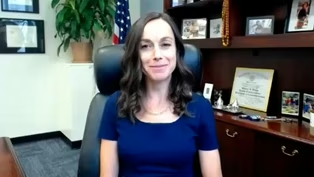
John Michael Leventhal, a retired New York State Supreme Court judge and the author of "My Partner, My Enemy," joins us to discuss his book.
Problems playing video? | Closed Captioning Feedback
Problems playing video? | Closed Captioning Feedback
MetroFocus is a local public television program presented by THIRTEEN PBS
“MY PARTNER, MY ENEMY"
Clip: 10/31/2023 | 6m 9sVideo has Closed Captions
John Michael Leventhal, a retired New York State Supreme Court judge and the author of "My Partner, My Enemy," joins us to discuss his book.
Problems playing video? | Closed Captioning Feedback
How to Watch MetroFocus
MetroFocus is available to stream on pbs.org and the free PBS App, available on iPhone, Apple TV, Android TV, Android smartphones, Amazon Fire TV, Amazon Fire Tablet, Roku, Samsung Smart TV, and Vizio.
Providing Support for PBS.org
Learn Moreabout PBS online sponsorshipJack: For generations, violence at home is something families kept private but only recently has it, to light as a social justice issue.
Domestic violence does not discriminate.
One in four women and one in 79 will be a victim of domestic violence or abuse.
New York is one of many states that to the issue head on.
We had the creation of the first felony domestic violence court in 1996.
John Leventhal made it his mission to bring more attention to the issue, which he has called an epidemic and he details his experience behind the invention what needs to be done to end domestic violence in his book, called my partner, my enemy justice Leventhal joins us now.
What prompted you to write a book about this?
Justice Leventhal: for 12 years, I did this important book.
I thought it was important because once O.J.
Simpson came, I think a lot of people thought, domestic violence just came about.
I used to these statistics prior to the O.J.
Simpson case is to so that this was while -- was of epidemic proportion prior to that.
Jack: I was a prosecutor in the late 1970's in New Jersey.
It was difficult to prosecute domestic violence cases then.
Why was it so much harder than?
-- then?
Justice Leventhal: Society viewed it as a private matter.
Police would go to a scene, maybe deliver the has been to a local bar.
Or of woman was injured, doctors and nurses would interview her and take care of her in front of the batterer.
They would not separate them.
It was no surprise that when they came to court and the judge would say, what do you want to do?
She would say I want to drop the charges and they would be dropped.
Once it became a societal issue, it empowered women and to disempower them.
It was in the hands of the prosecutor, then, not the hands of the woman to decide whether to proceed with the case.
Jack: Let's say a little about the domestic violence court.
How did that come about?
What was the concept behind it?
Justice Leventhal: When Galina Coumo was killed, that changed things.
The governor and Mayor Giuliani called for impeachment of the judge.
A judge cannot be impeached for discretionary reason.
But they found he had an antiwoman, and to prosecutor by is they needed a change.
Jack: You are taking this out of the regular court system and creating, literally and figuratively, a separate venue for these cases.
Why?
Justice Leventhal: Traditionally, courts want to be efficient.
Any domestic violence court, you want to ensure not only the rights of the defendant but the safety of the complaint, even after the case is over.
What I decided to do was bring back those who are lucky enough to get six months in jail, five years probation.
And I would bring them back every three months to ensure they would succeed.
Jack: You were keeping an active handle on all of this?
Justice Leventhal: Yes.
And we had 50% less violations than the general population.
The key was judicial monitoring and supervision.
Jack: Are we seeing progress being made in combating domestic abuse?
Justice Leventhal: Let me tell you historically.
Economically, women were at the bottom trend.
The rule of thumb was you could hit your wife with a switch not larger than the thumb.
After 1994, the violence against women act, statistics show that with the availability of shelters, primary aggressor statutes, with the prosecution of batterers, the intimate partner homicides -- and a lot of men's brief criticize these specialty courts, but they should know that intimate partner homicides of men has gone down 75%.
That is women killing men.
Allegedly in defense of being battered.
Of women, it is only going on 25%, but it has gone down.
But I think the availability of these things -- we have to do better, because we have shelters that do not accept teenage boys.
Women have to decide whether to stay where they are or leave their children.
Jack: Because he teenage boys cannot come with them.
Justice Leventhal: We have made more progress than any other country but we have far to go.
Jack: Thanks for joining us.
Justice Leventhal: Thank you for having me.
This is an important issue and close to my heart.

Video has Closed Captions
Clip: 10/31/2023 | 6m 52s | “MONSTROUS: THE LORE, GORE, AND SCIENCE BEHIND YOUR FAVORITE MONSTERS” (6m 52s)
THE NYPD’S NEW HEAD OF INTELLIGENCE AND COUNTERTERRORISM
Video has Closed Captions
Clip: 10/31/2023 | 13m 3s | MEET THE NYPD’S NEW HEAD OF INTELLIGENCE AND COUNTERTERRORISM (13m 3s)
Providing Support for PBS.org
Learn Moreabout PBS online sponsorship
- News and Public Affairs

Top journalists deliver compelling original analysis of the hour's headlines.

- News and Public Affairs

FRONTLINE is investigative journalism that questions, explains and changes our world.












Support for PBS provided by:
MetroFocus is a local public television program presented by THIRTEEN PBS