
Nada Tunnel
Clip: Season 31 Episode 12 | 6m 46sVideo has Closed Captions
The history of Nada Tunnel, a former railroad tunnel and the "The Gateway to the Red River Gorge".
The history of Nada Tunnel, a former railroad tunnel often called "The Gateway to the Red River Gorge".
Problems playing video? | Closed Captioning Feedback
Problems playing video? | Closed Captioning Feedback
Kentucky Life is a local public television program presented by KET
You give every Kentuckian the opportunity to explore new ideas and new worlds through KET. Visit the Kentucky Life website.
Nada Tunnel
Clip: Season 31 Episode 12 | 6m 46sVideo has Closed Captions
The history of Nada Tunnel, a former railroad tunnel often called "The Gateway to the Red River Gorge".
Problems playing video? | Closed Captioning Feedback
How to Watch Kentucky Life
Kentucky Life is available to stream on pbs.org and the free PBS App, available on iPhone, Apple TV, Android TV, Android smartphones, Amazon Fire TV, Amazon Fire Tablet, Roku, Samsung Smart TV, and Vizio.
Providing Support for PBS.org
Learn Moreabout PBS online sponsorshipIn the early 20th century, the economy in Eastern Kentucky was on fire, thanks to lumber that could be harvested in the area.
The Red River Gorge in particular was a hotbed of production, but there was just one problem: how to get the harvested timber out of the gorge?
That led to the creation of what is now one of the most iconic sites in the area, the Nada Tunnel.
[music playing] While driving through the winding road of Route 77 in Stanton, you'll come across one of the most unique features of the Red River Gorge, what looks to be a hole blasted through the side of a mountain.
This is a single-lane tunnel known as the Nada Tunnel.
Now it's a scene that looks like a postcard, particularly in the fall when it's surrounded by colorful leaves.
As you drive through the dark, narrow tunnel and approach the other side, it becomes easy to see how it earned its nickname, the gateway to the gorge.
[music playing] In the early 1900s, the Red River Gorge was ripe with massive old-growth trees.
The Dana Lumber Company, out of Charleston, West Virginia, saw the untapped potential of the area and purchased a large tract of land in 1910.
They needed an effective and economic way to haul the logs out of the area, so they commissioned construction of the Nada Tunnel, which they then laid train track through, connecting them to their sawmill and a main line to take cut lumber out of the area.
[music playing] The Dana Lumber Company moved into this area because of the timber industry.
It actually moved into this area in 1906 and started operation here, and with the tunnel being built in 1910 and 1911, they had a pretty substantial holdings of land in the gorge.
Their sawmill was located in the little community of Nada, which actually takes its name from the anagram of Dana Lumber Company.
And so, that community sprang up around the sawmill.
[music playing] From what I've researched, it looks like probably all of the actual manual labor was local people.
Probably most of the people were farmers, probably some loggers, just a variety of people from the area that needed jobs.
[music playing] The tunnel was built with, of course, a lot of dynamite to blow through the sandstone, and they also had a steam drill that they would use to chisel into the rock.
And then, the rest of it was manual labor, picks, shovels, and just hauling the rock out of the sandstone.
The tunnel is approximately 900 feet long, which is roughly two-tenths of a mile.
It is 12 feet wide.
And originally, it was 12 feet high.
And as the story goes, the first load of logs that the train started to pull through, it got stuck.
And so, they ended up having to increase the height of the tunnel to 13 feet.
In 1914, the Dana Lumber Company sawmill burned down.
The company went bankrupt and sold all of its rolling stock and property rights to the Broadhead Garrett Lumber Company.
When there were no more logs to cut, they just abandoned it.
By the early ‘20s, the lumber industry had stopped using the tunnel.
And in 1921, all of the train tracks were pulled out of the tunnel.
And then, by the early '30s, the lumber industry had pretty much died out in this area.
The tunnel sat pretty much vacant for a number of years, and the locals used it primarily as a footpath.
They'd ride horses, horse and buggies.
Eventually, there was a paved road that was laid through the tunnel, and it became a regular state highway, eventually, so Route 77.
Today, with the popularity of the Red River Gorge, the Nada Tunnel has become considered the gateway to the gorge.
[music playing] As you drive through it, this dark, narrow tunnel, and when you get on the other side, it's like the gorge just opens up.
And you start seeing the river.
And you have trees lining the road, tall trees that have grown back after the logging industry.
It's on what's called the scenic route.
There's access off that highway to a lot of trails.
There are a lot of pull-offs where you can stop, look at Red River, just kind of enjoy the scenery.
[music playing] Leigh says that as the Red River Gorge has grown in popularity, the tunnel has actually become a tourist attraction itself.
She says people will plan their route just so they can say they drove through an old train tunnel.
Well, the train tunnel is over 100 years old.
And how many places can you go and drive through a 100-year-old narrow train tunnel that was dug out by hand and by dynamite?
It's quite an experience.
When you drive through, it is extremely dark.
It looks a little eerie because your headlights don't go that far in front of you.
You see the rock walls on the sides, and it looks like it was just chiseled out.
And you can hear some water dropping on the sides, running down the walls.
[water dripping] It's a neat experience.
[birds chirping] [music playing] Just from my perspective, what the tunnel means to the people here is it's a reminder of the history of this community, Powell County, that we were an industrial community.
It was local people that did the labor, that built it.
There was a lot of commerce here.
It's a source of pride.
There are a lot of families here that have been in this area since the early 1800s or even earlier.
People in this community, whether they move away or come back, they're proud of their area.
They're proud of their history.
[music playing]
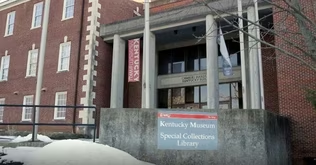
Video has Closed Captions
Clip: S31 Ep12 | 3m 34s | Chip Polston visits the Kentucky Museum in Bowling Green. (3m 34s)
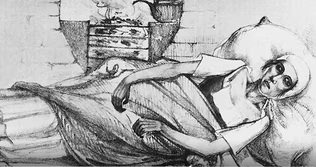
Lexington's 1833 Cholera Epidemic
Video has Closed Captions
Clip: S31 Ep12 | 4m 36s | A look back at the 1833 cholera epidemic in Lexington. (4m 36s)

Video has Closed Captions
Clip: S31 Ep12 | 8m 2s | Jackson Independent School District -- preserving local agriculture and feeding hungry kids. (8m 2s)
Providing Support for PBS.org
Learn Moreabout PBS online sponsorship













Support for PBS provided by:
Kentucky Life is a local public television program presented by KET
You give every Kentuckian the opportunity to explore new ideas and new worlds through KET. Visit the Kentucky Life website.