One-on-One
Natalie Renew; Alejandro Giménez-Santana; Vaughn Crowe
Season 2021 Episode 2451 | 27m 17sVideo has Closed Captions
Natalie Renew; Alejandro Giménez-Santana; Vaughn Crowe
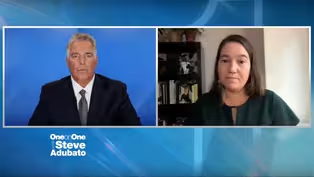
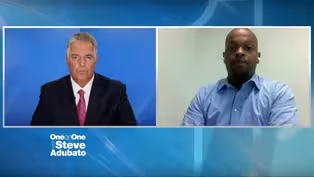
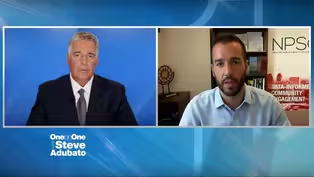
Natalie Renew talks about the ways the pandemic impacted home-based child care and the increased importance of high quality care; Dr. Alejandro Giménez-Santana discusses the rise in crime in the nation and why Newark is being recognized as a national model for public safety; Vaughn Crowe shares the impact of COVID on Newark’s economic development and technology ecosystem.
Problems playing video? | Closed Captioning Feedback
Problems playing video? | Closed Captioning Feedback
One-on-One is a local public television program presented by NJ PBS
One-on-One
Natalie Renew; Alejandro Giménez-Santana; Vaughn Crowe
Season 2021 Episode 2451 | 27m 17sVideo has Closed Captions
Natalie Renew talks about the ways the pandemic impacted home-based child care and the increased importance of high quality care; Dr. Alejandro Giménez-Santana discusses the rise in crime in the nation and why Newark is being recognized as a national model for public safety; Vaughn Crowe shares the impact of COVID on Newark’s economic development and technology ecosystem.
Problems playing video? | Closed Captioning Feedback
How to Watch One-on-One
One-on-One is available to stream on pbs.org and the free PBS App, available on iPhone, Apple TV, Android TV, Android smartphones, Amazon Fire TV, Amazon Fire Tablet, Roku, Samsung Smart TV, and Vizio.
Providing Support for PBS.org
Learn Moreabout PBS online sponsorship- [Narrator] Funding for this edition of One-On-One with Steve Adubato has been provided by The Turrell Fund, supporting Reimagine Childcare.
Rutgers University Newark.
The Fidelco Group.
Bank of America.
RWJBarnabas Health.
Johnson & Johnson.
The North Ward Center.
United Airlines.
And by The Adler Aphasia Center.
Promotional support provided by AM970 The Answer.
And by Northjersey.com and Local IQ.
Part of the USA Today Network.
- This is One-On-One.
- I'm an equal American just like you are.
- The jobs of tomorrow are not the jobs of yesterday.
- Look at this.
You get this?
- Life without dance is boring.
- I don't care how good you are or how good you think you are, there is always something to learn.
- I did do the finale, and guess where my trailer was?
A block away from my apartment, it couldn'’t have been better!
- People call me 'cause they feel nobody's paying attention.
- (slowly) Start talking right now.
- That's a good question, high five.
(upbeat music) - Hi, I'm Steve Adubato.
Welcome, once again, to a half hour program dealing with important policy issues, and issues like childcare.
And to kick it off, we have Natalie Renew, who is a director of a national organization called Home Grown.
Focused on improving the quality and access to home-based childcare.
Natalie, talk to us.
First of all, welcome.
Second of all, why is this more important now more than ever before?
- Thanks, Steve, it's great to be with you.
Childcare has always been an important issue in this country but now more than ever, the pandemic really laid bare how critical childcare is to ensuring that we have a thriving economy where women fully participate in work.
But also ensuring that children are cared for and supported during this challenging and difficult time.
Childcare is critical for children who need to be out of the home.
Quality childcare is critical so that children are learning and thriving and enter school ready to be successful.
And it's critical for their families so that then they can work and know that their kids are well cared for.
And it's critical for communities and economies to ensure that, you know, parents are working and that childcare owners and providers are able to offer services that are valued and supported.
- Natalie, you know this is part of our ongoing series called Reimagine Childcare.
The website is up right now.
And we encourage people to find out more and this people, they go, "Oh, you're doing a series on childcare."
This affects the economy.
It affects the stress on parents, disproportionately women, single women really especially.
But my question is this: To what degree has COVID adversely impacted home-based childcare?
- Sure.
So home-based childcare providers have experienced a number of things during COVID.
Firstly, there's been increased demand and reliance on home-based childcare, as center and school-based care shut down, more and more families look to home-based providers, including relatives and neighbors to care for their young children.
Simultaneously, home-based childcare providers have really experienced enormous hardship during the pandemic.
You know, in addition to sort of worry about their own health, bringing, you know, the children of essential workers into their own homes, exposing themselves to the virus.
They also have experienced significant financial hardship.
Really a triple whammy of financial hardships.
Which is one, the cost of care has gone up.
Sanitizing, buying PPEs and things like that have increased the cost of doing business.
They have had disrupted revenue, either because enrollment has changed or because parent's ability to pay has changed.
And for home-based providers, they have really struggled to access public supports, whether that is the paycheck protection program, or other state and federal support.
So it has been really very challenging for them from an economic perspective.
And despite that, you know, these incredible women and caregivers have continued to really support families through this challenging time.
- You know, Natalie, the series that we're doing is called in fact, Reimagine Childcare.
You have told our producers, and you've said publicly quote, "Our current childcare system is simply not working."
So reimagining childcare, we want it to be way more than a slogan.
If you reimagine it to what it needs to be, what it must be, what does it look like?
- Well, firstly, it's significantly, it's got significantly more public support.
We really need to think about childcare as a public good, and one that we as communities broadly value and pay for.
But also I think there's a real opportunity to think about childcare that needs different parents in diverse families and different places, and offers much more flexibility, and really supports different choices that parents make.
And so, you know, what we hear from home-based childcare providers is that they want to be respected and valued as a critical part of the childcare system.
And that, you know, from the perspective of families, their needs change.
When a child is a baby, they may want something that's different than when their child is a four year old.
And we really need to ensure that there is availability and supply of high quality options in homes, in schools, in community centers, and other forms of childcare.
So reimagining childcare for me, number one, starts with significantly greater public investment that is really targeted towards improving compensation and working conditions for providers and caregivers.
And it also really means getting more support to families.
Not only in terms of lowering the cost of accessing care, but ensuring that they have high quality options in different settings, including home-based settings.
- By the way, have we been putting up the website of Home Grown?
I wanna make sure that we do, even, if not now, in post-production, let's put it in there.
Before I let you go, Natalie, it sounds like it's not just professional for you and not just because you're the director of Home Grown.
It sounds personal for you, is it?
- Absolutely.
I really feel so incredibly honored and privileged to get to work with hundreds of home-based childcare providers across the country.
And these women are incredibly inspiring.
They not only care for young children in their homes, but they are pillars and anchors of their communities.
And I feel very lucky to stand beside them and support them in this work.
- And finally, support for Home Grown comes from philanthropic organizations, foundations, et cetera.
Same with us as a public broadcasting affiliate, a not-for-profit production company.
Same thing with you?
- That's correct.
Home Grown is supported by 15 national philanthropic organizations, who really came together around the fact that 7 million children under the age of five have their early childhood experiences in home-based settings.
And that setting receives the least attention, investment, research, innovation, and you know, we're really committed to changing that.
- And that includes the Turrell Fund right here in New Jersey, in Montclair, New Jersey.
Natalie, thank you so much.
We wish you all the best.
We will continue this conversation.
The reimagining childcare initiative is not a program, a series.
It's an ongoing commitment.
And Natalie, you're a part of our public awareness effort.
Thank you so much.
- Thank you, Steve.
I'm Steve Adubato, stay with us.
We'll be right back.
- [Narrator] To watch more One on One with Steve Adubato find us online and follow us on Social media.
- We are honored to be joined now by Dr. Alejandro Giménez-Santana, Director of the Newark Public Safety Collaborative, and Assistant Professor of Professional Practice at the Rutgers School of Criminal Justice.
Good to have you with us doctor.
- Thank you for having me, Steve.
It's my pleasure to be here.
- Tell everyone what the collaborative is and why it matters now more than ever, as we tape mid-summer 2021 with crime rising in urban communities all across the nation?
- So Steve, the NPC was created in 2018 before the movement that we know today as Reimagining Public Safety.
I agree with you.
Crime is rising in some cities across the U.S. Fortunately, in the city of Newark, we've seen a different trend.
And that trend has been different since both from the beginning of the pandemic, throughout the pandemic, and now in 2021.
We are seeing a slight increase now in violent crime, but throughout 2020, when violent crime was in the rise in other large American cities, what we saw in the city of New York was actually that violent crime was not spiking.
It was even going down.
And in regards to property crime, the reduction was even more significant, the reason-- - Why do you think this is Dr.?
- Sorry to interrupt.
Why, I think we had former Public Safety Director, Anthony Ambrose on many times.
We've spoken to Mayor Baraka about this.
Why do you think Newark?
I'm just across the river.
You look at what's going on in Washington Square Park, as we speak right now, and in other places across the nation.
What makes Newark different?
- So I believe in Newark, we're seeing a symbiosis of interests that are coming together from City Hall to the police department, the public safety unit, university, other anchoring institutions, community groups.
There's a good symbiosis in terms of what can be done to improve public safety in the City of Newark.
So you see leadership coming together with community groups.
And you see the police department being extremely proactive about thinking out of the box of what can we do to improve public safety in the City of Newark.
And I think that we are seeing that type of leadership really playing out.
And we are seeing through crime statistics that the City of Newark is an exception across the nation when it comes to increasing crime.
- By the way, this program is being produced, we talked about higher ed partners, we are producing in collaboration with Rutgers State University of New Jersey, and also Rutgers Newark.
But I'm curious about this.
So if Newark is doing, and Newark is doing better in terms of particularly violent crime rates.
Then why is Newark and what going on, what is going on in Newark?
Why is it?
I'm not saying it's simple, but in Baltimore, and Los Angeles, and Chicago, and Detroit.
Why is it not the national model?
- So that's what we are right now advocating for.
Here, at the NPSC, the issue that I, that I'm directing at the School of Criminal Justice and Rutgers Newark.
What we are advocating is for co-production.
It's a new model, it's different from a traditional community policing models of the past, which have existed since the seventies.
And the idea is through data informed community engagement, which is the way we call this technique.
How can we empower the community to work alongside the police?
And here there's no rankings.
It's not the police was that who's directing the conversations.
Not the police was talking to the community.
No, how can they become partners, equal partners, in the fight forum about for public safety?
Because in the end, it's a shared mission for all, for all stakeholders in the city to come together.
So we believe that through data, we can make decisions that are transparent, democratic.
We can show how the police can work alongside the community, and we can actually encourage the community, community groups, to take action.
Because through access to data, they can, for the first time I believe, see that they can play a role in issues like homelessness, initiatives like mental health problems, increasing warmness of certain problems.
And that is something that the police sees with good eyes, because the police also has problems that it cannot solve.
The community has the tools, and they have the skillset to deal with some of these problems.
And that's why I believe that here we are in a, in a perfect symbiosis between both groups.
- So, but I want to follow up on this.
- We respect and appreciate the positive things going on in Newark.
Not perfect, but much better than most.
But doctor, would you agree that on the part of a significant number of folks, particularly in urban areas, but not exclusively, that there is an anti-police sentiment?
That police, many of them feel under siege.
Many of them feel that they can't do their job to protect those, disproportionately, black and brown in urban communities.
That they're, frankly, forget about just defunding the police.
But the police are somehow the enemy.
That can't be a solution.
- So as you very well explained, even in the city of Newark.
Right now, let's remember Newark is under consent decree because-- - The federal government came in because Newark had such a terrible track record of disproportionally with black and brown individuals.
They were just the number of them that were, they were arrested for no reason, the crimes that were not being committed, pulled over all kinds of stuff.
So the federal government came in and said, "Cut this garbage out.
We're gonna monitor you."
Pick it up from there.
- Exactly, so as, as you explained, very well, the City of Newark is under consent decree because of those reasons.
And that's why the city, the police department had to change.
And that change, I mean, has gone through years now.
They had to improve the way they, they police the community.
They have to improve the way they collaborate with the community.
They have to be more data driven, which is something that was-- - About that, but I really, in the time we have, I want you to deal with the other question of so many who are watching right now.
I don't even know if it's so many.
But many police officers who are friends of our friends of mine, personally, say, "We're, we can't do our job.
We are under siege, under attack.
We're perceived as the enemy."
And for what happened with George Floyd, with the horrific, Derek Chauvin and his is the murder on camera speaks for itself.
But there are whole bunch of cops who feel like they're paying the price for that again, and again, again.
Which is not good for the people They're trying to protect.
- Exactly, and I agree with you a hundred percent.
I talk both with the police and with the community.
And I feel that resentment on the side of the force of the police, because they feel that they also been blamed for something to happen in other places.
But I also, I also think that it's important that we look into how police is policing the streets.
How the way they interact with their community.
And there was also a need for restoration and need for more social justice.
And I think that in Newark we are seeing those things.
We are seeing those things because at the leadership level, you see how the mayor, he's asking for more involvement of the community, how the community is giving feedback to the police.
And what I think is a very, very important now, and it's something I've noticed is the police is extremely proactive at listening.
They wanna listen from the community, they wanna learn-- - In Newark, though.
Is Newark the anomaly?
I'm not trying to be negative here.
But my question is, is Newark with mayor Baraka and the police department.
Nothing's perfect, but again, seemingly like a very collaborative relationship.
It seems like the anomaly.
- And I agree with you.
I mean, I'm talking from the perspective of Newark because it's where we are, where I am right now.
But I, I definitely think, of course, that there must be effort that's in all their places.
But the City of Newark, what I'm seeing is this symbiosis between the different ages, different stake holders, walking in the same direction.
When the mayor is talking about we need to be more proactive in community driven solutions for public safety.
When the police is open about it, and they explain that they are collaborating more, I think that there's, in general, a sense of we want to get there, and we know that we need to do it together.
So I agree with you that in the City of Newark, what we are seeing is, is that symbiosis of different parties coming together.
Because they all have a shared role, which is to improve public safety.
And the City of Newark, I feel that we need to understand that it's a city that right now is transforming.
And it's a city that in the future, by improving public safety, we might see a community thriving where they haven't been thriving over the last 10 years.
And that's what, something that I've seen that I've seen happening myself over the last 10 years, living here.
So I'm very excited to see what's the, what are the next steps in this process.
- Professor, I promise this will not be the last conversation.
Not even close because it's not you check off the box, hey, we did something on urban crime and police reform.
So much work needs to be done.
Thank you, professor.
We appreciate it.
And we look forward to future conversations.
All the best to you and the family at Rutgers Newark.
- Thank you so much, Steve.
Thank you for having me.
- Stay with us, we'll be right back.
- [Narrator] To watch more One on One with Steve Adubato find us online and follow us on Social media.
- We're now joined by Vaughn Crowe, who is a managing partner of Newark Venture Partners.
Good to see you, Vaughn.
- Steve, great to see you.
- For those who don't know what Newark Venture Partners is, describe it for everyone?
- You know, Steve, again, thank you for having me today.
Newark Venture Partners is a seed-stage investment firm, focused on enterprise software, based here in Newark, New Jersey.
It started in 2016 under the wonderful leadership of Don Katz, Ray Chambers, Mark Person, a lot of friends of Newark, RWJBarnabas, and several others who believed wholeheartedly that Newark has the intellectual capital and the financial prowess to attract early stage companies to our city.
That will help catalyze the city of Newark by way of creating a technological infrastructure that will support job creation, will generate market rate returns, and do good by our community.
So in a nutshell, that's who Newark Venture Partners is.
And we're fortunate to have it here.
- Sorry for interrupting.
So much of what you're talking about in terms of economic development and the technology ecosystem, ecosystem if you will, is about innovation.
To what degree as we're taping this late in July, 2021, has COVID impacted adversely or otherwise this initiative?
- You know, Newark Venture Partners, unlike other venture capital funds, not not immune from, from COVID.
I personally was affected.
But for Newark Venture Partners.
We've stayed the course and trying to find and support the best and brightest founders from all backgrounds.
And one example of how we've stayed the course deploying capital.
A company moved to the City of Newark from the bay area.
We led their seed-stage investment.
They saw the infrastructure that Newark brings to the table, doubled down, took our capital, took our guidance and moved their offices to Newark.
We don't expect that to be the case with all of our portfolio companies, but hopefully that's the example that as an outcome from the challenges that we've all dealt with in COVID, there is still hope and opportunity for business to see Newark and to see Newark Venture Partners as an opportunity to call the city home and contribute to the technological infrastructure here in our city.
- So let me ask you.
For businesses who are startups, right?
They're early in their development.
How has COVID impacted them?
I mean, they don't have the history.
They don't have the relationships, et cetera, et cetera.
How many, how hard to even survive it?
- It, you know, difficult to, but keep in mind, we're talking about startups in technology.
So built into their nature is the need to have some type of innovation.
A level of flexibility that shows that we can, we can be nimble, and we can figure it out.
So yes, again, challenging, Steve.
But at the same time, there is that, you know, there's that curiosity and that level of interest that exists, that suggests how do we innovate?
We've had portfolio companies that started off manufacturing security devices, saw a need to be helpful to educational systems and hospitals to track and monitor COVID pivoted in the middle of a pandemic, to offer services and products, to respond to the global pandemic that we were all dealing with.
That's what innovation and that's what technology and these creative minds that have come to Newark from all over the country.
That's the beauty of being in this industry.
Is that you have to be flexible.
You have to be nimble.
And the ability to pivot even during a global pandemic is a strength that we've seen with our founders and our early stage businesses.
And we hope to continue to support them such that they can continue to grow and raise money from other investors down the road.
- Let me ask you.
People talk about hiring shortage.
It's funny to call it, is it a hiring shortage or a labor shortage?
There are jobs, but there are not people to fill, enough of the right people to fill those jobs.
To what degree in your work at Venture Partners, are you seeing that the labor force is not there to the degree it needs to, to support the initiatives that you're supporting.
- We're investing in early stage businesses, three to five person employees, founder led.
So we're in all candor, we're a bit immune from those particular challenges.
With that said, we have had a few companies in our fund one portfolio that have grown.
And have taken office space in other parts of the city and other parts of the country.
And I have not yet heard there being too many challenges in finding labor to support their businesses, but I'm sure that as we reopen our offices and have more direct communication with our portfolio founders, we'll learn of those challenges and we'll do what we can to be supportive.
- Give me a minute or so on increasing diversity.
We have a long-term series called Confronting Racism.
Piece of it is increasing diversity.
Why is that?
And in terms of gender, race, culture, geographic bias, or people from different geographies, et cetera, et cetera.
Why is that important from a business point of view?
- So fundamentally first and foremost, Steve, it's just the right thing to do.
And so you start there, and then, you take two more steps to say, "Well, if it's the right thing to do, how can I create value from a different point of view, that point of view coming by way of culture, geography, education, gender, et cetera.
There is a direct correlation to the growth and prosperity of a business with diversity and inclusion, being a core focus of what you're, of what we're all trying to achieve here.
So 56% of our portfolio is comprised of founders of color and women.
Our investment team, a five person investment team, 60% of that team is comprised of persons of color and women.
And so we are a reflection internally of what we're trying to do externally.
And making money generating market rate returns and supporting founders from all backgrounds are not mutually exclusive.
And I think that we're leading an effort here, and hopefully my peers and colleagues will follow.
- Got a few seconds left.
I was born and raised and came out of the North Ward of the City of Newark.
As you well know, the North End Broadway Boys and Girls Club does not exist anymore, as you know.
You came out of a different club.
- Grew up in the South Ward of Newark, Hawthorne Avenue, South Ward Boys and Girls Clubs of Newark.
Because of challenges, I ended up taking two buses from my home, on Clinton Place at Hawthorne Avenue over to the (mumbles) club, Clinton Avenue clue.
And the Broadway Boys and Girls Clubs in Newark was my first job.
I had an obligation to bring my community along with the success that Newark Venture Partners will achieve.
We will make money, we will support founders from all backgrounds, but it's not enough.
We have an obligation to support the org, to support our children.
And for me, it was personal because I grew up there.
And who I've become today, all the good, you can largely attribute that to my family and to the Boys and Girls Clubs of Newark.
- A great mutual friend, Ray Chambers, and his support of the Boys and Girls Club is just, there are no words to describe it.
- There's no words to describe one of the greatest humanitarians, probably in our country.
- Hey, you make the Boys and Girls Clubs proud.
You represent quite well.
Thank you, Vaughn.
- Steve, thank you.
All the best, by the way, the other, there's another, remember the other guy?
One of the guys, Boys and Girls Club.
Oh, Shaquille O'Neal that's right, Right, gotcha (laughing).
Shaq.
- Yeah, we know of 'em.
- Yeah, exactly, thank you Vaughn.
I'm Steve Adubato, we thank you so much for watching.
Even whether you're in the Boys and Girls Club of Newark or not.
We'll see you next time (laughing).
- [Narrator] One-On-One with Steve Adubato has been a production of the Caucus Educational Corporation.
Funding has been provided by The Turrell Fund, supporting Reimagine Childcare.
Rutgers University Newark.
The Fidelco Group.
Bank of America.
RWJBarnabas Health.
Johnson & Johnson.
The North Ward Center.
United Airlines.
And by The Adler Aphasia Center.
Promotional support provided by AM970 The Answer.
And by Northjersey.com and Local IQ.
Part of the USA Today Network.
- Hi, I'm Abbie.
You might see me as an ordinary person, but I've been living with a brain injury since 2018.
Opportunity Project gave me hope and I've gained confidence through job skill training and helping my family.
Despite my challenges with memory, I see a possibility to keep improving.
- [Narrator] If you have a brain injury, you don't have to face your road to recovery alone.
Learn more about Opportunity Project and its partnership with Children's Specialized Hospital.
COVID's Impact on Home-Based Child Care
Video has Closed Captions
Clip: S2021 Ep2451 | 8m 13s | COVID's Impact on Home-Based Child Care (8m 13s)
The Pandemic's Impact on Newark's Economic Development
Video has Closed Captions
Clip: S2021 Ep2451 | 9m 56s | The Pandemic's Impact on Newark's Economic Development (9m 56s)
Video has Closed Captions
Clip: S2021 Ep2451 | 10m 5s | COVID's Impact on Public Safety (10m 5s)
Providing Support for PBS.org
Learn Moreabout PBS online sponsorship
- News and Public Affairs

Top journalists deliver compelling original analysis of the hour's headlines.

- News and Public Affairs

FRONTLINE is investigative journalism that questions, explains and changes our world.












Support for PBS provided by:
One-on-One is a local public television program presented by NJ PBS