
Nathan Jones
6/1/2023 | 26m 46sVideo has Closed Captions
Nathan Jones
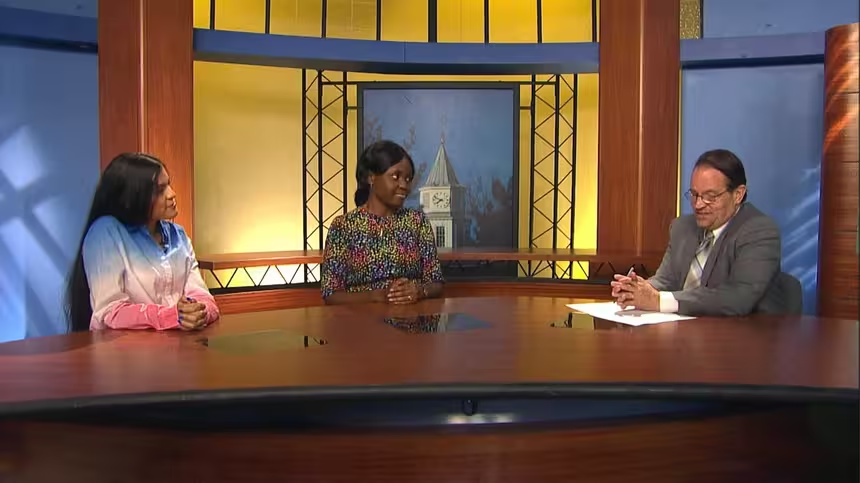
June, 2023 marks the planned start of a fascinating NASA mission at the Johnson Space Center in Houston. Four people will be isolated for a year to simulate a mission to Mars. And one of those people is Dr. Nathan Jones, who works in emergency medicine at Springfield Memorial Hospital. Fred Martino talks with Dr. Jones.
Problems playing video? | Closed Captioning Feedback
Problems playing video? | Closed Captioning Feedback
Eye on Education is a local public television program presented by WSIU
Nathan Jones
6/1/2023 | 26m 46sVideo has Closed Captions
June, 2023 marks the planned start of a fascinating NASA mission at the Johnson Space Center in Houston. Four people will be isolated for a year to simulate a mission to Mars. And one of those people is Dr. Nathan Jones, who works in emergency medicine at Springfield Memorial Hospital. Fred Martino talks with Dr. Jones.
Problems playing video? | Closed Captioning Feedback
How to Watch Eye on Education
Eye on Education is available to stream on pbs.org and the free PBS App, available on iPhone, Apple TV, Android TV, Android smartphones, Amazon Fire TV, Amazon Fire Tablet, Roku, Samsung Smart TV, and Vizio.
Eye on Education
Eye on Education features interviews with people making a difference in all facets of learning. From Pre-K through higher education, we highlight efforts to prepare students to become the world's future leaders in every discipline.Providing Support for PBS.org
Learn Moreabout PBS online sponsorship(camera clicking) (upbeat music) (upbeat music continues) (upbeat music continues) - "Eye on Education".
I'm Fred Martino.
June, 2023 marks the planned start of a fascinating NASA mission at the Johnson Space Center in Houston.
Four people will be isolated for a year to simulate a mission to Mars and one of those people is with us today.
Dr. Nathan Jones works in emergency medicine at Springfield Memorial Hospital and he is an associate professor at the Southern Illinois University School of Medicine.
Dr. Jones, thank you so much for being with us today.
- Thank you.
Thank you for having me.
- Give us a sense.
I know everyone was asking this question right away as they hear my introduction of why you were interested in this opportunity.
This is quite a commitment to be isolated for a full year with three other people.
You won't know well right away, but you will eventually know very well, and why you wanted to do this.
- Yeah, I mean, aside from just the adventure involved with something like this, I think the big thing, you know what drew me into a career in emergency medicine which is my primary job, is just I really love to solve problems and I think it's just a unique way to get to do that.
- [Fred] Incredible contribution and sacrifice to do this.
So, I guess what I'm hearing from your answer is that the contribution to science and to a actual missions to Mars means a lot to you to make this sacrifice, to do this.
- Yeah, I mean, it's a unique opportunity.
There's just not been a whole lot of similar things in the past.
I heard about it when I was kind of looking online on a tech website.
It said, you know, do you want to go to Mars?
And it seemed like a really neat idea.
Kind of grabbed my attention.
I read the article and of course, we're not truly going to the actual Mars, but we're going to virtual Mars for as much as NASA can create it to be.
And you know, it is just a once in a lifetime opportunity to get to contribute to humanity's reach further into space.
- So interesting.
And we'll be hearing more about this as you and three others are actually in isolation.
Tell me about the reaction of friends and family when they heard about this that you were gonna do this.
- Yeah, so obviously everyone's pretty excited about the opportunity and you know, that I've been selected.
There were varied emotions from my closest family.
I'm married and my spouse kind of had a mixed bag of emotions as you could expect.
You know, it's, she's very excited for me and for what I get to do, but she also realizes that there's quite a bit of hardship that will come along with it too.
I've got three children and you know, they've all gone through different phases of dealing with it on their own.
You know, I've got my youngest who draws pictures of himself standing and holding hands with me, you know, and that sort of thing.
And so, you know, they've all kind of got their ways of processing it, but generally speaking, everyone's pretty excited about it.
I know a couple of my children in school were learning about Mars and and isolation experiments and analogs similar to this.
And they knew that I was going to participate in it, but weren't yet allowed to announce it to their classes.
And so they were pretty excited that they were learning about something that was so important in school and that I was going to participate in it.
- So interesting.
And to give a sense of the sacrifice, talking to your wife and your children, as I understand it that will even be simulated as if you were on Mars.
I.E., I understand there's like a 20 minute delay between communication in that case.
- Yeah.
To make it as realistic as possible.
A large part of the challenge that humans will experience the further we go away or just the increased difficulty with communications.
You know, if there's a problem on the International Space Station, they can just call the the mission control and speak to them about it.
But it takes the same amount of time for those communications to get back for your family too.
You know, as we get farther away, if you run into any issues on earth and you need to get a hold of them it takes that long, you know, for those communications to get there.
And similarly, if I want to talk to them it takes that amount of time to communicate with them.
We are doing the best we can to intricate or to integrate various modalities.
We'll be able to send emails, which would be equivalent to a modern day text.
We'll record videos and audio recordings that we will send along and they will be time delayed but we will have communications and stay as much in touch as we can.
- Yes.
Very nice.
So you're gonna be there again for a year without a break.
Beyond the communication aspect what else concerns you the most about that amount of time?
- Yeah, I would say I have two things when it comes to that topic.
The first is that you can do a lot of things to try and make up for the fact that you're not going to be in person.
But sometimes whenever one of your children's having a hard day, there's nothing quite like being able to come up and give 'em a hug.
That physical touch and you just can't reproduce that.
On the other side of it, I think the hardest part for me personally is going to be the difficulty of if they don't adequately plan to schedule for the day and what expects to, you know, for them they expect us to take like 12 hours to work on something that takes me three, you've got a whole day to find out you kind of gotta figure out what to do with your day.
And so just staying occupied in a space like that I think is gonna be very difficult.
And I think as long as we're staying busy it'll be relatively easy to keep your mind off of being homesick.
And then I think there are gonna be moments in the mission probably when you're three quarters and beyond and where you're thinking more about being home that it gets more of a challenge.
- Yeah, I imagine it will be.
You mentioned the contribution to society, that certainly is an inspiration for you.
What else excites you about the opportunity to do this?
- Just the chance to explore in a way and in its own unique way.
Probably one of the neatest things so far has just been working with NASA and all of its professionals that they have working with them.
It's just been a great experience so far.
And it's, as you mentioned, year long mission.
I'm kind of excited to see what happens after that for NASA and for myself as well.
Right now I'm currently planning to resume practice in emergency medicine when I've completed it, but I'm just kinda excited to see what may be on the horizon.
I wasn't expecting, I guess what I'm saying is I wasn't expecting to even be doing this two years ago.
- Yeah, well, working in emergency medicine certainly you're used to dealing with stress.
It's at times a very high stress job.
What else would you say has prepared you for this experience?
- Two things I'd say to that.
My family always says we do hard things and you know, a lot of times we have choices to make.
I can do this or I can do that.
And a lot of times it's easy to take the easy path or the easy road and sometimes it's not the popular thing to do that extra work or to go the extra mile.
And I think doing those things that, if you you'll put yourself into a spot where you've got opportunities that other people may not have in the future, just by choosing to do the hard thing.
We don't need to do unnecessary hard things, but we have to be willing to work hard for things sometimes.
And then beyond that, I think what if you were to ask my kids why I'm particularly well-suited for this mission, I would say they would tell you that it's I can fix just about anything.
And what I mean by that is I've repaired just about every appliance around our house.
Not because I've had to, but just because I enjoy doing it.
You know, just a couple days ago we have a side-by-side.
I was tearing it down.
I'm supposed to be getting ready to go on this mission for a year, and I've got this side by side that's in the a hundred pieces all over the place and those sort of things.
And so I just kind of enjoy troubleshooting and fixing things.
It's one of the things that drew me to emergency medicine as a career.
But not just fixing things, but what I really enjoy is the challenge of sometimes when you've got limited resources.
And I think that's really what a mission like this is going to be all about and those are the skills that are going to be essential or something like that.
I just really enjoy that process.
- Tell me, Doctor, about the preparation that NASA has offered you before you actually embark on this.
- Yeah, so a lot of the training is going to be around the systems inside the habitat itself, how to operate them.
As you can imagine, astronauts have to do quite a bit of exercise to maintain their body masses.
And while we're not going to be technical astronauts having not left earth, but they do want to see exactly what those requirements are going to be whenever you exert them on the human body.
And with consideration to the food systems and all the other pieces of it.
If you look at just the mental health situation on a mission like this without considering all the other pieces, you don't really get an entirely useful thing.
So NASA is considering everything just as if we were really going.
And one of the more interesting ones is going to be the exercise systems I think for me.
- Okay.
Wow.
Well, I understand that you're gonna be working with three other people in a 1700 square foot space.
So the size of a pretty typical house.
There's a commander, a flight engineer, and a science officer.
You are the medical officer.
Give me a sense of your role.
- Yeah, so for most purposes the crew functions as one so we will share most duties, but I think where the medical part comes into play will be if someone gets injured, looking at the health parts of various components of the mission.
But also keep in mind, I'm not going to be independent as a medical professional on it.
We will have NASA's mission control supporting myself, but generally speaking, I believe most of the tasks will be team and crew wide.
- What do you know about the roles of the folks that you're going to be working with?
- Sorry, do you mean as far as what they're going to be on the mission or what they do outside of the mission?
- What they're gonna be doing during the mission a little, because obviously you said you'll all be maybe doing certain things collectively or to even working together, but I'm sure there are also things that individually each person will be the expert in or maybe be the only one to do certain things.
- Yeah, I think for most of the parts that I am aware of we will all contribute, but we might have, as you mentioned sort of a lead for each individual portion.
We will do, I'm not sure what the word is yet if it's been established or not, but you know Mars walks with the sort of EVA or space suit on and some of those will be doing some like research as far as collecting rocks and those sort of things.
And so we would take them back to the habitat and we'd have to analyze them.
And so for instance the science officer may be in charge of those collections, what we collect and how we process them and how we collect the data regarding those.
And then we'll have a crew commander and she will be basically have the the final say on the day-to-day tasks.
And then the engineer, my guess, will be in charge of as far as like some of the electrical systems and whatever.
NASA said that they plan to challenge us by causing certain systems that fail and have us try and fix them.
And I anticipate he would be the one responsible for repairing those systems.
- I know that one element of interest for NASA is the effect of isolation.
The psychological issues that that might entail.
- Yeah, so isolation, it's at this study at its core is an isolation study.
And that means that aside from the four of us we won't have any direct contact with anyone outside of it.
There will be, as we mentioned before the time delays involved.
And so, it creates some new challenges that we will have to overcome as far as psychologically and just as far as solving all the problems that would occur on this kind of a mission.
And so NASA has worked really hard to make us believe even while we are on the mission, that we are truly there.
And so they will be looking at just how that sense of isolation of being so far away from earth how it affects the human mind.
- I assume that you're gonna be able to bring a lot of reading material with you so that when you, when your mind is, needs something to occupy it you could do that.
- Yeah, so they have provided us with a certain amount of limited like hard books.
Beyond that, they're also providing us with some digital books as well.
- That's great.
I understand that NASA also wants to assess optimal food and exercise for people in a mission like this.
Tell me what you know about that.
What they're going to be looking at and even what you know about the kind of food that will be available to you, the kind of exercise that will be available to you as well.
- Yeah, so the food systems will essentially be the same ones that they would use on the International Space Station.
And so basically they're primarily freeze dried and MREs that are similar to what the military uses, but they're made specifically for space.
As you can imagine, the nutritional requirements are quite a bit different for military use versus space use.
And so there's some considerations for that.
As far as the physical fitness, I believe that they've kind of indicated that there would be sort of like resistance machines.
For instance, you might have like a rower and very similar stuff to what you would see currently on the International Space station.
And so there will be quite a bit of exercise required on the mission as part of the physical fitness needs for an astronaut or in this case a Marstronaut, you know, who would be on a real mission like this.
And then I believe probably when you combine those two things, you see one of the more interesting aspects and that is that the foods may not be what you were typically eating on a day-to-day basis outside of the mission.
And if you eat all of your favorite foods in the first month, I mean, you're gonna have a hard time for the next 11.
And and beyond that, if you exercise for as much as they would probably have you exercise I think the issue starts to become not just what the food is, but how much of the food I think a lot of us would need to eat in order to maintain our daily calories.
And so if all you have left is kale for a week at the end of the mission and you've gotta eat 3,500 calories a day to maintain your body's needs it's going to be a really interesting week.
- Yeah, not a pleasant one.
That doesn't sound good at all to me.
So it sounds like what you're implying there is that you're gonna have some choice in what you eat.
It's not like when we used to go to to school lunch and there were just, each day, depending on the day, there were just certain choices.
You're gonna have some choice amongst a variety of things being offered.
- Yes, that's absolutely correct.
So essentially they will send us into the mission at the beginning with a wide selection.
And what we do with that selection is going to be up to us through the course of the year.
So, you know, hopefully we will agree as a team to a reasonable plan and beyond that the food allow allowances each day will basically be selected by a team of professionals at NASA.
And so part of it you will have a say over as far as which one of those meals that are there that you eat.
But other parts, as far as what you're taking with you on the mission you won't have a say over.
It may require some creativity on holidays and birthdays and those sort of things.
You may be having a birthday meatloaf, I'm not sure.
- Oh gosh, all right.
Well you'll really, you'll really celebrate your birthday after this isolation I bet with cake and ice cream at home.
- [Nathan] That's right.
- Obviously, you know, we have some idea of how people are affected by isolation and being in space.
I'm wondering what are the areas, to your knowledge, where there is a belief that more information through this study and others that are coming up will be most valuable to NASA?
- Hmm.
Yeah, that's a good question.
And our astronauts are amazing human beings who've done some incredible things.
I think when you look at the current space program there are a few things that you noticed that would be different compared to a program like this.
I think that the longest that an astronaut has been into space at one time currently from NASA, is somewhere in 350, maybe 355 days.
And that's I think the record for NASA.
And so we are going to be on a mission that's not just longer than that, but if you look at even that astronaut, there were changes that occurred in the middle, new astronauts arriving, certain people leaving, new food supplies coming.
And beyond that, just the distance, and I think as I mentioned before, just the psychological thought process of the distance there and the communication delays, I think will be a large part of that too.
So if I've been up there for three months and I can call home and it's just like I'm talking to you on the phone right now it kind of takes away some of that distance, I think.
And if I can't do that and there's a 22 minute delay minimum, then it kind of makes it a little bit more challenging to adapt to those issues.
- Well there's no doubt it seems that NASA believes that they are going to get through collecting data and seeing how you and the other three folks on this isolation for an entire year that they're gonna learn a lot, because you are just the first group.
They're gonna be additional tests with a totally different cohort in 2025 and the plans are for another cohort in 2026.
So they obviously have an anticipation they're gonna learn a lot from this.
- Yeah, I mean, when you think about the amount of resources it took in planning and to actually even just continue the experiment, NASA obviously seems to believe in this sort of mission and what it's going to bring them.
They do have other analog experiments going on as well and those are adding pieces to it as well.
But I think that they absolutely are gonna rely on this mission, the two that follow it to guide them on their upcoming missions further out into space.
- So, I have to ask you this, it was something that that came to me as I was preparing to talk with you, thinking about what would I be doing if I was, if I was somewhere for an entire year and I had a lot more time on my hands at certain times of the day, because I wasn't going to be interacting with family or friends.
I wasn't gonna be going outside for a walk.
I wasn't, you know, all of the things that we do on a regular basis, go shopping, the list goes on and on, go on vacations.
I mean, I'm not here to depress you.
I don't want to talk about all the things that you're not gonna be doing for a year.
But then I thought, well, what are the opportunities?
You know, that's my personality.
I'm always thinking about opportunities.
And I imagine while you're there.
I would think anyone would want to do this.
You're gonna be taking a lot of notes to remember this incredible experience that very few people would ever have.
So I had to ask, I mean, all those notes do you plan to write a book when you return?
- You know, that's obviously consideration.
I'm not really sure.
I do plan to do quite a bit of writing.
Other things that I plan to do would probably be learning a new language, possibly learning an instrument.
I'm going to try and take a guitar in with me.
It'll be a smaller one, but I think it'll be enough to that, you know, I can, that I can learn with it.
And but as far as the question of writing a book, I would love to say that I will, but I have to see how much free time I actually have and how it goes, you know.
And what the contents of that, the thinking that goes into that looks like.
If it's depressing book, I don't think anyone's gonna want to read it.
- Well, I'm sure your experiences will be fascinating to talk about, because there's going to be an entire year of time to discuss and not just what you were doing and what NASA learned, but what you learned about yourself, what you did while you were there.
So I hope Dr. Jones, that a year, about a year from now as we're taping this just before you're going into isolation, I hope a year from now you will sit down with me again.
And regardless of whether you plan to write a book I hope you will talk to us about what this experience was like.
I am gonna be fascinated to hear all about it.
- I would absolutely love to follow up with you and let you know how it all went with regard to as much as that I'm able to speak to.
Absolutely.
- All right.
Well, Dr. Jones, thank you so much for being with us today.
Really appreciated it.
- You're very welcome.
Thank you for having me.
- My guest was Dr. Nathan Jones.
He works in emergency medicine at Springfield Memorial Hospital and he is an associate professor at the Southern Illinois University School of Medicine.
He is part of a year long NASA mission at the Johnson Space Center in Houston.
Well, that is "Eye on Education".
I'm Fred Martino.
Thank you so much for being with us.
Have a great week.
(mellow music)














Support for PBS provided by:
Eye on Education is a local public television program presented by WSIU