The Legacy Series: Living A Legacy
National Council of Negro Women: A Legacy of Change
Season 3 Episode 2 | 56m 6sVideo has Closed Captions
Nonprofit NCNW advances the African American woman, her family and community.
National Council of Negro Women, NCNW, is a nonprofit founded in 1935 by Dr Mary Mcleod Bethune to advance the African American woman, her family and community. Nearly a century later, the mission is the same. Explore dynamic leaders like Dr Dorothy Height and others still shaping this organization today.
Problems playing video? | Closed Captioning Feedback
Problems playing video? | Closed Captioning Feedback
The Legacy Series: Living A Legacy is a local public television program presented by WHUT
The Legacy Series: Living A Legacy
National Council of Negro Women: A Legacy of Change
Season 3 Episode 2 | 56m 6sVideo has Closed Captions
National Council of Negro Women, NCNW, is a nonprofit founded in 1935 by Dr Mary Mcleod Bethune to advance the African American woman, her family and community. Nearly a century later, the mission is the same. Explore dynamic leaders like Dr Dorothy Height and others still shaping this organization today.
Problems playing video? | Closed Captioning Feedback
How to Watch The Legacy Series: Living A Legacy
The Legacy Series: Living A Legacy is available to stream on pbs.org and the free PBS App, available on iPhone, Apple TV, Android TV, Android smartphones, Amazon Fire TV, Amazon Fire Tablet, Roku, Samsung Smart TV, and Vizio.
Providing Support for PBS.org
Learn Moreabout PBS online sponsorship>> If Dr. Bethune was here today, I think she would shed a tear, because I believe that she would see that the seed she planted has not only given us fertile ground, but has expanded in a way that I don't even know her vision even understood.
I think Dr. Bethune would also be encouraged by the youth that are coming.
She founded a university, Bethune-Cookman College then, University now.
Having a chance to sit at her grave, and I wiped her grave off, for me, the connection to her is, her intentions were to ensure young women were reared in leadership, reared in development.
The Bethune Height Career Pathway program that we have now is a brand-new program.
We're activating young women cohorts to prepare them for the next generation of corporate, economic, education, healthcare leaders and social justice leaders.
I think that she would say, "Well done.
Do more."
♪♪ ♪♪ >> This building in the nation's capital is so much like Mary McLeod Bethune -- mighty and strong and situated on a firm foundation.
It's home to the National Council of Negro Women, an organization founded by McLeod Bethune, its seeds planted a century and a half ago in the small town of Mayesville, South Carolina.
It is there that Mary McLeod Bethune was born in 1875, the 15th of 17 children of parents who were formerly enslaved.
She was a child with a thirst for learning and serving.
She walked 5 miles to school to get an education that her parents and a good number of her siblings could not.
She saw education as a vehicle for African-American girls to mature into women and become leaders and change agents in politics, economics, education, and civil rights.
As a teacher, her experience working in mission schools inspired her to start a school of her own.
It seemed an insurmountable quest for an African-American woman in the first years of the 20th century who was one generation removed from slavery, in the South, and with little to no money.
But Mary McLeod Bethune was undaunted, creating benches and desks from scraps and pencils from burnt wood.
In 1904, she founded the Daytona Educational and Industrial Training School for Negro Girls in Daytona, Florida.
Nearly two decades later, that school would merge with Cookman Institute and eventually become Bethune-Cookman College, a four-year co-ed institution.
Not resting on her laurels, she helped to open a hospital in Daytona that served black and white patients with an integrated staff.
She fought to bring the right to vote to women in the U.S. and to increase overall voter participation within the African-American community.
McLeod Bethune was the eighth president of the National Association of Colored Women, the forerunner to the National Council of Negro Women.
Founded in 1896, in Washington, D.C., its motto was "lifting as we climb."
And climb McLeod Bethune did, her achievements and influence undeniable.
Adviser to U.S. presidents.
Director of the Division of Negro Affairs in President Franklin Roosevelt's administration.
President of the Southeastern Federation of Colored Women's Clubs.
Cofounder of the United Negro College Fund and the Central Life Insurance Company of Florida.
The list could go on.
Her marbled image in the halls of the U.S. Capitol or bronzed in D.C.'s Lincoln Park and in Daytona, Florida -- all powerful representations of her monumental impact.
In its initial incarnation, McLeod Bethune's little school for Negro girls sat next to the town dump.
The site was prophetic.
What seemed worthless Mary McLeod Bethune made priceless.
She was a transcendent figure who saw obstacles as opportunity.
"I plunged into the job of creating something from nothing," she said.
"Though I hadn't a penny left, I considered cash money as the smallest part of my resources.
I had faith in a living God, faith in myself, and a desire to serve."
>> I knew Dr. Bethune, and the reason is that my great-grandfather, Abraham Lincoln Lewis... ...was a very close friend of Dr. Bethune's.
And because of their friendship...
...I benefited.
I'm struggling now for words that would capture this.
I was blessed to actually know Dr. Bethune.
What in the world was in the head and in the heart of the legendary... mm, yes, both of those words... Dr. Mary McLeod Bethune... ...who began this exceptional organization?
And I can only respond to my own question by saying that amazing and grace-filled educator and social justice activist felt a need for something that did not exist.
Yes, there were other organizations grounded in the lived experiences of black women.
But she imagined something which has lasted now for so many years that was necessary at that time and is no less necessary today.
And that is an organization that would come out of the very depths of our experiences as both women and African-Americans.
That two-fullness, if I can play with language for just a moment, she thought had yet to be fully responded to.
And so that is why she began the National Council of Negro Women.
>> Yeah.
Our founder, Dr. Mary McLeod Bethune, coined this phrase an "organization of organizations."
Her intention was to gather black women with a trajectory experience on their minds.
She wanted to ensure that black women's institutions were aligned around healthcare, education, economics, and politics for women in the 1930s.
If you can consider 1935, they were in the -- Our country was in the middle of a Depression, and as an organization of organizations, she believed that the council would be a meeting place and a grounding place for black women and black women's organizations.
So when she coined that phrase an "organization of organizations," that's exactly what the council is.
We are an institution that is made up of now over 38 national black women's affiliate organizations.
At that time, there were a little over 20.
>> The power of bringing together all of the organizations, and Dr.
Height used to demonstrate it, what Mrs. Bethune used to say, "Yes, if I have one organization here, one here, one -- If I tap you with this organization," but then they would bring the fists together and say, "You know, all together, if I tap you with this fist, you will feel it.
But if I tap you with one finger, you may not feel it.
And if we all come together collectively, look at the collective power."
>> And so Dr. Mary McLeod Bethune was ahead of her time.
Her mission then speaks to her mission now.
>> "If you want to go quickly, go alone.
If you want to go far, go together."
>> An organization is only as good as its leaders, and the leadership at NCNW has had nothing short of a stellar roster of nine dynamic women presiding over its nearly century-long storied existence.
>> We talked about Dr. Bethune's leadership in not only founding the organization, but Dr. Bethune was the visionary who started bringing us what we call these sections, bringing out presence across the country.
Then you think about Dr. Dorothy Ferebee, who was actually the past national president of Alpha Kappa Alpha Sorority, Incorporated.
She was one of the ones that actually collaborated with some other national leaders to bring us to a more national scale.
She worked on programming and was very, very instrumental in healthcare.
Vivian Carter Mason served after Dr. Ferebee, and around that time was when we saw the transition of Dr. Bethune.
So she had to carry the organization with the death of its founder.
And then by 1957, you see Dorothy Height.
Dorothy Height -- longest-serving president, almost 50 years of leadership, where she engaged, of course, not only in civil rights, but you've heard of the term the Big Six.
The Big Six were the civil rights organizations that were there meeting with John Kennedy, that were meeting with Lyndon Johnson.
She would be the only woman present for these meetings.
She was the stalwart civil rights leader of our time and in our organization.
She activated women's rights.
She was a massive political leader, and she met with leaders across the aisle.
Upon her transition out because of illness and age, by the time we get to Dr. Barbara Shaw, Dr.
Height then passed away.
Very difficult time for the organization.
So Dr. Shaw's job was to keep us together, keep the institution connected.
She was the glue that carried us from Dr.
Height's death.
She was an AME Zion leader, activating her faith partnerships which helped us in the time of grief.
And we transitioned to Ingrid Saunders Jones.
She was our corporate president.
She brought with her not only a $1 million endowment from Coca-Cola because she was a Coca-Cola executive, but she also turned the hands of time about our properties.
She was ensuring that we had our taxes covered.
She sold some properties to ensure we had capital in the organization.
And as her time transitioned, then we went to Dr. Johnnetta Betsch Cole.
Many know Dr. Cole for her work with the museum and being president of two black women's institutions, two HBCUs.
But Dr. Cole's resurgence was around social justice and intergenerational leadership.
Her job was to bring out the civic engagement work that NCNW had always understood, but now named it as a core practice, and also focused on something called "Four for the Future."
She actually pulled together a study to talk about what the future of NCNW had to look like for us to survive.
She then had to step down because of an illness and brought on Dr. Thelma Thomas Daley.
Now, Dr. Daley was the architect of ensuring the preparation of the new infrastructure of NCNW.
What do I mean by that?
Dr. Cole had a vision.
Before she stepped down, it was very difficult to be a president and chair of the board at the same time.
The amount of work that we were asking our leaders to do, it was just unreasonable.
And so in her transition, Dr. Daley was the one that galvanized our leaders and ensured that they were able to understand what this new infrastructure that we now see could activate.
Under Dr. Daley's leadership, she also ensured that this site that we're sitting in, Pennsylvania Avenue's headquarters of NCNW, is now a National Historic Site.
And that's because of the leadership of Dr. Daley.
In her transition, Dr. Daley was the convention leader that got the new infrastructure passed.
And now you see the presence of Dr. A. Lois Keith and Shavon Arline-Bradley.
Dr. Keith is our ninth chair of the board, the first chair only of the board.
And I'm the first president and CEO in this new infrastructure.
>> Our president and CEO, the Reverend Shavon Arline-Bradley, um, we are a team.
♪♪ ♪♪ ♪♪ >> I knew Dr.
Height for years, and with all of the power and all of the doors she opened and all of the people who knew her, she was very quiet and very humble.
And her humility in all of that.
I never heard her prance around talking about designers' clothes or designer bags or anything of that of that nature, you see.
And I'm very fortunate that she took me under her wings.
Dr.
Height used to bring in women from Mississippi and Alabama and Georgia, bringing all these women coming in.
We said, "How does she find these women?"
But she was empowering these women, and she may have met them on her -- some of her trips through the States, but she would get them involved.
>> My very first convention, I saw this lady sitting on this podium with this beautiful hat and was just poised to the ninth and was so sure of herself.
And when she would walk into a room, the room would just electrify, more or less.
You know, her appearance alone.
So I wanted to find out who this lady is.
I wanted to know more about Dr.
Height.
She was such, such a visionnaire.
I remember we were here at a convention, and she left the convention with this beautiful royal blue suit on, and she said, "Um, I noticed you all -- You all probably noticed that I left for a while, but what I did, I went and signed papers for us to, uh, maybe get this building that we now live in, this home for NCNW."
We were ecstatic.
We were so, so, so excited.
>> When I think about this building that we're sitting in, it's a bit emotional because we're the only black- and woman-owned building on Pennsylvania Avenue.
>> No president gets inaugurated without going by this building.
>> We sit -- what we call the corridor of power -- between the Capitol and the White House.
I need to honor Dr. Dorothy Irene Height.
She had the vision that black women would be seated in the middle of power, not only in this country, but in the world... and as a black woman, ensuring that she worked with philanthropists, with artists and entertainers, with government leaders to make sure that this building built on the land where slaves were sold, this building now stands as a beacon of hope and light in the middle of our country's most unprecedented space, which is Washington, D.C., on Pennsylvania Avenue.
So this space in and of itself, it not only represents the resilience of the enslaved ancestors that we have grown to learn about and love, but it speaks about the future, that we have a place in history and a place for longevity that we believe will be sustained until the end of time.
>> The January of the year that she passed away, we were at the Willard Hotel here in Washington.
It was for an MLK celebration, and I had a flight to catch, but she sent words to me to say she wanted to see me before I left that January.
And I thought, "Well, do you miss your flight?
Or do you stay and see what Dr.
Height wants?"
Well, I just decided, "Well, without a doubt, I'm just going to stay and see what Dr.
Height wanted."
You know, I mean, that's Dorothy -- Dorothy Irene Height that I'm talking about.
Little did I know... ...that was going to be the last time I saw her alive.
♪♪ ♪♪ The last thing I think that I was able to do for her was to be one of the ones to receive her body back here at the headquarters during her passing.
And, um, yeah.
And now to sit in an office and to be the chair of the board and the office that I would sneak in and sometimes put on a hat of hers that was here and say, um, "Hurry.
Get this picture before Dr.
Height get in here.
Hurry.
Put this picture up here.
Let me get this" -- It was something beyond my wildest dreams.
And I will do everything in my power to forever make her proud.
>> I do know that Dorothy Irene Height was pleased with the movement, and I know she would be pleased to see where we are today.
>> The blueprint for NCNW today was evident long before its inception, as Dr. Bethune always fought for issues coined the "Core Four."
Throughout Dr. Bethune's illustrious life, she had a heart for health equity, education, economic development, and social justice.
>> In education, we are now working to advance a program.
We've partnered with our friends Freedom to Learn to talk about ensuring that black history stays top of mind in schools across this country.
We're working now to begin to collaborate our advocacy and policy work to help train and educate communities across the country, with the youngest people in elementary school understanding civics.
We're also activating in public health.
Health is a major part of our work.
We have a Good Health WINs network that advances immunizations, but we're also now activating more on maternal health.
Why?
Because black women right now are suffering at the youngest ages and now losing their lives in childbirth.
And what we see is that this is a major part of a healthcare disparity space that we need to focus on.
I will also say that economics is a big part of our work.
We are going to be working with some of our national affiliates.
We have affiliates that are not a part -- not only a part of the Divine Nine, but also business sororities, to help us create generational wealth.
What does that mean?
Educating on retirement, on savings from every generation -- from college students, all the way up to our retiring seniors and my investors.
And then the last part of our program that's really important to talk about is our social justice work.
Our social justice work is connected.
Policies and programs are now combined in this space.
Why?
Because we also give direct action and direct service.
Programs are direct service, where we educate, where we teach our members and our communities on how to have quality life.
But the direct action is, we advocate to ensure systems change for black communities to thrive.
>> With NCNW, longevity means evolution.
>> NCNW's modernization is now named the New Era of NCNW.
When Dr. Keith and I came together as a duo, as a team, we decided that we needed to change the look and feel and to ensure that the country understood we're not gone.
We are now in remaking process.
Many people thought that when Dr.
Height died, NCNW died and that just wasn't the case.
But it was our job now to evolve -- evolve in our technology, evolve on social media, evolve in branding and color.
I'm in signature purple because this has become a signature color for us.
And we activated this new era to be around four things.
I call them the president's pillars -- mobilizing people, advancing policy, revitalizing programs, and solidifying infrastructure.
So with that has now come growth.
Growth of young women, collegiate women, growth of women in our sections, which are our chapters across the country.
And now organizing states.
We have sections in over 33 states across the country.
And now we have almost 19 organized states with state presidents and leaders.
That new era has been a commitment to activation, to advocacy, and also alliance with growing our affiliates.
♪♪ ♪♪ If you think about the course of black generations across history, there's always been a catalyst for movement.
There's always been a thing that has happened, an incident that has really pushed us.
Progress has been a friend, but also a challenge.
When you see progress, you tend to not see the regress.
And so as I think about generations now, I would not say that they're not active.
I would say that their vision of progress may be different.
What we may have talked about in the past around voting rights may or may not be a priority for some of our younger folks.
But I will tell you where you see young people activated.
They were serious about Israel and Palestine.
People asked why.
Well, it was because they saw it on social media.
You remember 10 years back, we thought about, like, a Michael Brown or Trayvon Martin, where you saw the resurgence of young people engaging.
So young people engaged based on issues that are value-heavy for them.
I also think about the black family.
If you do not know anything about NCNW, the Black Family Reunion was a major part of our work.
Dr.
Height was actually on the National Mall, bringing black families together.
The sanctity and strength of a black family and its resilience is entrenched in who's a part of that family unit.
And if civic engagement is not your priority, if your priority is, "I need to eat, I need survival skills," civic engagement may or may not be on your mind.
It's our job, folks like NCNW, to help bring that content to families.
So that's why I think there's been some shifts.
But I will tell you, young people were active and activated, but their values may have changed because they have had more access and more tolerance, I should say, than any other generation that has ever lived in this country.
>> Over the years, NCNW has garnered a rather impressive global reach.
>> When I think about the founding of our organization and Dr. Bethune's presence at the United Nations, not only being an NGO, but in the late '60s, Dr. Dorothy Height began her first charter in Senegal, in the continent of Africa.
She chartered a section there.
But that has since waned.
And now that we are back in leadership, the new era has committed ourselves to identify new countries, to bring sections to the continent of Africa and the Caribbean.
I just had the pleasure of joining President Biden in a delegation all the way to Angola to talk about the connections between the African country of Angola and the United States, but also other countries connected.
And NCNW is now working on advancing our global reach by bringing on a full-time staff.
We now have space at the United Nations, and we are activating our presence with programs around human trafficking, as well as economic parity for women and girls of African descent across the diaspora.
♪♪ ♪♪ ♪♪ >> Now, if you know anything about Dr. Cole, you know that she loves and cherishes two things -- black folk and women.
And for her, the idea that NCNW would not be adequately serving or reaching out to younger women was just troubled.
She just was -- I don't want to say preoccupied, but she was very, very concerned.
Having presided over both Spelman and Bennett, the only two colleges exclusively for black women in the country, she has a special connection.
>> It seemed to me that the organization founded by Dr. Mary McLeod Bethune, led so brilliantly by Dr. Dorothy Irene Height needed to become more intergenerational.
"After all," said I, "if the organization only consisted of women of my age, the organization would literally die out."
>> A lot of us that are still actively involved with NCNW -- and we are more seasoned women now -- we are the product of a Dr. Dorothy Irene Height that saw something in all of us, which we are eternally grateful for that.
And it planted a seed within me to want to reach back and to bring one.
And I make it my life's mission to bring other young women up.
>> Well, let me go back to Dorothy Irene Height because -- because even though we're saying that they're coming in now, a part of her focus really was to bring in young people.
And she really wanted to focus on middle-school girls.
The idea is to bring them in and to hear them, let their voices be heard, let them have a place on the board or a place of power.
You just don't bring in a chair and just sit it down and it doesn't match in some way, but you got to utilize it, and to utilize it, you give them a place, you let them be heard, let their voices be heard, and also to say, "Well, how -- What can they do to make NCNW better?"
>> I suspect when I'm long gone, that the next president of NCNW is somewhere at a college campus, getting herself ready to be here.
>> I had a great-grandmother who was involved in our hometown, and so her not having a college degree, this organization gave her an opportunity to still be around like-minded women, um, wanting to serve their community.
And so seeing that growing up, um, was really impactful on my life.
And when I got to my school and noticed that that was a need in the community around me, um, I got with a few of my friends and we decided to charter our section.
♪♪ Um, with the previous election, uh, we tried our hardest to disseminate the appropriate information and keeping people informed.
And then Good Health WINs was another initiative with the vaccination season approaching that we participated in and that we were really big on participating in.
♪♪ It's teaching me to be resilient and to continue to fight the good fight for my community.
And it also teaches me to remember that you are -- You're bigger than yourself, or you're a part of something that is way bigger than you.
And so it's always important to give back to your community.
But there's a quote that says, you know, "You lift as you climb," so as you progress, or as I'm matriculating in my college experience, I bring people up with me and the things that I learn and that I get to learn, being a part of NCNW, I get to kind of pour back into not only our surrounding area, but on my campus, to other young women who may need that same guidance.
♪♪ A good leader leads from love, and leading from love might not always mean that everyone is always happy with the decisions that you may make, but it's with their best interest, um, and that you're always putting those that you lead, um, in the forefront of what you do.
Joining NCNW gave me, like, a thousand aunties, um, who all just, you know, want so much and expect so much out of not only myself, but, um, other collegiate members.
And so getting to attend the National Convention and getting to meet some of our more seasoned members, uh, really, really uplifted me, really inspired me.
And I felt so -- I felt so empowered because these are women that I've met for the first time, and in a single -- in a single weekend, they were able to pour so much into me and they didn't know really much about me besides, you know, that -- or besides the fact that I'm in the same organization, I'm a collegiate member, um, and my name.
But they instilled so much, um -- so much power.
They affirmed me, affirmed that, you know, I was on the right track, affirmed that I was going to do good things, or that I'm going to do good things.
And that meant a lot to me.
And even, um, some of us, we went to -- We went out to eat for lunch, and another member noticed us eating lunch, and she came and sat with us and she said, "Hey, I own a business."
Or, um, she owned a business, I think, and also had experience as an attorney.
And one of my other section members was able to say, "Well, hey, I have interest in being an attorney."
And she said, "Okay, well, let me connect you or let me mentor you."
And so getting to have those seasoned, um, members around you gives you an opportunity for mentorship, for networking, but also just to have community.
Um, and not everybody grew up with having black women around them to uplift them and empower them.
And so I felt like NCNW definitely gave that, um, for me and, I know, for a lot of other people that attended the convention with me.
The future of NCNW truly does lie in the youth and in the collegiate members that we have currently.
Um, so many of us are still matriculating, of course, but looking to do really big things.
And so I think we're headed in the right direction.
And as long as we stay members and stay active, I think that the future is in great hands.
Back to something that was intergenerational, that gave me another opportunity to bond with my great-grandmother, who I'm so blessed to still have with me.
Um, not a lot of people still get to have their great-grandmother with them at 21 years old.
And so, um, it's given us an opportunity to get to do some things together.
But NCNW has also given me the opportunity to serve my campus in a way that I didn't think that I could.
Um, and so to be able to give other young women a community, um, it's super-cool.
And it's a super-cool experience.
Um, I didn't think that when myself and my best friend got together and decided to charter our section, that it would be what it was.
Um, but I'm just so proud of what we've been able to do for others.
And, um, I hope that that's something that will continue.
>> With accolades and accomplishments too vast to count, here are just a few success stories to highlight.
>> Right now, we have over 360 chartered sections with another 50 in the waiting.
And we are expanding on college campuses.
We're now -- Over 35% of our new membership are on college campuses.
I think about Dr. Mary McLeod Bethune, but also Dr. Dorothy Height, who was paramount in the passing of the Civil Rights Act, as well as the Voting Rights Act.
She also stood the test of time doing Wednesdays in Mississippi, where she activated and advanced women and children on the ground in Mississippi around housing and around economic development.
Many don't know this, but as you think about NCNW's reach, we have a Good Health WINs network that has expanded.
Over 30 states and national affiliates have gathered to ensure that we reverse the immunization practices of black communities.
And this is a public health opportunity.
And not only that -- I got to say this -- we have our own magazine.
Sisters magazine is a publication that we're really, really proud of.
>> At NCNW, the philosophy has been all the way through, uh, "leave no one behind."
And NCNW has been the only organization that I know of, major organization that you don't have to have a degree.
You don't have to have a lot of money, that "come, come, come."
And that's the concept about NCNW I hope we never, never lose -- that it's open to all women, regardless of the status.
>> Being a member of NCNW has so many different looks and feels, so I'll start first with the section member.
And a black woman can be a part of what we call a section.
A young woman could be a collegiate.
She could be a youngster at a university, an HBCU or some PWIs, which is a predominantly white institution.
She can come and learn about the section, pay her application fees.
Sometimes they go through an interview and then they become a part of a class of NCNW.
Any black woman from wherever she's from has a seat at NCNW's table.
And we also have something called a national member, or a direct member.
These are members who may be familiar with us nationally, but don't have the time to serve in a local chapter.
A national member can join us online and take part in activities that we have online, come to activities and events.
But then there's life membership.
Life members are those that are legacy and life members.
They have the ability to vote in our conventions.
They make policy and serve as delegates.
And then, of course, we have our affiliate membership.
You may be a member of a Divine Nine organization and want to support us.
You can become a member from your organization, as well.
♪♪ ♪♪ >> When we lift up that horrific process called enslavement... ...how could we say that we're in a time more troublesome, more horrific than that?
In fact, I'm thinking about the words of Dr. Mary McLeod Bethune -- and I won't quote her exactly because I can't at the moment -- but the idea I have chiseled into my memory.
She said, "If we will remember what our ancestors went through... ...then we will have the courage to do for our time what they did for theirs."
And so we are, in my view, in a very troublesome, I would say, dangerous period in the history, the her-story, their-story of my country where the divisiveness is so extreme, where the license, it would appear, to spew hatred... ...to pit one set of God's people against another seems to be endless.
But I refuse to be discouraged.
Disappointed, yes.
Because without engaging in very strong language, I do believe that our democracy is being challenged.
>> NCNW has political relevance like we've not had in a very long time, and we have it because of the sheer number of women that are behind this engine we call NCNW.
With more than almost 400 sections across the country, means we have presence in states all over the country.
Government leaders have to listen.
Faith leaders have to listen.
Educational leaders have to listen.
Economic leaders have to listen.
And with our network of over 38 national black women's affiliates, we touch over 2 million African-American and women of African descent across this country.
♪♪ ♪♪ Black women for decades -- and I can even say centuries -- have always fellowshipped.
It is a part of our culture to come together to address anything.
We do it in our families naturally.
We do it in our faith institutions naturally.
NCNW has become really a common-ground place for black women.
This is why CEOs and sisters that are serving in kitchens are at the same table, because we see black women as the core foundation of us advancing our community.
>> When we respect black women and their determination and their perseverance, we all make progress.
When black women win, we all win.
>> As I continue to do the work that I'm called to do, as my sisters -- and we do have some righteous brothers with us -- do the work... ...that we're all called to do through NCNW...
...I just can't give up the idea that it is not only fundamental work -- It is sacred work.
It is sacred work.
And even in troubled times, like we're in, I find...
I find so much strength and hope in the words of black women.
I'm thinking about Ella Baker, that great civil rights/women's rights activist, who said, "We who believe in freedom cannot rest until it comes."
I do believe that over the course of the history and her-story and their-story of humanity that women... ...have played -- how can I put it -- an unusually important role.
We are, for those of us who choose to do so, the bearers of the next generation.
We are those who tell our children their first stories far more than menfolk do.
We are those who so often... ...are doing overtime, double time as we serve... ...as mother, as life partner, but also as activist for justice.
And so, while I am so proud and grateful to have come into the world as black and as female, I know that while our responsibilities have been and continue to be so central... ...so often our burdens have often been so hard to bear.
♪♪ That great leader of NCNW, Dr. Dorothy Irene Height, once said, "A black woman doesn't always get to do what she wants to do, but she always does what she has to do."
♪♪ ♪♪ >> Dr.
Height made certain that Dr. Mary McLeod Bethune's name lived forever.
>> I go back to Dr.
Height because every day that I was around Dr.
Height, she always mentioned Mary McLeod Bethune.
And some of the people who have been on the board can tell you there was not a single day she would say, "Well, Mrs. Bethune wanted it this way," "Mrs. Bethune wanted it that way."
And even though she was the fourth president, her intention was to carry out the intention of Dr. Mary McLeod Bethune.
That was her goal every day.
>> And what would Dr. Bethune think of her beloved NCNW today?
>> As a youngster, my sister and I would sometimes be put in the back of a car driven by my mom, our mom.
Off we would go to Daytona Beach, Florida, where my mom wanted to be with her sorority sisters, her Delta sisters who worked at Bethune-Cookman.
And if Dr. Bethune was in her office when we arrived on that campus, my sister and I would have the almost indescribable privilege of going to see Dr. Bethune in her office.
And sometimes I do just stop and think, "Oh, what would Dr. Bethune say about this?"
Or, "What would Dr. Bethune think about that?"
And while, of course, I can only imagine what would she say about a time such as this... ♪♪ ...I am going to at least respectfully suggest that she would say, "Get up and get to work."
There is so much work to be done.
Yes, especially in these challenging times.
So much work to be done.
And so my sisters, get to work.
>> NCNW's legacy -- I hope that it will be that black women had their place in power, that black women will see NCNW as the one stop for all of us, as the grounding space, as the collaboration space, as the coalescing space.
I think our legacy will also be that we made a change in trajectories for women of African descent as it relates to education.
I believe that we will see black history not leave schools because of NCNW.
I believe that the Affordable Care Act and maternal health will be saved because of NCNW.
I believe that black women will close the wealth gap because of the advocacy and the programming of NCNW.
I believe our legacy will also be that this building space will be the beacon across the country.
There are now spaces in other parts of the country that are owned by NCNW.
I believe that our presence will be not only physical, but spiritual and emotional for black women.
And I think the most important legacy for me is that we stood the test of time and that it wasn't finances, it wasn't a split.
It was that black women figured it out.
And black women used different generations at one table in one moment in time to make sure we never die.
>> We're getting ready to celebrate 90 years.
Oh, we will be around for another 90, and another 90, and another 90.
>> Through the decades, we never really wavered from our "Core Four" issues -- health, education, social justice, and economic opportunity.
If you have those things, you can make a life out of that.
>> When spider webs unite, they can even tie up a lion.
I think that is NCNW's legacy.
Because as a black women's organization, we must focus on the double jeopardy of racism and sexism.
And for many in our organization and more importantly, in the communities that we serve, there's more than racism and sexism.
There's heterosexism, there's classism, there's ableism.
There are all of these systems of inequality.
But when we unite, that is when... ...we can have not just a tee-nincy or itsy-bitsy, to use two good Southern expressions, effect.
We can have a monumental effect in pushing back against these systems of inequality.
♪♪ ♪♪ ♪♪ ♪♪ ♪♪ ♪♪ ♪♪ ♪♪ ♪♪ ♪♪ ♪♪ >> This program was brought to you by WHUT and made possible by contributions from viewers like you.
For more information on this program or any other program, please visit our website at whut.org.
Thank you.
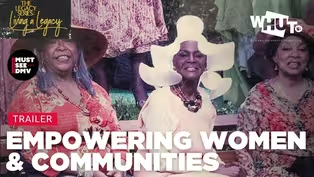
Empowering Women: The Story of NCNW
Preview: S3 Ep2 | 30s | Nonprofit NCNW advances the African American woman, her family and community. (30s)
Providing Support for PBS.org
Learn Moreabout PBS online sponsorship











Support for PBS provided by:
The Legacy Series: Living A Legacy is a local public television program presented by WHUT