
National Minority Health Month, 2024 NFL Draft in Detroit
Season 52 Episode 17 | 26m 46sVideo has Closed Captions
National Minority Health Month and the NFL Draft’s impact on tourism in Detroit.
For National Minority Health Month, Dr. Hayley Thompson, director of Wayne State University's CHECK-UP, talks with host Stephen Henderson about the efforts to tackle health inequities in Detroit and Michigan. Plus, Visit Detroit President and CEO Claude Molinari and Faye Nelson from the Detroit Sports Organizing Corp share how the 2024 NFL Draft in Detroit will impact tourism in the city.
Problems playing video? | Closed Captioning Feedback
Problems playing video? | Closed Captioning Feedback
American Black Journal is a local public television program presented by Detroit PBS
National Minority Health Month, 2024 NFL Draft in Detroit
Season 52 Episode 17 | 26m 46sVideo has Closed Captions
For National Minority Health Month, Dr. Hayley Thompson, director of Wayne State University's CHECK-UP, talks with host Stephen Henderson about the efforts to tackle health inequities in Detroit and Michigan. Plus, Visit Detroit President and CEO Claude Molinari and Faye Nelson from the Detroit Sports Organizing Corp share how the 2024 NFL Draft in Detroit will impact tourism in the city.
Problems playing video? | Closed Captioning Feedback
How to Watch American Black Journal
American Black Journal is available to stream on pbs.org and the free PBS App, available on iPhone, Apple TV, Android TV, Android smartphones, Amazon Fire TV, Amazon Fire Tablet, Roku, Samsung Smart TV, and Vizio.
Providing Support for PBS.org
Learn Moreabout PBS online sponsorship- Coming up, we've got a great episode of "American Black Journal" for you.
It is National Minority Health Month, and we're gonna examine the health inequities in the African American community and what can be done to eliminate these disparities.
Plus, we're gonna look at Detroit tourism in advance of the NFL draft, which is bringing hundreds of thousands of people to our city.
Don't go anywhere, "American Black Journal" starts right now.
- [Announcer 1] From Delta faucets to Behr paint, Masco Corporation is proud to deliver products that enhance the way consumers all over the world experience and enjoy their living spaces.
Masco, serving Michigan communities since 1929.
Support also provided by the Cynthia & Edsel Ford Fund for Journalism at Detroit PBS.
- [Announcer 2] The DTE Foundation proudly supports 50 years of "American Black Journal" in covering African American history, culture, and politics.
The DTE Foundation and "American Black Journal," partners in presenting African American perspectives about our communities and in our world.
- [Announcer 1] Also brought to you by Nissan Foundation, and viewers like you.
Thank you.
(bright music) - Welcome to "American Black Journal."
I'm Stephen Henderson.
April is National Minority Health Month, and that's a time to bring awareness to the health inequities that persist among racial and ethnic minorities and to take action to end those disparities.
This year's theme is be the source for better health, and my next guest is working to increase health equity in Detroit and Michigan by collaborating with community and corporate partners.
Here's my conversation with Dr. Hayley Thompson, the Director of Wayne State University Center for Health Equity and Community Knowledge in Urban Populations.
It's also known as CHECK-UP.
So I wanna start by talking about CHECK-UP and the work that you're doing here in Detroit to not only identify, but kind of coordinate responses to the health disparities that African Americans face in our community.
- Yeah.
So CHECK-UP stands for the Center for Health Equity and Community Knowledge in Urban Populations.
And we're grateful to have funding not only from the Office of Wayne State University's Vice President of Research, but CVS Health and the Office of the Chief Health Equity Officer there.
And it really is an effort to unite our academic researchers with our community stakeholders from different sectors of Detroit and the local area to come together around health equity solutions.
You know, typically, often, or at least historically, knowledge and solutions around health equity and health problems and disparities we see tend to come from academia sort of top down.
And there's been a movement over the past couple of decades to really integrate more community voice in the work that we do.
So, CHECK-UP represents that kind of effort, because we know, and I really strongly believe that good ideas and brilliance don't only lie in academia, they're not only found in academia, they're found also around Detroit communities.
Through CHECK-UP, we really see that in action.
Part of CHECK-UP includes a Detroit Community Health Equity Alliance, it's a coalition of 20 organizations, and as well as additional community residents who serve actually what we call persistent poverty areas or census tracts.
So these are census tracts in which at least 20% of the population have lived in poverty for the past 30 years.
- Wow.
- Which is different from just being a poverty track or non-poverty.
And as you can imagine, access to healthcare and health outcomes are worse in those persistent poverty tracks.
So our, we call it DCHEA, our Detroit Coalition, comes together to try to address those issues in a collaborative way.
We can't do that alone as academics, our faculty and staff and students at Wayne State alone.
We need to partner with community and not just partner with community, we need to bring that into leadership when it comes to these strategies and solutions.
- Yeah, yeah.
So let's talk about the situation we face here in the city of Detroit and the health disparities that come out of that situation, every time I see any of the numbers, they just raise the hair on the back of my neck.
They are so disparate from what we would expect in an American community.
African Americans are at risk for far more health issues than their white counterparts.
- Yeah, that's absolutely true.
We see that across the state of Michigan.
You know, the two leading causes of mortality or death in the state of Michigan are cardiovascular disease, heart disease, and cancer.
And when you look at Black/white differences, they exist across many minoritized groups.
But when you look at Black/white differences, they're quite stark.
So that mortality rates or death rates from heart disease are about 34% higher among Black Michigan residents compared to white residents.
Cancer, 32% higher among Black residents compared to white residents.
And a lot of my work and research is in cancer.
I can tell you that when you look at the city of Detroit and look at Black residents of the city of Detroit, those mortality rates are higher, even when compare them to Black people living in other parts of Michigan or Black people living in other parts of the United States.
So, you know, April is National Minority Health Month, and it's a really a good opportunity to really reflect and think about why, and what can we do about this?
- Yeah.
Let's talk about the reasons that those disparities exist.
I mean, obviously historical inequities play a huge role and current racism as well.
But there are some other things that make Detroit and Black Detroit particularly at risk for these things.
Talk about what they are.
- Yeah.
So you mentioned history and racism, and those are kind of really important starting points because that philosophy, hate practices associated with that history kind of really have a radiating effect and affect our communities.
They affect our institutions, they affect our families, and they affect our individuals.
You know, we really have gone through our major shift over the past few decades around how we look at health outcomes and the causes.
And so, you know, so often, it's very easy to say, to look at individuals and to blame individuals.
You need to go to the doctor, you need to eat better, you need to take your medication.
And those things are important.
They absolutely are.
But individuals don't exist in a vacuum.
We live in the context of families and neighborhoods.
So we've really shifted to think about multiple levels of influence on health, right.
At the community level, the institution level, policy and legislation is such a huge part of that as well.
And then when we think about that, we think also about their social determinants of health, right?
So things like transportation, public safety, the physical environment, the social environment, all these come together to influence individual health outcomes and population health as a whole.
So, you know, unfortunately, there's no one easy answer, but these are complex problems and they're gonna require complex solutions.
- Yeah.
Let's talk about National Minority Health Awareness Month.
Is the goal of something like this to raise awareness among us in the Black community or is it just as much to raise awareness outside the community for those who are charged with caring for this community, those who are charged with setting policy that affects this community to do things differently, to think about this more and to act accordingly?
- Yeah.
Thank you so much for raising that point, because certainly for people of minoritized groups, we need to have an awareness of how these different factors are affecting our health.
And we need connection to resources, right, to support a healthy lifestyle, connections to care.
But you're absolutely right.
You know, we need to think about healthcare systems and healthcare providers as playing a major part in this.
You know, we used to talk about this concept of cultural competency, right?
So it had to do with provide healthcare providers and understanding about different cultures across people of diverse groups, and being aware of the dynamics within those groups and intergroup dynamics to provide better care.
Now we talk about structural competency as well.
So how able are healthcare providers, how able are they to talk about the structural factors or the social determinants of health?
You know, are they assessing the social needs and social determinants of health among patients, right?
And do they know how to address those social needs?
In fact, you know, starting this year, CMS, the Centers for Medicaid and Medicare Services, they're now mandating that healthcare systems start to collect data on patient's social needs and connect that to the social determinants of health.
Right, so now there's greater responsibility on the part of our healthcare systems to not only track those needs, but also address them and provide people, connect people to resources.
And it'll be really interesting to see the research that comes out of this to see and understand more directly how addressing those needs really affects concrete health outcomes.
- Yeah, yeah.
And really it's about making sure that Black health is taken seriously.
I mean, we hear all these stories about the rate at which people are not just denied care, but just kind of denied even the acknowledgement that they need care because there are these disconnects, these cultural disconnects that exist between us and the medical system.
- Yeah, we certainly heard many of those stories around during the COVID-19 pandemic when people's concerns were not being taken seriously in terms of being tested for COVID.
I have to say, really the pandemic has really raised consciousness.
We kind of have now this kind of critical mass in terms of entities and people who have a much deeper understanding about not only the social determinants of health, but again, going back to the ripple effect or gradient effects of racism, implicit bias and how that affects healthcare and healthcare outcomes.
You know, a big part of that is trust and mistrust, and we really need to move the emphasis away from kind of thinking about how do we reduce mistrust among some of our patients and our populations, potentially Black patients and populations, because some of that trust is warranted.
It's absolutely valid.
There's much more a movement now in the field to think about the trustworthiness of our medical institutions and healthcare providers.
- Yeah, okay.
Dr. Hayley Thompson, it was really great to have you here with us on "American Black Journal."
Thanks so much for joining.
- Thank you.
- The spotlight is really gonna be on Detroit this week for the NFL draft, April 25th through the 27th.
It comes at a time when the city has been recognized by USA Today for having the nation's best river walk and best art museum.
I sat down at the historic Ford Piquette Avenue Plant with two people who have played vital roles in attracting tourists, developing the riverfront, and securing major sporting events.
Here's my conversation with Claude Molinari.
He is president and CEO of Visit Detroit, and Faye Nelson, who is from the Detroit Sports Organizing Corp. Claude, we recently, or somewhat recently changed the name of your organization to Visit Detroit.
It's an appropriate phrase, I guess to use to describe the NFL draft, but I don't think we quite imagined that everybody would respond at once, come Visit Detroit on the same weekend.
I mean, the number of people that we're talking about here who are gonna be interested in this, who are gonna be coming to our city, I can't imagine something else quite like it.
- Yeah.
I don't think that there's ever been an event like the NFL draft where 300,000 people descend upon your city in such a huge amount of people and mass over three days, it's really gonna be something incredible.
And you know, I think though, it continues to show that narrative of Detroit changing, because last year was the most visitors we've ever had in 2023.
2024 is gonna be boosted by this huge NFL draft and all the other great events we have coming.
It's just, it's an amazing time for our region.
- Yeah.
So I didn't know that 2023 was the most visitors we'd had.
What was the reason for that?
- I think a lot of it was to do with all the events that we had as well as the Lions were so successful and frankly there's a lot going on here.
And the perception of Detroit and Southeast Michigan and the state of Michigan is changing for the better.
People are starting to realize that this is a great place to visit and to live and to invest in.
- Want to add to Claude's point, though, people are so amazed and surprised at the fantastic city that we call Detroit.
I mean, I had the privilege of co-chairing the International Women's Forum Annual Conference, which is here in Detroit in partnership with my colleague Mary Kramer.
We had 700 women that came from all over the world to visit Detroit from 20 countries, most of whom had never been to the city.
So there was a lot of, there was, I won't say trepidation, but there wasn't a lot of understanding of the assets of Detroit and what it was all about.
And I have to tell you, they were just beyond blown away.
It was fabulous.
And, you know, many of whom spoke about just coming back to visit, bringing their family.
So, it was just amazing.
And we had the privilege of working with Visit Detroit to coordinate that conference.
- So Faye, you've been involved with all of this for a long time.
You know, we think about the riverfront now as just another part of Downtown Detroit, and it's getting us all kinds of praise and recognition.
And we're now, I think 20 years into that effort.
I'm not sure everyone knows that you're the person who built that, you were the first one to lead the River Fund Conservancy.
- Yeah, no, that's very kind of you.
It was a privilege and an honor.
I was with the Riverfront Conservancy as their Inaugural President and CEO for 10 years, a little bit over 10 years.
But it was an amazing experience to be able to really lead in partnership with our public and private partners, the development of a place and space that no one ever thought would have any chance of being renovated or restored.
So it was a great honor and a wonderful opportunity.
- Yeah.
And so much of what we're talking about now in terms of Detroit and the progress in places like downtown, it keys off of that riverfront.
I mean, if you think about what it was before, and this really inaccessible kind of dirty place.
And what it is now, which is a gathering place.
That attraction of people is the thing that fuels the idea that, okay, well what else can I do downtown?
- Oh, for sure.
- Or other things.
- It was such pride.
I mean, there have been so many folks that visit the waterfront, family reunions, business meetings, you know, and people are still shocked that, oh my gosh, right across the water, that's Canada, that's another country.
But it's wonderful.
And the team that's developing now, continue to develop the waterfront has just done a fantastic job.
- People ask us sometimes like, "Do you dye this water?
Like this can't be this blue."
I was like, "It's pure Michigan, baby.
What you talking about?"
They think this is like the Caribbean water.
It's like so amazing.
- Like real fresh water.
- But I think the most important point from thinking about or reflecting on the development of the waterfront is what it has done as it relates to the coming together of community.
The public, the private sector, working in partnership with organizations like Visit Detroit, the broad based community.
It's a wonderful story to tell.
- Yeah, so Claude, let's talk about logistics.
With the draft, 300,000 people, that's almost half the population of the city, although the mayor might yell at me if you heard me say that 'cause he probably thinks there's more people, but it's still a lot of people.
How's that gonna work?
- So the draft is set up so that Hart Plaza, Woodward Avenue, and then Campus Marshes and Cadillac Square will be the main draft area.
But we're gonna have satellite locations throughout the Downtown, Grand Circus Park, Capital Park, Beacon Park, Harmony Park.
All of these are going to be set up with remote areas that's gonna have video screens and audio.
So as it spreads out and expands and as the fans, you know, basically flood the entire city, we're still going to have a great experience for everybody.
And again, Corktown is gonna be very vital to this, Greektown is gonna be very vital.
Monroe Street is gonna have activations and video screens.
So while a worldwide audience of maybe 60 to 70 million people are gonna be watching, they're gonna see an incredibly vibrant, exciting downtown, loaded with people from all over the world, enjoying all the amazing things that go on in the city of Detroit.
And we're gonna be so excited to host them.
- Yeah.
So when you're selling something like this though, to the NFL, I mean, they would have real questions I would think about, okay, hotels, freeway access, restaurants, things like that.
Was it hard to sell this?
- It really wasn't.
You know, it's funny how that came through.
You know, the National Football League has less of a concern about having an incredible amount of hotel rooms in the right downtown core, like meetings and conventions, they recognize that they need to have five or 6,000 rooms specifically within walking distance of the convention center.
That gives us a hard time.
But really very few cities can support all of the hotel rooms that are gonna be needed in downtown.
So there's gonna be compression, which is frankly the great news for us, because we have 45,000 hotel rooms just within Oakland, Wayne, and Macomb County.
So the best part is now that the Downtown Detroit hotel rooms will be sold out, that'll just spread it out throughout the downtown core and then into the suburbs.
And we expect that Macomb County, Oakland County, they're gonna be flooded with attendees as well.
- Yeah, Faye, when you think about all of the different kind of pieces that you gotta put together for something like this, and you have private sector, you have businesses that are kind of developing downtown, think of how different it is than it would've been for us, say 20 years ago when we had the Super Bowl here.
And we had to do different things, right, to get ready for that.
It was a different city and we had to kind of dress ourselves up, I guess, I felt like when that happened, it's a different thing now.
And there are more people I feel like, at the table, ready to help in a different way than they had to.
But it's progress in really dramatic ways.
- Oh, I agree.
I can remember when the Super Bowl came to town.
And it was, you know, it was good.
There were people that from the suburbs that were marveling at being downtown for the very first time in about 10, 20 years.
You know, so, but you know, the vibe is so different now.
There's so much pride in Detroit and where it is now, and directionally where it's headed.
So we're just such a prideful community.
And it's just, I think to Claude's point, the draft, you know, everybody is winning.
And so, just the number of folks that we anticipate coming to town, our focus on not only the community, not only well community in terms of posting downtown, but also our focus on community.
Not only on where this event will land and when it will take place, but after the event and what we are working on in order to support our children and families.
- Yeah, yeah, this Living Legacy.
- Yes, yes, yes.
- Part of this, which focuses on literacy, is that right?
- Well, it focuses on literacy and active play.
We are just so grateful from, for the philanthropic community and the $1 million that has been directed to our launch of this Living Legacy program in coordination with the launch of the draft.
But, you know, the key part of this legacy program is that it goes beyond the draft.
So the focus is on literacy.
We're so pleased to work with Alicia Maryweather as she has identified, and we're supporting two schools, Dixon Middle School, which is a pipeline to Cody High School and the Detroit Lions Academy.
So that's one piece.
And then the other piece is active play.
So important to encourage our children to get out.
- Go outside.
- Outside and play, right?
So yeah.
In partnership with, of course, the Detroit Sports Commission, we are partnering with Project Play, which is a collaboration between the Community Foundation of Southeast Michigan, the Wilson Foundation, and also the Aspen Institute of Sports.
So, two major initiatives that we look to continue funding and supporting beyond the draft.
You know, as a Board Member of the Detroit Sports Commission, it's with privilege and pride that we have made the commitment with every major sporting event that we're able to attract to the city of Detroit, there'll be a community engagement component which will support that education and that play for our community.
- So Claude, your job is to sell Detroit all over the place.
And you're pretty new in the role still.
Tell me where we are and stuff that we need to still do.
Gaps we still need to work on filling to make this as attractive a place as we can.
- Yeah, I think that we've done a really, I think we've been very deliberate in that we've brought in, every year we've brought in large meeting planner events.
You know, one year we brought in 1,200 meeting planners from Connect Partnership.
The next year we brought in 500 meeting planners from the Scientific Association community.
This summer we're gonna be hosting 1,200 people from Professional Conference Meeting Association, so that we're introducing, reintroducing Detroit as a meetings, convention, and trade show destination.
That's really been, I think, a great opportunity for us to showcase the things that we now have in play.
Again, all the new hotel rooms, that's putting us on a different level.
We're not where we need to be, but we're getting closer.
And with the work that we're doing on the hotel that's gonna be attached to the convention center, I hope that's gonna be breaking ground in early spring.
And then we'll be in a much better position.
From the leisure travel side, we're seeing huge gains in that.
We've done a lot of overtures out in Europe.
We've worked hard with our French and UK partners to drive that narrative that Detroit is a great place to come to.
And we're seeing the fruits of those endeavors as well.
And so as people are starting to travel more and get back into it, Detroit is gonna be a very strong destination we feel moving forward.
And we're seeing the benefits of that.
And the best part is our hotel partners are seeing the best part of that, which means it drives more development.
And then we start to see even more hotels, and it's a virtuous circle.
The more people come, the more money there is in tourism, which means there's more development, more marketing, and it starts to improve.
- So I mean, obviously we need the hotels and the hotel space.
Are there other things that go along with that that we should be thinking about?
- Oh, enormous thing.
I mean, you know, again, when people come to visit, they may say, oh, all right, I like your stadium, or I like your room, but where am I gonna eat?
Where am I gonna sleep?
Where am I party?
Where am I gonna shop?
Where am I gonna get my sports?
So all the things that you can do, I mean, even like our airports, the fact that we have the number one mega airport in North America led by Chad Newton and his team.
They've done a, that's an incredible advantage for us.
The fact that Turkish Airlines and Iceland Air are now running nonstops.
Like, because that's two-way, yeah, our people are visiting them, but now people are coming to visit us.
And I think that all the attractions, the Ford Piquette Plant, where we're talking from, this is a huge benefit to our region.
All of the various attractions, that drives people to come here.
- And one other note about Detroit's riverfront, a documentary about its development can be seen right here on Detroit PBS on Monday, April 29th at 9:00 PM.
The film is titled, "Ignore the Noise: The Transformation of the Detroit Riverfront."
It's a collaboration between Detroit PBS and Free Age Films.
We hope you'll watch.
That's gonna do it for us this week.
You can find out more about our guests at americanblackjournal.org.
Plus you can connect with us anytime on social media.
Take care, and we'll see you next time.
(bright music) - [Announcer 1] From Delta faucets to Behr paint, Masco Corporation is proud to deliver products that enhance the way consumers all over the world experience and enjoy their living spaces.
Masco, serving Michigan communities since 1929.
Support also provided by the Cynthia & Edsel Ford Fund for Journalism at Detroit PBS.
- [Announcer 2] The DTE Foundation proudly supports 50 years of "American Black Journal" in covering African American history, culture, and politics.
The DTE Foundation and "American Black Journal," partners in presenting African American perspectives about our communities and in our world.
- [Announcer 1] Also brought to you by Nissan Foundation, and viewers like you.
Thank you.
(light music)
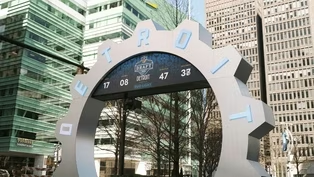
2024 NFL Draft puts spotlight on tourism in Detroit
Video has Closed Captions
Clip: S52 Ep17 | 14m 3s | The 2024 NFL Draft puts a spotlight on Detroit and attracts tourism to the region. (14m 3s)
Detroit Family Caregivers’ Project
Video has Closed Captions
Clip: S52 Ep17 | 9m 49s | Detroit Family Caregivers’ Project creates caregiving ministries in local Black churches. (9m 49s)
Providing Support for PBS.org
Learn Moreabout PBS online sponsorship
- News and Public Affairs

Top journalists deliver compelling original analysis of the hour's headlines.

- News and Public Affairs

FRONTLINE is investigative journalism that questions, explains and changes our world.












Support for PBS provided by:
American Black Journal is a local public television program presented by Detroit PBS