
National Monuments and Tech Regulations
Season 6 Episode 6 | 27m 16sVideo has Closed Captions
Controversies continue over national monuments and tech regulations as 2022 midterms begin
Utahns react to major headlines that could have a big impact on the state while public lands take center stage as the controversy over national monuments returns. Plus, the Facebook whistleblower ignites new questions over tech industry regulations as candidates line up for the 2022 midterm races. Rod Arquette, Robert Gehrke, and Amy Donaldson join host Jason Perry.
Problems playing video? | Closed Captioning Feedback
Problems playing video? | Closed Captioning Feedback
The Hinckley Report is a local public television program presented by PBS Utah
Funding for The Hinckley Report is made possible in part by Cleone Peterson Eccles Endowment Fund, AARP Utah, and Merit Medical.
National Monuments and Tech Regulations
Season 6 Episode 6 | 27m 16sVideo has Closed Captions
Utahns react to major headlines that could have a big impact on the state while public lands take center stage as the controversy over national monuments returns. Plus, the Facebook whistleblower ignites new questions over tech industry regulations as candidates line up for the 2022 midterm races. Rod Arquette, Robert Gehrke, and Amy Donaldson join host Jason Perry.
Problems playing video? | Closed Captioning Feedback
How to Watch The Hinckley Report
The Hinckley Report is available to stream on pbs.org and the free PBS App, available on iPhone, Apple TV, Android TV, Android smartphones, Amazon Fire TV, Amazon Fire Tablet, Roku, Samsung Smart TV, and Vizio.
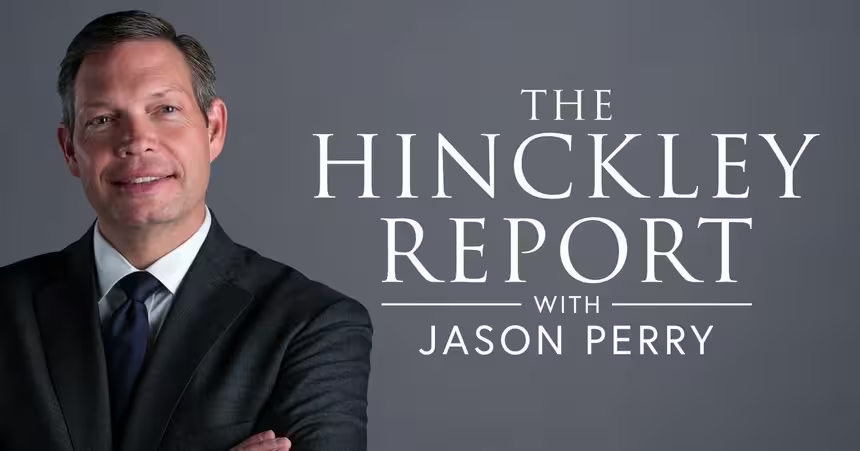
The Hinckley Report
Hosted by Jason Perry, each week’s guests feature Utah’s top journalists, lawmakers and policy experts.Providing Support for PBS.org
Learn Moreabout PBS online sponsorship♪♪♪ male announcer: Funding for "The Hinckley Report" is made possible in part by the Cleone Peterson Eccles Endowment Fund.
Jason Perry: Tonight on "The Hinckley Report," once again Utah's public lands are ensnared in controversy as the battle over national monuments continues.
Candidates line up for the 2022 midterm races, while leaders spar over redistricting.
And Utahns react to major headlines that could have big impacts on our state.
♪♪♪ CC BY ABERDEEN CAPTIONING 1-800-688-6621 WWW.ABERCAP.COM Jason Perry: Good evening and welcome to "The Hinckley Report."
I'm Jason Perry, Director of the Hinckley Institute of Politics.
Covering the week, we have Robert Gerhke, news columnist with the Salt Lake Tribune.
Amy Donaldson, executive producer with KSL Podcasts.
And Rod Arquette, host of the Rod Arquette Show.
Thank you for being with us tonight.
Big issues happening in Washington D.C. with very big impacts in the state of Utah and around the country.
Rod, I want to start with you on what happened this past week.
President Biden announced he's going to restore the size of Bears Ears and Grand Staircase Escalante National monuments.
This is a conversation we've been having even on the show for a long time.
Why is that the case?
Kind of give us a little bit what's happening.
Rod Arquette: Well, I think what was interesting.
I had a chance to talk with Congressman Curtis this week.
Of course, members of the congressional delegation wrote a combined op-ed piece about this, and they called it a monumental insult, and I asked I asked Congressman Curtis, I said were you surprised or disappointed?
He said not surprised but disappointed in the fact that they felt the delegation had been working with all parties involved, were really trying to get an audience with the president to sit down with the president and argue their points, and they never got that, and he said that's what disappointed the delegation more than anything was we couldn't get in front of the president.
Yes, the interior secretary came out, but he said he felt like that was more for show than anything else.
So they were not surprised but disappointed, and now the fight continues.
I think that's what frustrates a lot of people is the debate over this, are we ever going to settle the size, what it should be, and what it can be?
Jason Perry: Well, Amy, this disappointment idea that came from our delegation, what's interesting about the way this works is that no one was surprised about.
In fact, the administration kinda signaled by the way this is going to happen, and it's probably gonna happen tomorrow, just so you know, but there's nothing they could do about it necessarily.
Amy Donaldson: On indigenous peoples day, right?
So there was I think a message being sent.
I find it interesting that they think that Deb Haaland coming here, the interior secretary was ceremonial or was for show.
I feel like she's the one who's much closer to the ground, much more involved in bringing people together, having a discussion about why and how and what.
I think a meeting with the president would be very ceremonial.
I don't know always that he has some idea about what's happening here other than, you know, what we all know sort of what happened with the boundaries being changed under the Trump administration, and then this monument actually will be a little bit bigger because they're gonna leave the additional 11,000 acres that Trump designated, but I felt like-- I felt a little disappointed in the delegation talking about including tribal leaders.
This is the only national monument that was designated at the specific request of federally recognized tribes, and I find it insulting that you would attempt, then, to speak for people who are at odds with you on this issue.
And so, for me, I felt, you know, you want to say why you think it should be this way, and I didn't have any problem with some of the reasons they laid out, but we already have a history with Grand Staircase.
The trade that we made and you know that one of the arguments is this the trust lands for schools.
Rod Arquette: Yeah, the SITLA lands.
Amy Donaldson: We have more money by trading those, trading that land from Grand Staircase.
So some of the--some of this, for me, is just a show.
You're right, it is a political football, it has become one.
This didn't happen, none of these monuments--Grand Canyon was protested.
Nobody was ever in favor of turning any of these lands-- It happens every time, I'm from Alaska, that I think the issue here is that we're number four in the number of federally controlled lands, and that's what people are upset about.
Jason Perry: Robert, I want to ask you about this too.
You wrote a really great article this week about it that everyone I think should read, but I Wanna frame this with a quote from Senator Mitt Romney, because our delegation did engage almost immediately with their response.
And this is what Senator Romney said, he said, Yet again, Utah's national monuments are being used as a political football between administrations.
"The decision to re-expand the boundaries of Bears Ears and our Grand Staircase-Escalante is a devastating blow to our state, local, and tribal leaders and our delegation."
Kind of put that quote from him into context with what you have been hearing from people in the state this week.
Robert Gehrke: Well, I mean, I think they didn't mind when, excuse me, when President Trump shrunk the monument, eliminated almost the entire monument in the first place, and now this is somehow an insult to the people of Utah.
It's a little bit hypocritical.
Ultimately, what we need to get to is we need to get these sacred lands protected.
I mean, if we want to protect the lands, we've gotta come to some sort of agreement, get it funded, get some boots on the ground to try to preserve these areas.
And the unfortunate thing is that right now you've got a lot more visitors coming to this site, but you don't have more resources there to accommodate those visitors.
You don't have even a visitor center, you don't have toilets, you don't have the resources to protect the Indian artifacts that are there, so I mean it is--it does bother me, as Amy pointed out I think, to hear Mitt Romney talking about what tribal leaders wanted when it was--this was initiated by the tribes back in 2015, and there have been, you know, we've had five, six years since then to try to resolve this issue, and we haven't seen much action by the delegation to do that, so I think it's a little bit of they're gonna stomp their feet and be upset when they don't get their way, and you know, as Rod--excuse me, as Rod said, you know, when when the secretary of the interior Secretary Haaland came out, they say that's that's all for show, but when Secretary Zinke comes out, that was a great thing for the interior secretary to do, so it's just--it comes down to a matter of they are unhappy because they didn't get their way.
Amy Donaldson: Don't you think-- they're looking at management that would--the tribe would be central--the tribal coalition would be central to the management of this monument of Bears Ears, and you know everyone's saying, well, this-- how will this work?
Well, that's what they're gonna figure out, and that has to happen like immediately, because Robert's right.
There's no roads in some places where people are just driving and going on wherever they want, so, but you have a model like in Canyon de Chelly, where the Navajo nation owns that National monument, and it's run in conjunction with the federal government with the department of interior and National Park service, and I have been there.
I've run a race in that monument, and I love seeing the native people caring for and benefiting from and you know showing off this amazing living archeological site, and so I think that you have models, you have examples where this has worked, and I think the key to this is getting some kind of structure in place so that this can be managed, because right now people don't--you know, random people are coming from other countries in some cases, and they're going-- The other thing is I would point everybody back to after Grand Staircase was designated.
A lot of ranchers were upset about it, a lot of businesses changed and pivoted, happened in Emery County, too, with a shutdown of mines there, now they have great recreational industries that have--they pivoted.
They learned to make money in a different way.
There are also costs to that industry, and I would just caution everyone like it's not just like a free for all now, now we have to say how do we want this to happen?
And this was already happening.
This will just protect so that people generations from now can enjoy it.
Rod Arquette: Yeah, I think the issue that a lot of people had-- well, not a lot of people, but the surveys show that it's the size.
I mean, do you need this big of a monument, 1.3 million acres, 1.9 million acres-- I really enjoyed Robert's article because Robert pointed out the management, is there going to be money allocated to manage this?
This is a huge project, are we going to take benefit of-- take advantage of it?
The other point I wanna respond to Amy on the disappointing side from Curtis's point of view, and I think other members of the delegation.
You know, Joe Biden spent a long time in the Senate, he understands back and forth, he understands let's argue, let's debate, let's make your presentation, and then we can do it, they didn't get that out of Biden.
You know, Mike Lee told me a couple of weeks ago.
He said during the Obama years, Joe Biden was always up on the Hill.
He was working with lawmakers, working you know, doing the the grippin' and grinnin' so to speak, but you don't see him anymore.
You don't see-- Now, now, now, now, he is president, that's a little bit different role than when he was vice-president, but I think they felt because he's, you know, he came from a legislative background, Joe Biden, that he would at least be willing to sit down and listen to them.
That's where the disappointment, I think, is what they brought up.
Jason Perry: So, Robert, on the list--go ahead, Robert.
Robert Gehrke: I was just going to say if I could to kind of pick up on the point Amy made, if you look at the Zion National Park, Arches National Park, Bryce Canyon National Park, Capitol Reef National Park, all of these are areas that started as national monuments.
They were preserved and protected under the Antiquities Act is national monuments first, and I think it's hard to say that those communities have done poorly because of that.
I don't think those hindered economic development in those areas, and I think they've enhanced economic development in those areas in creating this huge tourism industry.
I don't think Moab would be happy if you try to get rid of Arches National Park.
So I think, ultimately, if we can get together and come together and protect the lands and get this area funded, get the resources on the ground, it can be a tremendous asset for these communities, but if we're going to continue to fight about it for the next 25 years as we have in the case of Grand Staircase, it's gonna be a deadlock.
It's gonna be a stalemate, and it's gonna be detrimental to the communities and detrimental to the lands that we want to protect.
Amy Donaldson: And all of that land is open for grazing, just FYI.
Rod Arquette: And there are going to be lawsuits.
I mean, it's just coming.
The court either--yeah there always are.
You know, I think what people would like to find would be a congressional solution that would be be supported by the president.
We would like that.
There's no doubt it's headed for the courts again, and we're gonna get another court ruling.
Amy Donaldson: When the courts have consistently supported the idea that you can use the Antiquities Act to do exactly what Joe Biden and President Obama have done.
Rod Arquette: Well, there's a question on that, too, the use of the Antiquities Act.
Jason Perry: Well, so talk about that for a second, Rod, because that's what these decisions are based in that, that power that the president has under the Antiquities Act to do these kinds of declarations, and that's why-- Amy Donaldson: You have to have significant artifact--and archaeological and natural significance to the community.
Rod Arquette: But the fighting continues about these things because whoever's in kind of in the chair of the president under this gets to-- Amy Donaldson: No, no the fighting continues because politics has become a blood sport.
That's why the fighting continues.
It takes executive action.
Look, it's not just--you're gonna write all--you're going to govern by executive action, well, I'm going to come in and undo everything you did by executive action.
Rod Arquette: And the argument is true, yeah.
Amy Donaldson: That as part of this, it is part of this issue.
Rod Arquette: It is part of the issue.
The other issue is the debate over control.
Who controls the land?
Amy Donaldson: Which I love, because-- Rod Arquette: Is it the tribes, is it the state, is it the federal government, that's what it comes down to, who controls this land?
Amy Donaldson: And I feel like the best solution, and Representative Curtis was involved in this, is a state, federal, and tribal central, the tribal coalition has to be at the center of this and with the support of the state and federal and they can have input.
I mean, if you look at what they say they're losing, they're not losing the things they say they are big, and that's what bothers me is if we could just at least all be talking about the same set of facts and then we could have a real productive conversation about what do you need, and how can I give that to you?
Because that can happen, this can be mutually beneficial for everybody in the area and everybody around the world who wants to come and enjoy these-- but right now because of our political landscape, I just see it getting-- Talking about football, it's whoever has the ball, and then it goes to the other team.
Jason Perry: Robert, final word on this, particularly about these-- Robert Gehrke: Amy made an excellent point that we're overlooking in all of this, it's not--this is not a federal land grab, these were all federal lands to begin with, they're just changing how they're managed, and they're not really restricting all that much either.
As Amy noted, there's a ton of grazing in the Grand Staircase.
When they drew the Bears Ears boundaries, they drew them very carefully to exclude mineral resources that might be developable, so I think we're-- there's a lot of hyperbole going on here and wailing and gnashing of teeth, but ultimately at the end of the day, we're talking about how do we want to protect these lands that I think we can all agree deserve to be protected.
Jason Perry: Let's kind of transition to some events that happened this past week.
There's a little bit of this thing even with our high tech industries when it comes to our public lands, too, which has been a source of constant conversations, including whether or not even some of these companies stay in the state of Utah.
But this week Silicon Slopes met in the state of Utah, all these high tech companies.
Apple executives here.
Amy Donaldson: Yeah, we had Steve Ballmer, former CEO of Microsoft, you had Tim Cook here.
He actually went to a basketball game, so you had crossover.
Jason Perry: So, they had some comments about where they see the state of Utah is going and what they would like to see.
Let's start with you, Amy, I know you looked at it closely, and let's get-- Amy Donaldson: I guess I'm squirming in my very comfortable chair, because I saw Mike Lee and Mitt Romney engaging with Steve Ballmer and Tim Cook, and I read Art Raymond's piece in the Desert News about how Mike Lee was instrumental in bringing Zuckerberg here a couple--in 2020 and then this situation with Tim Cook, but I--for me, what that--and I'm an outsider, I didn't cover this, so I'm like everyone else just watching to see what's happening, and I feel like that tells me that's why this industry will never be regulated.
Facebook will not get the regulation that it needs.
In broadcast we can't say certain words on the radio, we can't swear, there are all kinds of rules about what you can and can't put on broadcast television or broadcasts radio, but on the flip side we can't regulate absolute fiction being passed off as news articles and news programs on social media.
It's mind boggling to me, but I saw that, I read the articles, I didn't feel like a sense of, oh, this is amazing or excitement, I felt like they're all in the same boat, and we are not in the boat.
That's how I felt.
Even on the educational, I don't know how you felt about the educational.
Rod Arquette: Well, the Internet has been the wild west from the beginning, and how do you tame the wild west?
I mean, and you know, when you talk about regulation, I think people sometimes grow a little uncomfortable, wait a minute here, let's not regulate this thing too much, or how do you regulate it?
That you don't get censorship on top of it, and that's gonna be your--that's going to be the real question.
And I--what I really enjoyed was the fact that lawmakers and some of the high tech leaders actually had a breakfast, and they had an exchange of ideas about what bothers the high tech industry, and they listen to the legislators.
The legislature provided a lot of business incentives for these companies to get going.
I noticed the Governor said just--I think it was today or yesterday--those incentives are coming to an end will be cut, you know, you're kind of on your own.
Amy Donaldson: What bothers me about that is that's them saying here's what we need from you, like we don't like these statement bills, drinking laws, and I feel like people missing at the table or all the rest of us who have to live with whatever they work out for themselves.
So you want me to come here, this is what I need, and then they're making these deals at some breakfast that we're never invited to.
I mean, I'm not saying I should be, you know what I'm saying?
[laughing] Jason Perry: Robert, can we talk about this regulation for a second?
'Cause there's the local side, too, but I've been very interested in what's happening with our--some of the congressional committees too.
We've had whistleblowers from Facebook in talking about Instagram, the harm to children in particular.
Talk about some of that, because it's political, yes, but it's also to mental health and even life or death in some cases when it comes to suicide from some of these impacts of social media.
Robert Gehrke: Yeah, I mean, I feel like it's an important issue that's probably getting attention now because of the politics, because it's beneficial to some of these Congress members--members of Congress, but it is important, too, because, you know, you see--when we were kids, we didn't have cell phones when we were eight or nine years old.
We didn't grow up with that, constantly being bombarded with that, and we're seeing the real consequences of that, and yeah, these companies know it.
They know it's a problem, they know that misinformation on their platforms is a problem, and I think going to Amy's point, I think the only way you're ever going to see them, you know, brought into line or held at some standard is if they're legally liable for the information that they put online, for the damage that they do.
You know, in our business, Rod, Amy, myself, we would be held accountable if we publish misinformation, if we knowingly published false information, and these are publishers, and so they need to be responsible for the consequences of their actions, I think.
You know, that's a pretty basic premise, and we need to move toward that, and I'm not confident that we're going to get very far down that road, because you know, as Amy pointed out, we see who wants to buddy up to them when, you know, when you see how much money that gets lobbied, and so you know, it's gonna be an ongoing struggle, and I don't think it's gonna get better until it gets much worse.
Rod Arquette: For these lawmakers to be talking about regulation or how do we control this, how many of these lawmakers are getting money from the high tech.
Amy Donaldson: And that's the problem.
Rod Arquette: That's the issue, I mean, you know you can talk, yeah, we're gonna fix this, we're gonna fix this, and oh, by the way, thanks for the campaign contribution I mean, you gotta think about.
Jason Perry: Hey, Rod, let's put this into perspective, because I thought it was an interesting comment from Senator Markey from Massachusetts, because you talk about this, you know, will there be regulation, and I think these arguments are good, but I wonder if you think this is a fair comparison to the impact these companies might have.
This is what he said, this is about Instagram in particular.
He said, "Instagram is that first childhood cigarette meant to get teens hooked early.
Facebook is just like Big Tobacco, pushing a product they know its harmful to the health of young people."
I mean, they're trying to make that connection.
Rod Arquette: Yeah, well, just watch a group of teenagers and how they use the cell phone and how they communicate with each other.
I mean, it is very addictive to these kids.
I mean, let's be honest, for many of us what do we do first thing in the morning?
Grab the phone and see what messages we have on the phone.
So I think he makes a very, very good point and the power of it how we regulate that.
Someone suggested the other day, I heard this, and I went that's odd, we regulate cigarettes, do we now need to regulate cell phones to children under 16?
And I'm going whoa.
Amy Donaldson: The association of pediatrics has already given parents some guidance on what they--what screen time they should or shouldn't be having.
Rod Arquette: And I think for parents, a lot of parents are lost on this, how do I lock this out, how do I block this?
They don't know how to do it.
Maybe we need to campaign mom and dad, this is what you need to do on your cell phones.
Amy Donaldson: Listen, I had to have my kids teach me how to use my smart TV, so I don't know.
I think that I mean, there has to be regulation.
The problem is the money is with the big businesses who don't want to be regulated.
They don't--we'll take care of it, we'll have a--and I mean I watched that "60 Minutes" piece with Francis Haugen and she-- her telling me or telling us that they disbanded their office of integrity after the election, because oh everything's okay now was exactly my fear, it confirmed for me that this is about making politicians happy in a moment, and then we can make as much money as we want.
They want engagement and what drives engagement is anger, it's negative emotions, it's I want this, I want that, I need to buy this, I need to buy that, and the social dilemma is a film I recommend every--a documentary I recommend everyone watch, but it will--and it will change the way you--but this information has been out there for almost a decade, and we have changed nothing, and we're not even talking about-- We're--look at the pandemic, how much more dependent we became on all of our technology.
Do you think our kids are not also?
I had a granddaughter in kindergarten doing Zoom calls for kindergarten, and I'm thinking to myself, she has no-- her childhood and mine resemble literally hardly anything about--there's no-- What she's experiencing and what I experienced are completely different universes, and I-- it's more isolating in a lot of ways, it is more--depression is higher amongst younger people, suicide is higher amongst younger people, and everyone wants to blame this fact that you couldn't go out and see your friends.
There's also like this massive dependence on social media, and if we don't decide that we're gonna do something about this for our kids, then I--and it's gonna be a huge money issue.
Rod Arquette: Mm-hmm, and the industry is not gonna discipline itself.
Amy Donaldson: No industry is, let's be honest.
Rod Arquette: It goes back to profit, profit, profit, and if they see profit-- Amy Donaldson: No industry is, we even had this debate about police, we had this debate about in the media, oh, sure, we're gonna take care of it, no problem.
That's like telling me to be in charge of how much sugar is in my house, it's just gonna be hidden in my cupboard, Jason Perry: Okay, let's transition for a moment into the 2022 elections, because we should, right?
'Cause we're gonna have to at some point.
So it's interesting, I want to get to what's happening locally.
So, Robert, interesting comments from former President Trump this past week as we're starting to get ballots in the mail this week for municipal elections.
Amy got hers yesterday, ours will all arrive soon, and we're starting to look at what's happening in 2022.
Former President Trump was still talking about voter fraud and encouraging Republicans maybe not to vote in the next two rounds.
Robert Gehrke: Yeah, I mean, I got it kinda goes part and parcel with what--the damage he's done to our democracy in the first place right.
If you've undermined the integrity of the elections, the trust in the democracy, and now you're telling people to stay home, you know, it's sort of a short-sighted play on his part I suppose because if his supporters stay home, then his candidates are going to lose, but he is still the, you know, the most prominent Republican out there, and when he makes statements like this, it could potentially have an impact, and so you know, but at the end of the day, it's--we should be trying to support the integrity of our democracy.
It's the only system we've got, and rather than tear it down, I would like to see the president--the former president--you know, bolstering it, propping it up.
If there's--if there are problems, then fix the problems, but he can't really point to specific problems.
So I guess the solution is tell everybody to stay home.
Amy Donaldson: He'll point to one specific problem, he didn't win, and he said before the election even occurred, if I don't win, then there's fraud, right?
So he's very much in this for himself.
What I'm disappointed about is other Republicans and really other Democrats saying you should be voting-- I hate--I got my municipal ballot and my mayor and my city council person are running unopposed.
That's what I don't want to see.
I want to see more people involved.
I want to see more people running so that I have better choices, and this environment is so toxic, and I would love to see both Democrats and Republicans coming out and saying on a wide scale, not what--we've had individual voices, but massive numbers of them coming and saying you should be voting, that you can trust this process.
It is not--there is not widespread corruption.
We're lucky we live where we live, and we have the options we do, and we're going to do something.
I wish we would pass Motor Protection Act, but we're not.
Voting rights, I don't see that happening, but I--just a big statement, just even publicly getting together and saying you should be voting.
We should want everyone voting.
We want engagement.
We don't want you to just get on Facebook and have your-- Jason Perry: Now, Rod, Carson Jorgensen who runs the Utah Republican Party came out pretty quick talking about this.
Rod Arquette: Yeah, I had 'em on the show yesterday on my radio show yesterday, and he laughed.
He said at first I thought it was a joke.
I mean, that's how he kind of looked at it.
It was laugh or cry, but this whole debate is going to be fueled there's a new book out that Molly Hemingway has written called "Rigged."
It talks about how the election was not stolen but vandalized, and people are going to read that, especially Trump supporters who will go ah-ha!
I told you so.
This is what happened here.
This debate's not going to calm down, but I found it interesting that Carson laughed at, he said I really thought it was a joke at first.
You have to understand Trumps sometimes, and I--did he really mean that?
Yeah, you have to understand where he's coming from sometimes, and I think he feels in his heart of hearts that things were done--I don't know if you could say the election was stolen, but things were rigged to prevent him from winning.
That's what he honestly believes, he's going to share that with his supporters, and his supporters are gonna believe it.
Amy Donaldson: I'm gonna disagree with you straight up and tell you I think he's all about himself, he's all about what's good for him, and so he will tell any lie necessary to support the fact that he should-- People are still acting like he's the president.
I saw a member of Congress act-- say he couldn't say definitively there was no fraud in the last election.
It's ridiculous this debate is still going on in every member of Congress who doesn't come out and say the election or not rigged, there is no widespread fraud, you can trust this process, especially in states where they know their state, like in Utah, you can vote through the mail, there isn't an issue.
Rod Arquette: But named me one politician that isn't all about himself.
Jason Perry: Okay, we're gonna have to leave it this way, but this is a conversation we'll keep having.
Thank you all for participating, and thank you for watching "The Hinckley Report."
This show is also available as a podcast on PBSUtah.org/HinckleyReport or wherever you get your podcasts.
Thank you for being with us.
We'll see you next week.
♪♪♪

- News and Public Affairs

Top journalists deliver compelling original analysis of the hour's headlines.

- News and Public Affairs

FRONTLINE is investigative journalism that questions, explains and changes our world.












Support for PBS provided by:
The Hinckley Report is a local public television program presented by PBS Utah
Funding for The Hinckley Report is made possible in part by Cleone Peterson Eccles Endowment Fund, AARP Utah, and Merit Medical.