
Nature Preserves
Clip: Season 32 Episode 1 | 4m 9sVideo has Closed Captions
Explore Kentucky’s nature preserves and how they protect our natural heritage. (79 characters)
Learn about Kentucky’s diverse network of nature preserves and the important role they play in protecting wildlife, habitats, and natural landscapes. Discover how these protected areas help conserve the state’s scenic beauty, support biodiversity, and ensure future generations can enjoy Kentucky’s rich natural heritage. (327 characters)
Problems playing video? | Closed Captioning Feedback
Problems playing video? | Closed Captioning Feedback
Kentucky Life is a local public television program presented by KET
You give every Kentuckian the opportunity to explore new ideas and new worlds through KET. Visit the Kentucky Life website.
Nature Preserves
Clip: Season 32 Episode 1 | 4m 9sVideo has Closed Captions
Learn about Kentucky’s diverse network of nature preserves and the important role they play in protecting wildlife, habitats, and natural landscapes. Discover how these protected areas help conserve the state’s scenic beauty, support biodiversity, and ensure future generations can enjoy Kentucky’s rich natural heritage. (327 characters)
Problems playing video? | Closed Captioning Feedback
Where to Watch Kentucky Life
Kentucky Life is available to stream on pbs.org and the PBS app.
Providing Support for PBS.org
Learn Moreabout PBS online sponsorship[birds chirping] Over the course of this season on our show we're going to be talking a lot about the 50th anniversary of the program here in Kentucky that set up the nature preserves here.
This is Zack Couch, he's the executive director of the program.
Zack, thanks so much for being with us.
Yeah, it's a pleasure to be with you today.
Blanton Forest is not a bad office for you, is that right?
It's a wonderful place to visit.
Yes, sir.
It's gorgeous here, it really is, and enjoyed our time here.
So, looking back in 1976, when the office was first set up, what was the landscape then?
What did things look like for places like this in Kentucky?
That's a great question.
So, in ‘76, the nature preserves commission at the time was established through legislative action.
So, we had a bill that was passed, signed by the governor in March of that year; then the work really began of, "Okay, we have the bones of an office starting to come together, now we need to bring staff in and figure out, okay, what's the work ahead of us, what's the landscape?” So, when you got the people together, you were finally staffed up, what were some of those early challenges that the agency faced right out of the gate?
So, one of the big challenges was, “Okay, what work needs to be done here for nature preserves?
Well, what areas do we need to target for land acquisition?
Where does the funding come from for land acquisition?
Where are the rare species and the rare habitats in Kentucky?” Technology obviously has evolved tremendously over the last 50 years; what has that meant for you all in terms of where things were in ‘76 to what you're able to do now?
So, technology has been a huge advancement for us in this state.
You take a place like Blanton Forest, it was identified by Marc Evans, one of our former staff ecologists, who would sit down and spend hours and hours and hours looking at print-offs of aerial photography with a magnifying glass.
And he's looking for big trees, where are large crowns, expansive systems, and you take what that looked like in the early ‘80s, mid-80s, to now, we're able to sit down with all of our GIS programs, pull all this data together, create models, and start to identify where these places are.
What do you wish more people knew about nature, particularly in Kentucky?
For Kentucky, I think most folks see a place like Blanton Forest and they think, “Okay, it's a wonderful trail system,” which it is, but at the same time we buy these properties and protect them not only for passive recreation but also just to maintain some sort of look into the past of what Kentucky was.
When you walk around in Blanton Forest, you're looking at a forest the same way as Daniel Boone would have seen it a few hundred years ago.
It's a step back in time, so it's not only that we want to provide people with this area for passive recreation, but we also want to provide a place where we can see what Kentucky looked like several hundred years ago, what the species were.
As well-intentioned as people may be in areas like this, we can love something like this to death, can't we?
most certainly, yeah, and that's something that we're very diligent about, we continue to monitor throughout our system.
If you ever visit some of our nature preserves, you'll see sign-in sheets, so we can get an idea of how many visitors, are we getting here, that's important data that we have, because we don't want to have people love it to death.
The conservation challenges that you faced in ‘76 versus the conservation challenges that you have now, how have those changed over the 50 years?
The first hurdle that we had to come across, again, was just figuring out, “Okay, what are the rare species, where are the rare places, where are our wetlands, our old growth forests,” we have a good idea of that now.
Now it's a matter of finding the funding to do the land acquisition, to do the protection, to work with the people that own it, to make sure that we don't have issues with invasive species coming in and altering the habitat.
Final question; the legacy that you really hope to leave here, the next 50 years for the organization, what do you hope that will look like?
As great as these places are, we have even more places that we have yet to protect; we want to acquire those, and we want to maintain those areas in perpetuity.
Zach, thanks so much for letting us be here, and we look forward to exploring a lot more of these nature preserves over the course of the season on the show.
Absolutely.
Same here.
Thank you.
Thanks.
[birds chirping]
Video has Closed Captions
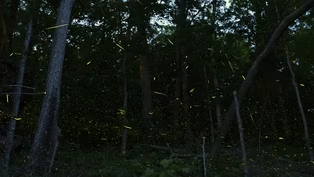
Clip: S32 Ep1 | 8m 32s | Discover why fireflies matter and how you can help keep their glow alive. (68 characters) (8m 32s)
Video has Closed Captions
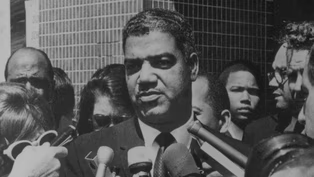
Clip: S32 Ep1 | 9m 34s | Explore the legacy of Kentucky civil rights leader Whitney Young Jr. (9m 34s)
Providing Support for PBS.org
Learn Moreabout PBS online sponsorship










Support for PBS provided by:
Kentucky Life is a local public television program presented by KET
You give every Kentuckian the opportunity to explore new ideas and new worlds through KET. Visit the Kentucky Life website.