
Nature trail weaves Indigenous knowledge with Western science
Clip: Season 12 Episode 10 | 4m 16sVideo has Closed Captions
A Menominee "phenology" trail labels plants in three languages.
At the College of the Menominee Nation in Keshena, a "phenology" trail identifies plants by common, scientific and Menominee names. Signs illustrate seasonal phases and traditional uses, braiding together Western science with indigenous ways of knowing.
Problems playing video? | Closed Captioning Feedback
Problems playing video? | Closed Captioning Feedback
Wisconsin Life is a local public television program presented by PBS Wisconsin
Funding for Wisconsin Life is provided by the Wooden Nickel Fund, Mary and Lowell Peterson, A.C.V. and Mary Elston Family, Leon Price & Lily Postel, Stanley J. Cottrill Fund, UW...
Nature trail weaves Indigenous knowledge with Western science
Clip: Season 12 Episode 10 | 4m 16sVideo has Closed Captions
At the College of the Menominee Nation in Keshena, a "phenology" trail identifies plants by common, scientific and Menominee names. Signs illustrate seasonal phases and traditional uses, braiding together Western science with indigenous ways of knowing.
Problems playing video? | Closed Captioning Feedback
How to Watch Wisconsin Life
Wisconsin Life is available to stream on pbs.org and the free PBS App, available on iPhone, Apple TV, Android TV, Android smartphones, Amazon Fire TV, Amazon Fire Tablet, Roku, Samsung Smart TV, and Vizio.
Providing Support for PBS.org
Learn Moreabout PBS online sponsorship- Angela Fitzgerald: When viewed from outer space, the borders of the Menominee Reservation stand out as a patch of deep green.
It's a place that attracts visitors from around the world who come to learn how its forests are managed.
- These are 180-year-old trees.
And it's time for them to regenerate.
- Angela: The thick woods have been kept healthy and full, even while supplying the lumber mill that helps sustain the tribe.
- Take a little walk in here.
As a part of the treatment, we got butternut in here as well.
- Angela: While many have sought the tribe's know-how, more and more visitors are being introduced to Menominee ways of knowing.
- We hear a lot now about traditional ecological knowledge.
- Most of us, maybe all of us grew up with the Western ways of knowledge, Western ways of knowing.
And what we are doing here is introducing awareness of our Indigenous ways.
- We're looking at the insights of the agriculture of the Menominee ancestors for, like, the past 800 years.
- Angela: Indigenous ways of knowing have been passed generation to generation, in a culture whose measure of time is also its own.
- We follow a 13-moon calendar, and each of those moons has their own name.
They provide environmental cues.
- Angela: Environmental cues seen by visitors on an autumn tour during Falling Leaves Moon.
They would see very different things on a summer stroll during Raspberry Moon.
Those changes are what's explored along the phenology learning path at the Sustainable Development Institute on the campus of the College of the Menominee.
- As you study phenology, you would want to come and observe from when the plant emerges in the spring until the plant dies back in the fall.
- Angela: Phenology is the study of life cycles through seasons.
It's an established method of science and a traditional practice of Native people.
The phenology trail brings the two together.
- And we work really hard to make sure that we're braiding all of those ways together.
They have to work together in this modern world.
- Angela: Braiding together science and traditional knowledge is seen in the signs that dot the winding trail.
- It includes the scientific name, the common name, what we call them in our Menominee language.
- And the plants that we specifically identified to observe are plants that have meaning to the Menominee people.
The Menominee meaning for this tree is "Grandmother's lung."
- Angela: The inclusion of Menominee names helps add a dimension to understanding.
- Our language is a way to see the world the way that our ancestors saw the world.
It's a way to connect with things around us.
- Angela: Kohkomaehsah Naehpan, or the name "Grandmother's lung," draws in meaning shaken off by the English name "quaking aspen."
- The quaking aspen root system lives for thousands of generations.
It's a key indicator for the health of Grandmother Earth.
- There's a deeper connection and a deeper understanding associated with all of these things we have around us.
- Angela: A deeper connection because the phenology trail helps illustrate the interconnection between all living things.
- That's a whole life change, to start viewing the world that way.
It gives you purpose to come out and to form those relationships with those plants.
Nothing lives in this world by itself.
I hope that people start looking at the world around them a little bit differently.
[wind blowing]

Preview: Food + Farm Exploration Center
Preview: S12 Ep10 | 30s | Learn about agriculture in our state at Farm + Food Exploration Center in Plover. (30s)
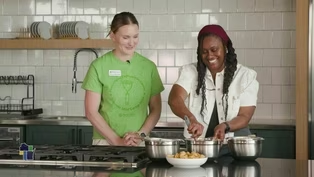
Teaching agriculture through hands-on learning
Video has Closed Captions
Clip: S12 Ep10 | 3m 37s | Inside Plover's ag learning center where families explore where their food comes from. (3m 37s)
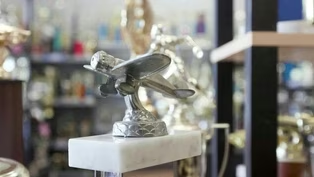
Upcycling accolades in Madison
Video has Closed Captions
Clip: S12 Ep10 | 5m 18s | The National Trophy Recycling Program repurposes trophies to make new ones for nonprofits. (5m 18s)
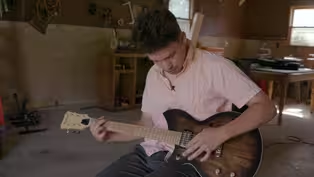
Teen builds custom guitars from scratch
Video has Closed Captions
Clip: S12 Ep10 | 4m 4s | Pulaski teen Ian Vanveen taught himself how to build electric guitars. (4m 4s)
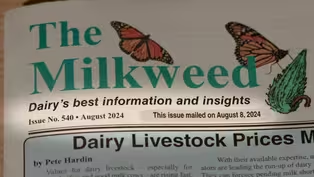
45 years covering Wisconsin's dairy industry for The Milkweed
Video has Closed Captions
Clip: S12 Ep10 | 5m 12s | Pete Hardin is one of the last true originals in the world of agricultural journalism. (5m 12s)
Providing Support for PBS.org
Learn Moreabout PBS online sponsorship












Support for PBS provided by:
Wisconsin Life is a local public television program presented by PBS Wisconsin
Funding for Wisconsin Life is provided by the Wooden Nickel Fund, Mary and Lowell Peterson, A.C.V. and Mary Elston Family, Leon Price & Lily Postel, Stanley J. Cottrill Fund, UW...