
Navigating the COVID Landscape; Joseph E. Nyre, Ph.D.
6/7/2022 | 26m 32sVideo has Closed Captions
Navigating the COVID Landscape; Joseph E. Nyre, Ph.D.
"Steve Adubato is joined by a panel of community leaders in education and healthcare to address the complex issues surrounding the post-pandemic world. Guests Include: Michele Adubato Chris T. Pernell Roger León Joseph E. Nyre, Ph.D., President, Seton Hall University sits down with Steve Adubato to talk about the impact of the pandemic on the higher education community."
Problems playing video? | Closed Captioning Feedback
Problems playing video? | Closed Captioning Feedback
Think Tank with Steve Adubato is a local public television program presented by NJ PBS
Navigating the COVID Landscape; Joseph E. Nyre, Ph.D.
6/7/2022 | 26m 32sVideo has Closed Captions
"Steve Adubato is joined by a panel of community leaders in education and healthcare to address the complex issues surrounding the post-pandemic world. Guests Include: Michele Adubato Chris T. Pernell Roger León Joseph E. Nyre, Ph.D., President, Seton Hall University sits down with Steve Adubato to talk about the impact of the pandemic on the higher education community."
Problems playing video? | Closed Captioning Feedback
How to Watch Think Tank with Steve Adubato
Think Tank with Steve Adubato is available to stream on pbs.org and the free PBS App, available on iPhone, Apple TV, Android TV, Android smartphones, Amazon Fire TV, Amazon Fire Tablet, Roku, Samsung Smart TV, and Vizio.
Providing Support for PBS.org
Learn Moreabout PBS online sponsorship- [Narrator] Funding for this edition of Think Tank with Steve Adubato has been provided by The Healthcare Foundation of New Jersey.
Veolia, resourcing the world.
The Robert Wood Johnson Foundation.
The Turrell Fund, supporting Reimagine Childcare.
PNC, Grow Up Great.
The Port Authority of New York and New Jersey.
Moving the region through air, land, rail, and sea.
The Russell Berrie Foundation.
Making a difference.
Prudential Financial.
And by NJ Best, New Jersey'’s five-two-nine college savings plan.
Promotional support provided by Insider NJ.
And by NJ.Com.
keeping communities informed and connected.
[MOTIVATIONAL MUSIC] - Hi, I'm Steve Adubato.
Welcome to a very important and compelling program that looks at navigating the COVID landscape.
We have an expert panel and yes, we're talking about navigating the COVID landscape in urban communities, particularly Newark.
Our guests are all connected to the city of Newark, but it has implications beyond that.
And also the role of not-for-profit organizations, government, et cetera.
We're honored to be joined once again by Dr. Chris Pernell, Chief Strategic and Integration and Health Equity Officer at University Hospital.
Michelle Adubato, Chief Executive Officer at the North Ward Center, an organization our father founded, Michelle in 1970 if I'm not mistaken?
- Yes.
- Yes, I wasn't born then.
That was a joke.
It's okay.
And Michelle's also the founder of the Center for Autism, and let me disclose, she is my younger sister.
And Roger León, who is the Superintendent of the great Newark Public Schools.
Good to have all of you with us.
Dr. Chris, let me jump right into this.
You did a one-on-one interview with us for our "State of Affairs" program.
What do you believe it means when we say, "navigating the COVID landscape," particularly in cities like Newark, what does that mean?
- Steve, it means preparedness.
Look, I have this conversation with our national partners in public health, our state partners and our partners right here in the beautiful, brilliant city of Newark.
We need to help the public understand what preparedness looks like and what's in their toolkit.
It's access to longitudinal care.
It's where can they get care, care that is socially and culturally fluent, so that they have appropriate management and identification of disease that would make an infection like COVID more severe or worse.
It's access to rapid testing.
It's access to know when do I get tested and what type of test should I get?
Can I do a rapid test at home, or should I go to a healthcare provider and get tested?
It's access to vaccines and now, oral antivirals, so that as soon as a disease is identified or an infection is identified, someone can get into appropriate care.
It's helping people understand the steps that they should take in order to ensure that they are helping themselves and that their entire household is healthy.
That's what I mean by navigating, and that oftentimes is not just strictly clinical.
That is a mix of both clinical and social services.
- And also the superintendent is working with his team to navigate the COVID landscape in the schools.
Michelle, you and your colleagues in the not-for-profit community, we're a not for-profit organization as well, the Caucus Educational Corporation, Michelle, what does it mean for you and the team, and describe the North Ward Center for those who may not know, please.
- Well, the North Ward Center has a myriad of services that are based in one-to-one contact, in-person.
It doesn't work on a Zoom, and so we have wonderful preschools that are contracted out by Newark Public Schools.
We have youth leadership development programs, Casa Israel Adult Medical Day, family success programs, the Center for Autism that I brought in and many other services that are based in grassroots.
And what Dr. Chris said was interesting, but the problem that we're having is it's like people want to think COVID's over.
- We're taping going into May, 2022.
Michelle, let me disclose a couple things before you jump in again.
Michelle had COVID, it was a very serious case of COVID early on in the pandemic.
Dr. Chris has talked very publicly about the personal loss that she has had with her dad in April of 2020 and other family members.
Michelle, pick up your point.
- There's mixed messages out there right now.
It's interesting, when lockdown was going on, you knew what you had to do, you were locking down, and it was get your vaccination.
Then, it was get your vaccination, and for a second, you thought this was gonna be over, and I'm gonna say for a second, and then you realized this isn't over.
There's waves going on.
So for us, that's about navigating, how do we navigate those in-person services, which I know Newark Public Schools is doing that, and they're doing, by the way, a tremendous job.
I think they were very, very responsible in saying to our children and our staff, "Keep your masks on," when others have said, "Take 'em off."
And really, is this about what we call personal liberties or the health and welfare of your neighbor and yourself, and that's what we're battling right now.
- Complicated, Roger, please, navigating the COVID landscape in the Newark Public Schools, 50,000 plus students we're talking about, correct?
- Yes, absolutely 55,000 plus.
The realities of where we are today is quite unique.
We've never been here before.
The fact that we've experienced this global pandemic and that it has impacted everyone equally has been quite an interesting reality.
And when I say equally, I actually mean that whenever anyone has been in a personal crisis, you turn to someone else, and so this virus has impacted everyone equally in that the people that you go to may be also consumed with the realities that exist because of this virus.
I find that it is an incredible opportunity for us to exercise things that are extremely important when you are witnessing ever-changing guidelines.
Our strategy in Newark has been to stay the course, to say we are not going to allow the realities of every moment to also shift every single one of our responses.
And that the only time that we deviated from anything that we said we were doing was when all of the science suggested that it was the right point and time to do this.
Imagine, if you will, people who were getting the vaccine were only of a certain age.
The fact that we have five year olds doing it today, contemplating even younger than five year olds is a reality that we were not witnessing at the moment in time when we were targeting our most elderly.
So the over-communication becomes also extremely important so that everyone understands what we're doing, why we're doing it, and when we are actually doing it.
- Well said, Superintendent.
Yeah, I see Michelle and Dr. Chris as well, but Michelle, I'll come to you in a second.
Dr. Pernell, real quick, say whatever you wanna say, but the superintendent's talking about our kids.
How about kids navigating the COVID landscape?
What, navigate?
I just wanna play with my friends!
I wanna go to school.
I wanna be able to have fun.
Look, what is this?
How are they doing Dr. Chris?
- You know, COVID has fundamentally, I would say impacted social emotional learning, especially for our young people, because we're asking them to learn in ways that they were not necessarily used to.
I have beautiful nieces.
I have five nieces in total from the age of 10 to 16, and I remember one of them who had never stepped foot in a high school building but had been in high school for almost two years.
And so, in her first time being inside of a high school, she's like, "I'm gonna have friends "outside of my household?"
And I thought about that and how different that was from when I entered high school or for my youngest niece, who's in her primary school years and learning difficult concepts and having special needs and things of that nature, having to navigate that.
This has not been easy for our children whether we're talking about the emotional or even the psychological stress that they've had to encounter because of the isolation, because of doing things that are unusual, and because they too could get exposed and infected and have to fight a disease that we didn't have a lot of tools for in their age group.
- But at the same time, Michelle, at the North Ward Center, and I know this well only because of the work you're doing, our dad did before, and you mentioned the youth leadership before.
As we do this program, we're about to go into the spring and summer season, and I know that kids being outside, playing at Roberto Clemente Field in Newark, New Jersey part of the North Ward Center Summer Youth Leadership Program, they're playing baseball!
Our son, Nick, happens to be one of the coaches in that league and seeing those kids, it's extraordinary!
It's the greatest thing in the world, particularly for urban kids.
How are they navigating this, Michelle, and how much do they need those kinds of programs, please?
- I think we have to take the burden off our kids.
Whatever I worry about, like my granddaughter said to me, "Nona, COVID's done.
It's done.
Why are you wearing..." 'cause I still wear masks when I go into a supermarket.
I feel like I'm the only one wearing a mask.
And you know what, I say to her, along with everyone else, "It's much better than it was, but sweetie, it's not over, "and we still need to take precautions," but I measure myself, because I just think our kids have gone through way too much, and it's the adults now that have to be the responsible parties to make sure that their social emotional needs are met and to weigh risk versus reward, that mitigation process.
So our youth leadership development, that wasn't an easy decision.
I know for everyone else, and I think it was what Roger said is do you stay the course?
I have to tell you that it is not clear anymore, and I can't tell you why.
I can read a-- - Wait, hold on, Michelle.
What's not clear?
You mean the rules?
- The rules make no sense.
You know, one day it's this, I've had five people read the same thing and interpret it differently, and how do you navigate that?
So it's about being, really what Roger said is like, okay, we're gonna be reasonable.
This is what we're gonna do.
Like at the North Ward Center, I mandated vaccines.
That made a huge difference, but people still got sick.
Let me clarify, people still got COVID in January.
- But Dr. Chris, they were not as... Michelle, I'll come back to you.
- They were actually were not as sick.
- They were not as sick, correct?
Clinically and un-clinically, go ahead.
- Yes, because in January, let's remember what we were facing, it actually had started late November and December.
We were facing the Omicron variant, and this is why I said preparedness, okay?
Preparedness means this.
You have a toolkit, you have multiple tools.
You have multiple mitigation strategies in that toolkit, and you are vigilantly following the science and the data, and that informs you which tool to pull out of your toolkit.
So when we got that variant back around that time that Michelle was describing, it was a variant that did not have the same properties as the original strain, so it invaded some of the protection of our vaccines.
So then we knew that you not only needed to be vaccinated and complete the primary series, but you also had to be boosted.
That's what we gotta do a better job of right now.
- Chris, I'm gonna let Michelle pick up her point, because here's the thing, you made that sound clear and logical.
Michelle is saying, and she's not alone, but Michelle, as we do this program, you're making a tough decision about a memorial service we have, a tribute to our father who passed away in October of, go ahead, and we don't know what, inside outside, do we have it?
And you have make that call, Michelle.
You have to make that call.
- How many people have been in the same situation where my father passed away during COVID, and we have yet to respect and honor his passing.
- As we do this program, and you have to decide how and when and if.
- And for a second, when I made the decision, and I was very adamant.
You know what, this was two months ago, we're gonna do this.
You know what happened, January, boom, it went down and oh, okay, take a breath, okay.
You know what, no one's gonna stop us now.
We're gonna go inside.
It's gonna be okay.
And now it's creeped up, and it's another variant.
And, you know, these are the, really what I would just say, impossible.
There's no right answer.
And so you just have to make a decision based on not what everyone else is making a decision on, and that's the problem, there's no clear set guideline.
- And so you can't call Roger, Michelle, you can't call Roger and say, "Roger, what are you doing, "'cause we're gonna do the same thing," but it's in different circumstance.
- And that's the beauty of what we have been living, knowing however dark it has been.
- Roger, are you sure you wanna go with beauty?
- Beauty, beauty?
- It is very complicated.
- Go ahead.
- What the discourse that we just heard between both Michelle and Chris is how complicated this is.
And what I'm suggesting is that what is gonna happen after this is something that needs to be very well studied, because our problem is not only addressing learning loss-- - And there's a real learning loss.
I'm sorry for interrupting you, Superintendent.
There's a real learning loss for our kids in our schools, correct?
- Absolutely, absolutely.
- Go ahead, pick it up, pick up your point.
- So there's learning loss.
There's also what I am calling unfinished learning, because students did pick up from March 13th not until a whole good year and a half later.
They didn't finish that which what they were learning.
Then Dr. Pernell's talking about all of the social emotional learning needs that we also have of our students, but that's what we are currently dealing with.
The concern that exists is what happens later.
I just wanna put on the table that there's a lot of unteaching that has to occur.
One of our biggest realities is that we have three and four-year-olds in our pre-kindergarten programs all throughout the city of Newark, and there are incredible programs where we have to begin to unteach the importance of sharing.
You see, we've taught students, oh you hide behind this mask.
Oh, you don't share cookies.
Oh, you don't hold each other's hands down a hallway.
That has created an inherent problem for us as a community.
We have to be very empathetic to each other's needs, and we're not able to do that right now, because we're overly protecting selves.
There's gonna come a point in time where this virus is way, way, so behind us, and our young children are gonna be in a very vulnerable situation in that they have learned behaviors that have to be untaught, and that's the beauty of what I'm referencing at right now, that we should be able to see clearly that there are identified problems that are gonna exist way after COVID is gone.
- We got about a minute and a half left.
- Can I weigh in on two quick points, Steve-- - Real quick.
- Two quick points, I wanna weigh in.
So Michelle previously said, "There is no right answer."
What I want people to understand is there is no risk-free scenario.
There are scenarios where there are higher risk or lower risk, right?
- But there's always risk.
- Right, but there's always risk, but we wanna minimize the risk, so that's how I want people to think about it.
And then the only other second point that I wanted to make is that there are behaviors that we will adapt, maybe not totally unlearned, but adapt because living in a crisis does demand a different posture, a different emotional posture, a different physical posture, a different intellectual posture.
But I think it also will breed a sense of resilience that otherwise may not have been there.
So we have to find both the strengths and the opportunities for improvement.
- Michelle, final comments, go ahead.
- I hope you're right, Dr. Chris.
I hope we learn some good things about this.
I'm still trying to figure it out.
One thing I do think that we can learn from when people are in constant uncertainty in crisis is be in the moment.
When you're having that good moment, that moment that you're sharing, whether it's in a classroom, whether it's in an office, in your family, enjoy it, enjoy it.
If I've learned anything from being sick and dealing with this is enjoy what's in front of you right now.
- Well said, Michelle.
Michelle Adubato, Dr. Chris Pernell, Superintendent Roger León, I wanna thank all of you.
And to be clear, we have a partnership with each one of your organizations in very different ways.
And you make a difference in the community in very powerful ways, and I cannot thank you all enough.
We talk about navigating.
Some people call it surviving, but it's also navigating and hopefully thriving at some point.
I'll get off my soapbox, but we can't just simply navigate and survive.
We have to thrive, easier said than done, and hopefully this conversation's been helpful.
I wanna thank our very distinguished panel.
We appreciate it, thanks so much.
I'm Steve Adubato, that's a very smart panel.
Stay with us, we'll be right back.
To watch more Think Tank with Steve Adubato, find us online and follow us on social media.
- We are honored once again to be joined by Dr. Joseph Nyre, President of Seton Hall University.
The University's one of our higher ed partners.
Good to see you Dr. Nyre.
- Steve.
Great to be with you.
Happy Easter.
- Absolutely.
We're taping this after Easter going into May 2022.
Let me ask you this.
I wanna jump right into the number one challenge you feel, again, there are so many, you and I have had so many conversations about leadership connected to COVID, being the president of a university, et cetera, et cetera.
Number one challenge slash opportunity facing the higher ed community, particularly the folks at Seton Hall right now.
- Well, I think the period of change has been greatly accelerated in higher ed, and I think that's a challenge and a wonderful opportunity.
We in higher ed have been criticized over the decades of being slow to change and the pandemic accelerated changes that were already underway and has really opened the door to new ways of thinking into how nimble higher education can be.
So I see that as both a challenge but a wonderful opportunity.
- The other issue that gets talked about a lot is affordability.
And we've had abstract, not abstract, but theoretical, philosophical, and practical discussions about affordability.
But I wanna be really clear here.
You and your wife, Kelly, have made a personal gift of $500,000 to the university.
Being a first generation college student matters a lot to you, to your wife, Kelly, who I believe is a former school public school teacher, if I'm not mistaken.
- That's right.
- Those dollars go to students to give more opportunity.
Is that not correct, Dr. Nyre?
- Yeah, we made our gift, thank you Steve, focused in two areas.
One is to support scholarships for students.
We know how much a small amount of money for each student can change their capacity to attend a school, college, or university.
And we know what it's like to struggle firsthand to afford going to college.
That was certainly my experience as a first generation college student.
Then the other part of our gift is going to support faculty research and instruction, which we think is central to the quality and health and wellbeing of the university.
- You know, the other thing that's interesting, I was reading about this, Dr. Nyre, and you were at the University of Kansas, correct?
- Correct.
- With Kelly as well?
- Right, So I went to university of Wisconsin, Missouri, Kansas and then school out in Boston.
I met Kelly at the University of Kansas.
That's correct.
- And you recalled quote, this is a press release that was put out by the university.
You recalled working with Dr. Michael Roberts, University of Kansas, who founded the university's Clinical and Child Psychology Program.
Why did that influence you so much, Joe?
- He changed my life.
He took me under his wing.
He mentored me.
He helped me reach further than I ever thought I could.
And he brought those things within my grasp.
And we worked together on research and new therapeutic modalities and he opened doors and helped me realize there's so much more you can do.
And here's how you can do it.
And that interaction between a faculty member and a student I think is the marrow of what separates universities and their capacity to really change lives change destinations.
And we're in the transformation business at Seton Hall University.
That's what we do.
- And you know- I'm sorry doctor, but along those lines the new Men's Basketball Coach, Shaheen Holloway, a graduate of Seton Hall University, a former assistant coach.
Those of us who are Seton Hall University Basketball fans, we've seen him play, seen him coach and it's exciting on a lot of levels.
But he's a leader.
He's a mentor.
He's also, if I'm not mistaken contributing a percentage of his own salary to support certain initiatives at Seton Hall University as well.
Translation or let me translate in this way, or ask this way.
What impact does someone like Shaheen Holloway coming back to Seton hall have not just on basketball but on the spirit, the culture and the university and its students?
He's the demonstration of a Seton Hall alum, Again, that goes out and accomplishes great things and comes back to give back to the university.
And he's doing it in a very unique way as you've well noted.
What do you believe the real impact is from an academic point of view in terms of college sports and being successful in college sports, what is the real benefit to students who are not involved in athletics at that level?
- So we see college as a transformational experience.
There's a handful of decisions you make in life that change your destiny.
Choosing a college is one of them.
The vibrancy of the college experience, how you meet friends, how you feel passionate about what you do each day is in part driven by extracurricular out of classroom experiences.
And when your basketball team or your athletic teams are competing on the national stage or competing at the Prudential Center against a rival.
It's a time when 20,000 people come together to celebrate being part of a community and being forward leaning and thinking about this university on a national stage.
So it's not abstract.
It's concrete.
This is where best friends are made for life.
This is where you meet a professor that changes your destination, like Michael Roberts did for me.
But I'm also excited about what our coaches do when we use Shaheen Holloway as an example, to mentor students to succeed, certainly on the court, but they're succeeding in the classroom and in the community.
We call it the three Cs.
Classroom, Court, and Community.
That sort of leadership is something we think also changes the lives of student athletes.
I've been a visiting fellow at the Buccino Leadership Institute for several years now.
and it's been an honor and a pleasure of mine to meet with those students to teach and to learn from them.
And Dr. Nyre has also joined us many times on our sister program, Lessons in Leadership.
So to Dr. Joseph Nyre, President Seton Hall University, one of our higher ed partners and all the folks at Seton Hall, we wish you all the best.
Thank you, Dr. Nyre, I appreciate it.
- Steve.
Great to see you.
Thank you for all you do.
- Yeah.
Well, thank you.
I'm Steve Adubato, that's Dr. Nyre from Seton Hall.
See you next time.
- [Narrator] Think Tank with Steve Adubato has been a production of the Caucus Educational Corporation.
Funding has been provided by The Healthcare Foundation of New Jersey.
Veolia.
The Robert Wood Johnson Foundation.
The Turrell Fund, supporting Reimagine Childcare.
PNC, Grow Up Great.
The Port Authority of New York and New Jersey.
The Russell Berrie Foundation.
Prudential Financial.
And by NJ Best, Promotional support provided by Insider NJ.
And by NJ.Com.
(Sounds of Water) - (Narrator) Most people don'’t think of where there water comes from.
But we do.
Veolia, more than water.
Resourcing the world.
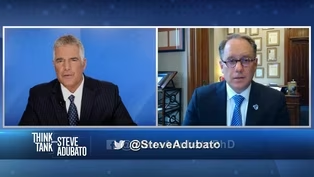
COVID-19's Impact on the Higher Education Community
Video has Closed Captions
Clip: 6/7/2022 | 7m 17s | COVID-19's Impact on the Higher Education Community (7m 17s)
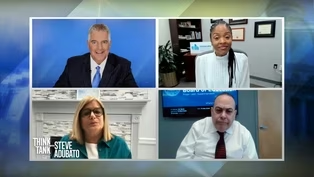
Navigating the COVID Landscape
Video has Closed Captions
Clip: 6/7/2022 | 18m 48s | Navigating the COVID Landscape (18m 48s)
Providing Support for PBS.org
Learn Moreabout PBS online sponsorship
- News and Public Affairs

Top journalists deliver compelling original analysis of the hour's headlines.

- News and Public Affairs

FRONTLINE is investigative journalism that questions, explains and changes our world.












Support for PBS provided by:
Think Tank with Steve Adubato is a local public television program presented by NJ PBS