Veterans Affairs
NC Strive - Central Piedmont CC
4/26/2021 | 1h 11m 26sVideo has Closed Captions
Military Veterans on Campus Discussion – Whole Health and Wellness
The third webinar on NC Strive 2021 focuses on Whole Health and Wellness and is hosted by Central Piedmont Community College in Charlotte.
Problems playing video? | Closed Captioning Feedback
Problems playing video? | Closed Captioning Feedback
Veterans Affairs is a local public television program presented by PBS NC
Veterans Affairs
NC Strive - Central Piedmont CC
4/26/2021 | 1h 11m 26sVideo has Closed Captions
The third webinar on NC Strive 2021 focuses on Whole Health and Wellness and is hosted by Central Piedmont Community College in Charlotte.
Problems playing video? | Closed Captioning Feedback
How to Watch Veterans Affairs
Veterans Affairs is available to stream on pbs.org and the free PBS App, available on iPhone, Apple TV, Android TV, Android smartphones, Amazon Fire TV, Amazon Fire Tablet, Roku, Samsung Smart TV, and Vizio.
Providing Support for PBS.org
Learn Moreabout PBS online sponsorship[dramatic music] - Hello and welcome to NC STRIVE 2021.
My name is Chris Cathcart, and I serve as the vice president of student affairs, for Central Piedmont Community College.
At Central Piedmont, we probably support our active military and veterans students and their families.
We strive to help these individuals to transition from service to our campuses, in a purposeful and caring way.
On behalf of the leadership team at Central Piedmont, I want to extend my sincere thanks to you for joining us, and for being a part of NC STRIVE 2021.
- Hello, my name is Tracy [indistinct].
I'm a veteran, I served seven years in United States Navy.
Currently, I'm a counselor, at Central Piedmont Community College.
Our center provides counseling advices to our veteran students, as well as their family members.
We also connect our students to community resources.
Today, I have the honor of presenting to you, introducing and presenting to you, and actually having a conversation with Zachary Cobar.
Zachary is a former student at CPCC.
He served three years in the United States Army, and six years as a reservist.
I will be asking Zachary a series of questions regarding his transition of mental health as a student.
I would like to introduce Zachary.
- How's it going, Tracy?
- I'm good.
- So first, I wanna give a quick thank you to you Tracy and NC STRIVE for allowing me to speak about my life transitions and mental health experiences as a student vet.
So currently, I'm an academic advisor for Central Piedmont Military Families and Veteran Services.
I help navigate other student veterans on their educational journey.
As a former Central Piedmont student, I understand the difficulty, that some student veterans can experience while pursuing their college degree.
Especially if they have other underlying issues such as mental health.
- Zachary, can you tell us a little bit more about your background?
[indistinct] - Of course, so I committed to the army at the end of my junior year.
My family has, is full military brads and prior service, so I always thought about joining the army and even glorified a little bit as a kid.
But you know, as you grow up, you start realizing the commitment and you know, what you're really signing up for.
So as I grew up, it was less and less of a thing I wanted to do.
What I really wanted to do was go to college, but I also struggled with what I wanted to do with my life, what I wanted to study.
So you know, that kind of probably contributed to a poor effort in high school.
On top of the financial ability of my family, you know, I wasn't gonna pull out student loans and go into debt.
I really wanted to make sure I had a plan if I was gonna undertake college.
So you know, not really seeing any other option, not seeing a future for myself in the next five or 10 years, after my bio final in June, I went over to the army recruiter across the street and I committed to a minimum contract with the army.
And, you know, I thought, you know, three years would give me enough time to grow up a little bit, to figure stuff out, and to, and if, you know, if it works out, I have a career, and if it doesn't, I can start a new and you know, use the G.I.
Bill to go to college.
- Hmm, sounds good.
What were some of your stressors that kind of activate some mental health issues while you were in the military?
- So [laughs] the military in general.
I mean, it's tough, we all know that.
I think what really affected my perception in the military at first after basic was the constant rotation of leadership I had, immediate leadership.
You know, I came in and within the first two years, I had at least three or four supply sergeants.
And I really didn't have a consistent mentor or somebody to kind of teach me the ropes.
Eventually, it came down to a point where during my second year, I was the lone responsible person in the supply room.
And as a result, I was, I mean, this position usually has three or four people, qualified people.
And, you know, during those times, it was stressful.
You know, supply sergeants in general are some of the most hardest working and, you know, I'm wanna say we're very appreciated, but you know, we have a lot of responsibilities.
And one of those responsibilities I had to undertake by myself, was doing 100% change of command inventory, where I'm working six days out of the week, getting maybe six hours of [indistinct].
But even before that, you know I had, what I used to cope was alcohol.
Military was the first time that I really self-medicated and would, you know, binge drink on the weekends and whatnot, because like, I mean the military in general, you know, mental health is not really a thing that we talk about.
And, you know, alcohol is, I wouldn't say it's, while the old adage that I would always get told is, you know, you're old enough to serve, so you should be old enough to drink.
But you get in trouble then, you know, that's your career.
[indistinct] be impossible, you know, so [laughs].
- Wow, so you mentioned that the way that you dealt with those types of stresses, is, you self-medicate using alcohol.
So can you tell us a little bit about your transition out of the military and how you manage without the self-medication or alcohol?
Can you tell us a little bit about that?
- So coming out of the military in 2014, I didn't wanna like, even though, you know, it kind of gave me a bad taste in my mouth,ú I didn't wanna leave the military.
I didn't want to, you know, just burn my bridges, right?
So I, what I did was, you know, I signed up for a six-year reserve contract.
That gave me the opportunity to kind of balance my life between being a student and into the military and, you know, keeping it in my back pocket if I ever wanna go back in.
- So can you talk a little bit about how you managed as a student at the wonderful community of Piedmont?
- You know, my first semester, I did great.
There was the first wake up call where I had, you know, I had something to prove and I came out and I was like, "I can do this," you know?
Like I've been through the ringer in the military, so like, doing an essay or like late night assignments, that's nothing compared to what I did before.
[indistinct] - But there was a moment during my second semester where I was like, okay I see success, I see the doors open, what do I do now?
Like, or more like, I kind of felt like the stress like, as far as I got to succeed, like, there's no other choice.
So definitely periods of highs and lows.
But what got me out of a little bit of a funk was getting involved.
And how that happened was, you know, I was already, I already got the letter for Phi Beta Kappa, so I was already going back and forth on that.
However, it was in my English class, in Dr.
Page's English class 112.
And I was having a heated debate with one of the other students.
And afterwards, he came up to me and he was like, "You know, I really enjoyed our debate."
And I think you would do great in student government, and we could really use someone like you.
And that kind of took me aback because like, I'm just, you know, a student, you know, going about the days and just going about the routine of going to class and going home, and maybe I'll go to the library and study.
I never had anybody come up to me and just be like, "Hey, you should really [indistinct] up."
And that was that like, I'm gonna say the aha moment, but that was when the door opened, I just walked through and so happened that the next class got canceled, and I was stuck on campus.
I didn't have anything else to do, so I walked into student government and to student life and, yeah, things just changed.
- Wow.
[Zachary laughing] - That's amazing, so Zach, it looks like you have come full circle.
You went from high school to the military, to community college, to a four-year college.
You graduated from a four year college and you come back to Central Piedmont Community College, to be a professional, and as an advisor.
So what followed that and those different transactions?
What recommendations would you give a student?
Just think back of a student who will be in your shoes as when you first started out.
So how would they, how could they manage?
In your particular role, how could they manage the stressors?
Because we all have 'em.
- Right.
- What recommendations would you give to that student?
- You know, I would, what really helped me out with my transition, into Chapel Hill was talking to a therapist.
And just being upfront with what you're dealing with.
You can talk to friends, you can talk to family, you can talk to close ones, all you want, but you know, they, you know I remember a conversation I had with my best friend.
And he was like, "Look, I'm always here for you.
I'm always here to talk about your struggles and stuff, but I'm not a licensed professional, I'm not a professional at this."
So I think you really should go check out a therapist, so they can help you deal with some of these more complex emotions that I was dealing with.
During my first year or first semester at Chapel Hill, I really got that transfer shock, like, upside the head.
And it was difficult, I was going through, I was in my late 20s, seeing other people when, you know, situations where I thought I would be, having a family, you know, a career and everything, but I'm still in college, right?
So you know that, when my best friend told me that, I really took it to heart, because he's, you know, somebody, when your best friend tells you something like that, you should probably like, listen.
So I did, and I met a counselor who had a military background, who was, you know, training to become a licensed professional and it opened up, so it made me so much clear about my background.
Just very quickly like, you know, my mom had me when I was 16.
My family life was unorthodox, I should put it.
I didn't have the stability that I needed at the time, nor the resources to be able to go to talk to a therapist.
So to actually have the therapist and talk to somebody to deal with some of these more complex emotions I've been dealing with all my life, it was just that breakthrough that really made me understand who I am today.
And I would also say, I took medication for a little bit for my anxiety and depression and it was, it definitely helped me understand and kind of like deal with those issues.
- Wow, well, thank you, Zachary, that's all the questions and we got, was able to get insight on who you are, the manager you have become.
And again, personally, it's just an honor to have you as a colleague or on our staff, as advisor.
You've been here for three months, and you already have made great strides.
People know who Zachary is, and some students request you as an advisor.
But so you're doing a lot of right things, and I just encourage you to keep doing what you're doing and knowing that you're making a great impact on a lot of students, not just students, but faculty and staff as well.
And so thank you for this time, do you have any questions or any, if there are any recommendations to conclude with?
- Just get involved, especially, I mean, I would definitely, if I were to tell, talk to a student who is thinking about, or a student veteran, thinking about going to college, I would definitely recommend them to go to community college.
The benefits far outweigh the negatives and what you hear about community college.
Even if it's not at Central Piedmont, I would advise them to come to Central Piedmont, of course, but you know, come get your two years out of the way.
It's a lot cheaper in the long run, get involved, and yeah, just make the most out of it because me personally, I think it was a better experience for me to go to college later in life rather than earlier.
'Cause I had a plan and I knew what I could do.
- Good, well, again, thank you for your time, thank you for sharing, and have a good day.
It's just an honor to be a part of our team.
- Hello, everyone.
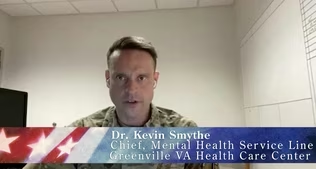
I'm Dr. Kevin Smith, psychologist with the Durham VA Health Care System, Greenville Health Care Center.
I'd like to talk with you today about whole health and the promotion of self-care.
I'll start by saying that all of us can acknowledge that our current healthcare system is broken.
It oftentimes is expensive and underperforming.
Despite large expenditures, citizens suffer from more chronic conditions and poor health than most.
Healthcare consumes 18% of our GDP, and cost continue to rise.
An enormous portion of our healthcare expenditures, about 75%, go towards treating chronic conditions.
Conditions which are largely affected by people's choices and behaviors.
This is unsustainable.
And if not corrected, our nation will lose the ability to compete in a global market.
Whole health is often a strange approach for people.
But whole health is basically an approach to healthcare that empowers and equips people to take charge of their health and wellbeing.
And live their life to the fullest.
Many of you already practice whole health, but some of you don't.
How can we explore ways where we can promote self-care, and treat chronic conditions before they start?
The VA has undergone a cultural transformation.
There has been a shift from the current healthcare system, which was largely based on a problem, or a problem-based disease care, to something known as person-centered healthcare.
When we begin exploring what matters for us as veterans, we have an opportunity ourselves to facilitate change.
The VA is undertaking the most significant changes in the philosophy and healthcare, ever embarked by an organized healthcare system.
Our mission is to honor America's veterans by providing exceptional healthcare that improves their health and wellbeing.
VA is the largest healthcare system in the country, and while facing challenges, the issues of access is broadly recognized for the high quality of its healthcare services.
The healthcare crisis in the United States includes high costs that arise exponentially and disappointing outcomes, particularly with chronic disease management.
This was stated in an Institute of Medicine report on integrative medicine and the healthcare of the public.
A disease division-driven approach to care has resulted in spiral costs, as well as a fragmented healthcare system.
What we have is reactive and episodic.
As with most Americans, veterans have an increased number of chronic conditions when returning to civilian life.
Serious and complex service-related injuries often contribute to disease-driven care and chronic conditions that are not well managed.
A greater number of service-related injuries represents challenges to the VA. Let's look for a moment, not the wheel that you have in front of you that talks about components of proactive health and wellbeing.
I can't stress the importance of proactive in this model, working with the body, trying to look at our surroundings.
How can we develop personally, and look at self-care, food and drink, recharging.
Spending time with friends and family and coworkers.
Also the concept of spirituality, the power of the mind is immense and if we can harness this for whole health, it's comprised of a circle of health with at the center, you.
You are a person, and you expand outward and encompass mindfulness awareness.
There are eight key areas of self-care, professional care and the community.
The practice of whole health address is exploring what matters, self-care and clinical care.
Let's look closer at this model.
As we can see, me is the center of this model.
And a mindful awareness, simply being here now.
Being aware of what's going on for you in your environment, within your body.
The power of mind, relaxing and healing is a component.
Spiritual and soul.
Growing and connecting.
We want family and friends and coworkers to play an important role in our whole health.
Relationships are important.
How do you recharge?
How do you sleep?
How are you feeling refreshed?
What practices do you engage in?
Food and drink should be nourishing and refueling.
Our personal development asked us to look at the concept, that which we'll talk in a moment, about developing a personalized plan.
Your personal life and work life should be in sync, in balance.
Surroundings include physical and emotional.
And then finally, we work at the top for our body to feel energetic and flexible.
These are conventional and complimentary approaches that all contribute to prevention and treatment.
Again, we must ask ourselves, what really matters in our life?
What brings you a sense of joy and happiness?
Why do you want to be healthy?
For some, it could be the presence of family.
For some, it could be that goal that you set for yourself.
That gives you joy when you fulfill that goal.
How can we better adapt this model into our whole health?
We look at a promising list of drivers for whole health.
Within the VA, legislation in 2016 called the Comprehensive Addiction and Recovery Act was signed into law, and this model was based on innovative grants and different programs, especially pertaining to opioid safety.
Many folks suffer from opioid addictions to try to treat chronic pain, but we don't look at other methods for treating chronic pain.
In 2017, flagship facilities were identified and funding was allowed to look at alternative ways to manage pain.
Finally, in 2018, we want to look at supporting veterans from military to civilian life and providing VA medical centers with different options, for mental healthcare, as well as medical care.
We look at other options that are showing promise.
Acupuncture, meditation, Tai Chi, yoga, massage for treatments, psychological concepts, such as guided imagery, biofeedback, or even clinical hypnosis.
These have shown great promise, in treating chronic pain and medical conditions.
But again, we focus on empowering a self-healing mechanism for the whole person, while creating a personalized, proactive, patient-driven experience.
When we look at personalized, we look at what our unique interests that we hold, that drive our need to be healthy.
How can we be proactive?
By assisting people and not waiting for health problems to happen.
We look at other medical conditions that require us to live a certain way, and minimizing health problems is a great way to be proactive before these problems exist.
Patient-driven services, providing care based on what really matters, is an important driver.
We know as healthcare continues to climb, we look at what choices people have, and what choices veterans have.
Again, we have chronic conditions that we try to manage, and looking at whole health is vital.
Let's look further at the purpose of why whole health is so important.
Whole health and the whole health model enables the VA to improve the veteran experience.
Improving access to care.
Improving self-efficacy.
Looking at managing pain and reducing opioid dependence.
Also, we look at how whole health, helps us reduce mental health concerns, like depression, anxiety, PTSD, and of course, suicidality.
We want to improve the VA employee experience as well.
Helping balance work load and helping staff, it will ultimately help the veteran.
Reducing utilization on traditional healthcare resources are very important.
We see this through decreased emergency department visits and hospital admissions.
And incentivizing folks to be healthy.
These constructs work.
If we look at this whole health system, it's built on empowerment.
Healthcare, including whole health, should be a collaboration between the patient or a veteran and their provider.
But looking at what goals for treatment exist.
We do that through a personalized health plan.
This PHP should encompass a pathway, wellbeing programs, and whole health clinical care.
A team that works in concert to promote health, whole health.
We look at a personalized health plan that involves partnering.
Achieving optimal health and wellbeing is very important.
We know that as part of this process, a veteran engages in self exploration.
How do I know what I don't know?
So we explore to look at, what is the mission?
What is the aspiration?
What is the purpose?
We look at the acronym map.
We want to set shared and smart goals.
Goals that should be specific, measurable, action-oriented, realistic, and time-based.
Sharing these goals with your provider and your loved ones helps us to develop a plan that can meet our whole health goals.
The veteran can work independently or in partnership with professionals and peers.
Peer supports are available throughout the VA and in other systems as well.
Think of a coach that can help you with your own plan and engage in care.
Education and skill building are offered and support with PHPs.
And ideally that occurs within the larger community.
We also want to look at the concept of self-care further.
We define this as the practice of taking action.
Taking action to preserve and improve one's health.
Many times, veterans and other patients will come and say, "What should I do?"
This decision should be arrived through the partnership between that veteran and that provider.
But that veteran needs to take an active role in promoting wellbeing and happiness, especially during periods of stress.
We look at several dimensions of self-care.
The physical dimension, which again, asks us to look at spending time outside, engaging in play, having a healthy diet, and access to medical care.
Emotional self-care.
How do you relax and use pets?
Maybe gardening.
How do you emote feelings and how do you engage in the arts?
Intellectual dimension is looking at how I'm going to grow, what books or podcasts can I involve myself with?
Puzzles maybe seeking further education.
Spirituality is also an important dimension.
This could be nature observing a walk in the park.
This could be more meditation or prayer, or just simple reflection and forgiveness.
Forgiveness for those who have, we perceive have wronged us, or maybe other forgiveness aspects.
Social dimension of course, is where we inspire others.
How can we keep our electronic forums in view, to look at engaging?
We also look at professional, taking time off from work, and looking to engage with colleagues.
How does your practice look like?
That's a very important personalized decision.
Recently, I had been deployed and I found myself looking at dimensions of self-care in an austere environment.
Whether it's a love of animals, or looking at, observing a sunset, or doing physical activities, trying to stay busy is very, very important.
And trying to look at keeping ourselves occupied, so we can live in the moment.
We look at the engagement of health, whole healthcare as helping us partner for the VA, to meet our mission of honoring America's veterans, by providing exceptional healthcare, that improves health and wellbeing.
Thank you so much for your time.
- Hi, here at CPCC, we have a lot of opportunity, for our veterans and military family members.
Not just at CPCC, but also ranging from the mountains, to the coast.
Let's go over a few of those.
Here at Central Piedmont Community College, we offer counseling for both personal, academic and career.
Also, we have disability services with equal access learning.
That is the goal.
Student life is all about getting the students interactive with one another, joining clubs, and service-learning opportunities.
Zach shares with us how vital and long-lasting the relationships built were to his student success story, and the transitions as well as his mental health.
Single Stop is also another opportunity here at Central Piedmont Community College.
We overcome financial barriers with food, housing, legal, healthcare, tax, all kinds of things for different needs of the students.
Several emergency grants to help pay for basic expenses are also available.
Last but not least, is our Military Families and Veterans Center.
Tardy is gonna speak to this more in detail but I just wanted to let you know, that we support engage and advocate for our students.
We help get them connected, to all of those above services.
Like I mentioned before, we have other colleges in North Carolina is, has a plethora of wonderful resources, within their college system.
I will highlight a few here, but I encourage you to do some fun research, on the services provided through our education establishments, throughout the state.
For example, UNC Charlotte, has a lot of the same resources mentioned above.
Also, they have a student veteran association which is student led and ran.
And its purpose is to foster community for veterans, on campus.
They recently just moved to silver status, for their level of military friendly school, and they have two ROTC units on campus.
They also have a dedicated space, just for their veterans.
Wake Technical Community College, offers three veterans zones for veterans and their families.
Alp State is over in the mountains.
They offer career counseling and a mentoring program.
One way they honor veterans, is the application fee and deposit fee is waived.
UNC Wilmington supports veterans and their dependents.
As a matter of fact, one third of their military affiliated population is spouses.
NC State they have great resources.
Their guide is very user-friendly, and you can get on and scroll through a variety, whether you're looking for fitness, or finance.
They have fun by honoring their veterans and their family, and their families at military appreciation games, and they have three ROTC programs, right on campus.
And then right here in Charlotte, we have Queens University.
They offer smaller class sizes, student veteran association, and are part of the Yellow Ribbon Program.
Might be wondering what that Yellow Ribbon Program is, I encourage you to look more on the BA website.
However, I will tell you real quickly, that it helps with higher out of state and private and graduation school tuitions.
Also, if you're listening to this NC STRIVEs event, on whole health on this, and think your institution has more to offer, then be the person who brings the recognition to your campus.
Wingate University in Monroe North Carolina did just that.
They had the certification piece and a couple of passionate veterans, made it their mission to help educate the staff on military cultural competency, as well as create a space for veterans and dependents, attending their college, your mission is not over.
Tarey, would you like to tell us more about our CPCC campus?
- Hi, my name is Tarey Ham, I'm a counselor with Center for Military Families and Veterans Services, at the central location.
At military families and veterans services, we understand the cycle social challenges, that veterans experience transitioning from soldier to student.
It is our mission to provide students, with a learning space that understands their journey that provides them with the holistic support they need to be successful.
We provide veteran students with the innovative and equitable academic support, to include academic and career navigation, certification of veteran benefits, and providing them with access to mental health counseling with licensed conditions.
We understand that it takes a village.
Partnerships across the community college with Single Stop, and Central Piedmont Care, helps us to ensure that our students receive support for those secondary and tertiary needs.
Our smart partnership with career, and assessability services, helps us prepare veteran students for the changes in trends in the workplace.
Community partners like Veterans Bridge Home, and Goodwill help us to expand our supportive services to veterans across the Mecklenburg community.
When we can't meet face to face, our student veteran association, our women's veteran club, and our virtual hangout, allow us to connect with our veteran students virtually and to keep them connected to one another.
If that's not enough, our monthly newsletter keeps our veterans updated on wellness tips and tricks, and keeps them abreast of what's happening in the veteran community.
As Central Piedmont we promote academic excellence.
Our solute veterans national honor society, recognizes the honorable service and scholastic achievements of student veterans through scholarship and networking.
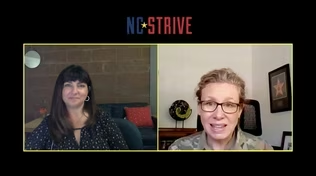
- Good morning my name is Nicole French.
I am currently serving in the reserves that's why you see me in uniform.
I am currently, this conference happens to fall right in the middle of my annual training.
So I'm grateful to be here with you.
And I want a special shout out to all of our students who are currently serving in uniform as reservists and national guard members and all of you family members who support your loved ones in uniform.
And I am here with Amanda Fink who is the wife of a reservist in America and we'll share a little bit of her experience with you.
She's also a provider CPCC and gives that to our military families.
So and I want to just thank you administrators and faculty, just for your investment in military and veteran families.
Thank you for your interest in learning more about military culture and the life of those in uniform.
And thank you for just being with us today.
My objectives really are to set a foundation for, really, we're talking about whole health.
We're talking about being our best, so that we can give back, in whatever ways we can.
In when we serve in uniform, our health is priority.
It impacts our ability to do our mission, and take care of those to the left and the right of us.
And I would argue that all of you are very important, to your own families and to the same community.
Your health is important.
And so what is, my hope is that you will show up with an open mind and be thinking about what is it that I want to, think about when it comes to my own health and wellbeing.
And I want to make an invitation to you, to [indistinct] those connections that would make your life better.
And I also want to invite you to think about resources that you're interested in just learning more about, and sharing with others in your life.
There is not a dearth of resources really in this community and state and nation.
I think there are other barriers that really get in the way of us, having conversations like this.
And so I'm just honest with you and Amanda and all of the schools represented here.
My contact information you'll have feel free to reach out to me.
You know in uniform especially today I've read, I got connected with veterans, which helped me in my own transition off of active duty in 2014.
And when we're in uniform we have a clear mission.
We know what our mission is.
It's communicated by our commanders, And even if the mission is unclear, at any given point we know that our job, is to keep the persons who are left and right alive, and to come home safely.
We are a part of a unit when we put army uniform, we are part of a tribe.
And we look out for each other, we have accountability for each other.
It is we celebrate holidays together.
We become each other's family and greatest support network.
And then when we wear this uniform, there is a network of care resources, on any given military installation you have anything you need, from schools to commissaries, to post offices, to recreation, everything you need is available on post.
When we take this uniform off, all of a sudden we're looking for a new purpose.
And those of you who are matriculating at a university, or studying, you have found your purpose, or maybe are finding your purpose through academics, but your purpose becomes academics, and studying for that next job.
What on campus or whichever university or college you're going to there's a network of opportunities to connect.
Making new friends, finding new mentors.
There are a variety of online campus opportunities for service and for connection.
And then you've got care networks that are built in on campus.
Whether you need medical assistance, psychological support, if you need tutoring assistance, there are.
When I think of a campus, I sometimes think of a military installation everything you need is at your fingertips.
They make it really easy, for you to focus on your academics.
At some point, new service members, veterans and your families, will be looking for the next chapter, you're on campus studying and you will enter in at some point, in your academic journey, looking for what's next?
A job?
So if BBH has aligned its programs, with a transition model.
And our programs are aligned with purpose, which employment we work on cultivating relationships with companies who wanna hire those of you who have served, because of your leader training, because of your experience, and because of whatever additional academic subject matter expertise you bring to the field.
Veterans Bridge Home works to create a community that volunteers together, that gives back together.
Opportunities for networking, for those of you in uniform, spouses, and our veteran community.
And we also work with care networks here locally and across the state, and really across our nation, for military and veteran families.
And I'll go in [indistinct] and highlight a few resources, in that care network, available in your community.
I wanna just give you a snapshot of William Bridge [indistinct] comes to mind as I think about transition.
And we go through transition constantly throughout a lifetime.
And as a student you are in any one of many transitions you may be facing.
Whether it's a new relationship, whether it's ending a relationship, whether it's choosing a new degree.
Whether it is finishing up your academic work and transitioning to internship and work experience.
Whether it is wrapping up internship experience and looking for your first full-time job in your field of study.
There are many life transitions we go through.
And what I've [indistinct] about, William Bridge's model is he's inviting us to pause and pay attention to our psychological response, our experience around transitions.
Endings and beginnings come together.
When you think about transition out of uniform that decision is made.
When that decision is made, [indistinct] change that occurs and the ending has begun even before that new beginning that where am I gonna live?
What is my job going to be?
Before that new beginning starts, you're navigating particular endings, and new beginnings at the same time.
And so creating space for really, naming your experience is really, really important, as you think about your own whole health, and prepare for this next chapter.
And that's comes back to presence one being present for life is the heart of thriving.
I really love the work of inner personal neurobiology, Dan Siegel out of UCLA.
He and so many others have contributed to helping us better understand the mind, which is relational, it's embodied, and there is presence.
And how do we cultivate presence with ourselves so we can bear witness to our experience, and help us understand ourselves?
As well as cultivate presence between us, showing up and bearing witness to the experience of another.
So when I talk about presence I'm talking about this state of curiosity, and openness and accepting the acceptance, and loving kindness.
And I think this is a state that sometimes especially during endings that may be hard.
I think about the mourning process and the grief process that's just normal to any ending, it's part of any lifestyle.
It can be a part of, you know, exciting new beginnings as well.
How do we cultivate this sense of presence to our lives?
And one of the ways we can cultivate presence is paying attention to those activities we can do on a daily basis, that cultivate optimal mind health.
I'm not gonna take time to walk you through this helping mind to platter, but I definitely wanted to bring attention, to the ways we can cultivate a healthy mind, with a shout out to time in activities.
This is meditation using maybe the inventory that Dr. Smith referenced, the whole health program is a fantastic program, available at the VA. You can Google it, you can get online, you can download this whole health inventory.
And that time you spend pausing to pay attention to number one, your state.
Are you able to be in this open, accepting kind state with yourself, but paying attention to what [indistinct] and they've got a great whole health inventory therapy.
We are focused on mental health resources in particular in this event.
And therapy is a great time to pause, and reflect on your life.
And your state at any given moment, with a trusted other who can be an observer, and bearing witness and a participant in your journey.
And when we talk about resources, we're talking about relationships.
So the care networks that Amanda and I are part of people who are service providers, who want to give back and participate with you on your journey.
And so whether it's a professional care network like, the mental health resources we will talk about whether it's your medical professionals, or service providers in every other category.
There have been topics for example employment, when you're looking for your next job.
Yes we need relationships with employers, but we have a variety of employment service providers, who can mentor you.
Who can look over resumes, but these are [indistinct] and in the veteran community, I also want to highlight that the veteran military community, service community, these are relationships that can expand your tribe.
Increase the network of people, through which connections can be made.
That gets me excited.
So I want to pause briefly and just read a few lines from David White's book called "Consolations".
[indistinct] nourishment and underlying meanings of everyday words.
And I think help is really timely as we talk about and think about what kinds of help do I need right now in my life?
David White says, "Help is strangely something we want to do without, and yet we are born with an absolute necessity for help.
Grow well only with a continuous succession, of extended hands, and as adults dependent upon others for further successes, and possibilities in life even as common individuals.
This overwhelming need for help, never really changes in a human life.
From the first day we are brought from the womb, calling lustily for that commodity.
We need extraordinary physical help, to get through our first years.
Continued help through our childhood and extraordinary emotional help, and good luck to get through our adolescence.
After that the need for continual help becomes more subtle.
Hidden, as if by the illusion that we are some agents, able to survive on our own.
The one corner of the universe, able to supply its own answers.
It may be that the ability, to know the necessity for help, know how to look for that help, and then most importantly how to ask for it, is one of the primary transformative dynamics that allows us to be ourselves into each new epoch of our lives.
We can't birth ourselves, you ask them help, to ask for the right kind of help, and to feel that it is no less than our due as alive human beings to feel in effect that we deserve it.
Maybe the engine of transformation itself.
Our greatest vulnerability is the very door through which we must pass, in order to open the next door of our lives."
This feels really timely during the pandemic especially, when many of our normal supports were no longer accessible.
And I love how he talks about you know, as adults it almost becomes like an illusion that we need help and it's veterans and military members it is so much easier to give help, to offer help, than it is to ask for help.
And so I invite all of us to, I hope David White's, you know words, kind of open you up to thinking about what is kind of help, do I need right now.
Welcome to North Carolina, I'm happy you're here, I'm happy I live here.
There is a lot of great, there are great people in this state, and there are great organizations in this state.
And there are many resources that are available.
And so the exciting part is, what connections do I wanna make right now?
And these care networks, like NC serve those in uniform currently, on duty reserve guard as well as veterans.
Those who have served even just one day and your families.
You're part of paying attention in that particular way with presence is getting, making those connections early.
It's part of a national prevention plan, to make those connections as early as we can.
All of us are committed to reducing suicides in this state and across the nation.
And let's lead by example because it starts with us.
This state has been doing this work for over 10 years.
In a formal way, connecting dots.
On behalf of military and veteran families we've got a resource guide that's published every year, and of amazing incredible resources available to you.
The next step in this state was really building care networks.
And in the Carolinas we've got really six care networks, run by different backbone organizations, that are available for military and veteran families.
You can call one number and you will get a team of individuals who can help you navigate care across social determinants of health, housing, employment, social enrichment, benefits.
And you know, each network has a map just like this, really highlighting those at the local level trusted partners.
I mean, part of wearing the uniform is you have to build trust, with a person to your left and your right your life depends on it.
And we are cultivating trust, with organizations and people who wanna give back.
So that's an ongoing relationship and our hope is to connect you with providers or needs.
And so as you identify what's most important to me now, and today, we are really focusing on, social enrichment connections that can enhance your life, and mental healthcare relationships, that can enhance your life.
And I'm going to, as this is a map, each network again, has ongoing relationships with these partners.
They're national partners, they're regional partners, state providers, and really local partners, that do really, really good work.
And I'm going to introduce Amanda here.
I'm gonna have her introduce herself, and talk about her own experience, and then we'll get into some of these pointers that you may be interested in connecting with yourself.
- Thanks Nicole, you know, some of the things that you've said have really touched me personally.
And one of the things that you mentioned was this transition piece.
And how the ending can look like the beginning.
And I wanna share with you a little bit about how I think that happened to me without me realizing it.
I have been married for about 24 years this June, and we have two wonderful kids.
And one is graduating high school, and one will be entering high school.
So we are living the transitional period of our lives right now.
In addition to that my husband joined the US Navy in 2015.
And we then moved to North Carolina in 2016 and then he deployed in 2017.
So we felt like as soon as we were getting our footing on something, something else was happening.
And when he deployed, I am not one to just kind of sit aside and thought, if he's going to go out and serve, then we're all gonna go out and serve.
And so I applied for a position here, at Central Piedmont Community College to be a counselor, for their Military Families and Veterans Center.
And I thought what better way than to use my passion and my skills combined.
And I work part time, and I'm able to still be there for my kids.
And for me, it was a win-win.
I was gonna feel good about myself, and my husband was gonna be serving the country, And I was doing my due diligence.
And through a CPCC, I have learned about so many resources in this state.
I have learned all that we have to offer here at the college.
And we've talked about that already earlier today, but I'm just still so impressed, with what this two year institution provides, to so many students and their families.
Not only that, but then I learned about all the resources in Charlotte, and it's very impressive, that we have an area right here in North Carolina, that does not have an active site for a base that is so invested, in their veterans and military family members.
Then we move on to North Carolina, and all of the resources within this state.
I mean, we are so rich our diversity of what we offer, to our families and individuals, I'm just blown away and constantly bragging on this.
Let me tell you a little bit about how, getting connected in one area, gets you connected in multiple areas.
First I think that you have to be intentional.
I think you have to be present as Dr. French was saying, and kind of show up for yourself, and know what you need to do.
So part of me being intentional was coming out to get this job.
It was never a doubt in my mind, that I would land this position, because I knew I wanted it so badly.
From there CP introduced me to Veteran Bridge Home and from Veterans Bridge Home, they introduced me to NC Serves.
And NC serves has allowed me the opportunity to network with so many people within the state.
And one of the gifts that it has afforded me, is being allowed to participate in a grant funded event where I became a trainer for mental health first aid, to help end veteran suicide.
And as Dr. French said, this is something that we all are responsible for.
And so I take this job very seriously, but I'm also very honored, that I'm able to be a trainer, for mental health first aid, to help end veteran suicide.
I tell you all of this, to let you know how it does indeed come full circle.
I did what I thought was an altruistic act of serving others.
And what I've learned is that, I was the one being served along the way.
People understood about my husband's deployment, in a way that I wouldn't have been able to understand myself.
I have friends that were checking in on me and they were so nice and so thoughtful.
But the people who had lived experience, knew certain questions to ask and what to say, at different points of my husband's deployment and I will always be thankful for that.
Additionally, they shared with me their stories and experiences.
They opened up and were vulnerable about, what they went through and their time what their families have gone through.
And I am honored that they trusted me to share those experiences, and helped me learn through their lens.
Overall, I just wanna say that I felt blessed and great, in the end enriched, because what I thought was an altruistic act of service, ended up being a greater service to me.
I look forward to you hearing more about the resources that I have learned about, as Dr. French continues to let you know.
- Thank you Amanda, I just love hearing your story and thank you for your service as a military spouse, and military certified therapist, in our community.
So NC serves Veterans Bridge Home, we're a team of teams, NC serves is built on this team of teams model, where we have and I want to go through some of the team players in this area of social enrichment and mental healthcare.
So as I think of as we talked about, you know, Veterans Bridge Home and others like team red, white, and blue, and your veteran coffees that exist across the state and the Juul fund also the sponsors a coffee, in the state and also does art therapy for example, or veterans and family members.
But these social enrichment opportunities, are so important for our own health and wellbeing.
It feels great to be in our own tribe again.
And it's through a network of friends, that we make connections.
To a variety of connections, whether it's a job lead, whether it's a mechanic, whether it's an opportunity for service.
So we know how important and like social connections are, and there are a variety of opportunities to make those connections in your community.
And with the pandemic there've been more and more opportunities provided online, especially as we think about those, who maybe have transportation issues or mobility issues, it has become even easier to connect through a smartphone, or your device.
And then we've got organizations that provide kind of lay care.
So part of the mayor's challenge, and the governor's challenge with SAMHSA, the VA DOD, has been really connecting with churches and paraprofessionals that serve a very important role.
So right here even in Charlotte, they have a Steven's ministry program, which is a national program, but of parishioners who get over 40 hours, of training to be listeners and lay counselors.
It's an incredible resource.
So if you are a person who would feel more connected talking to a lay counselor who has faith, and where your faith is important, and you want to start sharing spiritually there, that's available here in Charlotte and across the nation.
And then you've got peer support organizations like Vets4warriors.
They have peer supports that have military experience who are available for a phone call and peer mentorship.
You have networks like Alcoholics Anonymous, where there are support groups across this nation and every community for those [indistinct] recovery.
And then you've got, I put UNC Charlotte on the side to represent four-year universities, but you've got two year universities like CPCC, you've got on-campus resources like the Counseling Center, at which Amanda works.
And then UNC Charlotte has a great counseling center also.
So every single university and college should likely has counseling services that are free and available to you if you are a matriculating student.
Oftentimes these resources are time-limited, like you may have already heard in this segment, but they're great networkers and they can get you linked in the community.
So I work at Veterans Bridge Home, I do a lot of behavioral health consultation and I wanna highlight some of the resources available, so beyond that brief time-limited resource on campus, Cohen Network, Cohen Clinics are across the nation.
We have two in North Carolina and they're doing tele-health across the state.
And they expanded licensure of clinicians across the region during the pandemic.
Also time-limited, but it's amazing what you can accomplish in eight to 12 sessions with a licensed clinician.
So and again, access is pretty easy.
You will get a call back within 24 to 48 hours and get scheduled an initial consult.
And it is, they're working really hard to get individuals who are interested in counseling, whether it's individual or marital counseling, with a clinician within two weeks, that's incredible access to care, and many people use it as they're working [indistinct] getting enrolled in the VA, and getting longer term care services.
Vets4Warriors also runs a Cohen Clinic here in North Carolina, offers time-limited therapy, which the Warrior project has sponsored several different programs, including equine therapy here in the state of North Carolina.
They also have sponsored residential treatment programs in Montgomery and Atlanta where you may have a dual diagnosis of depression or PTSD and substance abuse.
Please don't hesitate to reach out to one of our reserves networks.
Myself, we're happy to get you plugged in to the most appropriate treatment resources.
And then I really, it's important to just mention all of the great resources the VA offers.
The Vet Center and the VA offer a plethora of resources.
You've got the Vet Center, you don't have to be enrolled in the VA.
They have a mobile Vet Center that goes out into rural communities that can be blasted in your community, but they serve combat veterans, those who have experienced military sexual trauma and offer a variety of support groups.
The VA offers a variety of specialty programs, including the whole health program you heard about today, military sexual trauma, substance abuse, and a variety of other very specialized treatment programs.
And then we work very closely with our local community hospitals that provide emergency care, as well as residential care, and to those with insurance, and those without.
And I want to just talk you through, here are some crisis connections that are available to you in the state of North Carolina.
We have crisis intervention teams, police officers that go out with [indistinct] and do assessments at your location if you are in an emergency.
We have a variety of emergency resources, like 211 if you are in threat of losing your housing or [indistinct] homeless.
So there are a variety of emergency resources located here in North Carolina.
I wanted just to bring your attention to different options for you.
Just a reminder, you can walk in at the VA to primary care, mental health, substance abuse if you need triage.
And I already mentioned a variety of specialty programs, including a caregiver program that's offered at the VA. Tele-health [indistinct] the VA, and even Chaplain couples retreats.
I also included some links and useful resources, make a connection for students.
There are a variety of students who have accessed care and have shared their story, I encourage you to take a look at it.
For administrators and faculty, the VA has an on campus toolkit that can help you really get your message out to veterans on campus.
And if you're a clinician, and want to consult about PTSD or any other clinical issue, there are free consultation lines.
And I would be remiss if I didn't do a shout out to coaching and to care.
For family members, for friends, if you have, and are wanting to help your veteran get connected to the VA, that is a great resource.
And I'm just gonna close with just an invitation to pay attention again, to yourself.
There is training out there, the Governor's Institute is partnering with all providers across the state to expand training, so that we can become good battle buddies to the veterans and military members on campus.
So I have a link to the training there, I encourage you to take one hour and take three basic trainings, one on military [indistinct] and two on suicide prevention.
We invite you to join the challenge and become part of this suicide prevention initiative.
Thank you so much for your time and attention, and please reach out to us at Veterans Bridge Home, CPCC, and NC SERVES, and all of that information is in this slide deck.
Take good care.
[dramatic music]
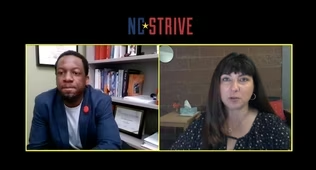
Clip: 4/26/2021 | 5m 43s | Amanda and Tari discuss opportunities for student veterans (5m 43s)

Providing Support for PBS.org
Learn Moreabout PBS online sponsorship
- News and Public Affairs

Top journalists deliver compelling original analysis of the hour's headlines.

- News and Public Affairs

FRONTLINE is investigative journalism that questions, explains and changes our world.












Support for PBS provided by:
Veterans Affairs is a local public television program presented by PBS NC