Veterans Affairs
NC Strive - Johnson C Smith
4/28/2021 | 1h 6sVideo has Closed Captions
Military Veterans on Campus Discussion – Education
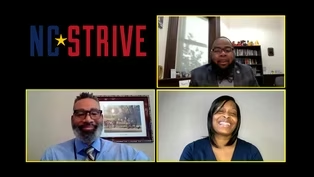
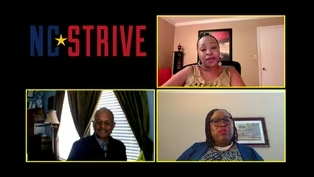
The fourth webinar on NC Strive 2021 focuses on Education and is hosted by Johnson C Smith University in Charlotte.
Problems playing video? | Closed Captioning Feedback
Problems playing video? | Closed Captioning Feedback
Veterans Affairs is a local public television program presented by PBS NC
Veterans Affairs
NC Strive - Johnson C Smith
4/28/2021 | 1h 6sVideo has Closed Captions
The fourth webinar on NC Strive 2021 focuses on Education and is hosted by Johnson C Smith University in Charlotte.
Problems playing video? | Closed Captioning Feedback
How to Watch Veterans Affairs
Veterans Affairs is available to stream on pbs.org and the free PBS App, available on iPhone, Apple TV, Android TV, Android smartphones, Amazon Fire TV, Amazon Fire Tablet, Roku, Samsung Smart TV, and Vizio.
Providing Support for PBS.org
Learn Moreabout PBS online sponsorship[bright music] - Hello and NC Strive.
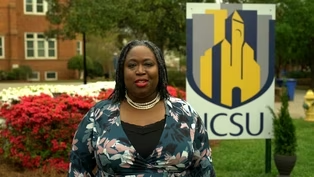
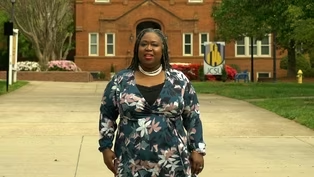
I'm Dr. Cheryl Harris Curtis and I am on the host campus Johnson C. Smith University, a historically black college university located in Charlotte, North Carolina.
I am the director of educational enhancement services and the dedicated veterans advocate for the university, today with our focus on education we're gonna bring to you in three segments a little information about how we colleges and universities across the state of North Carolina can support veterans military students and their families.
Our first segment is going to be a student panel where veterans will speak on why they decided to participate in college.
Next, we wanna to bring to you a discussion about the economic impact and implications of participating in higher ed.
And lastly, we're gonna have some folks give you some advice on how we colleges and universities can help veterans, military students and their families.
But before we get into all of that, there's going to be a welcome from the president of Johnson C. Smith University, Clarence D. "Clay" Armbrister.
- Greetings.
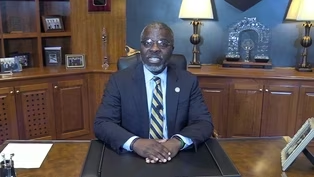
My name is Clarence D. "Clay" Armbrister, 14th president of Johnson, C. Smith University.
And I would like to welcome you to the 4th and final segment of the North Carolina student transition resource initiative for veterans education, a topic which is near and dear to my heart, as a 154 year old institution.
It has long been a part of our university's core mission to help people transition who may not have had any other opportunity for educational advancement.
Our institution has a proven track record of working with people, seeking higher education for a better life.
From our very beginnings, we educated newly freed men and provided opportunities to those, once oppressed, today, we continue this work by opening higher education, to those who don't fit the mold of traditional college students whether it is supporting our adult degree seekers, our work with students aging out of the foster care system or our efforts to provide a liberal arts education to veterans after their military service is complete.
JCSU has an expert perspective on helping students through these transitions.
We understand the unique challenges veterans face through our veterans support hub.
We strive to provide our veteran students with wraparound services to ensure their success.
Some examples of the support we provide are administrative assistance and applying for the GI bill grants and scholarships as well as health and counseling services.
We help remove barriers to earning a college degree.
We believe it is the absolute right of anyone who has dutifully served our country to obtain a degree.
JCSU has set forth the tools and practices to empower veterans to do so.
During this final part of the conference, you will hear from current veteran student and veteran alumnus who will discuss why they decided to pursue a degree.
We are also hosting a discussion about the economic impacts of participating in higher education.
For our final segment we will ask our veteran students how we can better serve and support them as scholars.
We hope these panels will provide you with more information and a good starting place to discuss how we can better support the scholars who have honorably and bravely served our nation.
Again, welcome to Johnson C. Smith University.
And thank you for joining us.
We are pleased to be part of this North Carolina strive conference and we look forward to furthering this conversation.
- Greetings.
I am Dr. Takeem Dean.
I served as a Dean of students at Johnson C. Smith university and we are joined today with one of our current students and one of our esteem alumni and I'm gonna have them introduce themselves.
And so I'm gonna start off with Sameerah who was one of our current students.
If you can tell us about yourself, your classification and after you, if Mr. George Curtis can introduce himself as well and then we'll get started.
- Okay.
Hello, I'm Sameerah Williams and I am currently a student a senior here at Johnson C. Smith University.
- Hey, good morning.
My name is George Curtis and I am a graduate of Johnson C. Smith University.
- Great.
Great.
Thanks for joining us today and just have a couple of questions regarding your experience in the military as well as at Johnson C. Smith University.
Can you both tell us the branch of the military that you serve or have served in as well as what skills that you've acquired that helped prepare you for the rigors at Johnson C. Smith University.
- I was in the United States Marine Corps and the skills that allowed me to advance or to take on the rigors of being at Johnson C. Smith University was when I went over to Afghanistan and I had to take on leadership roles as a corporal.
And those leadership roles allowed me to be able to stand in front of my classmates and give presentations and to be able to speak clearly and to be able to speak adequately about what it is that I was talking about.
- Curtis.
- And for me, I am a retired from the United States army.
What transitioned over was the fact that I never quit.
I knew that once I started, I was gonna finish.
I got support from the school, but I went with me.
I bought a lot of 'em, stay focused, stay with it.
I was able to go without sleep for many nights when I was trying to be more how to do algebra [laughs] and how to do the things the skills that I had last fall from school.
So yeah, those things where there with me and I had a lot of help from friends and family.
- At Johnson C. Smith University, we believe we are the best of the best.
And so why did you believe were the best of the best?
What made you choose Johnson C. Smith University when you were thinking about your collegiate journey?
- At first, I was coached by my roommate.
Who's a former golden bull and he was like, "well, girl, come on, let's go ahead and going on down here and sign up."
And I was like, well, I don't even know what I wanted.
You'd have an education program.
What do I wanna do?
So once I found out, what I wanted to do I began to look at the coursework.
And once I got adequated with the coursework, I was all right.
I was ready to go.
- With me.
I knew that I wanted to attend HBCU.
So once we moved to Charlotte, Johnson C. Smith was a logical choice.
And then when I heard about Johnson C. Smith from other graduates who told me how it's a big family and how the professors there were, which would take you into the wing and make sure that you succeed.
They always told me, he said, "listen they will not let you fail."
They will push you to the brink of where you are like, Oh man, I can't stand them.
But when you leave there and you will love them.
And I still have contacts with many of my professors now who are still telling me "Hey, they follow me and do my progression do map my new professional."
And they still stay in contact and still they still push me today.
- In higher education we get students that come from many walks of life.
And oftentimes we have veteran students who show up on our campus, such as yourselves, think back, Mr. Curtis and also, if you can think currently Sameerah about, what do you wish we as faculty staff and administrators knew about veteran students what would that, what would those one or two things be?
- Well with me, I will be looking back.
I wouldn't know.
I know that me being there wasn't as traditional as someone who has left, post education and coming to the post secondary education.
So, for me, I always that they would just knew that the experience that came along with it a lot of things, and a lot of places they talked about I had seen firsthand, sometimes I also wanted them to understand that sometimes there are because I have been in combat and I have seen a lot of different things.
I bring a lot of different psychological luggage with me and with that luggage and then it takes a little more, patience and a little more of that.
We understand where you are going and we got to, so that right there, they did what they could with the knowledge they had.
I just wished that he had a little more knowledge about veterans and what some of the issues that we go through physically and psychological.
- I would have to agree I'm currently on campus now.
Well, we're not currently on campus, but when I was on campus, I felt that there could have been more of a liaison.
More of let's say, I need to talk to someone or a counselor or something of that nature.
I felt as if it could be more of a one-on-one type deal.
So yeah, that they understood where I was coming from.
And not as if I'm not grateful for where I'm at but someone that understood where I was coming from, from the veteran's point of view.
- Points, well taken.
Thanks for sharing that.
That's good information for us to consider, not just at your university, but institutions throughout the world as we invite veterans on our campus.
And so if you had to offer some advice to other fellow veterans who are considering higher education what would be that advice that you would offer them?
- My advice to a veteran coming in would be to do your research about what school you wanna go to, what you want to study and would your coursework that you did over in the military would that carry over into your college credits.
So you're not taking classes over that you've already taken.
That would be the advice that I would give.
- Yeah, I have to agree in the military, we go to a lot of schools, we go to be able to have the training and the, in the, government's been spent a lot of money on us too and everything.
And some of those, some of that training transitioning to the civilian world.
And I wish that the university would look at that and say, Hey, you know, you have this disparate.
So let's count that as credits let's see how we can count that as a credit and a thing.
So I would tell somebody who's coming in saying, Dean do your research, try to find a point of focus where do you know what you wanna be?
Or how do you wanna proceed?
And then go here and go at it.
I would tell him to be patient it's a whole new world especially leaving the military and coming into the environment is a whole new world.
You with people who may be a lot younger than you, and they may, sometimes you may find it kinda not really frustrating but more so, wow.
Was, I like that when I was at age.
So, yeah so I'll be telling them they have a little patience and I would tell them to no matter what, it's distinct with it.
And the day when you walk off the stage, you'll be good.
- Yes, could I also add, also do your research financially because once your 36 months is up and you still have more school to do, how are you gonna pay for it?
They have to come out of pocket, or you may have to go another route in terms of finding funds to continue to support your education.
So that would be the other thing that I weigh.
- And another about.
Yeah, also, there's still the piggyback on that is to look at the different programs they have, both there's with the VA and some programs there's not with the VA that will help you pay for whatever you want to go into.
So research, yeah.
Don't take it lightly that you wanna just get there and it's gonna be like the television show.
[laughs] It's gonna be hard.
You're gonna be some nights when you don't sleep.
So your expectation has to be realistic.
- That's right.
And can I add one more thing also, with the liaison per se, also getting with other veterans that have already gone through the process that would better assist you as well, too especially if you're a freshman just coming in and you never done this before.
If they are a sophomore or junior they have the experience and they can, help to guide you along through the process.
- So it seems what you're both saying is that that dedicated veterans advocate is important.
- Yes.
- Right.
- For veteran students as well.
- Yes.
Very important.
Very important.
Yes.
- Okay.
Mr. Curtis, this question is directly toward you because you graduated.
You are one of the students that I'm proud of that you have a new career for yourself.
What things happen at Johnson C. Smith that helped prepare you for the chosen career that you're in now.
- Oh, wow.
Okay.
Well, I graduated with a bachelor degree in psychology, which is great.
I had some great professors.
They did not hold back.
They gave it to me straight and they gave it to me in a realistic manner.
And they prepared me for the next career that I'm going to go into.
So I'm grateful for them.
I'm glad that they was, kind of work with it.
They kind of worked with me to make sure that I was getting there.
They just was great.
And it's really like a family.
It really is because my family knows my professors that's the answer I have.
I mean, they know my kids know about my professors last week and by name they would know who just said, Oh, I know he talking about so that way there was great.
And Johnson C. Smith.
They did a great job.
We can show that I was ready to step out of the environment of school into the environment of work.
So the only thing I would just, kind of say any, maybe a little work on is the making sure that you have somebody there, when it's time for you to go into the world of work to make sure the transition is a little smooth having some people that you have will be poor with already and saying, Hey, we have this students coming out.
You may want to take a look at them and to help you a little bit.
So besides that, I really don't have any complains.
- The career counseling aspect is important.
- Yeah.
I think it is.
It's very important, especially when you going into the world of work and it's so competitive.
And why are you competing with other people coming from different universities coming from different countries?
Because the world is smaller now because of technology.
And so since technology made the world smaller you're not only competing against your neighbor you're competing against the world.
And by doing that, you have to be ready to start running from day one.
- Sameerah, as you get ready for another career.
- Yes.
[laughs] - Talk to us about how you plan to navigate the next chapter of your life after leaving university.
- Okay.
I'm sorry to cut you off.
[both laughs] My plans for the future is to go into education hopefully to become a pre-K teacher.
So I plan to get my licensure to become a teacher for North Carolina schools, public education system - As we close out this segment, as Mr. Curtis, as you think back to your experience at Johnson C. Smith and Sameerah, as you think about your experience currently at the university what are some things that is worth highlighting that you say, you mentioned some great things that have happened to you or for you at the university.
You've also shared some things that we can enhance.
What are some highlights of your collegiate experience at the university that you want other veteran students to hear about?
- The first thing is the campus.
The campus is beautiful.
I really enjoy being on a campus.
I really enjoy the history that come along with it.
I really enjoyed the professors and the most the people that they operate and work as for every day, they are awesome.
I mean, they are great.
I can't speak too much about them 'cause they really do it.
I had problems.
I had issues with financial the team there helped me do that.
I had problems with my assignments.
'Cause I said I was transitioning from one point to another point and they helped me.
They made sure that I was on point.
I was ready to go.
And I really appreciate that.
So Smith, the people, the professionals who work there every day from the person who clean to the person who teach all of them were in professional.
They always took care of me and they made sure that I was good and they made sure I was ready.
So I'm there every day.
It was what I appreciate the moves.
And that's my little back, I think about the people that most.
- Sameerah.
- All right.
My current experience is that I could speak about Johnson C. Smith is the family atmosphere being able to go into a professor's office or even the Dean and feeling like family, feeling like I can, come in and it doesn't necessarily have to be about score.
It can be about life and being able to have that family cohesiveness to say, Hey I'm going through XYZ as a need somebody to talk to.
So that's the takeaway for me.
- And I think here in both of your reflections I think about our model we'll we'll be talking about at Johnson C. Smith University the only historically black college university in the city of Charlotte is where you become yourself.
You change the world and Curtis you're definitely doing that in your profession.
- Yeah.
Waiting patiently and excitingly and change the world once you get that diversity.
So I wanna thank both of you for taking this time to speak with me and share your experiences as a veteran student at Johnson C. Smith University.
And as we say, continue to hold high the gold and the blue.
This panel it's about the economic impact and implications of higher education.
So would you all please introduce yourself?
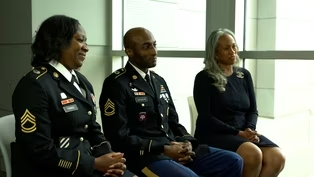
- Hi, my name is SFC Jessica Thomas and I'm a U.S Army Recruiter.
- And I'm SFC Jason Sanders, Station Commander for the Salisbury Recruiting Station.
- Hello, my name is Melita Pope Mitchell and I served as the Interim Dean of the Metropolitan College of Professional Studies here at Johnson C. Smith University.
- Thank you all for spending time with us today.
So I would like to start our panel discussion with a point of clarification Dr. Mitchell as an expert in CTE Career and Technical Education will you share with us the definition of CTE?
- Sure, CTE stands for Career and Technical Education and Career and Technical Education prepares individuals to move straight into the workforce.
And to also I get the technical and skills and knowledge base to be able to move into careers not just jobs that are sustainable and help to further our workplace success.
- So is there a difference between CTE and vocational education?
- There is, you may be familiar with the stigma around vocational education.
There were historical issues with both education where they felt people were being tracked into certain jobs, low skill, low paying jobs Career Technical Education is quite different when that as it does prepare individuals for high paying jobs for jobs that require specific skillsets they can be anywhere from business to information technology, health care, agriculture, manufacturing but there are high skilled technical jobs that individuals can go out and make a very good living with.
- All right.
Did not know that.
So we had a panel discussion with student veterans and we asked them what made them decide to go to college.
So I'm gonna ask the same question of you all.
Why shouldn't military students or veterans go to college and why is it economically advantageous?
- Well, I'll start off.
I'll say competition.
It's a big thing.
Competition in the military is one of those aspects you have to always look at do you want to compete?
You wanna go ahead and issue for the promotion points which the degrees do offer.
You wanna go that route shot a barriers occasion, this is one of those aspects of without that conduct, without that degree coming out in the economy you don't wanna be left behind.
You wanna always show that you're more prepared than that person to your left and your right.
- So from my perspective, it is important promotion last by being in the military, but at the end of your career however long you may do, you have to come out of being in the military and you're going onto the civilian force.
So you should have a background in military but you still wanna remain competitive with the civilian counterparts that were still, advancing their sales while you were in the military.
So the bigger part for me is just life after the military you wanna be competitive and have a background education to get to the next level that you're trying to get after the army.
- Well, I think it's important for one, the military prepares individuals for the skills that they need on the job force.
Working in a team is highly important.
Having very strong communication skills is extremely important.
So going to the next level whether that's Career Technical Education or one to a two or four year institution well then give them those specific skills in a certain labor market that will help them advance in their career.
- A decade ago, the jobs that required education beyond higher education, they didn't exist.
As far as veterans, you could get out of the military you get a good paying job fast forward to today.
How has that changed based on your experience?
- Well, you can still get a good paying job but nowadays there's so many veterans that are getting out of the military.
A piece of paper saying, you serve on me.
It's not enough anymore.
You need a higher education background to push you to the next level.
So I think that's why education has pushed so much now because a lot more veterans are getting out and instead of not working, they're going into the workforce.
- Okay.
- And it's one of those aspects where the world is not gonna stop.
Just 'cause you got out those jobs require diplomas, inadequate or require degrees the ones that need the bachelor's and master's degrees.
You don't wanna stop.
You always wanna know the world is gonna evolve and you have to be able to chase it.
- Dr. Melita, similar to the questions that were just asked of Sergeant Sanders, sergeant Thomas, CTE was viewed as programming that a lot of persons to skip college and go straight to work.
Why CTE becoming more of a focus in post-secondary education?
- Well, as we see jobs in different fields require more technical skills and bare specific technical skills.
The importance of continuing education particularly in CTE is showing individuals how they can acquire those skills so that they can get these high paying jobs.
If you look at information technology or even the myriad of opportunities within health care they require very specific skills.
And CTE is what prepares those individuals for those skills.
- Can you say some examples and you you've done that how participating in higher education it makes a difference.
So what is something else that you can share?
Something else that you felt like I need to say that to them.
- Okay.
looking into that no matter what's going on, it's your life, your career no matter what nobody Bible said that you live with your decisions to better yourself.
It's not a bias as a group.
It's not their career.
It's not their job.
If you have your modest set to something you should always stick to it, no matter what it's gonna be.
A lot of obstacles in the world.
[chuckles] We saw Thomas a bit through those in the military.
Don't let anything stop.
You always go for what you want to go for.
- Dr. Mitchell, what role do you see post-secondary institutions playing in supporting the military students based on your experience as the Dean of metropolitan college at JCSU - Sure, based on my experiences, I believe number one that we owe our veterans, the support that they need to move back into civilian life.
So as educational institutions, whether that's someone pursuing CTE, post-secondary CTE, a associate's degree a four year degree or graduate and beyond, we need to make sure that we have the resources on campus that allow veterans to transition a whale and to have the support systems that they need.
A lot of times, that's things, students who are having some difficulty with that adjustment though I've never served in the military.
I understand that the environment there tends to be extremely structured.
So, you know when things are happening, who's in charge of it.
And there's very strict guidelines there.
When individuals come into the educational setting there's a lot of freedom.
There's no one necessarily checking to make sure you're coming to class no one making sure that you're getting that homework done or they're just studying for that test.
So helping individuals like our veterans understand how to manage that time and how to hold themselves accountable in that type of situation.
I've noticed they may need some support in that.
- When you all think about the veterans, military students and then making that transition and they do speak to that beam, a stark difference between when they served and coming to higher education what are some advice you give to those students?
So that transition can go a little smoother.
- So many you have, there are times like your time like she's being in the military you don't have to think about anything is automatic.
You have to be at this place at this time.
You have to be at PC.
So, probably prioritizing what's important balance.
You have to learn a balance of how to have regular life and your life that you're trying to build.
So that would be the advice I'd give because even me being in the military now and been going to school for my masters, I have to balance and prioritize.
Okay, I know I have to work these hours but I know I have to do my paper.
So just try to find a balance and learning how to get it together, to get where I'm trying to get net.
- Alright.
- Yeah, I made a good point that you asked that question.
I think of a lot of similarities in that as far as the military member to college student, same thing you're gonna have operating off a little bit of sleep, right?
We still got off, operate off a little bit of sleep and be expected to perform same with giving problem solving, being able to problem solve.
You've given a solution into that solution through analyzing the situation same way.
Oh, I don't wanna go too in-depth into that, but it's a lot similar.
As far as the military was doing in college students do just like a school.
We give them material you're expected to learn that material and then perform on that subject.
Same thing, military college, civil affairs.
- So what are some resources that you all are aware of that will help them with that transition?
Because you say you're a college student now so you've done an undergraduate working on a master's.
So what is the resources that you have utilized you share both, or either can speak to that.
- So, for me, the joint service transcript.
So it is just a, it's a transcript of everything that I've done in the military.
As far as growth in learning my job just doing classes to remain to be promoted in the military field.
When I went to my college I was able to pull that and give it to them.
And they actually gave me college credits for what I did in the military and starting to educational credits.
So for me that was a bonus that make me wanna do school even more because it's not like I left, even though, sometimes we feel like, okay, we went straight to the military versus knowing college that that joint service transcript gives us like a balance together to say, no you didn't let what you did here.
We're gonna turn it into this to help you further along.
So for me, that was a big plus.
- It's all right.
Anything you want to add?
- The joint service transcript is a huge asset military members.
We use that joint service transcript to kinda keep on track with our compares outside the military while the treading we have inside the base.
And as far as where we're traveling, AIT, advance individual training, basic training simple training that we do, these classes, they all add up.
So that joint service transcript transcript gives us Sergeant members a sense of accomplishment.
- So if I'm sitting here now as a veteran military student, and I say joint service transcript, what are they talking about?
Where would I go?
Who would I go to see, to get that information?
- Okay, so if you wanna go and try to pull that proper, every service member has access to their own joint service transcript.
We can go online and pull it doesn't cost anything.
So we can pull print off.
For me, Thomas would be more so that we can we have readily access to.
- And now with getting out of the military, it's a lot different now before you people were just getting out and there wasn't any resources they do have soldier for life, decision SFL, tap.
So in there, they teach you how to do a resume.
They teach you how to pull your joint service transcript how to read your DD two 14.
So you have a lot more resources getting out when it's time for you to get out.
So therefore they do have access to that and they do.
We'll go over it with them if a case they'd never heard of it before.
So the soldier for life is the link between the army life and civilian life to further them whenever they going into the education.
- So you mentioned resume writing and we have an expert right here.
You hate.
So I call her that but she is an expert she's worked with career.
So hearing what they're saying about the joint services transcript then I'm actually going to speak to someone who can help them with their resumes now that they would, if they didn't do all or some of that what are they gonna do when they come to the institutions Dr. Mitchell - When they get to our educational institutions there are so many resources there that are accessible to them that I would love to see our students tap into not just our veteran students but also our students, but in particular they talked about the joint services transcript.
And when our military veterans come they can definitely utilize our career services.
It opposite of on campuses, where they can talk about the experiences that they had in the military as well as the things that they're experiencing in the educational setting and have someone work with them to be able to word that on a resume to be able to use those transferable skills and to communicate that to potential employers.
The other thing that I would like to mention is our counseling services.
Sometimes there's a lot going on in life.
You're dealing with family, you may be working you may be dealing with your education.
You may have children and sometimes our veterans need people to talk to as well.
So there are counseling services available on most institutions campuses that they should also utilize and removing the stigma from that as well.
Just having someone who is unbiased that you can talk to, I think is a huge resource that we offer for our students.
The other thing that they mentioned was the similarities between the college student's life and a better military person's life as well.
And I think there are veterans really are a huge resource on our campuses because they can help.
Sometimes our college students understand the structure that may be needed while they are coming to an environment that is a little less structured.
I do see some frustration sometimes when they're interacting with individuals and not just students but maybe faculty and staff as well who don't adhere to those strict guidelines.
So they want it.
I want our veterans to know that they have skills and experiences that they should share with others.
And when there's an opportunity for them to teach others those skills that they've learned in the military, they shouldn't be hesitant to do so.
- So we live in a society with the thanks for your service kind of, we love veterans situation, but let's be realistic.
What is some advice you would give to veterans that you would give to them to be realistic about their experience when they transition from military to higher ed - Take advantage of maybe opportunity.
I think it's very important whether you serve the day a year 20 years in the military, it's very important that the benefits that you are in deserve to you that you make sure you get those as well as talk.
So kind of talk and be honest with civilians military personnel, everyone about your experiences whether it was good, bad ways to get better.
So just take advantage of the opportunities and just be open and be transparent with what you had going on.
- You made a good point I'll go ahead and put in networking people.
That's the various huge one where you don't know somebody else or they know somebody who may know.
So that's my takeaway from it.
- Yeah, I think that, again the team building aspect that individuals learn in the military is something extremely valuable that they can bring to the college campuses whether they're pursuing post-secondary CTE or two year or four year degree or beyond.
So being able to share, again, those skills that they've learned to help other individuals become better while they're bettering themselves.
And also just to be transparent when things are difficult when they're not understanding stuff, then when they need a resource and they can't find it on campus to be sure that they communicate with the individuals there we have a wonderful veterans advocate here at Johnson C. Smith University, and individuals should feel comfortable knowing that there are someone on campus that they can talk to about the things that they need and to get those needs met.
- So I'm hearing you all say that they need to if they have, if you don't ask have not 'cause you asked not.
So is there anything that I haven't asked that you feel got to share?
They didn't notice she didn't ask this.
I got to tell them.
- Well, one thing that I wanna share, we started off the conversation, talking about post-secondary CTE and opportunities there, there are over 30 million jobs that are specific skill jobs that CTE prepares individuals for but I don't want to present CTE as it is the only Avenue or the end of educational journey individuals who pursue post-secondary CTE go on to obtain four year degrees.
They go want to obtain graduate degrees.
So it really depends on what your needs and desires are.
And I would hope that through this conversation and the resources that are out there, that our veterans who are looking to further their education look at all of their options and know that regardless of what path they choose there's always the opportunity to continue if that's what they want to do.
- It's a good point she made.
So another thing I would like to put out there as a 60% of jobs are here require a bachelor's degree.
So our encouraged the viewers at home named by Washington go out and get the bachelor's degree.
Don't miss this as a personal opportunity.
Huge, huge thing.
- So for me, I would say, just go big if you can dream it, you can achieve it.
- Sergeant first-class Thomas Sergeant first-class Sanders and Dr. Mitchell, I thank you so very much for your time.
We're gonna share information about how people can contact you later on in this broadcast.
But again, I can't thank you enough for your time and your advice and your wisdom.
I'm Dr. Cheryl Harris Curtis.
This concludes our panel discussion.
I appreciate you individually and collectively, thank you.
- Thank you.
- Thank you.
- I want to start by saying that in no way, do these questions or your responses necessarily pertain to the organizations for which you are currently employed, with that said, please introduce yourself to the audience starting with you ladies first.
- Okay, welcome.
Thank you guys.
Hello.
My name is Tracy Threatt.
I'm a veteran.
I served seven years in the United States Navy and two years as a reservist.
Currently I am a counselor at CPCC which is Central Piedmont Community College.
I worked specifically for our students virtues.
- Good morning, everybody.
I'm Dr. Kenneth Dunn.
I'm a, I'm a retired Marine.
I served 30 years in the Marine Corps, retired in 2004.
I worked for the Marine Corps as a civilian.
I head up something called the Marine Corps leadership seminar and our seminar visit universities throughout the country to tell them about the advantages of Marine Corps leadership and how that can lead to a possible step, in the Marine Corps as an officer, we visited Johnson C. Smith.
We visited Johnson C. Smith University in 2017 as part of linguistic Charlotte.
And that's where I meant a good doctor.
And we've had a great professional relationship since then.
Thank you.
- Well, thank you both for being here.
In today's session you will be providing advice to colleges and universities about what they could be doing to better support veterans and their families.
I once had a veteran students say to me that a lot of schools look good on a pamphlet but when you get there not so much.
So what would you suggest some possible solutions to that so that colleges and universities can truly be veteran friendly.
- Go ahead, Tracy.
- Okay, Cheryl, I have three suggestions.
There is, I would definitely suggest that they have a resource center.
I don't think if the school do not have a resource centers is not effective for veteran students.
Not only have a resource center but have staff who are trained with the educational benefits in order to be able to help the veterans students.
The second, I would suggest that they have a website with information that's easy to access for the Metro cities while they're doing a search for these schools.
They should see the veterans center as an important Attunity to that school.
So that search should be extremely important as it should be visible on their home page and the third I would definitely suggest that the students must provide the degrees or the certificates that enabled the veterans to further their education or apply for jobs.
So just not have veterans come there and be a part of the school have programs that these veterans can use while they after school have certified programs.
And the veterans could use those are my three recommendations.
- Thank you.
Dr. Dunn.
- Hey, thank you, Tracy.
Those are very good recommendations I think.
I would say, first of all, that, in order to develop a welcoming environment for veterans I think, I think that it's just like this is like hiring hiring panels.
You can tell people that you believe in diversity but until you showed somewhat of a diverse nature in that organization and folks come in they're not gonna believe it.
I would carry that kind of over to the veterans by saying, Hey, listen, if you're serious about welcoming veterans to your organization do you have any veterans on your staff?
All right.
And if you don't have any veterans on your staff that is recognizable veterans, then you should thinking about doing that because nothing gives an invitation, a welcome, like someone who is where you want to be.
Okay, so what I recommend is that if you don't have any veterans on your staff, look, they're hiring some maybe it's part-time, maybe it's a student who can get pass along information.
You may not necessarily have to have specific classes that are addressed to veterans, but you can take you could definitely have that individual or those individuals who have give their view of things.
Another way to welcome veterans, I think, is your environment or your classroom environment should have pictures of military organizations that you can and then the Marine Corps will flood you with posters and photos and videos and those types of things.
And those are sort of reminders to the students coming in that you appreciate veterans and you're looking to help them to succeed.
So the two things I would say is, Hey make sure you have a veteran or veteran reputation in your organization who is present, okay.
And the second is gesture and gesture, academic environment, so that you include the military show some social military scenarios, or some posters all these things are sort of reminders to that student that you're serious about working with veterans.
- So as you wanna work with colleges and universities in your vast experience what are some things that you saw were glaring?
Ooh, I wish they wouldn't have done that.
And what are some things that you say they doing very well?
We'll start with you Dr. Dunn.
- Well, I would say that as we, the purpose of the main college of seminars, we invite her.
We pretty much invite ourselves to the campus.
And that normally takes about a year because we wanna get on the academic calendar.
In other words, we don't wanna have a seminar normally lasts from four to six hours.
So it's a day-long event, but we couldn't afford to do was we couldn't afford the call for instance, called Johnson C. Smith University in August.
It's just a question of coming to visit you in September.
This is not a term.
Ideally we would contact JC Smith University a year out so you can get on the academic calendar.
So one of the first deficiencies that I noted and bring a leadership seminar on board was I had to make sure I was talking to the right people on the faculty normally for the Marine collusive seminar, they were in the schools of business because schools of business normally have leadership development courses which coincide with what we want to bring across to your students.
So I would say a deficiency is whenever out I could not get to get through to the schools of business.
And they had a top to some other department at university.
I really didn't have a lot to do with leadership because what they did was that was a mixing and matching their faculty member normally could not understand what we were trying to do and they would not.
And the fact that we're not paying the students to attend universities.
That was it's open invitation.
We had worked very, very hard with their faculty to elect adapter there.
We came to Johnson C. Smith University, we communicated, she set up the building guest speaker, we had all the we needed.
So I would say that upfront in my view is very important.
You had the right person on the faculty to welcome the leadership so I am.
- And Ms. Threatt, You have the same question.
What would you, what do you saw that?
Ooh, glaring no, no, but [indistinct] - Yeah, I'll start with the positive but I would say that schools and universities are doing well with is providing that space but providing that resource center for our best.
So that's one way to welcome them.
What I would say that they need to work on.
And they need to mandate that the green zone training any reasonable training should be mandatory, all faculty staff, as well as students.
So you get the students there, you're welcome there but then you add that training that's needed.
If training is the key component that I find for having the students, having your faculty and staff educated, who are not familiar with the military or the military experiences to have been knowledgeable that's gonna help the students that helps along with a lot of other things.
So just the no-no I think not having that on training mandatory as faculty and staff come on board and then that knowing that veteran community.
- So Ms. Threatt, can you take us right to the next question?
You talk about the green zone training.
Is there any other training that you feel in your experience that they must have on most colleges and universities to support the veteran military students and their families?
- Absolutely, I think that because the women and the men are quite different, so I think having specific trainers for each, and that may be a district for some universities, but I think that's a good starting point again, in the resource center, the best place where the individuals come and they know that that's a safe place again.
And then on the funding of each university or colleges I definitely think that if you have a Pacific training designed specifically for women, that's, I think that will be a plus.
- Dr. Dunn, any trainings that you would like to add.
- Well, I would say that training coming in other words, to prepare for I'm recording this of seminar, I would just say that it is important that the students understand what the purpose is of the [indistinct].
In other words we would send the head, read head information, all right.
And in this case, a Dr. Curtis would pass on information what the leadership team was going to do.
But mostly I would say that it's important that those students know that we're coming in there we're coming in to tell them about Marine Corps leadership and what the Marine Corps leadership can do for them.
All right.
Even if they don't pursue a career or a stent in the Marine Corps, you can certainly help them in other things that they do in life.
- So a lot of times schools miss the mark in supporting the military students or the veterans families what is something that schools can do not just to support the veteran, but also make the veterans spouse, dependents, make them feel as if they're included or a part of that university culture.
I'll start with you Ms. Threatt.
- I definitely think what I call checking in on the students and the family and what that does is provides the advising and counseling and peer support.
So checking in and just to find out how they're doing.
You're not just waiting to...
There was some type of disruption in the program.
So checking in on it from time to time.
- Dr. Dunn, how can folks take care of veteran families?
- I'll go back to my active duty days.
And what we used to do was, we have picnics cookouts, those types of things, but what we I insisted on is that if we had let's just say you have a military family day at Johnson C. Smith University.
All right.
You take a look at your calendar, okay.
And you say, Hey, listen, this is a great time to do this September, October early, the academic year.
All right, 'cause you may wanna have another one but you pick a day and you say, listen, this is gonna be something that the Woodward that we're going to do in conjunction with our military community.
All right.
You bring your veterans organizations then in touch with recruiters, okay.
Because recruiters were bringing assets digital ad, all right.
But you set up a family day, military family day, the cheat Dr. Curtis and ministry is that when you do that you got family, you got a ton of it to the families.
You can't tailor it to the organization.
You got to tell us your family.
Normally, military families have small of young children, you know?
And so what I do is I say, listen, we have our cookout or wherever it is, we're gonna make sure that the moms and the children can attend.
So maybe it's not at noon.
Maybe it's an innocent at three o'clock in the afternoon.
After the kids get out of school, Hey said, Hey you're gonna have dinner on Johnson, C Smith University.
And then you bring those families in.
You got moms, dads, children, students, all right, you have just a gathering of all these military folks.
And at some point you probably have a speaker at brought in, Dr. Curtis, she would say something, they have a guest come in but I would say, I would definitely tell it to that family.
And it's something I think that you could do early in the year.
You can make improvements on it over time, but with proper planning, you can have a military family day that your students would certainly appreciate because you gotta not only send out a welcome walking on your family, but you're also gonna provide a lot of critical information that the family can use.
- So my next question I have for you is if the school is not doing what it should be doing, the veterans know and the veterans are going to express that to somebody what is your advice that you would give to veterans if they call you up and said, "Hey, school's not really hitting the mark."
What's some advice that you've given to students in the past, or that you would give?
- Well, okay, go ahead Tracy.
- You can go head Dr. Dunn.
- Well, I don't, I've always been able to observe from mothers going, if students are get life, it's that tells you Dr. Curtis, right?
I said that it was wrong that you hadn't seen a senior the Marine Corps recruit on your campus in over 10 years.
I said that doesn't make any sense because this is North Carolina.
That's very pro military state.
And when I talked to our recruiting service they did not have you on a mat.
So what I've done in the past is I'll go back to our headquarters and pass that information on the mirror and say, listen we need to get some recruiters down to Johnson C. Smith University, because as it turned out our call, we had two of the students who signed up for the Marine Corps while we're there.
So what I say is, I mean, from my vantage point I've been able to go back to my organizing headquarters.
My communication with, with the faculty that is like, Dr. Curtis is just that, "Hey, listen we send you whatever mission you need to stay in touch with me.
And we'll see that information.
Thanks.
- Ms. Threatt.
- Of course, at our center and just being a vet myself, we advocate on behalf of our students but we also empower them to advocate on behalf of himself.
I think that's the key is so they just point them in the right direction.
If this not as a solution, if we don't get a solution we definitely step in and advocate on behalf of our students and for our students.
And not just the students out in the community as well for the family as well.
And I think empowering them and to let them know so their voices are heard.
I think that' what I would add.
- Well, I have taken some good notes because you all have said some things, I checked some boxes like we're doing a great job.
And I looked at some things like, we need to step that up.
So I wanna thank you all for sharing that advice on the NC Strive website there's going to be some information so that people have questions.
They can reach out to you, your organizations or just the different things, the different resources.
'Cause there's no way in this one hour segment, we could capture everything.
So again, this information, your contact information if you don't mind, it'll be on the website.
But before I let you go today if there is one that I have not asked that you feel is important and pertinent to this discussion that's gonna be really helpful.
Then please share it at this time before I let you go, we'll start with you, Dr. Dunn.
What's something that I didn't ask that you feel is important to know.
- I think it's important that you develop a feedback mechanism that occurs.
In other words, EVs versus the number of questions and name instead of giving you ideas that we think will work but inclusive, I'm recording.
So now we pass out a survey and we asked the target audience, that is the students.
How do we do, what did we, what did we cover?
What did we miss?
I believe that occurs that in order to have an effective process is you need some type of feedback mechanism.
In other words, for instance, you hold a family day, right?
That's inclusion in the family day forced yourself to get information from that audience.
How did we do, what did we miss?
What can we do better next time?
Because that will drive you towards ultimate success.
If you're just running by the seat of your pants, yessing and top of the passers by all right, that won't do it.
Developing is a feedback mechanism that will give you put in information so that you can make very changes on whichever way you need to go.
But that's what I have.
- And thank you, Dr. Dunn, that reminded me at the conclusion of this.
I need folks to hit that feedback mechanisms that we have exact drive.
You could give us some feedback, the good, the bad and the ugly Ms. Threatt, what's your advice?
- Definitely.
Yes.
I would definitely say keep track of the students success.
Those who have successfully graduated keep track of retention in the transfers.
I think we need to do a better job when we brought in our students and celebrating them through the success.
I'd rather they 'cause I work at a two year university.
So it was two-year college going to a four year college to keep a better track of our students and not just let them disappear.
I would say check in for they check out.
- Thank you all.
I appreciate you so very much, but if I should have given me that you'd given everyone across the State in the words of Dr. Dunn, we've got a feedback mechanism.
I need you all to make sure that you hit the link below and you give us some feedback let us know how we're doing, how we can improve.
And again, I could not thank you all enough for your time and attention.
We thank you so very much.
- You're welcome.
And thank you.
Thank you.
Thank you Dr. Dunn.
- Thank you Dr. Cheryl.
- From the campus of Johnson C. Smith University, I Dr. Cheryl Curtis would like to thank you for spending time with us today.
If you played any role in this to production whether you're a videographer, a moderator, a panelists or guest speaker, I wanna say to you individually and collectively, thank you.
Have a wonderful day.
[bright music]
Providing Support for PBS.org
Learn Moreabout PBS online sponsorship
- News and Public Affairs

Top journalists deliver compelling original analysis of the hour's headlines.

- News and Public Affairs

FRONTLINE is investigative journalism that questions, explains and changes our world.












Support for PBS provided by:
Veterans Affairs is a local public television program presented by PBS NC