
NDP Recap & School Life for LGBTQ+ Students
Season 6 Episode 33 | 26m 46sVideo has Closed Captions
A survey reveals what the Nevada school experience looks like for LGBTQ+ students.
We first recap Nevada Democracy Project’s second Community Listening Session held at CSN’s Charleston Campus 2/13/2024. The biggest takeaways: local elections and concerns about Nevada’s kids. We then interview Silver State Equality about the results of a recent survey showing what LGBTQ+ students are experiencing in Nevada’s schools.
Problems playing video? | Closed Captioning Feedback
Problems playing video? | Closed Captioning Feedback
Nevada Week is a local public television program presented by Vegas PBS
NDP Recap & School Life for LGBTQ+ Students
Season 6 Episode 33 | 26m 46sVideo has Closed Captions
We first recap Nevada Democracy Project’s second Community Listening Session held at CSN’s Charleston Campus 2/13/2024. The biggest takeaways: local elections and concerns about Nevada’s kids. We then interview Silver State Equality about the results of a recent survey showing what LGBTQ+ students are experiencing in Nevada’s schools.
Problems playing video? | Closed Captioning Feedback
How to Watch Nevada Week
Nevada Week is available to stream on pbs.org and the free PBS App, available on iPhone, Apple TV, Android TV, Android smartphones, Amazon Fire TV, Amazon Fire Tablet, Roku, Samsung Smart TV, and Vizio.
Providing Support for PBS.org
Learn Moreabout PBS online sponsorshipThe results of a new survey show what life's like for an LGBTQ+ student in Nevada, plus... -We need to focus on our state and what we can do here, because depending on the President is getting us nowhere.
-...highlights from our second Nevada Democracy Project listening session.
That's this week on Nevada Week.
♪♪♪ Support for Nevada Week is provided by Senator William H. Hernstadt.
-Welcome to Nevada Week.
I'm Amber Renee Dixon.
Assembly Bill 261, which became law in 2021 in Nevada, requires K-12 schools to teach the histories and contributions of diverse groups.
A new survey sheds light on how well that bill's been implemented from the perspective of the LGBTQ+ community.
We'll discuss that ahead, but we begin with the Nevada Democracy Project.
It's a partnership between Vegas PBS and The Nevada Independent.
And together we're holding community listening sessions to find out what we should be reporting on.
We held our second listening session at the College of Southern Nevada's West Charleston campus.
I moderated along with Nevada Independent Reporter Naoka Foreman, who will join me after we listen to some of what was said.
-I think that there should be a push on educating voters, because educated voters are stronger voters.
-I bring my daughter to these events.
I want her to be educated.
I want her to be a part of community.
But the problem is, is that we don't invest enough money in our kids.
And we don't invest in our general community too.
Right?
Like, if we invested more into education, we wouldn't have to do as much voter education.
-I think education has really changed, and it's not for the best.
Teachers used to own their classrooms and be the leader.
If they wanted to teach reading that day and they did not understand it, they had the ability to teach it another day and reteach it for as long as they needed because they were in charge of their classrooms.
-These kids came back from the pandemic different.
Socially, emotionally, it was a lot.
And one of the things that I saw was it was really hard for schools to really punish kids for certain behaviors, because it was like, okay, it's a pandemic.
You know, things are going on at home.
This, this, that, and the other thing is happening.
And so they really weren't punishing for little or-- I mean, they really weren't punishing for anything.
So even the high aggressive, violent behaviors, they were kind of getting a slap on, slap on the hand in the beginning.
And then it got so bad that they started to have to punish for little things.
-I think college students now, this is the time that we deserve to have safety in our campuses.
-I'm a foster parent.
I brought in 36 youth, became a permanent parent to 11 of them.
And it's a huge issue.
[applause] -Thank you.
So it's kind of, in my opinion, just seen as like the forgotten youth.
It's kind of like there's never any benefits really dedicated to them.
The State tries.
They miss the mark every time.
-I think just like the big ticket items are just a bit too big for me, because I'm just a bit more worried about what's going on in the local areas.
Like, let's say floods or damages to the areas.
Because of the flood that's happened in September, there's still like construction going on in my areas.
-These nuclear issues affect all of us.
The radiation is everywhere.
It's at the bottom of Lake Mead.
It's in the older houses here in Las Vegas, and workers are going into these homes, getting exposed.
They don't even know that they're exposed.
People go out and recreate on the dry lake beds.
They park on the edge where those heavy particles bounce across and collect, and they're getting exposed, potentially.
-I think the environment is a huge one.
I think trying to start a family is very scary to me, as I'm getting older, because I don't know how the world is going to be that they're walking into.
-Something I really agreed on was that we should introduce like, civic classes into our school curriculum.
As someone who's going to go into high school quite soon, I think it's really important that we're educated on topics that will help us in the real world, like politics and dealing with our own lives and money.
-Me, as a student, and other students should be more educated about life and how it would be helpful if we could get jobs at a younger age, because it would be more helpful later on in life.
-Getting employers to work with K-12 is so important, and there's programs out there that can help foster that, that can pay for these young people to be inside of workplaces and learn and grow.
That's what they need.
-I think you should be, you could be younger to vote.
-How old do you think you should be in order to vote?
-At least 13.
-And how old are you?
-8.
-I'm really just here to listen.
I'm from American Samoa.
So unfortunately, I am a US native, so I don't get voting rights.
So to sit here and listen in these community listening sessions, it's really important for me to educate people that get a voting right to be able to-- so that my kids and my nieces and nephews that are going to come down the pathway, that they know that there are people that are going to advocate for us, because my father served 27 years in the military.
My mom, 20 years in the military.
And so not being able to vote, it's really important for me to come to a listening session like this so that you hear from me that we need you to vote.
-Ask 10 people at the caucus, Who's your State Assemblyman and who's your State Senator?
Out of those 10 people, nine of them could not tell you.
This is the first time I've seen where we have to take our election all the way down to the school board, the commissioners, that far down.
-At this point right now, I don't trust any of the candidates.
None of them are in our best interests.
Right now, what we need to focus on is what he said earlier.
It's the local.
We need to focus on our state and what we can do here because depending on the President is getting us nowhere.
As I mentioned, The Nevada Independent's Naoka Foreman moderated with me and joins us now.
Naoka, thank you for coming in.
So that was our second session.
Our first session was on the Historic West Side of Las Vegas.
And from that session, from what we heard there, we went away with that and said, Let's cover redlining and the modern day impacts of it and the modern forms of redlining.
So my question to you is based off what we heard in this second session, what are you looking forward to exploring and us possibly covering in depth?
(Naoka Foreman) Yeah.
During the conversation, school discipline and the school-to-prison pipeline came up quite a bit.
And I didn't really hear anything new.
But what stood out to me in our newsroom was that school police could potentially build up a rap sheet on students without letting parents know.
So we'll be taking a dive into that.
And also Eric Neugeboren, who came to the community listening session and he's an intern at The Inde, he'll be looking into school discipline reports before, after, and during the pandemic to see what those numbers look like.
-And that would be in direct response to that woman, a former teacher, who spoke about what she's seen in terms of discipline during those different time periods.
-Yes.
-So other issues affecting the youth that we heard, we heard from the youth themselves.
They would like civics classes.
They would like financial literacy classes.
One little boy even said, I want to learn about taxes.
Another issue that emerged from that session was the importance of voting local, not just for who's going to become the next President, but for county commission, city council, even local judges.
And it was brought up how difficult it can be to find out information about local judges.
But in that area, The Nevada Independent has a solution.
And what is that?
-Correct?
Judges decide our fate, the fate of our family members.
So judicial races are extremely important, and they're not covered much in the news.
And The Inde is trying to change that with what is called the "Judicial Project," in partnership with UNLV.
And what happens is we send judicial candidates detailed questionnaires, and we've-- detailed questionnaires, and then a panel of lawyers and law students help evaluate the candidates in the race.
We then share those profiles, which can be found on our website, along with an analysis of the race, which is written by legal experts.
-Which is so important, as you mentioned, in terms of families and issues of custody and foster care.
What a tremendous resource that The Nevada Independent is providing.
We will also be covering the ranked choice voting issue which did get brought up at this session.
There was a neat exchange between a proponent of it and then a woman who came and said, Well, I think it could have a negative impact on Presidential elections.
And right then and there, the proponent was able to correct her and say, No, this does not include Presidential elections.
This is at the state and then some Federal Office levels.
It was neat to just be able to kind of get that misconception taken care of there.
But it is a really complicated topic.
So I know we will both be looking into that more, ahead of November, when it appears back on the ballot in Nevada.
And lastly, Naoka, the right to vote itself.
We heard from that woman who said she's from America Samoa.
What do you know about why she cannot vote?
-From what I understand is that American Samoans and other people who are natives to US territories can only participate in primaries and send delegates to the nominating conventions for each party, but they don't vote in the general election.
They also have nonvoting members in the House of Representatives who can only vote on amendments.
-Wow.
-And their state-- if someone from America chooses to move to the US territories, their state can send them an absentee ballot and allow them to vote.
But the unequal voting rights in these territories stems from a 1900s idea that says that these alien races wouldn't understand Anglo-Saxon principles, and they're still affected by this idea today.
-All right.
Thank you, Naoka Foreman of The Nevada Independent, for coming on.
Look forward to having you back on.
And a couple of important dates for you to know about this election year: Tuesday, June 11, is Nevada's primary election day.
And then Tuesday, November 5, is the general election.
There are early voting options for both.
And in the meantime, we encourage you to make sure you are registered to vote.
What's it like attending school in Nevada as a member of the LGBTQ+ community?
That's what a recent survey sought to answer, the results of which are described as heartbreaking.
Here to explain why are Andre Wade, State Director of Silver State Equality; Jessica Munger, Program Director from Silver State Equality; and Zach Billot, a UNLV student who serves on Silver State Equality's LGBTQ+ Student Advisory Council.
Thank you all for joining us.
Silver State Equality is a statewide LGBTQ+ civil rights advocacy group and the group behind this survey.
This is the first year that you are doing this survey.
And when you describe it as heartbreaking, it was you who described it that way, Andre.
Why?
(Andre Wade) It's heartbreaking because of the findings.
And when we started this student advisory council, it was in 2020, the summer, our board of advisors wanted to do something to address students' mental health, given the stay-at-home measures that were in place.
And we were getting reports of suicide completions and struggling with academic performance, and so we decided to tackle this issue by creating a student advisory council.
And the way I designed it was to have it primarily be students with some adult mentors that are involved to help guide the students through their work and would require for them to conduct a statewide survey to find out from students what is happening, what they want to see changed.
And that is something that we finally were able to do last year when the council was implemented.
-And you had to do it when school was back in full person, correct?
-Yeah.
It took a while because we had to seek funding, we had to see what the COVID-19 measures were going to be, and get staffed up for it.
So once Jessica got on board, was able to hand the program off to her.
And she implemented things, and here we are today talking about the survey.
-All right.
For Zach and then Jessica, do you agree with Andre that the findings are heartbreaking?
And were the results surprising to you?
Why or why not?
Zack first.
(Zach Billot) Yeah, I certainly agree with Andre.
And I think the results are not surprising, but they're certainly concerning.
And I think what the survey highlights is that young people, much like adults across the country, are experiencing a lot of hardship.
And whether that sort of was born out of COVID-19 or whether it was exposed in a higher light because of it, I think it's really important that the survey be taken seriously as a measure to improve the well-being for students across the state.
-Jessica, heartbreaking?
(Jessica Munger) Absolutely, yeah.
Yeah, and I would say both shocking and expected.
I think that even though the results confirmed a lot of things that we have heard from other places in the country and, and expected was going on with our students, it's still disturbing.
And that's shocking to hear.
-So the findings themselves, what stands out to each of you?
I'll start with you, Andre.
-You know, one of the findings were that a lot of students identified not having inclusive curriculum.
Curriculum that shows LGBTQ+ history, history makers, was difficult to find not in their curriculum, because it's powerful to see yourself when you're reading.
And it's powerful for your peers to be able to see who you are in the books that they're reading.
And so for them to identify that that is a concern is heartbreaking, but it's also good because of a bill that was passed in 2021.
-So then how well do you think that bill has been implemented, which is to talk about and teach about diverse perspectives?
If you are finding this in your survey that-- we'll put up the specific percentage of how many students reported not having the access to that or not being instructed on that.
But yeah, where do you think that bill stands?
Because it is law.
-Yeah.
So with the bill passing in 2021 and being fully implemented in 2022, it's still going to take some time for school districts to implement the curriculum, because they're in like about seven-year cycles.
-Of textbooks?
-Textbooks, overall curriculum.
-Okay.
-And teachers have to get trained on the curriculum.
So it's a long process.
And so it's gonna be a little while before we actually see the students benefiting from that inclusive curriculum.
-So then from here, where do you go?
I mean, is it time to say, Hey, why isn't this in effect already, or do you stand back and wait?
-It's time for us to put this report in front of decision makers, lawmakers, folks at the Department of Education and at local school districts, to let them know that this is what we're finding.
And it's commensurate with national studies that have been done by groups like GLSEN.
And so as Jessica mentioned, it's heartbreaking but not surprising because we've seen these results in studies before.
So we just have to do our advocacy to make sure that things are implemented, no matter what the laws are in place.
-Jessica, what stood out to you from the findings?
-You know, one thing that really shocked me was the number.
I think it was 79.4% of respondents said that they have faced discrimination by those in authority at schools for their LGBTQ+ identity.
That's a shocking number to me and, and has stood out since since that number came in.
So yeah, I really feel for the fact that so many students in our state are experiencing institutional discrimination at school.
That's a problem.
-How is that possible when teachers are meant to be there in a supportive role?
Anybody have any perspective on that?
Zach?
-Well, I think this goes back to something that's important about what Andre is speaking on.
Policy is really important.
And I think the survey certainly highlights that there's areas of improvement.
But there's certainly ways that we stand out as a pillar of the community for LGBTQ people compared to other states.
But I think it's very difficult to legislate on some of the cultural issues that might exist.
You can change curriculum, but it doesn't mean you're going to change minds right away.
So I think that the important thing that this survey highlights is that there are a lot of students who feel like policy supports them, but then their LGBTQ identity holds them back compared to their other peers, because there's sort of these cultural expressions that either their teachers or authority figures might still maintain or hold that then can hold them back in the classroom.
-And this is something we discussed off-camera that you can get legislation passed, but how do you change what you term "cultural expressions" or the sentiments of people?
How do you do that, Andre?
-You know, it takes time.
The equality movement has had great success over the past couple of decades, some of the most success of any civil rights movement.
And it's about changing hearts and minds.
We've done that with marriage equality.
And there are a lot of other facets of our life that we need to have that same sentiment change as far as acceptance.
And so training is one thing, but there's a lot more that we need to make sure it's being done.
So there's national recommendations for teachers and administrators to have at least one hour of LGBTQ+ specific trainings.
That's something we want to make sure that's happening across Nevada.
We're not saying it's not happening at all.
We just want make sure that it's happening at some point.
-Zach, I did not ask you what stood out to you among the findings.
-I think the finding that was most shocking to me was the students citing a lack of LGBTQ-specific resources, almost 75% of the students that we surveyed.
And whether those resources are earmarked for mental health or physical health or maybe just a specific safe space or inclusion area for LGBTQ people, I think it highlights that there's certainly work to be done to make educational institutions in the state feel more welcoming for LGBTQ people who for a long time have sort of been pushed into the darkness.
And I think it would be great if schools across Nevada could sort of serve as that light to help some of these students that are really struggling at this time, even beyond the pandemic and just in the regular classroom, really grow into themselves.
-Will you explain what a safe space looks like, where it's usually located, when it's accessed.
And this is within a school, correct?
Jessica?
-Sure.
So some of-- some of what we were asking about included spaces on campus that might have a rainbow flag or some indicator that the people who work there have an openness to your identity.
And if you've not experienced sort of feeling excluded from a lot of spaces, that might seem like a small thing.
But as a person who is looking for allies in your spaces, it's important to see spaces designated saying, We are specifically here to be allies for you, and you specifically are welcomed here.
So even if it's just, you know, physical designation that, you know, We've had training, or We accept you, that goes a long way for people.
-And, Zach, you are four years, about four years removed from high school in Nevada.
I think you told me Spring Valley is where you went.
So what was your experience like as a member of the LGBTQ+ community in a Nevada school?
-Yeah, so I wasn't out in high school.
-Okay.
-But I do think that the dynamics that play out in high school environments can make it difficult to feel comfortable coming out.
And whether that be peers or authority figures, like some of the students cited in the survey, I think it's important that we recognize that everyone's experience and their process of coming out is different.
And for me, specifically, because I wasn't out, it sort of made the environment less hostile.
But obviously, there were a lot of situations where people make microaggressions or derogatory statements about the community.
And as someone who might not be out, it can make it really difficult to feel like you can accept your own identity if people are willing to sort of make those statements, even though they know that they are people in the community that have the identity.
-They're aware of that presence, yet they continue to say that kind of thing.
What about parents, though?
What role can they play to improve the experience of their students in Nevada schools?
Who wants to take that one?
-Well, there is research done by Dr. Caitlin Ryan out of San Francisco with the Family Acceptance Project.
It's been around for a couple of decades now, research based, and it shows that the more accepting parents are of their LGBTQ+ identified child, the more likely they are to have positive outcomes.
And we've really seen a lot of parents embrace their, their kids.
On the flip side, you've seen parents attacked for accepting their kids, especially those who are transgender and gender nonconforming, which is completely heartbreaking.
We spent decades trying to get parents to be more supportive.
Now that they are, you know, in general, now they're getting push back.
And so we just want parents to feel supported, to feel empowered to advocate on behalf of their children, going to school board meetings, which there are some that go and speak out on behalf of their children and others.
And so we want to make sure that they have the tools and resources like this study to show to their, their school administrators like, Hey, something needs to change, if there are reports that things aren't going well on campuses.
-And I bring this up because I came across this from the ACLU of Nevada.
"Nevada requires school districts to adopt policies that protect students' privacy and allow them to use the school facilities that match their gender identity.
But it is up to the students' families to contact the school to create an individualized gender support plan for the student."
How well is that going over or actually being utilized by parents?
-So I've heard in settings that there are some individualized plans that aren't being implemented, or teachers aren't-- or parents aren't aware of the resource for their children.
And so we have to raise awareness about that resource being available to parents.
And then once the parents have submitted the request, that it's actually followed through and implemented.
So there are a lot of reasons and steps why it's not happening, but there are some reports that there are a lot of students out there without these individualized plans.
-Jessica, let's talk about this survey.
In particular, how it was conducted, how many people were surveyed, demographics, etc.
-Sure.
So the students on the council helped to create the concepts that they wanted to survey.
They were curious about the school experiences of their, of their peers.
So we put together this survey, and we sent it out, not just through the students and mentors, but then through Silver State Equality email list--we have a robust list in the state--through social media, through our organizational partners and coalitions, and the really fantastic progressive networks in Nevada.
So this is a very hard-to-reach population, right, LGBTQ+ junior high and high school students in Nevada.
And I'm really proud that we were able to get 76 folks to respond to us in full and tell us all about their experience.
And then we had follow-up conversations with eight students to go a little bit more in depth into what they're experiencing.
I absolutely love the image of students from six different Nevada counties coming together and voicing what's going on for them.
What an empowering opportunity.
So we had, like I said, six counties represented.
We had a decent amount of rural representation, which was very important to us.
So another thing we did was to go out and do on-the-ground outreach to these, these students.
So we went to pride events all across the state, including rural prides.
And we talk to students and parents and teachers.
We met with some student groups directly and really tried to recruit the voices of the rurals, which I'm very glad that we were able to do.
-So I imagine this continues in 2024?
-Yeah, absolutely.
Yeah.
So the council is excited to, to jump off from where we started with this survey, continue to collect student stories.
I really think that it's powerful to have the voices and direct words and stories of students out there as you're talking about changing hearts and minds.
In my experience, there's so much power in stories from individuals.
And so I'm really excited to continue that, that process.
-Thank you all for joining us.
We ran out of time, but I appreciate this important discussion.
And thank you for watching.
For any of the resources discussed and to find out more about the Nevada Democracy Project, visit our website, vegaspbs.org/nevadaweek.
And I'll see you next week on Nevada Week.
♪♪♪
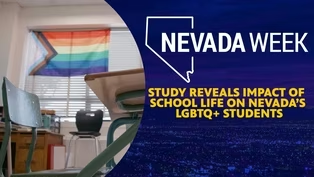
The impact of school life on Nevada’s LGBTQ+ students
Video has Closed Captions
Clip: S6 Ep33 | 14m 48s | Silver State Equality explains the results of a study on what LGBTQ+ students experience (14m 48s)
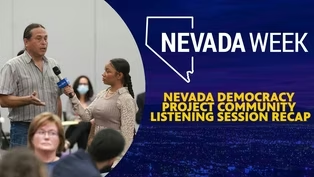
Nevada Democracy Project Community Listening Session Recap
Video has Closed Captions
Clip: S6 Ep33 | 10m 35s | Amber Renee Dixon and Naoka Foreman recap the NDP Community Listening Session. (10m 35s)
Providing Support for PBS.org
Learn Moreabout PBS online sponsorship
- News and Public Affairs

Top journalists deliver compelling original analysis of the hour's headlines.

- News and Public Affairs

FRONTLINE is investigative journalism that questions, explains and changes our world.












Support for PBS provided by:
Nevada Week is a local public television program presented by Vegas PBS