
Neal Shapiro; Sonia Manzano
12/18/2021 | 26m 11sVideo has Closed Captions
Neal Shapiro; Sonia Manzano
The WNET Group’s President & CEO, Neal Shapiro, discusses American Cities Rebuilding Conversation Series, which includes a diverse group of thought leaders addressing the country's biggest issues during the pandemic; Sonia Manzano shares her journey on the iconic PBS show, Sesame Street, as well as her new show on PBS Kids, Alma’s Way, which is inspired by Sonia’s own childhood.
Problems playing video? | Closed Captioning Feedback
Problems playing video? | Closed Captioning Feedback
Think Tank with Steve Adubato is a local public television program presented by NJ PBS
Neal Shapiro; Sonia Manzano
12/18/2021 | 26m 11sVideo has Closed Captions
The WNET Group’s President & CEO, Neal Shapiro, discusses American Cities Rebuilding Conversation Series, which includes a diverse group of thought leaders addressing the country's biggest issues during the pandemic; Sonia Manzano shares her journey on the iconic PBS show, Sesame Street, as well as her new show on PBS Kids, Alma’s Way, which is inspired by Sonia’s own childhood.
Problems playing video? | Closed Captioning Feedback
How to Watch Think Tank with Steve Adubato
Think Tank with Steve Adubato is available to stream on pbs.org and the free PBS App, available on iPhone, Apple TV, Android TV, Android smartphones, Amazon Fire TV, Amazon Fire Tablet, Roku, Samsung Smart TV, and Vizio.
Providing Support for PBS.org
Learn Moreabout PBS online sponsorship- [Narrator] Funding for this edition of Think Tank with Steve Adubato has been provided by The New Jersey Education Association.
PNC, Grow Up Great.
The Turrell Fund, supporting Reimagine Childcare.
RWJBarnabas Health.
PSE&G, committed to providing safe, reliable energy now and in the future.
The Robert Wood Johnson Foundation.
Johnson & Johnson.
The Russell Berrie Foundation.
Making a difference.
And by Georgian Court University.
Promotional support provided by Insider NJ.
And by NJ.Com, keeping communities informed and connected.
[MOTIVATIONAL MUSIC] - Hi.
I'm Steve Adubato.
Once again, we are honored to have Neil Shapiro, the President and Chief Executive Officer of the WNET Group.
Neil, good to see you.
- Good to see you, Steve.
- I'll put this into context.
We've been long time partners and have worked affiliated with public broadcasting in our region.
The WNET Group, explain to everyone what it is and why it's so significant.
- Well, we call it The Group 'cause it gets bigger and bigger.
We are now both Channel 13, Channel 21 and NJ PBS.
We have digital channels, like "Create" and "World."
We now have "NJ Spotlight."
We have "All Arts," which is our 24/7 channel.
And we want to make sure it's the group because you know, we wanna serve everybody with all kinds of content on whatever platform they're on.
- So we're gonna talk about this "American Cities Rebuilding" initiative, which is so important, that you and your colleagues lead leaders from across the country, talking about urban America today and in the future.
But I wanna ask you something, it's an issue I've been thinking about an awful lot as we move into 2022.
The role of public media in an age where there's so much distrust, distrust of those of us in the media, the "fake news" thing, I'm not even going there and the need for accurate credible information, not just about public health and COVID, but other issues.
So it's a loaded question, I know, but how do you, big picture, as a leader of PBS, across this country, but the leader in this region clearly, what's our role?
- You know Steve in some ways I think it couldn't be more clear, because we now live in a time as you said, where it's not just information you can trust, but it's also information that's important.
I think we've always had that, the integrity, of the point of view that we don't carry anybody's political water.
We don't bring a point of view to discussions, but I think we're also at a point now where we realize how complicated a lot of these issues are, whether it's climate change or justice or economic development or human rights or whatever it is, these are really complicated issues.
And I think what public media is all about is smart discussions, where we're not afraid of complexity.
We're not afraid of detail and shows like these, where people get a chance to talk and they really make their case in a civil and smart way, is exactly what public media is about.
And I wish it weren't true, but as you look across the field of media, there are so many places where it's all about, you know, heat and not about light.
Where it's all about confrontation, not a place where you can have reasonable discussions.
I was talking to someone the other day about this notion of public intellectuals, and it's really vanishing almost everywhere, but public media.
That's what we're about.
Finding thought leaders, giving them a chance to talk, exchanging ideas, because that is the way we move forward as a country.
- If you're looking for more light versus heat, check out "MetroFocus" every night, and Neil created that with some other folks and they have a great team over there.
Three terrific anchors.
Great producers behind the scenes.
Check out "MetroFocus" and "NJ Spotlight News," both sides of the river, covering the region.
Neil let's talk about this American- - We also oughta check out your show too, as well, right?
- Yeah and by the way, to be clear, I've said this to Neil before, I've said it to other colleagues I'm Catholic, so I'm comfortable saying this is, well whether you are or not, it's a blessing to be even affiliated with public broadcasting, to be able to do what we do, how we do it, in this venue with no water to be carried for anyone, as Neil said, I don't take that for granted.
Neither does anyone at the Caucus Educational Corporation.
Neil, listen, the "American Cities Rebuilding" conversation series, where did it start?
How did it start?
And where are we going from here?
- Well, it started with our conversation with "NJ Spotlight," which as you know, there's a series of smart conversations, where they have people come in, back in pre COVID days, come in person and listen to thought leaders.
And we thought, how can we make that bigger?
And inspired by some of the things that happened in "South by Southwest" or the "Aspen Ideas Festival."
If you've ever gone to them or seen them, you know they're big gatherings of a lot of smart people talking about important issues.
And COVID was a reminder that, first not everybody can go to those issues anyway, but now with COVID, nobody could go into anything and could we do what we do best, which is bring people together and use our technology to have a virtual festival.
So 2 years ago we started with two days, this year we did it over five days.
We did it with three other public television stations.
And we really dove into the big issues facing American cities, because those issues are the issues facing the whole country.
And I do think cities are the laboratory in which these things are discussed and where there'll be fixed.
- Okay.
So some of the issues: the economy, healthcare, education, arts and culture, housing and gentrification, climate change.
Neil, you talk about getting in depth, to what degree did you sense there was an appetite to get, people call it, "into the weeds" as if it's a bad place to go.
And into the weeds is trying to understand the complexities of these issues.
What was the appetite for it, Neil?
- You know, there's a tremendous appetite for it.
Both people who wanted to be on the program, people were curious about it, people wanted to help us do it.
It was really gratifying to see it grow.
I think, as you said, Steve, some of the things that made it seem so great, was I think, I can't remember who said it but at the top of the show, one of the people said, you know, "There are Republicans there are Democrats, "and then they are mayors."
And the point is the mayors are people who can't get caught up in partisan divides.
They have to get things done.
And so much of the discussion was about what's working in our city?
What are we doing?
What are pilot programs that can work?
And the problems are huge.
I mean, cities are both a laboratory to fix things and a laboratory in which you can see where things go.
So when people talked about the homeless issue and we have people from Seattle where it's a huge issue and different ways in which both for nonprofits and governments working together to try to solve it.
And I do think about if we can solve it there, we can solve it all over the country.
- And by the way, some New Jersey folks, because we're a New Jersey-based operation, the mayor of the great City of Newark, Ras Baraka.
Corey Booker, the former mayor of Newark, the Junior United States Senator New Jersey.
So many others who were involved in this.
How did all these people get asked and then agreed to this, all over the country?
- Well you know there's a lot of networking.
I have to say, part of the draw was a lot of the people we had doing interviews were people you see on our various news shows, public media shows, so that helped.
- Christiane Amanpour involved?
- Christiane was involved, everybody on her show was involved.
Some MetroFocus people were involved.
People like Jeff Greenfield who have been part of the PBS family were involved, but it was also making connections.
So we talked to Mayor Baraka and we said to him, you know, what we really want to explore is the way in which industry, private industry and the city can work together.
And we said United Airlines is a great example.
As you know, a huge employer in Newark.
And that was a great session.
Where United really talked about the importance of them to being a good citizen of Newark.
Why it helped their business and why it helped Newark at the same time.
And the mayor talked about what a great partnership it was that they would talk about things.
They wouldn't always agree, but there was a real sense they would both profit if they could do things well.
- Yeah, you know, Neil the last time you were with us.
Neil's has also joined us on our other program around leadership.
And so much of what we're talking about is leadership, in and of itself, because I connect leadership and innovation, pivoting, being agile, all these things, which is what Neil and the team do every day in public broadcasting.
And we do as well, which is why we're here.
Neil, the biggest impact of COVID from your perspective on public media/public broadcasting?
Not just 21, 22 months into this, but frankly longer term?
- I think the biggest impact is reminding ourselves and our audience about how important our mission is.
That when the world fell apart and even as the world has come back, both, as you said, Steve, a place to be essentially a trusted news source.
A place for serious discussion and a place to all the other things that make public media so great.
Inspiring dramas, entertainment that will whisk you away from your everyday concerns, science and history.
Locally owned stations, which care about your community.
All those things are unique to public media.
And I think in the upheaval we've been in, it's been a reminder to them and to us, that we have responsibility that we need to work through these issues we've had and keep trying to serve the public.
You know, Steve, you and I normally talk face to face, Now we're not, but the fact is we've found a way to make it work, because at the end of the day, it's what the audience needs and wants that counts.
- One more question about this and the old expression that my dad taught me, "No money, no mission," is for any non-profit, for a for-profit as well, but definitely for a not-for-profit.
And we're a not-for-profit, public broadcasting not-for-profit.
Neil, from your perspective, to what degree has there been an impact, a significant impact, positive, negative, anything in between, in terms of development slash fundraising for public broadcasting in these last two years?
- On the one hand, I've been heartened by some examples of people who have really stepped up, who've said like, "What you're doing is amazing."
"I'm gonna double or triple my contribution.
"I can't do it every year, "but I'm doing it now because it makes a difference."
And then on the other hand, I've had people who said, "I lost my job.
"And even just the annual membership is too much for me.
"I'm sorry."
You know, I'd like to tell the people who could do more.
You're not just keeping the stations alive, you're helping to make up for all those people who wish they could play now and no longer can.
And that's one thing that's great about public media, is that we're all in this together.
- Yeah.
It's so funny.
Neil just said "We're all in this together," a great quote.
Back in 1991, back in the day, Neil, I was doing an interview with then United States, Congresswoman Millicent Fenwick, former ambassador to Italy.
And we were in person, obviously, in her home, in Bedminster.
And at the end of the interview, we're going back and forth and we were talking about politics in Washington and she said, "Steve, sometimes people forget, "we're all in this together."
And it just reminded me when you said this.
And wouldn't that be a really terrific thought in Washington and Trenton and Albany and frankly, all around.
I know that's not my job to editorialize, Neil, but we are all in this together.
Hey Neil, thank you.
- That's a great closing note.
- Yeah, it is.
And we try not to forget that we're all in this together.
Neil, thank you for joining us.
We look forward to continued partnership and we'll follow the work of "The American Cities Rebuilding" initiative," and all the best, Neil.
Thank you.
- Thanks, Steve.
Good to see you again.
- Same here.
I'm Steve Adubato that's Neil Shapiro.
We'll be right back.
To see more Think Tank with Steve Adubato programs and to listen to Think Tank with Steve Adubato the Podcast, visit us online at steveadubato.org.
If you would like to express an opinion, email us at info@caucusnj.org.
Find us on Facebook at Facebook.com/steveadubatophd and follow us on Twitter @steveadubato.
- So the world of public broadcasting, PBS.
We're all honored, any one of us connected to public broadcasting to introduce Sonia Manzano, an actor, author, speaker, a lifetime Emmy Award recipient, and you may recognize her as Maria, Sesame Street.
Can't be right.
44 years?
- Yes.
Remarkable.
I was on that show with Big Bird, and Oscar the Grouch, and tormenting me for 44 years, and I live to tell the tale.
(Steve laughing) (Sonia laughing) - How great the experience of being a part of this iconic, extraordinary show, Sesame Street?
- Well, as you could imagine, it was just remarkable.
It had personal meaning for me.
I was raised in the Bronx in the fifties, watching a lot of television at a time when Latin people, and people of color were not in the media.
We were not represented in any way, and I certainly did, on some unconscious level, wonder what I was gonna contribute to a society that was blind to me.
So when I got on Sesame street, it was boom.
They saw the need, and I was there to become my own role model in essence, which is what I became, but for all the children who finally had the opportunity of seeing someone who looked like them, that was thrilling.
- How'd you break in?
How did you break that barrier?
- You know, I wish I had a dramatic story to tell, but I was doing, you know, the most important work.
- It's hard work.
- Oh, yeah, it's hard work.
I forgot that.
I forgot that, but the most important things happen to you when you're not paying that much attention.
I was in a show called Godspell.
I was in the original company, and the show, Sesame Street had wonderful role models for African-American children, which was their target audience to reach, and in the sixties, everybody had a political platform.
An activist on the west coast said, "You should have, you should have a role models for the Latino."
We were called Spanish people in those days then, not Latinx, or Latin, or whatever, and you know, and so when Sesame Street, and PBS kind of stepped up to the plate, and said, "Sure, you got it," and I got cast as Maria, and Emilio Delgado got cast as Luis, the Chicano from the west coast.
- You know, we didn't have you on to talk politics, and I'm not gonna talk politics, but I am gonna ask you something.
- I may not answer.
- That's okay.
That's okay.
It's only because as we taped this right around Thanksgiving, 2021, it will be seen later.
There are some people, some prominent folks in DC in elective office, who actually said, you know, "Sesame Street, you know, they're Communists?"
(Sonia laughing) And I hear you laughing, because any one of us who grew up with Sesame Street or who are kids or kids who grew up with Sesame Street, and I'm thinking, "Huh?"
Does it, is it funny to you, or something else when people connect Sesame Street to politics?
'Cause that ain't what it's about.
- I know.
It never has been.
In all of the years that I was on that show, you know, whoever was in the White House was whoever, we went to the Easter egg roll event, and we went to the holiday celebrations.
It was never a thought that crossed our minds who, whose white house you should attend, and whose you shouldn't, so it's really kind of a, I think it's a reach, and it makes me laugh, and because it's never been about that.
- You know, your journey, you know, your story, and the book, your memoir, Becoming Maria: Love and Chaos in the South Bronx, your father, an alcoholic.
Your mom was physically abusive, and you survived that, and thrived.
What impact do you believe it has had on you?
- You know, I think that people often say to me, "You overcame this childhood to become a success on Sesame Street," but I believe that I embraced it, meaning I never forgot it.
I always remembered the comfort that I used to find watching television, the how I used to sort of, you know, lose myself in westerns, and Father Knows Best, and Leave It to Beaver, and the stories that they told, and the order that those shows had, even though I wasn't reflected, as I said.
I can complain about it, but I also found a lot of comfort in it, and I never forgot that becoming Maria.
I always assumed there was some kid out there in the same situation I was in, watching me, and expecting the comfort that I received from watching television.
- You thought, wait, so Sonia, you thought a lot about the responsibility you had to be, I'm using the term role model.
It's such a cliche, but to be a role model, and so much more, no?
- Well, I didn't think of it as a role model.
I thought of it as being sincere.
Really remember what happened, and really remember what you thought when you were watching television, and the producer was John Stone, at that time.
I remember one day I was in my early moments on the show, I was wearing makeup, because they put makeup on you, and when you're 21, you don't need a lot of makeup.
And John Stone came in, and he pulled me into the makeup room, and he said, "I go through all the trouble of hiring a real person, and you make her up to look like a Kewpie doll."
Well, the makeup artist was flabbergasted, and she was taking all my makeup off, and I realized, "Oh, these people aren't kidding.
They really do want a real person who looks as regular, like a kid, you know, in the street as, they weren't kidding."
Well, I ran with it.
Once I understood that, I ran with that, and so that meant being very unslick, talking the way that I talked, being sincere in all the emotions that I presented.
That's what it was, not being a role model, per se.
- How much of Sesame Street was quote "scripted, " versus any degree of being able to ad-lib?
- There was a lot of ad-libbing.
There was a lot of- - Really?
- Yeah, there was, and it was because John Stone would come in with the script, and he'd say, "Oh, this is overwritten.
Say this.
This is what this bit is about," and then we would kind of rewrite it right on the spot, and then he would, he would shoot it.
So the rehearsal kind of veered a lot away from the script, not what the script was about, but how it was presented.
Now, the Muppet pieces were very carefully scripted when, you know, Ernie and Bert, like in their house, and those, those inserts were very carefully scripted.
- It's, let me do this, because I want to ask you about Alma's Way in just a second, but we're doing this special on the New Jersey Education Association Convention in Atlantic City.
You were a keynote speaker there.
What was that experience like for you?
- Well, it was great.
I always take these speaking opportunities to re-examine what I'm doing, and their theme was justice was in their theme, and so I- - Racial, social equity?
- Racial, social equity, and justice, and I remembered how, my own political awakening, and I remembered seeing the Young Lords, and embracing my own culture, because it was the first time I had seen a political activism that had to do with being Puerto Rican, which is what I am, and so I, you know, I took them, and they really gave me a gift, because I took the opportunity to re-examine my own political awakening, or being proud of who I was as an American in- - Tell me about Alma's Way.
- Alma's Way is a animated show for preschoolers, debuting on PBS kids.
It already has debuted on October 4th.
I never would've thought of creating a kids' show.
I'd rather stick a pin in my eye after Sesame Street.
That's a tough act to follow, right?
- Yeah, what do you do for an encore?
- I know.
Oh, please, and it was this huge show, I mean, but Linda Simensky from PBS Kids asked me to create a Latin family show, and so I did.
I made them Puerto Rican.
I am New Yorican.
I made them in the South Bronx, 'cause that's what I knew.
But the theme of it was left up to me, and I noticed that a lot of kids were turned off to school before they even discovered the joys of thinking, because they were asked to memorize, and because they had to take so much tests.
They were tested all the time.
So I said, "Whoa, let's take a step back."
This is the theme of the show.
Everybody has a brain.
Everybody can think things through, it's not all about memorizing, and getting information.
It's what you do with that information, and that is the goal of Alma's Way.
- It is, Lin-Manuel is involved?
- Well, he wrote the theme.
He wrote the theme, which is fabulous.
You know, I remembered his line from Hamilton, where the character says, Alexandra Hamilton says, "I'm not stupid," because he didn't go to the colleges that all the other leaders had gone to, and it's a wonderful way he could, Lin-Manuel has the capacity of saying with three words, what it takes most of us 50 words to say.
(Steve laughing) Well, who's who could write a theme song better than him?
He got all the thoughts in, you know, this 50-second theme song.
I wanted (indistinct).
I wanted Puerto Rican this.
I wanted hip hop, because it takes place in the Bronx, and I wanted the theme about thinking, and he absolutely did that, and then Bill Sherman, of course, the composer of the music was able to combine styles so seamlessly also.
- Amazing.
By the way, check out Lin-Manuel's interview on Metro Focus with our, my great friend and colleague, Rafael P. Roman, just really good stuff.
Listen, before I let you go, do you ever get tired of people coming up to you, and telling you the impact you have had on their life playing Maria?
Do you ever get tired of that?
- Yes, but there's only one, (Steve laughing) there's only one thing that's gonna make me feel worse is when they stop coming up to me and telling me what the impact I had on their lives as Maria.
(chuckles) - Well, I asked for a selfish reason.
For our kids, for so many other kids, thank you.
For parents of those children, and for so many grandparents, let me just say thank you, and you honor us by being with us.
You honor the public broadcasting family, and you've made a huge difference, and than that Emmy behind you is just- - Oh, this old thing.
(chuckles) - Oh, yeah, this old thing.
Well, it doesn't even do justice to your work.
Thank you so much, Sonia.
- Thank you.
Music to my ears.
Lovely talking to you.
- Well done.
Thank you.
I'm Steve Adubato.
That is Sonia Manzano, and this is why I love to do this show, because where else would I meet Maria?
Okay.
See you next time.
- [Narrator] Think Tank with Steve Adubato has been a production of the Caucus Educational Corporation.
Funding has been provided by The New Jersey Education Association.
PNC, Grow Up Great.
The Turrell Fund, supporting Reimagine Childcare.
RWJBarnabas Health.
PSE&G.
The Robert Wood Johnson Foundation.
Johnson & Johnson.
The Russell Berrie Foundation.
And by Georgian Court University.
Promotional support provided by Insider NJ.
And by NJ.Com.
- I'’m very grateful that I'’m still here.
- That'’s me and my daughter when we went to celebrate our first anniversary.
- With a new kidney I have strength.
- They gave me a new lease on life.
- I'’m still going everywhere and exploring new places.
- Nobody thought I was going to be here, nobody.
- I look forward to getting older with my wife, that'’s possible now.
- [Narrator] We'’re transforming lives through innovative kidney treatments, living donor programs, and world renowned care at two of New Jersey'’s premiere hospitals.
- They gave me my normal life back.
It'’s a blessing.
- [Narrator] RWJBarnabas Health.
Let'’s be healthy together.
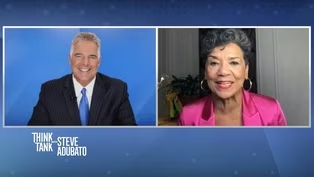
Sesame Street's Maria Shares Her New PBS Program, Alma's Way
Video has Closed Captions
Sesame Street's Maria Shares Her New PBS Program, Alma's Way (13m 45s)
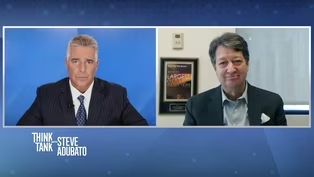
WNET Group CEO Discusses American Cities Rebuilding Series
Video has Closed Captions
WNET Group CEO Discusses American Cities Rebuilding Series (11m 56s)
Providing Support for PBS.org
Learn Moreabout PBS online sponsorship
- News and Public Affairs

Top journalists deliver compelling original analysis of the hour's headlines.

- News and Public Affairs

FRONTLINE is investigative journalism that questions, explains and changes our world.












Support for PBS provided by:
Think Tank with Steve Adubato is a local public television program presented by NJ PBS