Echoes of a Revolution
Ned Canty on the author of The Barber of Seville
Clip | 5mVideo has Closed Captions
Ned Canty explores Pierre-Augustin Caron de Beaumarchais's connection to the American Revolution.
The general director of Opera Memphis, Ned Canty, explains the fascinating connection between the clever protagonist Figaro and the man who carried out a clandestine plan to fund money and arms to the American rebels of the 1770s.
Problems playing video? | Closed Captioning Feedback
Problems playing video? | Closed Captioning Feedback
Echoes of a Revolution is a local public television program presented by WKNO
Echoes of a Revolution
Ned Canty on the author of The Barber of Seville
Clip | 5mVideo has Closed Captions
The general director of Opera Memphis, Ned Canty, explains the fascinating connection between the clever protagonist Figaro and the man who carried out a clandestine plan to fund money and arms to the American rebels of the 1770s.
Problems playing video? | Closed Captioning Feedback
How to Watch Echoes of a Revolution
Echoes of a Revolution is available to stream on pbs.org and the free PBS App, available on iPhone, Apple TV, Android TV, Android smartphones, Amazon Fire TV, Amazon Fire Tablet, Roku, Samsung Smart TV, LG TV, and Vizio.
[orchestral string music] - The Barber of Seville is one of my favorite operas.
So many people think of opera with, you know, people dying, you know, on the floor by the end of the show.
But so many of the best operas, so many of the ones with the best music, are comedies.
And this is one of those romantic comedies.
There were other versions of this play that were done.
The Rossini is the one that we all know, because it's the one that Bugs Bunny featured in his cartoons.
So this is the one that has won the test of time, whereas some of the others are just not as popular.
The character of Figaro, you know, his very first aria the, you know, Figaro, Figaro, Figaro, the, you know, la la la la, that one that everybody knows, in that aria what he says to introduce himself to everybody.
He says, I could do anything.
You want a wig?
Great.
I can do that.
I'm a barber.
That's easy.
I can also take care of your secret love affairs.
I can give you advice.
I can do some minor surgery.
Anything that you need done, I can do it.
And so Figaro is just this incredibly lovable character.
And part of the reason that Bugs Bunny was able to work so well with The Barber of Seville is that Bugs is kind of, Figaro.
He's the little guy punching up.
So, the opera was written by Rossini in the 19th century, but it is based on one of three Figaro plays that were written by Pierre-Augustin Caron de Beaumarchais, the French playwright, and the first of those plays that was premiered in 1775 was The Barber of Seville.
Beaumarchais is, the closest person I can compare him to is Ben Franklin.
In terms of someone who was just a polymath, who, you know, he was a watchmaker who figured out problems that allowed pocket watches to be a thing.
He was a musician.
He taught the daughters, taught music to the daughters of King Louis XV.
He was a spy.
So he was sent by the French king to England to burn these scurrilous pamphlets about Marie-Antoinette.
All of these things, that he got involved in.
And what's most relevant to our discussion today is that he was an arms runner.
And arguably, were it not for the fact that he went to bat for America in 1775, 1776 to the French government before they were willing to get involved in the war.
Had he not done that, there is a better than even chance that we would never have won the war, that we would have been a British colony for who knows how much longer.
So the French were very interested in what was happening with the American colonies, with these rebels.
And, Beaumarchais, because he was a storyteller more than anything, he was someone who was going to the French king, and he was telling all these stories about these brave Americans, these brave colonials.
They weren't even Americans yet.
These brave colonials who were fighting against the British, really pumping up their successes, trying to get the the French monarchy to buy into helping them.
And he was doing that in 1775.
Through 1776, he was still, he came up with a plan that would allow the French and Spanish governments to help the American rebels without actually coming out and saying they supported the war.
So he set up a holding company called Roderigue Hortalez and Company and he used that company to take in money from these, from the kings of France and Spain and use that money to buy gunpowder, munitions, clothing, uniforms, all of this stuff, and ship it to the colonies.
And in 1777, when we were on the retreat from the Battle of Saratoga, because we had literally run out of bullets, we were leaving.
Burgoyne was on the verge of winning.
As these soldiers are retreating, they run into a caravan of materials that have just been dropped off by Beaumarchais's ships, and they're able to resupply.
They get all of, new uniforms, they get new bullets, they get new munitions, gunpowder, all of it.
They're able to go back.
Burgoyne eventually has to surrender.
And it is this victory at the Battle of Saratoga that gives the French monarchy the courage to finally say, okay, we're going to get in.
We're going to officially support the rebels because they've shown that they can win if they're given the materials that they need to pursue the war properly.
You know, this is a comedy that is 200 years old, and yet we still do it over and over.
It makes us laugh.
It is still showing up, you know, not just in Bugs Bunny but it's showing up in Seinfeld.
It's showing up in The Simpsons, it's showing up on SpongeBob.
It shows up in more commercials than, you know, you could chuck a stick at.
So this music and the story, these characters, are eternal and they are as vibrant today as the characters in Hamilton are vibrant when you put them on stage.
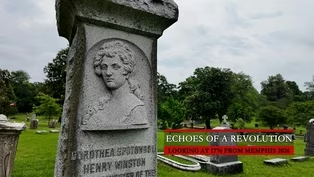
Revolutionary Residents of Elmwood Cemetary
Video has Closed Captions
Kim Bearden introduces us to a couple prominent Memphians with Revolutionary ties. (2m 21s)
 Now Playing
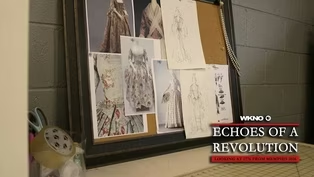
Ned Canty on the author of The Barber of Seville
Video has Closed Captions
Ned Canty explores Pierre-Augustin Caron de Beaumarchais's connection to the American Revolution. (5m)
Providing Support for PBS.org
Learn Moreabout PBS online sponsorship












Support for PBS provided by:
Echoes of a Revolution is a local public television program presented by WKNO