
Negro Spirituals: The Music That Helped Free Enslaved Africa
Clip: Season 50 Episode 26 | 6m 27sVideo has Closed Captions
Negro Spirituals: The Music That Helped Free Enslaved Africa | Episode 5026/Segment 1
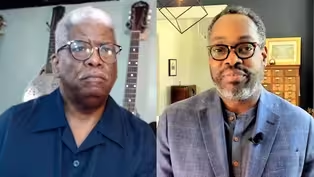
One of the largest and most significant forms of American folksongs, the Negro spiritual, has a long history in America, but how do these religious songs relate to the music heard in the Black church today? A look at the history of Negro spirituals and gospel music, and the influence these two genres have had on contemporary artists. Episode 5026/Segment 1
Problems playing video? | Closed Captioning Feedback
Problems playing video? | Closed Captioning Feedback
American Black Journal is a local public television program presented by Detroit PBS
Negro Spirituals: The Music That Helped Free Enslaved Africa
Clip: Season 50 Episode 26 | 6m 27sVideo has Closed Captions
One of the largest and most significant forms of American folksongs, the Negro spiritual, has a long history in America, but how do these religious songs relate to the music heard in the Black church today? A look at the history of Negro spirituals and gospel music, and the influence these two genres have had on contemporary artists. Episode 5026/Segment 1
Problems playing video? | Closed Captioning Feedback
Where to Watch American Black Journal
American Black Journal is available to stream on pbs.org and the PBS app.
Providing Support for PBS.org
Learn Moreabout PBS online sponsorship(relaxing piano music) ♪I will open up my heart ♪ (gentle piano music) ♪To everyone I see - Can you talk to me about the connection between gospel and the Negro spiritual?
- Yes, absolutely.
Gospel music, black gospel music is an offset of the Negro spiritual.
One of the main differences between the two, is that we are not exactly aware of the composers of Wade in the Water, or Joshua Fought the Battle of Jericho, or Didn't my Lord Deliver Daniel.
However, there are known composers of famous gospel songs, like, Oh Happy Day, Edwin Hawkins, or Total Praise, Richard Smallwood.
And so while there are certainly similarities between the two, there are certainly differences between, but both are certainly influential to the culture and the fabric of American music, and America in general.
- I feel like another connection between gospel and the Negro spiritual is the way it uplifted people, and kind of gave them hope.
Because I feel like a lot of people you know you feel hopeful when you hear gospel music, and Negro spirituals.
- Absolutely.
The Negro spiritual was so important to these enslaved Africans, who as scripture would foretell, were brought into the strange land, having been asked to sing a new song.
We understand that many of these enslaved Africans, came to the Americas with different dialects, different languages that they spoke.
Music has always been a universal language, and coded therein within these songs were messages, not only messages of hope, but messages that would lead these enslaved Africans to freedom.
Follow the Drinking Gourd, they were following the constellation.
Deep River My Home is Over Jordan, Jordan River scripturally is of course referring to in their context, the Mississippi.
It was their way to freedom.
If you think about jazz and blues, and certainly black gospel music, songs like Precious Lord, written by the father of gospel music Thomas Dorsey, were written to express the despair and the tragedy of having lost not only his wife and his child in a car accident, but it certainly expressed the hope of a savior, that would lead him through those troubling times.
(relaxing piano music) ♪ Precious lord ♪ Take my hand ♪ Lead me on, let me stand ♪ I am tired And so both of those genres, these truly black American genres, speak to both the reality of the situation, but also the hope of a present future.
- I know I've heard people say in the past that the music today is not the same, and it just is not as emotional as it has been in times past.
And when I think about a lot of the R and B artists today, not all of them come from a gospel background.
So when you compare to rhythm and blue singers of the past, most of them had their roots in the church, Aretha Franklin, Sam Cook, Otis Redding, those people, and then today, they just say it doesn't feel the same.
- So many of the legendary R and B and soul singers that you named, like Aretha Franklin, James Brown, Ray Charles, Anita Baker, and all of those, not only were they influenced by the sounds of gospel, but they were influenced by the preaching of the gospel too.
Aretha Franklin talks about how her father, the very legendary Reverend CEO Franklin, influenced the way that she's sang, by virtue of the way that he preached.
- [Rev.
Franklin] I believe that they have taken away my lord.
I believe the world is concerned about that.
- And so the cadence in his hoop.
You know influenced her soul efforts and her vocalism.
James Brown talks about the way that he moved across the stage.
And we talked about James Brown as the godfather of soul and certainly influencing the dancing of Michael Jackson and Chris Brown.
He learned those by just sitting around in church and watching the pastor move across the pool pit as they were getting to the height of their sermon.
And so if there's anything missing, it's not even so much then missing the sounds of the gospel singing.
They're just missing the entire lived experience of the communion, the theatricality sometimes, the performative aspects of black church.
There's nothing like black church folk getting together on a Sunday.
All of these genres from the blues to gospel to jazz are still heavily heavily utilizing elements of the Negro spiritual, which of course are connected to African culture and tradition.
The idea of the storyteller, the Griot in African American culture, this idea of community engagement within music.
The idea that music is going to be part of almost every great life event.
And that happens with gospel.
It happens with jazz.
It happens with rhythm and blues.
It happens later with rock and roll.
It happens of course, with hip hop and rap.
And I know that we try and steer clear of trying to make connections between the two, but there is no hip hop and rap without the Negro spiritual, without the storyteller, without the call and response.
There are certainly elements of hip hop and R and B that have, hip hop and rap and R and B that have found their way into gospel.
Video has Closed Captions
Clip: S50 Ep26 | 10m 11s | The Sacred and the Secular: How Gospel Music Grew from the Blues | Episode 5026/Segment 2 (10m 11s)
Providing Support for PBS.org
Learn Moreabout PBS online sponsorship New Episode
- News and Public Affairs

Top journalists deliver compelling original analysis of the hour's headlines.
 New Episode
- News and Public Affairs

Today's top journalists discuss Washington's current political events and public affairs.

 New Episode
 New Episode
 New Episode
 New Episode
 New Episode
 New Episode
 New Episode
 New Episode
Support for PBS provided by:
American Black Journal is a local public television program presented by Detroit PBS