
Neighborhoods Day/The Vanguard Artist Collective: Overture
Season 49 Episode 28 | 26m 46sVideo has Closed Captions
Neighborhoods Day/The Vanguard Artist Collective: Overture | Episode 4928
Arise Detroit is getting ready for its 15th annual neighborhoods day in august. We’ll get the details on this huge citywide event. Plus, four African American artists from Detroit come together for a first of its kind exhibition focusing on the Black experience. Episode 4928
Problems playing video? | Closed Captioning Feedback
Problems playing video? | Closed Captioning Feedback
American Black Journal is a local public television program presented by Detroit PBS
Neighborhoods Day/The Vanguard Artist Collective: Overture
Season 49 Episode 28 | 26m 46sVideo has Closed Captions
Arise Detroit is getting ready for its 15th annual neighborhoods day in august. We’ll get the details on this huge citywide event. Plus, four African American artists from Detroit come together for a first of its kind exhibition focusing on the Black experience. Episode 4928
Problems playing video? | Closed Captioning Feedback
How to Watch American Black Journal
American Black Journal is available to stream on pbs.org and the free PBS App, available on iPhone, Apple TV, Android TV, Android smartphones, Amazon Fire TV, Amazon Fire Tablet, Roku, Samsung Smart TV, and Vizio.
Providing Support for PBS.org
Learn Moreabout PBS online sponsorship♪♪ Coming up on "American Black Journal" we've got a really great show for you this week.
ARISE Detroit!
is getting ready for its 15th annual Neighborhoods Day in August.
We're gonna get the details on this huge city wide event, plus four African American artists from Detroit come together for a first of its kind exhibition that focuses on the black experience.
Stay where you are, you're not gonna wanna miss this.
American Black Journal is next.
Announcer 1: From Delta Faucets to Behr Paint, MASCO Corporation is proud to deliver products that enhance the way consumers all over the world experience and enjoy their living spaces.
MASCO, serving Michigan communities since 1929.
Announcer 2: Support also provided by the Cynthia & Edsel Ford Fund for Journalism at Detroit Public TV.
Announcer 1: The DTE Foundation proudly supports 50 years of American Black Journal in covering African American history, culture, and politics.
The DTE Foundation and American Black Journal partners in presenting African American perspectives about our communities and in our world.
Announcer 2: Also brought to you by AAA, Nissan Foundation, Ally, Inpact at Home, UAW Solidarity Forever, and viewers like you.
Thank you.
♪♪ Welcome to American Black Journal I'm Stephen Henderson your host.
And as always I'm glad you've joined us.
For the past 15 years the non-profit ARISE Detroit!
has mobilized 100s of groups and 1,000s of volunteers for a citywide event that's called "Neighborhoods Day", and it happens on the first Saturday of August each year.
Even in the midst of the pandemic, ARISE Detroit!
was able to keep this massive community service day alive by encouraging COVID safety precautions for all of the participants.
Here's a brief look at some of the annual activities followed by my conversation about this year's event with Executive Director, Luther Keith.
♪♪ Luther Keith, it is always great to see you this time of year as you get ready for Neighborhoods Day.
Welcome back to American Black Journal.
Well, it's great to be back Stephen.
We appreciate you coming back every year.
Yes.
To let us celebrate this great day for Detroit with 1000s of Detroit-ers all over the city.
Yeah, yeah.
So I wanna start with last year.
Hmm-mm.
Which was the 14th annual Neighborhoods Day, but maybe the most different of all of 'em because of the pandemic.
Give us a sense of how all that went.
You made so much effort and so many preparations to be able to have Neighborhoods Day even though there was a pandemic.
How did that all come together?
It definitely was the most challenging year because early in the year, you know we're talking about March, April as we start planning looking ahead to the future last year, and at one point and I remember telling somebody in the national media that we aren't gonna have a Neighborhoods Day here in Detroit, there's no way it's possible.
Then as we got into it, we thought about it.
We didn't want to be a canceled event because this day has come to mean so much to so many, and we even in the pandemic we were getting calls and offers saying, are you guys gonna have Neighborhood Day this year?
'Cause a lot of people look forward to this.
And we thought about it and our fiances were cut severely, I mean, whoo, down to 20% of what we might normally have.
So a lot of the materials and things that we provided groups, we didn't have money for.
But we thought about how could we do this?
So we thought about if we made people sure they observed the health mandates, if they social distance, if they masked up, took all the safety precautions, and if we scaled back on some of the things that we provided, we thought that we could do that.
And in a typical non-pandemic year, we would have over 200 events all over the city on Neighborhoods Day, in our 10th year we actually had over 300.
So a typical year we're gonna have more than 200 events, which is a lot.
Last year in the depths of the pandemic, we had over 100 groups across the city participating.
And this year we're going to have more than 100 again.
Of course the big game changer is this year that we have the vaccine.
So a lot of people are vaccinated.
We're encouraging all of our activities for the people to have their volunteers vaccinated.
Some groups in fact are saying they aren't going to accept volunteers unless they are vaccinated.
And of course if they aren't vaccinated, we want people to mask up and social distance.
But what's been so great Stephen is how the community has responded.
This is a unique day for Detroit and sometimes I don't think people appreciate what this day is for Detroit.
And if I can blow our own horn for a minute for my volunteers and their board members and my staff, I don't think there's another group outside of the City of Detroit that could organize over 100 events or mobilize all over the city on the same day (chuckles) that is not named the City of Detroit or Michigan State government.
Which is really a testament to how much people want this day to happen, how much they want to be part of it.
And so we are just thrilled.
I mean, I'm in the office today still getting calls, is it too late to register?
Is it too late to register?
Because people wanna be part of it.
So it's very uplifting and inspiring, in these troubled times Stephen, you so outlined the so eloquently on your radio show and on your TV show, we need something to feel good about in these times.
We have been through so much, we have lost loved ones, and we've had a hard way to go.
But I think the heart of Detroit still beats, it beats in all these neighborhoods that have gone through so much.
And if they didn't, there's no way we could do a Neighborhoods Day.
I think Neighborhoods Day is actually a great celebration of hope in this city all over.
Because people don't do this, like they don't have all these events that we're gonna have all over the city on August the seventh, and even beyond we have some even past on that day.
So again, it's been very challenging but we are gonna make it happen.
We have some great sponsors that have stepped forward this year to help provide the resources to the community groups.
And people are excited about it.
They're excited about it 'cause this year we're gonna be back with the beautiful banners that we could not afford last year, providing more T-shirts.
We've got support from our local hardware chain Hammer Time, True Value Hardware which has five hardware stores in Detroit east side and west side.
They stepped forward, so gonna be providing vouchers of a minimum $100 per organization that is the beautification or cleanup project.
Other things, Meyers and First Nation have stepped forward as our title sponsors.
And so it's all come together and it's a great thing to see and it makes you feel good to be apart of this community and people wanna be apart of it, they wanna help make a change.
And again, one thing I would emphasize very quickly, Neighborhoods Day is not about one day.
Right.
People do this stuff all year long with very little fan fair and I've come to use this, I've probably said this on your show Steve, but Neighborhoods Day is like, your loves you everyday of the year, they love you.
Steve, we love you, but on your birthday you get a chocolate cake.
(laughing) and Neighborhoods Day is a chocolate cake for all the neighborhoods in Detroit.
All the people who work all year doing great things, this is your chocolate cake day, and we want everyone to be apart of it.
Yeah, yeah.
So, I'm wondering this year, this will take place about a month after this awful storm.
Yeah.
That caused all the kinds of damage.
Yeah.
And in certain parts of town like the east side, I mean.
Right.
We haven't seen before.
Does that influence the ways in which you focus some of the resources of Neighborhood Day?
Well, certainly, that's one of the things I was thinking about today as a matter of fact, I was listening to a certain radio host talk about this on his show.
And I'm trying to think of a way quite frankly where we can get some resources to help some of these groups that have been hit hard by flooding, so anybody out there (chuckles) who is listening or viewing, there was a step forward like the Home Depot Foundation because people need things like water, heaters, and things like that.
And so this flooding really hit us by surprise, but certainly we will love to partner with any organization, foundation, and make these resources available to the community.
Well, so again, that's one of the great assets of ARISE Detroit!
'cause we have forged relationships with so many of these groups in all of the city, so we could actually be a direct connect to the people who need the resources and where the need is greatest.
Yeah.
So, for people who might not go participate in Neighborhoods Day, give us some of the highlights of.
Well, first of all, just go to our website, arisedetroit.org.
Our registration fee is only $25 this year.
Normally it's 50, and last year was 25 because of the pandemic, people are facing some challenges.
So it's really $25, and we've actually done the math, for $25, you're gonna get over $300 in resources when you add banners, and T-shirts and resources for children, and vouchers and things like that.
So simply go to our website, with is arisedetroit.org, you can register online very easily, pay by credit card, debit card, or even a cheque by July 15th which is the deadline.
Or give us a call here in the office, 313 921 1955, 313 921 1955.
The other great thing about this day, Steve, people go through our website at arisedetroit.org, you can see in real time right now, we have about 100 people registered right now, all of the event on the east side, all the events on the west side.
And once each that once volunteer is listed, so you can literally go online, find this (inaudible), call Sally Jones, say I see you want volunteers, we wanna come out and help you, so in real time you can directly connect with these community groups, and again ARISE Detroit!, I think this is a beautiful thing about Neighborhoods, we do not plan or organize these events, these are all events planned by the people who live in these neighborhoods who know what they need, who know what they're doing.
We're simply a connector if you will, in marketing of this to the community, but every person does their own thing, their own way and I have to tell people, people say, where is Neighborhoods Day?
Because they think it's like, everybody goes to Belle Isle or Crowne Plaza, no Neighborhoods Day is wherever you want it to be.
If you want it to be on your front porch, you can hold it on your front porch.
Or at a park or wherever, that's the beauty of Neighborhoods Day, you literally can drive all over the city to almost every zip code and see people doing things.
Health, there is parades, concerts, beautification projects, I like to emphasize that Neighborhoods Day is not just a cleanup day, like most city makeover, nothing against cleanup, a lot of that goes on because it's important but a lot of other things go on too, so we're gonna have school supply giveaways, food giveaways, we have an expungement fair, a lot of different quality of life issues, and then we're gonna have some peace marches 'cause there's a real concern about crime in our community.
We have some groups that are gonna be engaging in public safety things, so it's really today, a lot of great kids activities are gonna be happening.
So it's a service more of the best of Detroit, a service for the heart of Detroit.
So, Luther Keith, before we end, I just wanna say this is, it's such an incredible operation and to have accomplished all this and been doing it again 15 years in, it just blows my mind every year.
So kudos to you for the idea for Neighborhoods Day and for pulling it off as well as you do, and for surviving through the pandemic with this event and coming out the other end, it's.
Yeah, thank you.
And the true love should go to all the people in all the neighborhoods, I'm just happy to be an instrument to be able to do this and I'm blessed to be able to do it, I'm inspired to do it, and it's great to feel like in some small way, I can serve the community in the rise of Detroit, so I can serve the community and we're very blessed and happy to do so.
Four African American artists who live and work here in Detroit have united for a first of its kind exhibition at the Detroit Artist Market.
The show is called the "Vanguard Artist Collective: Overture" and it features the works of fine artists, Sydney James, Rashaun Rucker and Tylonn Sawyer and writer Scheherazade Washington Parrish.
This is the first time these four friends have put on an exhibition together, and I spoke with two of the artists about the collection of works, which focus on the black experience in America.
Scheherazade Washington Parrish and Tylonn Saywer, welcome to American Black Journal.
Thank you for having me.
Thank you.
Having us.
(chuckles) Yeah.
So I'll start with this is half of the collective that's put this exhibition together, and there are four of you, all artists living and working here in Detroit.
But tell us, you guys are friends, you've known each other a long time.
I wanna hear about the genesis of that friendship and how this whole thing comes together.
We all became friends in stages.
And me and Tylonn became friends first.
And it's odd that I don't quite remember when it happened, like I remember him being in rooms like even at the same table, and he remembers different moments where we were together but when it clicked, it was.
Yeah.
Forever ago.
Yeah.
Right.
Yeah.
So what I'm getting at here is that Detroit is a pretty small place in terms of the artist community, and people run into each other people, people rub elbows with each other and the idea that we're kind of all one community I think, is pretty easy to get at here, but there are lots of connections among artists in Detroit.
Right.
Yeah.
Yeah, most definitely, like, like I know like I was a writer and a poet, so I met Scheherazade in a poetry scene and then somehow like Sydney, I remember being at like an artist event and meeting Sydney, and then I needed a ride to another event (chuckles) and she gave that to me, and literally that's, we've been friends ever since.
And Rashaun knew me online and I met him outside the art store, and like ever since then just somehow, some way shape or form, we've all like connected and just been been friends first, and then everybody had their own individual sort of like artistic practice going on, but we were definitely like friends before we sort of like settled into an artistic collective.
I met Sydney at a birthday party.
And it was decided then that we were friends.
(laughing) Yeah.
Okay, so let's talk about this wonderful art exhibition you guys have put together, where did idea for that come from?
Well Jeff Cancelosi at the Detroit Artists Market, asked us about it maybe a little over a year ago, and we all had different things going on so like we're like, I think he asked about the actually before the pandemic, right, if I'm not mistaken.
And so once the pandemic happened, things had to be shifted around.
And so, just throughout the year like we all still work on like our individual projects but, because we are friends and we talk or chat every day, we just sort of like discuss like our work and our practice and like what it was gonna look like when it's finally decided to come together, and here we are.
(laughing) Like in this one exhibition.
And it's reflected both, not just the Detroit experience but the black experience.
Scheherazade talk about how important that is.
That's always an interesting question for me, and I always wanna say, right, it's as important as being black is.
Right.
And it is very difficult to wrap my head around like separating these experiences, right.
That is a thread that weaves us together is this black experience, this black in Detroit experience, this black in America experience, and so I, I don't think it could, it is as important as our lives here are.
Yeah.
So given that, how do you choose then what goes in the exhibition?
How do you choose the things that you wanna include and what you leave out?
Hmm.
(laughing) I'll say those pieces choose me, right, that's the easy way out.
No, you choose the pieces that because this is a group show, it's a collective presentation, you choose the pieces that speak to one another.
That have a conversation with themselves as well as the audience is what I would say.
Yeah.
And Tylonn, what about for you, choosing what goes in this exhibition?
What you wanna say about that?
Well, my work always interrogates what it means to be a black American and so I'm just coming off like a show where it's like different bodies of like different aspects of my work, we'll talk about the black experience in America and so just thinking about like conceptually, which one would compliment like my peers, like in this particular exhibition.
Like I would say like I think that my work and Scheherazade's work sort of like has a conversation and that we kind of talked about this idea of the monolith of blackness and so from my, like from my particular body of work, I was taking on sort of the concept of what I call black on black thoughtcrime, sort of when Black thought leaders and intellects sort of debate each other in this intellectual arena publicly, and thus it seems like there may be a schism in black unity because of that, and I know Scheherazade works dealing with redaction in the way that taking a piece of writing that somebody may have had and then like removing things to get to the core of it, which in this particular case I know was about the Hannah Black issue who was also a black woman.
Then when we looked at Sydney and Rashaun's work, Sydney's work is about the black woman experience, and Rashaun's work is about a black male experience and so thinking about this sort of like how those sorts of images that we create just kind of all work in tandem with one another and say that that's, just throughout our conversations, it just kind of naturally coalesces that way.
Yeah.
It's a really interesting time to be a black American, there's a lot of conversation (chuckles) that's going on, there are a lot of things that are happening that I don't think any of us might have predicted a year ago, two years ago.
(laughing) And I think that has an influence over art, it has an influence over art in every different artists space.
So I wonder for the two of you, what that effect has been.
And I guess, how it's changed your relationship with your art?
As we see the world kind of come a part a little bit around the idea of inequality, and a real push toward a really different set of conversations at least, if not yet solution, Scheherazade.
I can definitely say that these past couple of years have shown up in my work in the way that it is.
I use these pre existing works, pre existing text, and throw that like things are taken away, things are erased, you know blacked out and it's very much parallel to how my life has been in my house.
And this is the structure and I have to take away things to make time for art and add things to still being the mom, you know all these things.
And so lately, it mirrors, my actual life mirrors the process of my work.
Wow, wow.
Tylonn, how about you?
Well, my work is, like I said because it deals primarily with the intersection of politics, pop culture, race, individual and collective identity, just sort of like what's been happening and towards these national conversations.
It's almost like content overload, like in a way of like things to pull from that you could just like make a body of work from, because there's just so many facets, like from poverty to police brutality, towards black excellence, you know there's still positive things to constantly talk about as well.
But definitely like in the last year between 2020 and now, it's definitely been like just sort of the like a flood of like all of these issues maybe that we've been talking about throughout the years, just sort of like being dumped right like into our minds (chuckles) or like in our laps in a way.
And I found that, like for my word, it's important to kind of like sift through that and see if I can find something to really, really like hone in and interrogate it and be able to present that to the public in a cohesive way, in an emotional way.
So, this exhibition is at the Detroit Artists Market.
Talk about what you want people who come to see it to take away, what message from your work, and from the collectives, do you want to leave with people?
Scheherazade.
I want people to read my work.
And from that work, I want them to question it, I want them to question their place in it, how are they implicated.
And I want them to leave with thoughts of changing, whatever discomfort they may experience, that's gonna happen.
Yeah.
Yeah, you want people to be a little uncomfortable.
Absolutely.
Yeah.
Yes.
Okay.
If you can sit comfortably with the work, I would question that.
Wow, wow.
Yeah.
Tylonn, what about you?
For me, I would say I would, it is my hope that people come there like they pay attention to the work and its political implications and think about what it means to be black, and what really are issues and like how we can work together and compromise to like solve these particular problems rather than constantly debating each other publicly and picking apart things, but let's find like something that we have in common, a particular issue that we are capable of solving and then let's break that apart and dissect it and then like really, really like accomplish our goals.
My work is always thinking about us, like first black people within the world like as a whole.
But I'm a strong proponent that you need to take care of home first before you can take care of like anything else, and so that's where my work always starts from a black perspective and then goes outward from there.
By the way, you can check out this wonderful exhibit by the Vanguard Artists Collective through July 24 at the Detroit Artists Market.
(upbeat ambient music) That's gonna do it for us this week.
You can find out more, especially about our guests at americanblackjournal.org.
And as always, you can connect with us on Facebook and on Twitter.
We'll see you next time.
Announcer 1: From Delta Faucets to Behr Paint, MASCO Corporation is proud to deliver products that enhance the way consumers all over the world experience and enjoy their living spaces.
MASCO, serving Michigan communities since 1929.
Announcer 2: Support also provided by the Cynthia & Edsel Ford Fund for Journalism at Detroit Public TV.
Announcer 1: The DTE Foundation proudly supports 50 years of American Black Journal in covering African American history, culture and politics.
The DTE Foundation and American Black Journal partners in presenting African American perspectives about our communities and in our world.
Announcer 2: Also brought to you by AAA, Nissan Foundation, Ally, Inpact at Home, UAW Solidarity Forever, and viewers like you, thank you.
♪♪
Video has Closed Captions
Clip: S49 Ep28 | 10m 19s | Neighborhoods Day | Episode 4928 - Segment 1 (10m 19s)
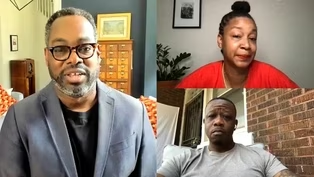
The Vanguard Artist Collective: Overture
Video has Closed Captions
Clip: S49 Ep28 | 11m 39s | The Vanguard Artist Collective: Overture | Episode 4928 - Segment 2 (11m 39s)
Providing Support for PBS.org
Learn Moreabout PBS online sponsorship
- News and Public Affairs

Top journalists deliver compelling original analysis of the hour's headlines.

- News and Public Affairs

FRONTLINE is investigative journalism that questions, explains and changes our world.












Support for PBS provided by:
American Black Journal is a local public television program presented by Detroit PBS