VPM News Focal Point
Neighbors | March 31, 2022
Season 1 Episode 6 | 26m 46sVideo has Closed Captions
Explore how Virginians help one another to build stronger communities.
A historic Black church serves and strengthens Richmond’s Jackson Ward community. Living organ donation changes minds and saves lives in Richmond. In a Dublin store, shopping with no money is no problem.
Problems playing video? | Closed Captioning Feedback
Problems playing video? | Closed Captioning Feedback
VPM News Focal Point is a local public television program presented by VPM
The Estate of Mrs. Ann Lee Saunders Brown & Dominion Energy
VPM News Focal Point
Neighbors | March 31, 2022
Season 1 Episode 6 | 26m 46sVideo has Closed Captions
A historic Black church serves and strengthens Richmond’s Jackson Ward community. Living organ donation changes minds and saves lives in Richmond. In a Dublin store, shopping with no money is no problem.
Problems playing video? | Closed Captioning Feedback
How to Watch VPM News Focal Point
VPM News Focal Point is available to stream on pbs.org and the free PBS App, available on iPhone, Apple TV, Android TV, Android smartphones, Amazon Fire TV, Amazon Fire Tablet, Roku, Samsung Smart TV, and Vizio.
Providing Support for PBS.org
Learn Moreabout PBS online sponsorshipANGIE MILES: How much is a person willing to sacrifice to save a life?
Living organ donors put themselves at risk to give life to loved ones or sometimes help strangers.
We'll share one inspiring story.
In our Black Church series, we'll meet Virginians on a spiritual mission giving heart and soul to help neighbors in need as their church has done for more than a century.
And we'll show you a store that needs no price tags because everything is the same price, free.
You're watching VPM News Focal Point.
Production funding for VPM News Focal Point is provided by Dominion Energy, dedicated to reliably delivering clean and renewable energy throughout Virginia Dominion Energy Actions Speak Louder The estate of Mrs. Ann Lee Saunders Brown and by ♪ ♪ ANGIE MILES: Thank you for joining us for VPM News Focal Point.
I'm Angie Miles.
If you think good fences make good neighbors, today we'll show you why Virginians with willing hearts and helping hands make even better neighbors.
First, a roundup of some top stories statewide.
In Richmond, the James River Association is planning a seven million dollar education center along Dock Street.
This is one part of a conservation project to give students and the public better access to the river.
In Chesapeake, veterans are getting a new healthcare center.
Construction begins this summer on a 200,000 square foot facility to provide primary and mental healthcare for current and former service members.
In Fairfax, the Northern Virginia Regional Commission has launched a campaign to collect coats, socks, and other necessities for Ukrainian refugees.
In the months since Russia's first attack, more than four million people have fled their native Ukraine.
We'd like to take a moment to celebrate our own VPM News journalists, who won top honors in the metro radio category of the Virginia Associated Press Broadcasters Awards.
Ben Paviour and Whittney Evans took first prize for their continuing coverage of marijuana legalization in Virginia.
First place for best sports feature went to Ian Stewart for coverage of Black Girls Hike RVA.
Megan Pauly, Sara McCloskey, and Crixell Matthews also earned second place awards for their series on student debt.
Congrats to all the winners.
ANGIE MILES: For most organ transplants, the donor and recipient must have the same blood type to prevent rejection of the organ.
But doctors at VCU Health Hume-Lee Transplant Center are among the first in the country to successfully perform a blood type incompatible liver transplant.
The transplant is giving a Henrico woman and her son more time together.
KEYRIS MANZANARES: In medical terms, Brenton Luper and his mother Karen Luper are incompatible, yet, through a rare procedure, Brenton was able to give his mom a piece of his liver as a live organ donor.
KAREN LUPER: We were not a match.
BRENTON LUPER: Yeah.
KAREN LUPER: Our blood types were not a match at all.
KEYRIS MANZANARES: To save Karen's life, the team at VCU Health Hume-Lee Transplant Center performed what's called an incompatible liver transplant for the first time.
KAREN LUPER: Every day I wake up, I'm so grateful.
I'm grateful for the life that my son gave me, I'm grateful for my doctors.
KEYRIS MANZANARES: Karen has lived with liver disease for over 20 years.
KAREN LUPER: You compensate, and you adjust your lifestyle to what you could do, and you managed it.
I mean, I worked full-time, and I was a single mother with two kids.
KEYRIS MANZANARES: According to Dr. David Bruno, one of Luper's doctors, the liver impacts almost every system in your body.
You can't live without one.
DAVID BRUNO: Your liver makes bile, so in some ways, your liver makes bile to help you digest fat, but also to excrete some waste products.
It makes everything in your body that helps you make a clot except for one factor.
KEYRIS MANZANARES: Brenton says when he was younger, he saw his mother suffering for decades, living with a life-threatening liver disease.
He says it made them closer.
BRENTON LUPER: You want to make sure you're there for each other and spend as much time together as you can, and I think it helps foster a little bit tighter of a bond sometimes, 'cause you don't know which trip to the hospital may be the last or something of that nature.
KEYRIS MANZANARES: Karen says she knew she'd need a liver transplant, but never imagined the life-saving organ would come from her son.
KAREN LUPER: It was like my son didn't even blink.
It was just, oh, absolutely.
KEYRIS MANZANARES: Since the Luper's were not a blood match, Karen and Brenton underwent weeks of preparation.
BRENTON LUPER: I mean, I feel like each week, it was a different test or drawing more blood or whatever it may be, so that they could increase the likelihood that her body would accept my liver.
KEYRIS MANZANARES: Brenton says he'd do it again in a heartbeat.
BRENTON LUPER: And this has really given us a lot more years with each other, and I don't think you can ask that much more from something.
KEYRIS MANZANARES: Dr. Bruno says the Luper's case is remarkable from a scientific perspective.
DAVID BRUNO: You could give non-identical compatible transplants.
If your donor is O, then that can go into anyone; O is a universal donor, and there are subtypes of A that you could give to anyone, A2 for instance, but they didn't have any of that, actually.
KEYRIS MANZANARES: Earlier this year, VCU Health received the largest donation for liver research in U.S. history: $104 million.
The money will be used to stop, treat, and prevent liver disease.
Dr. Bruno says the donation makes VCU an epicenter for liver research in the country and creates awareness.
DAVID BRUNO: I think it shines a light on the disease, and how, really, right now, this is our only choice at the end of the day, that if your liver fails, that you need a liver transplant.
KEYRIS MANZANARES: With the transplant, Karen's liver has regenerated, changing her life.
KAREN LUPER: I don't have to compensate for exhaustion, and I don't have to compensate.
I'm not worried about something's going to happen at any minute and I have to go spend a week at the hospital.
People really should consider being an organ donor.
It is an opportunity for them to give life to someone else.
KEYRIS MANZANARES: Karen says she'll never be able to thank Brenton enough.
KAREN LUPER: For a son to give his mother life is, it's a feeling that you can't express.
BRENTON LUPER: We both also like to constantly give back, and I think that's something that is one of the forefronts as far as a character trait that we both have is what can we do, not for ourselves, but for others.
KEYRIS MANZANARES: Reporting for VPM News Focal Point, I'm Keyris Manzanares.
ANGIE MILES: One in 10 Americans has some type of liver disease.
Dr. Bruno says the best way to prevent the disease is to drink and eat in moderation, exercise, and live a healthy lifestyle.
He also encourages people to sign up to be organ donors.
ANGIE MILES: Donate Life is the country's leading advocacy group for organ donation.
It's headquartered here in Richmond.
April is National Donate Life Month.
Joining us in the studio today is Lara Malbon, head of Donate Life Virginia.
Thanks for being here Lara.
LARA MALBON: Thank you for having me.
ANGIE MILES: I was speaking with a father recently, an organ recipient, who said it's hard to express the good that a person can do by checking a box.
Can you talk about the power of organ donation?
LARA MALBON: We all have the potential to save lives.
One person can save up to eight lives and heal 75 others by checking a box at the DMV.
So we encourage people the next time they are at the DMV, when they see that they can register to become an organ, eye and tissue donor, that they do check the box.
But you just don't have to do it at the DMV, you can also do it online at donatelifevirginia.org or if you have an iPhone you can open up your health app and register there.
ANGIE MILES: Okay, so DMV, online and on your phone.
Okay, now we just saw a story about a living organ donation.
That's helped a a mother and son to have more time together.
What's the difference between signing up by checking that box and being a living organ donor.
LARA MALBON: So when you sign up at the DMV you're registering to become a deceased donor.
But right now there are 2,600 people waiting for that lifesaving organ transplant in Virginia.
So another way to save lives is to become a living donor.
Where you can donate one of your kidneys or a part of your liver.
ANGIE MILES: Okay, we have two kidneys, donate one, two people get to live a long healthy life right?
And then with the liver, which regenerates very easily, it's just a portion of the liver that's taken.
And, and then in two people, the liver regenerates again, right?
LARA MALBON: Correct, correct.
ANGIE MILES: Okay.
LARA MALBON: And you have the potential to save lives by doing that.
ANGIE MILES: Okay, it seems that the pandemic may have made it a little bit more difficult for people to be involved in this way to become organ donors.
But hopefully we're seeing the light at the end of the pandemic tunnel.
Are you anticipating that we may see more people step up then.
LARA MALBON: We hope it's something that people will consider and if anyone is thinking about it we really encourage them to contact their local transplant center.
And from there, they will begin the process of answering all of their questions and part of that will be a full physical evaluation as well as a mental evaluation.
ANGIE MILES: Okay, because there are some requirements and there are some risks involved with being a living donor.
LARA MALBON: Yeah, there are some risks.
It is a surgery, but we encourage you to talk about that with your transplant center because it can answer all questions about it.
ANGIE MILES: But you have to be at least 18, right?
LARA MALBON: At least 18.
ANGIE MILES: And in good health LARA MALBON: And in good health.
ANGIE MILES: Okay.
Thank you so much, Lara, for being with us to share this life-saving information.
Donating an organ is an act of caring and while there are many to show kindness to others it seems some people are more motivated than others.
When it comes to acts of kindness.
Why is that?
Keyris Manzanares addresses the question in our people of Virginia segment, Keyris.
KEYRIS MANZANARES: Thanks Angie.
We asked each person the same question.
What motivates some people to want to help others?
Here are some of their responses.
DEMONTE TAYLOR: People that actually see what's going on and what's happening and get by now, if it doesn't impact them, then they don't understand the severity or how important it is to actually get involved.
EDDIE GUNNEAU: Having a good neighbor just to go and talk to is really important, especially around this area.
feeding meals, and just, companionship.
STEPHANIE RASINSKI: I think people don't get involved because they feel like they aren't part of a community?
That they don't feel like they're welcome.
OTTIS WILKINS: Because you can improve on a community.
It takes communication.
It takes effort.
And if we don't do it, the communities continue to erode.
And that's what we're trying to prevent.
KEYRIS MANZANARES: What motivates you to help other people?
We invite you to share your thoughts on our website at vpm.org/focalpoint.
ANGIE MILES: The living legacy of Black churches in America is cemented on service.
A rich heritage reflected in Virginia's Black congregations today.
A recent survey found 55% of Black Americans say it's essential that Black churches help people with bills, housing, and food in addition to serving as houses of worship.
After 155 years, Sixth Mount Zion Baptist Church in Richmond's historic Jackson Ward still strives to meet the spiritual and physical needs of its community.
In part two of our series on Black Churches in Virginia our editorial producer Samantha Willis introduces us to the people powering this house of faith in its labors of love.
(vehicles whooshing) REV.
DWYLENE BUTLER: We are in the A.W.
Brown Fellowship Hall at Sixth Mount Zion Baptist Church.
It is named after our third pastor, and this is also the place where we host our weekly food pantry.
(metal clanging) The food pantry for us is one of those things where we feel like if we can help them meet basic needs, then they can focus on something else.
And so, one of the things that we at Sixth Mount Zion believe is we are partners with others in the community so we can't do this on our own.
We are grateful for partners like Feed More that donate so that we can donate.
(engine buzzing) We get fresh fruit, fresh vegetables, fresh meat and bakery items, and we give them away to those in the community who come.
REV.
TYRONE NELSON: Most of the people that we serve, 97, 98, 99% of them, are not members of our church.
These are people who just connected and they just know that that big brick church, they try to help people, look out for 'em.
(plastic rustling) KEITH CALEB: Somebody's going to enjoy the contents that we put in here, so we try to make sure we pick the best apples.
If things are rotted or damaged, we set 'em to the side.
So we try to pick the best produce stuff that we would eat ourselves and it just represents a blessing.
This is the best we could put together for you.
I can't imagine spending my Friday any other way.
Just to see the faces and see the feedback from the community.
It's a greater reward than any amount of money that I've ever made in my life.
DORISHA SANDFORD: My favorite part is to see everybody, everything coming together, and then as our friends come to the door, we can pass it on to them, which is a blessing for all of us that God has blessed us to have something to eat today.
And then they can go home to their loved ones and share.
(bags rustling) [Volunteer] Hello, how you doing?
[Visitor] Thank you.
Thank you.
[Volunteer] You're welcome.
REV.
TYRONE NELSON: So many people will come, we'll give 'em a bag of groceries, then they'll pull me to the side and be like, "I got surgery next week.
Can you pray for me?"
Or, "I've been going through some stuff."
And so they look at us as like community pastors.
So you're not going to get to somebody if they're hungry, if they don't have anywhere to stay, so you got to start with the human need part of it first.
(wheels roaring) KEITH CALEB: Being of service is bigger.
Getting outside of yourself is bigger.
Fellowship, I get to know Miss Gloria, I get to know everybody here, everybody has a story.
We find out connections, and then we all get to serve and connect with the people that come.
So today is not just about the bag, it's about community, it's about fellowship, and it's about being a blessing.
(vehicles whooshing) BENJAMIN ROSS: Sixth Mount Zion was organized on September 3rd, 1867, by the Reverend John Jasper, an extremely popular and celebrated preacher here in Richmond.
Started out with just 10 members, but as time went on and as Jasper's fame grew, we were well over 3,000 members at the dawn of the 20th century.
We've had a lot of things happen at Sixth Mount Zion over the years, certainly surviving the highway story.
Well in the mid-1950s, Interstate 95 was being constructed and it came through downtown Richmond, and specifically through the historic Jackson Ward neighborhood, an African American neighborhood.
Hundreds of homes were destroyed to make way for the highway and Sixth Mount Zion was to be destroyed 'cause we were in the path of the highway.
Three alternatives were offered to the church.
One, tear the church down and let the highway come through.
Two, move the church out of the way so that the highway can come through.
And then three, leave the church alone and swing the highway around the church, primarily based on the John Jasper legacy and what that legacy meant to the state of Virginia.
Well, of course, that third alternative did prevail and the church was not demolished, the highway does swing around the church.
And needless to say, I would imagine thousands of motorists who use Interstate 95 and 64 see the church as they travel up and down Richmond.
I jokingly call our church the Gibraltar of Jackson Ward.
REV.
TYRONE NELSON: We have somewhere between five, 600 active members.
We did before the pandemic, so we'll see where we shake out, once we come back.
We've been completely virtual since the second Sunday in March of 2020.
It's been difficult.
Churches weren't created to be empty, they were created to have people.
REV.
DWYLENE BUTLER: We were not live streaming before.
We had to make that adjustment, which was a steep learning curve.
>>I think it sounds pretty good.
>>All right, thank you.
REV.
DWYLENE BUTLER: There were costs associated with it, but we had to do it in order to continue to stay connected with our congregation.
REV.
TYRONE NELSON: Good morning, my brothers and my sisters, we thank you for being a part of our worship experience this morning.
REV.
TYRONE NELSON: I had a different mindset.
And my mindset was if our people wanted to know what was going on here, they had to be here.
But now I know that we minimized the exposure.
So we have people, one of our member's father, he's watching from Kansas City, you know?
So we got people who are watching from all over the place.
We don't see things like we should when we're not spiritually connected.
When you are open to the technology part of it, you allow people to tap into your world and your space when they may not have initially.
Come on, church family.
♪ Won't you put your hands together ♪ ♪ As we sing about His ways REV.
DWYLENE BUTLER: I think it will be crucial for churches, this church and every church, to understand that we now have different ways of connection.
All of them are important.
What we have come to understand is the church is full of all of us and we are going to have to navigate how we can stay connected in meaningful ways that are new and creative and different than what we did before.
♪ Was the blood for me Come on, help me sing- REV.
DWYLENE BUTLER: Once the pandemic is in the past, and we don't know when that will be, it will be crucial that we rebuild our congregation from the ground up.
Ministries that we might have had before, we may not have them anymore.
Ministries we didn't have before, we will need them now.
REV.
TYRONE NELSON: Listen, I love you.
I miss you.
I can't wait until we can be here together.
I think- REV.
DWYLENE BUTLER: We believe that it is crucial for us to get people to understand that everything that we do can be part of our witness for God.
We can't tell somebody, "Go ahead and get saved," while they're hungry, so we have to make sure that before we can save them, we serve them.
REV.
TYRONE NELSON: You want 'em to hear you, then make sure they got some food in their belly or they got a roof over their head or some clothes on their back, and then you can move the other things.
So to me, it's all about the relationships.
The relationships are what make community anyway.
I don't care whether it's in the church or outside of church, it's all about people bonding off of shared experiences.
DORISHA SANDFORD: They don't judge you.
They don't look at you funny when you come to get your groceries.
And then sometimes if you're just there to get groceries, they also ask you what else you need help with.
So they'll let you know that they're very concerned.
We're here to give groceries out today but we can also ask them, "What else do they need help with?"
Most places like, "Okay, show up at 9:00 a.m. to 12.
"We're giving out groceries and that's it."
And then they go on home.
Sixth Mount Zion, they do more than that.
(bag rustling) All right.
DIANE JOHNSON: They're lifting us spiritually, they're motivating us.
But not only that, when I tell them that they throw it back at me to make me feel good about myself, because I know a lot of times, and this happens a lot when you go to an agency for assistance and they make you feel real low.
These places like this, they have such a wonderful spirit that they make you feel wonderful about coming.
They're guardian angels, they really are.
(bags rustling) REV.
TYRONE NELSON: One thing that I wanted to make sure of when I came here, when I left, that people would know when they see this church that it's a community's church.
ANGIE MILES: As many as 28% of those living near Sixth Mount Zion struggle with food insecurity.
That's according to the nonprofit FeedVA.
Learn how you can help the church in its mission by visiting their website.
Sixth Mount Zion continues its ministry both virtually and now in person as well.
ANGIE MILES: In a small corner of Southwest Virginia there's a group of people who ask themselves what they could do for others, and their answer has become a bright light in a little town.
It's the Pulaski County Free Store.
We invite you to stroll with us to downtown Dublin right now.
(squeaky sign swaying) TERRY RATCLIFFE: Everything here is free, we give it all away.
There's a lot of people in the community that need help.
There's some that's ashamed to ask.
There's a lot of people that don't want to be seen and they'll show up when we're not here.
SABRINA DAVIDSON-RATCLIFFE: My daughter and I took a trip to New York City and saw a little elderly lady laying on the sidewalk.
Homeless, obviously, it just broke my heart because that was somebody's mother, grandmother, friend, coworker.
And I knew at that time that something needed to be done.
And I promised her that I would do something.
TERRY RATCLIFFE: And that's what started it all.
We opened in a storage unit.
We were there for two months and we'd average about 30 people a day.
Well we outgrew it.
We had no bathrooms, no lights or anything, no heat.
And it was getting wintertime, so we bought this.
We're averaging between 130 and 150 families in three hours every Sunday.
HAZEL WINES: There's a really high rate of poverty in Pulaski County and a lot of Southwest Virginia.
And it's really common for a lot of places that do offer help, to do a lot of means testing and put other barriers in between people and help.
And we wanted to remove as many of those barriers and just be a place where people could help each other.
It's not just food, it's not just clothes.
It's about living in a house that you feel happy about.
So we make sure we have toys and decorations and everybody deserves to live a life of dignity and we want to help provide that.
SABRINA DAVIDSON-RATCLIFFE: There's so much stuff.
People don't realize it, and they just keep purchasing more and more and more and more and more without realizing that there's already enough here.
There's also people that are in dire need of these articles.
And it's just to help them have some dignity to come in here and just be able to shop like a normal store and not have this embarrassment where they have to prove that they are in need of something, that they have to show their proof of income or their whatever.
It's to just say, "Hey, everybody's welcome.
Come in here, get what you need."
And that's it.
TERRY RATCLIFFE: The refrigerator is open 24/7.
We come by every day and put something in there.
And the community does too, it's not just us.
If it wasn't for them, we couldn't have it either.
There's a lot of people that, in the community that doesn't have anything, or if they get something out of here to eat, then that gives 'em a little more money to buy what they need.
HAZEL WINES: And we're really interested in teaching our community how to take care of each other.
We think there's a lot of individualist push in our society and we've forgotten how to care for each other.
So it's less of a charity and more of a mutual aid hub.
MELINDA WILLIAMS: It's helpful because a lot of people around here may not have the money to buy the essential stuff and they can come here and get the essentials without having to pay for it.
'Cause it's like we said, it's absolutely free GARY WILLIAMS: The things that's hard to find in the store.
Maybe things you've needed and can't really afford.
You might find it here and things you don't need, you can always bring it and donate it for somebody else that might need it.
MELINDA WILLIAMS: And it keeps everything out of the landfill.
It's usable stuff, it's really nice.
I love it.
HAZEL WINES: We're really proud of what we're doing here.
And we don't just want to do this for Pulaski County and we want to teach other people how to start mutual aid hubs in their community.
We want to spread what we're doing.
We want to see other people take care of their communities too.
ANGIE MILES: Free Store founders welcome monetary donations because the nonprofit pays out of pocket to keep the doors open.
Thanks for being with us for this edition of VPM News Focal Point.
We always welcome your feedback and story ideas and invite you to read more about today's topics on our website, vpm.org/focalpoint.
We'll see you next time.
Production funding for VPM News Focal Point is provided by Dominion Energy, dedicated to reliably delivering clean and renewable energy throughout Virginia Dominion Energy Actions Speak Louder The estate of Mrs. Ann Lee Saunders Brown and by ♪ ♪ ♪ ♪
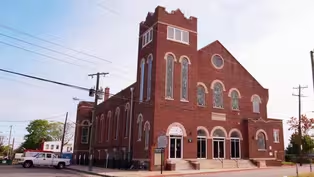
The “Gibraltar of Jackson Ward”
Video has Closed Captions
Clip: S1 Ep6 | 8m 18s | Meet the people powering Sixth Mount Zion Baptist Church, the “Gibraltar of Jackson Ward.” (8m 18s)
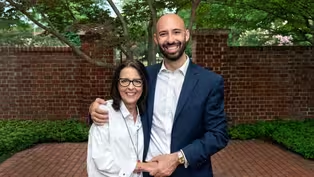
Henrico woman saved by a piece of her son’s liver
Video has Closed Captions
Clip: S1 Ep6 | 4m 17s | This rare liver transplant surgery at VCU Health saved a mother's life. (4m 17s)
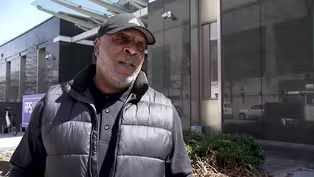
Neighbors | People of Virginia
Video has Closed Captions
Clip: S1 Ep6 | 43s | Virginians share they think some people help others, and why some don't. (43s)
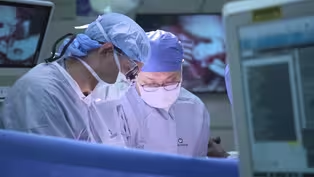
Organ donation saves lives, here's how to sign up
Video has Closed Captions
Clip: S1 Ep6 | 2m 52s | One organ donor can save eight lives and heal 75 others. Here's how you can register. (2m 52s)
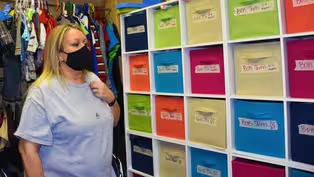
The shopping spree that’s always free
Video has Closed Captions
Clip: S1 Ep6 | 3m 33s | An unusual Virginia store invites neighbors to shop for what they need... and pay nothing. (3m 33s)
Providing Support for PBS.org
Learn Moreabout PBS online sponsorship
- News and Public Affairs

Top journalists deliver compelling original analysis of the hour's headlines.

- News and Public Affairs

FRONTLINE is investigative journalism that questions, explains and changes our world.












Support for PBS provided by:
VPM News Focal Point is a local public television program presented by VPM
The Estate of Mrs. Ann Lee Saunders Brown & Dominion Energy