RTP180
Neuroscience | September 2022
9/23/2022 | 58m 59sVideo has Closed Captions
Discussing neural development, Alzheimer's disease, the central nervous system and more.
RTP180 highlights neuroscience research in their October 2022 meetup. Local experts join to share regarding neural development, Alzheimer’s disease, the central nervous system and more.
Problems playing video? | Closed Captioning Feedback
Problems playing video? | Closed Captioning Feedback
RTP180 is a local public television program presented by PBS NC
RTP180
Neuroscience | September 2022
9/23/2022 | 58m 59sVideo has Closed Captions
RTP180 highlights neuroscience research in their October 2022 meetup. Local experts join to share regarding neural development, Alzheimer’s disease, the central nervous system and more.
Problems playing video? | Closed Captioning Feedback
How to Watch RTP180
RTP180 is available to stream on pbs.org and the free PBS App, available on iPhone, Apple TV, Android TV, Android smartphones, Amazon Fire TV, Amazon Fire Tablet, Roku, Samsung Smart TV, and Vizio.
Providing Support for PBS.org
Learn Moreabout PBS online sponsorship- [Announcer] We stand on the threshold of a great new age of exploration.
It's ultimate destination, the furthest reaches of the universe.
- [Robotic Announcer] Three, two, one.
[upbeat music] ♪ - Good evening, everyone.
Good evening, good evening.
How are we doing?
[audience chattering] Good to see you all welcome to the Frontier.
Welcome to RTP180.
I know we're excited because this event has been at capacity for a while.
And some last minute tickets opened up and then we were sold out again and then some tickets opened up and we were sold out again.
So it's great to see you all.
So my name is Andrea Cash, as it says up there, I am your guest host tonight.
I own Andrea Cash Creative in Durham.
I help small businesses and non-profits in the triangle with communications and marketing, and I'm happy to be your fill-in host.
Wade Minter, your regular host is traveling.
So we wanna say safe travels to Wade and you'll see him again next month for RTP180.
I wanna thank RTI International on behalf of everyone here at the Frontier.
Yes, they are our presenting sponsor.
They make all of this possible.
We are so grateful for that.
A quick show of hands, is this anyone's first time at RTP180?
Nice.
Love to see that, welcome.
So let me tell you a little bit about how this works.
We have four speakers tonight.
They are each gonna get about five minutes to come up and present.
And we really try to stick with five minutes just because we want to allow time for Q&A.
We wanna allow time for you to ask your questions.
So following the five minute presentations per speaker, there is an immediate Q&A with that speaker.
And how that works is you raise your hand.
I run around and hand you the microphone so you can ask your question.
And then there's a prize for that, everyone who asks a question gets a cool pint glass.
So if there's something in it for you, be thinking of your questions.
I want to encourage you to connect with us on social media, tweet or it didn't happen.
So share our speakers wisdom for the greater good.
The hashtag is RTP180 and also be sure to tag us.
Our handle is frontiertp.
And I wanna remind you that the Frontier has been a home for creative freelancers and startups and stem professionals and emerging companies since 2015.
This multi-building campus offers free co-working and meeting rooms, encouraging collaboration as well as private offices and wet lab space where entrepreneurs and startups can grow.
In addition to the everyday co-working activities, the Frontier host special events like this one, happy hours, yoga, tons of pop-up events.
So you wanna be sure to check out the full calendar at rtp.org.
The mission of course is to make the Frontier a community rather than just a place where people come to work.
So we're gonna get to RTP180, if everyone's ready.
Yeah.
[audience cheering] Neuroscience on deck.
So he is an associate professor of chemical and biomolecular engineering at NC State University.
His group engineers cellular and molecular platforms to understand how information is stored and accessed in biological systems.
Please welcome our first speaker, Dr. Albert Keung.
[audience applauding] - All right, thanks everybody.
It's great to be here.
So I'm gonna start with a decidedly non-science story that often pops into my head actually, when I'm thinking about a new project.
So about 10 years ago, I was doing a post-doc up in Boston, actually where my parents still live.
Was having dinner with my parents and my mom had just made really delicious dish, it's kind of eggs, eggs hard boiled in a soy sauce based broth.
And she was recounting, she was saying, "Oh, this is your dad's favorite dish."
And I looked at my dad and he looked at us a little sheepishly and said, "Maybe after 30 years of marriage, I can say this, "but I don't really like eggs."
[audience laughing] And my mom was like, "What?
"But you always eat it so quickly for like, "from the first time I made it for you until now "you always eat it really, really fast."
He's like, "Well, I mean, the first time made it for me, "we were dating and I wanted you to keep dating me.
"And then after that, you know when somebody you love "makes you something to eat, you eat it."
So anyways, it's not science related, except that it pops into my head a lot because observation is really useful and important in science.
But we can run into some quandaries with correlation.
Basically in this case, my dad always ate these eggs really, really fast, but you can come up with several different conclusions from that.
or interpretations.
One is that he really likes the eggs or another interpretation is he really loves my mom.
So this gets me thinking a lot about approaches in our group because the human brain is super complex and it's very hard to study.
We can observe it in postmortem tissue.
After somebody dies, you can the brain and slice it up, image it, study the anatomy.
There are some really advanced noninvasive methods to image and study the brain now.
And those have given us tremendous insight and continue to be super important.
But it'd be really nice if we also had a complimentary method where you could experiment, perturb, modify and see how parts of the brain responds in a molecular and cellular level.
So that's what I'm gonna tell you about today.
Kind of a new model that I think will be complimentary to a lot of the really advanced imaging techniques that we have today.
So you can take cells, skin cells, or blood cells from adults person, and you can reprogram them into something called stem cells.
And you can use what we call reprogramming factors, to do this.
And these stem cells can then make those little tissues over there called human cerebral organoids.
And I put a little penny there to give you some sense of scale.
So they're usually a few millimeters in diameter.
Now, what are great about these are that they're pretty easy to make in the lab.
You can generate them from adult people with different types of diseases, different backgrounds, and genotypes, and they contain, if you slice them open and zoom in and stain different cells with different colors, you can see that they have a lot of different cell types, over tens of different types of neurons, astrocytes, progenitor cells.
And they can form some polarized types structures as well, that are reminiscent of the types of structures that you see in the brain.
The other advantages are that they don't think.
They're not making neural connections at the level that it would be concerning ethically.
And so you can really use these models as experimental systems, to perturb and study how they react.
So I'm just gonna give you a few different examples of different types of perturbations that you can do with these and what you can learn from them.
So actually this is a project that an undergraduate and a PhD student in the group collaborated on and the undergrad really liked mechanical things.
And so she asked, well, what happens, are your brain cells and tissues sensitive to mechanical perturbations?
Oftentimes when you think about biology, we think about soluble factors and things floating in solution, but we're physical creatures and we experience forces.
And so she created these micro wells out of these hydrogels and then she and Delara forced these organoids to grow inside of them in different shapes.
And what they actually found was that if you grow them in shapes that have more constraints, more kind of points of indentation and strain, these organoids will have cells in them that are biased towards turning into one type of neuron over a different type of neuron.
Another graduate student was interested in substance abuse disorder, addiction.
And so he asked, well, could these organoid models tell us, or at least recapitulate some properties of addiction that we know exist in rodent models, for example.
And so what he did here was he took some organoids, he exposed them to dopamine, which is the neurotransmitter that is regulated by cocaine predominantly.
And he had exposed one batch of organoids to an acute dose.
So one single dose of dopamine, and he saw several hundred different genes turn up and down on basically, change in their levels in these organoids.
And then he also exposed a different set of organoids to dopamine, but in a repeated fashion chronically over a week.
And what he found was that if you do it chronically the number of genes that respond to dopamine decrease.
this is called gene desensitization.
And it actually kind of mirrors in a kind of macro scale level, what you might expect to see in a model of addiction.
If you continue to take a drug of abuse, then you might see your response to it decrease over time.
And then the last example I give you is you can create organoids out of cells from people with different types of diseases or disorders.
So our lab is particularly interested in a neurodevelopmental disorder called Angelman syndrome.
And it occurs in about one in 15,000 children.
And in that disorder, UBE3A is a protein that's lost in neurons in the brain.
And so you can see that on the top left where the red staining is very dim.
Over at UNC Chapel Hill several years ago, they actually discovered some chemical compounds that could turn up that level of the protein is called Indotecan can here on the bottom.
And so we asked, could these organoids be used to screen or test potential therapeutics?
Things that could turn back up this gene that's lost in kids with Angelmen.
And indeed you can see that when you add this chemical compound, you can see this rescue in the level of this protein.
The neurons in these organoids are also electrophysiological active.
So they're firing action potentials.
And in patients with Angelmen, these are hyperactive.
You can see a lot of, it's kind of like an EKG signal if you guys are familiar with that.
So you can see a lot of hyper active spiking and these types of neurons in these organoids.
And if you add this chemical compound you can basically calm that down.
So to kind of bring this back 180, the human brain is very challenging to study.
I think what we really need is we need all of those powerful imaging and noninvasive techniques, and we need to continue advancing those.
And it'll be really nice if we have these complimentary models that we can also probe at the molecular and cellular level.
And with that, thank you for your time.
Happy to take any questions.
[audience applauding] - Question.
I see a hand right here.
- [Questioner 1] You talked about the chronic effect of the, I guess the more it's exposed to something, the less effect it has.
Can you talk about how that plays into changing habits?
If you think about from a pain perspective, there's tens machines that send electrical signals to the brain to kind of overwhelm the brain so it doesn't think about the pain anymore.
How does that relate to changing habits?
- Yeah.
So in this case, we were specifically looking at organoids that kind of model the reward center.
So the striatal areas of the brain.
And what happens in the case of cocaine for example, is that you basically get too much dopamine and the cells have certain transcript, certain kind of gene responses that they'll have in response to normal levels dopamine.
But if you have too much dopamine due to cocaine, those responses get tamped down over time.
And so you need more dopamine or more cocaine in order to get that same level of response.
So that's part of the addictive aspect of it, but fundamentally you're actually changing kind of the threshold at which your neurons are responding.
And that's, I think a major problem underlying kind of molecular cellular mechanism, underlying substance abuse.
- See a question right here.
- [Questioner 2] So I heard you say that there were, the samples you're taking for stem cells do not form the neural connections.
So I'm wondering if you have been attempting to sample the brain cells and grial cells.
I don't know if your research is moving in that direction or these are, how are you mimicking the brain part of activity in your research?
- Yeah, so there's ethical considerations that we have to have.
So we think about that a lot.
And how far do we want to advance these models.
So there's work where, including in our group, where we're interested in fusing organoids, that kind of mimic different parts of the brain to try to understand those connections and how they interact.
And so, you'll often see maybe like one to three levels of neurons kind of connecting, but these things have a million, 10 million cells, the human brain has a hundred billion.
So over three orders of magnitude difference.
So we can't ever recapitulate the complexity of the human brain.
But we can start to, I think what we can use these things for is to study kind of levels of one, two, three connections, neural connections, but not the level that really you need to study like true behavior.
So there's definitely limits to what you can do with this.
- I see two questions.
We'll get to you both.
First one right here.
- [Questioner 3] Yeah, so in the case of addiction, different brain regions are differentiate impacted by drugs of abuse.
So do you have the ability to differentiate these stem cells into neurons that would be present in different brain regions?
- Yeah, yeah.
So there are different types of organoids.
So you can make four brain organoids, mid-brain, high brain, dorsal, ventral like organoids, so you can do that.
The other thing you can do with a lot of the upcoming recent Omix technology is that you can actually study, you can take these organoids and they contain about 30 different types of neurons, actually in them, many different sub types of neurons.
And there are methods where you can study the gene expression of individual cells, and you can do that for hundreds of thousands of cells.
And so we actually have, we've done that with cocaine, with morphine, with a few other compounds to study how individual different subtypes of neurons respond differently to drugs of abuse.
- Last question right here in the front.
- [Questioner 4] Hello, so I'm curious if you've studied brain development, considering the work that you were talking about regarding the organoids and how physical stress can change differentiation alongside say, using some chemicals, has your lab done work on brain development and using organoids differentiation in comparison to brain development, or are the two subjects just to different to study by comparison?
- Actually, that's a great question 'cause development is actually, neurodevelopment is probably the best aspect of human biology that these models model, can capture.
Because they tend to capture earlier stages of development rather than adult.
So a lot of the addiction work that we're doing, it's hard to translate that directly because they're not as mature neurons as they're in the adult brain.
So the neurodevelopmental aspect is really key and people have done things where they've compared like the characteristics of these cells with early neurodevelopment in humans.
And they've found a lot of similarities basically.
And one of the useful things that we found is with Angelman syndrome, one of the key questions in that disorder is when do you need to treat the kids?
So if we develop a therapy, when, is treating them at one years old enough?
Sometimes we don't diagnose children early enough to be able to treat that early.
So one of the things that these organoids showed us was when this protein that is lost is actually lost.
And at what point can we reactivate it?
So we actually use these models to figure out kind of that therapeutic time window at which the therapeutic treatment might have the most impact.
So definitely neurodevelopment is important, yeah.
- Thank you so much, Dr. Albert Keung.
- Thank you.
[audience applauding] - Great job.
Good job.
Okay, let's get to our next speaker.
She is a professor of medicine and the director of the Duke Center for the Study of Aging and Human Development, AKA the Duke Aging Center.
She's also co-director of the Duke UNC Alzheimer's Disease Research Center.
Let's give it up for Dr. Heather Whitson.
[audience applauding] - Hi, good evening.
So I'm gonna tell you about why the Duke UNC Alzheimer's Disease Center is studying people who do not have Alzheimer's disease.
But first I wanna ask you to think to yourself, where did you find your calling?
And I'm gonna tell you something that's kind of cheesy, which is that when I was in high school, this is true, I came across a quote, which was that.
"Your calling is the place "where your great gladness "and one of the world's great hungers meet."
And so I went off to college with this sort of hope in my heart that I would find my calling, and I did.
I found it at this place, which is, anybody recognize it, know it?
It's the Memory Disorders Dementia Living Residence of the Palo Alto VA Hospital.
So it's a place where people, veterans, living with dementia live and are cared for and I loved it.
I volunteered there and I loved the hours that I spent there.
And as a biology major, I was also really fascinated and curious by what was going on in the brains of these patients that I was interacting with.
So I felt that sense of gladness and I was also very aware that dementia rates were increasing at staggering rates and so it felt also like a place that was probably one of the world's great hungers but my next lesson in dementia was personal.
So this is me, young me graduating from college.
This is my mom and dad, who are here tonight as well as my 83-year-old grandmother, who had traveled from Arkansas to come and see me graduate from Stanford and it was a great trip full of wonderful memories, but it was also the trip when it became very clear to my family that my grandmother had dementia and prior to that, the sort of forgetfulness and memory changes we had attributed to her age or some grief because of the loss of my grandfather.
But on this trip, it was clear it was something more and shortly thereafter, she was diagnosed with Alzheimer's disease and seven years later, by the time that she died, she was receiving 24/7 care and really didn't recognize most of the family.
But the thing that I know now that I didn't know then was that the changes that had been happening in her brain had been happening for years to decades prior to that trip to California.
So, many of you probably know that the proteins that are associated with Alzheimer's disease are amyloid and Tau, and those accumulate in and around the neurons of the brain.
They accumulate for several years, we think, before the cognitive symptoms often manifest in most people but now we know that even before that, the way that the brain metabolizes energy changes.
We know that years and decades before that, it seems like there are activations and changes in the immune cells of the brain, the microglia, the astrocytes and also in the vasculature of the brain that seemed to precede that.
So, increasingly, it's become clear that, you know, we're all born with a certain genetic propensity for Alzheimer's disease.
In fact, most of you might know that the gene that's most associated with risk of Alzheimer's disease is the APOE gene, a single locus and that link between the APOE gene and Alzheimer's disease was actually discovered here in the research triangle.
so it was somebody named Allen Roses who was a professor at Duke, and also worked at GSK.
So, we know that you're born with that gene, and now we know hundreds of others that are implicated as well, but for most people you live 6, 7, 8 decades before the disease manifests.
So we're very interested in what happens in this period of time between when you're born, what's the role of comorbidities, things like high blood pressure, obesity, even vision and hearing loss that have been linked to your risk of Alzheimer's disease?
What's the risk of biological aging?
And by that, I mean those molecular and cellular changes that happen with time and occur in every cell of the body affect affecting the function of every tissue.
And then what about exposures and lifestyle choices like diet and exercise and exposures like environmental toxins, pathogens that we know activate our immune system and more chronic exposures that activate our immune system like poverty, racism.
So we're very interested in these questions and we think these questions are the next era of Alzheimer's disease research because it's where so many opportunities are to intervene before the amyloid and tau and before the symptoms of memory loss.
So, but there's some big problems with the current evidence base.
So one big problem is that most of the studies that have previously studied Alzheimer's disease have enrolled people who had Alzheimer's disease.
Now that's not that surprising, right?
If you wanted to study Alzheimer's disease you'd go out and roll people that have Alzheimer's disease and maybe some controls who are age matched peers that don't have the disease.
But the problem is that study population misses those opportunities to understand what's going on with the disease in the years before it's obvious that the person has it.
And most of the studies on Alzheimer's disease have enrolled people who were highly educated, socioeconomically, advantaged, and white and in fact of the landmark clinical trials lately that have been in studying and giving to people drugs that are possibly beneficial for Alzheimer's disease 96% of the study population has been non-Hispanic white.
That's pretty disgraceful when we think about the fact that black and Latino populations in America actually bear and disproportionate burden of the disease, higher prevalence rates.
So in the Duke UNC Alzheimer's disease center we wanna study Alzheimer's disease in new ways.
One thing that we wanna do is to recruit a population of our own and also to conduct and support research that is inclusive of all of us and representative of the diversity of our state.
We also want to enroll people who are younger people who don't yet have Alzheimer's disease but have a family history of it.
So we're a big center.
We were just funded by the N.I.H.
We received designation as a federally funded center today it's actually to the date.
This is our one year anniversary.
So happy birthday to us.
[crowd clapping] Thank you.
We're a lucky state because we're actually Wake Forest has one too.
So now we have Duke UNC and Wake Forest together.
We have two funded Alzheimer's disease research centers.
We are big, I run this center with my co-director at UNC, who is Gwen Garden.
She's a neurologist, the chair of neurology there and we also represent dozens of faculty researchers at Duke, UNC, Chapel Hill, and our three partner schools which are NCCU North Carolina Central University, ECU, and UNC Pembroke.
Our goal is to provide the N.I.H., which receives data from all of these funded centers across the country, our goal is to provide data that is different than the other data that they're getting from some of the other centers.
We want people who are younger and more diverse.
We are specifically focused on black communities in North Carolina, Native American or American Indian, particularly the Lumby tribe and people from rural North Carolina all of these groups, very underrepresented.
We're recruiting people as young as age 25 and at age 45, we start following people every year to let them know more information about their risk of Alzheimer's disease and if in fact, they maybe showing some early symptoms of it and also so that we can start understanding when that happens.
We're particularly interested in perimenopausal women since that's one of those metabolic changes that has been associated with some of those changes that may proceed the disease and we're collecting a lot of novel biomarkers to try to understand more about the disease.
We currently we're shooting for 500 people in the first five years.
We currently have 84, not bad for a pandemic year.
So.
We are also sort of taking the show on the road as it were.
We're going out into Eastern North Carolina, our catchment area.
We're doing public awareness.
We're doing educational events, really trying to show people, again, starting at very early ages, the importance of brain health, and also to start to talk about the importance of being in the research that can make you both a beneficiary of the research, and also a contributor for future generations.
We're also very committed to hiring, and training a next generation of research workers that will also be more diverse, and reflective of the state.
So I will say that I am delighted to found my calling and even more delighted to now work in a center where I think for most of us it's way more than a job.
It's a calling to protect brain health.
- [Andrea Cash] Thank you.
Thank you, Dr Whitson.
Questions?
Oh, I see a lot of hands over here.
Okay.
Start right here.
- [Crowd Member] Hi.
So I was just wondering if there were any like ethical dilemmas with having people that don't show any signs of Alzheimer's in the studies where maybe you know they might not want to know that they are at risk of Alzheimer's, and like the ethical dilemma of like you figuring out that potentially they have a risk of Alzheimer's like do you tell them, or like, do you not tell them depending on like what they want, and like that dilemma basically.
- Yeah.
Thanks for that.
That's a great question about the ethical concerns of letting people know their risk of Alzheimer's disease when right now we don't have a cure to offer and so it is an opt in.
People can tell us whether they want to know or they don't want to know.
And in the old days of Alzheimer's disease research it used to be sort of the recommended thing that you didn't tell people, partly because the thinking was that telling people might change their behavior on the cognitive exams, and things like that.
We, feel quite the opposite that if people are gonna be in our study, they've partnered with us.
If they want to know they can know anything that we know.
But you're right.
Some people choose not to know, but I think in the days of you know 23 and Me and Ancestry.com a lot of us are getting a lot of information about our health, so.
- [Andrea Cash] Question?
- [Crowd Member] Yeah.
- [Crowd Member] Thank you.
I really appreciate your talk and input.
Has your research showed that dementia and Alzheimer's is hereditary?
- Yeah.
So there's certainly a family connection.
Both we know certain genes that are associated with the risk of Alzheimer's disease and then even aside from genetics, there is also people who don't have some of those known genetic factors.
It still seems if you have family members that had Alzheimer's disease or other related dementias, there's a higher risk and we don't know if some of that has to do with maybe like early life exposures.
But there are certainly genes as well that are connected.
- [Andrea Cash] One more question right here.
- [Crowd Member] Hi.
So how early does the amyloid plaque buildup starts?
And how soon do you have to start the intervention order, to deter or alert, or stop dementia or Alzheimer's disease?
- Yeah, I think the question was how early do you have to start to stop the disease?
So we don't have any proven therapies yet.
It's actually, Alzheimer's disease is the only one of the top 10, diseases in this country associated with death that doesn't have a proven prevention or cure.
But what we think is that is that if we are likely to find interventions, it's probably like I said, years to decades before the person develops symptoms.
Now there's the trick.
Not everybody develops symptoms at the same time.
So, because we think that it's so heterogeneous what people experience through their life's lifetime that contributes to opening the door to this disease.
So the way that I think of it is you're born with some sort of genetic propensity, but clearly throughout the life span.
So for example, if you're exposed to additional stressors that cause a lot of activation in your immune system if your gut microbiome changes, because of changes in diet there's increasing evidence that it changes this sort of gut brain access and signals to the brain and the nutrients that the brain has to metabolize, which then also affect its ability to clear or produce amyloid.
So there are so many things that affect the development of this disease that I think we've long given up the idea that there is like a single smoking gun cause.
The good news is that means you can start as early as you want to.
You're probably preventing it right now.
If you make a healthy choice.
- [Andrea Cash] Thank you so much.
I know we're a little bit out of time, but thank you.
Fascinating.
[crowd clapping] - [Dr. Whitson] Thank you so much.
- Okay.
We'll keep it moving right along.
He is a tenured faculty member at NC Central's Neuroscience program and department of Chemistry and Biochemistry.
He also has a joint appointment with UNC Pharmacology and Duke Pathology.
Please welcome, Dr. Sommnath Mukhopadhyay.
- Good evening.
So my boss was supposed to give the talk.
He got ill so that's where he is.
No, seriously.
This is me.
[crowd laughs] This is me.
And I, Alicia put this picture but I keep this picture floating around the social media just to remind my wife time to time.
Please don't stress me.
I lost this.
I lost all of it.
[crowd laughs] I just took it out.
So I actually am going to talk to you about something that you all are consuming right now, here.
So don't blame me.
I will give you a solution too.
So yes, my talk is say no to booze and pot because I'm working on this area for the last 20 years, starting in the Mid West, St. Louis but in central campus or even city Chapel Hill everybody knows my lab as a booze and pot lab.
So students are initially very interested to join my lab every year and I'm saying no, but let me get into that, what it is all about.
We know all about that recently or for last 30 years, in the university campuses and all around the people are consuming.
Our adolescents college goers are consuming alcohol and cannabinoid, that we call the pot in different ways.
So the question is that there are a lot of studies has been done with the adult but my group is particularly interested to know when you are consuming, cannabinoid, or marijuana, and alcohol together even at the subthreshold level over the weekend, after your adolescence.
What happens to your brain?
And the way that that effect sustained?
So we developed a model that we call the the civic cannabinoid receptor agonist.
This is the antagonist, and I will not go into the details.
Basically.
This is we call we call the A.I.E.
Adolescence intermittent ethanol and adolescence intermittent cannabinoid.
That means it mimics the what happens in the dorm scenario.
So basically people consume, two days.
Then couple of this gap, then couple of again, two days.
So we develop this model in the animal and these are the animals date, adolescent period.
We give them two days on two day off for at least 1, 2, 3, 4, 5, 6, 11 doses and then we did some behavioral study and then we kept them to grow all the way to the adulthood and again, did the behavioral study.
And these behavioral studies are related to some learning and memory behavior.
And it will see yourself that what happens here.
And then we try to find out by sacrificing them to see can we find out what happens in their brain?
So basically we are asking this question that whether this AIE or AIC alone, or in combination, cause any effect in the adult brain.
Or whether this treatment changes their behavior in the hippocampus area that is a regions of the brain that controls our memory and whether this effect persists during the adulthood.
And if there is any cure or there's any hope that we can still drink, but will not lost our memory.
So this is, you'll see that there are two sets of data here quickly and we'll not go into the details.
This is the behavior that we measured where we called the spatial memory or Y Maze test.
Where you can see that this is the right after the treatment and this is the alcohol cannabinoid and together and see, there is a decrease.
These group of animals did not get this and there is a decrease in their spatial memory function.
and when the CB1 receptor antagonist that's a drug that I'm calling is R1, is given along with them.
None of them has that impact.
They maintain their behavior, a learning behavior same as the control group.
But look at this, what happened.
This is very important.
This happened in the age adolescent and this is key in volume too.
You drink around when you are 21 to 25 and then when you reached your adulthood then also, sorry, not 20 to 25, say 18 to 21 and then when you reach your complete adulthood that effect persists.
This is very alarming.
We all have done a lot of things, good things bad things during in our college life.
But this combination has really has a persistent effect.
So we did another type of test what we call the novel object recognition, which is a part of the cognition and see all of this going down.
But when we have this drawing along with it.
This block this effect and again, same thing.
The same trust remain during the adulthood and then with this drug, this effect can be prevented.
So then we dissect the animals and trying to see whether that impacts the brain.
This is the area of the brain where new neurons are formed.
So look at this, this is the cannabinoid and this is the drug marijuana.
Cause the decrease in the new neuron formation that we fancy on with neurogenesis with the drug it get blocked with ethanol does the same thing.
All alcohol treatment combination does the same thing.
So this drug is really giving us a hope that it can be prevented.
And we measured a couple of the cell proliferation to make sure that whether the brain cells different types of brain cells growth is basically affected by this marijuana or alcohol and whether this drug can prevent that.
And we showed that, yes, this can be prevented.
Combination treatment, same thing.
Then we looked into something fancy we call the cell death.
This is an enzyme assay.
We call it clip Caspis 3 and as you can see here again, the same way, this all of this increased the cell death in the brain and this particular drug, when present with this alcohol or marijuana they can prevent that effect.
So based on all this, we come up with the model that alcohol and it has been proven by others release.
There is a group of compound that we call endocannabinoid in the brain that binds to this marijuana receptor that is present in the brain.
And then, it actually increase several inflammatory factors or immune factors in the brain to prevent this new neuron formation and we can prevent that with this CB1 receptor antagonist and we are still working on it looking into the safety part of this thing in particular this model.
But when you have a decrease in the neurogenesis, you may have loss in the integration and alteration of the existing brain circuit and the sinus formation which may lead to long term learning and memory impairment.
So I'm saying have this information, ask your college goers not to drink and smoke pot simultaneously if possible, [audience laughs] or to avoid, but there is a hope coming in the horizon, and I hope someday I'll be able to stand here and say, drink, but drink along with this drunk.
Thank you.
[audience claps] - Thank you.
Just say no, I remember that from being in elementary school.
Who had a question over here?
I'll go back here.
- Here.
- Over here.
- So what is the role of adult neurogenesis in the brain?
What does it do?
I mean, is it necessary?
- Good, great questions.
So we lost, as soon as we reach adulthood everyday we are losing almost anywhere between 15 to 20k neuron and it increases with the stress, different factors, when you're writing the grant, or when you forget your wife's birthday all those stress increases.
There are certain areas of the brain though, and neuron is one of the type of the cells in our body that doesn't divide from one to two, two to four.
There are certain areas of the brain where new neuron from the mother neuron or neuron stem cells still generates there are specifically two areas that has been proven how this 400 or 500 neuron per day can integrate with the existing circuit is a big question.
Some people in the field don't think that they're important but in the last 10 years, it has been proven that they're playing a very important role.
It is more like that, certain part of your house circuitry is damaged.
Now you bring the new circuitry and you're trying to integrate that.
So we are still learning this adult neurogenesis and its role in the addiction area, all learning and memory.
But definitely there are now proof that this adult neurogenesis plays a very important role regulating the hippocampal learning and memory function.
- That's good.
[whispered lightly] - Hi, I have a couple questions.
Did you look at different timing of giving this drug does it have to be simultaneous with the consumption?
Can it be afterwards?
And also, is there a difference between if you're only having alcohol, only having pot or is it the combination of the two that causes what you've been seeing?
- Great questions.
Yes.
We have tested five different treatment exposure window and how early we can start it to have this effect.
So I'm just showing you, the one piece of data that is definitely we proved that, but yes across the board, early time point exposure or individual exposure with alcohol and cannabis there may be a little bit difference but overall qualitatively, they produce the same effect.
- I'm gonna move a little bit just to keep equity in mind here.
Right?
We'll go right here.
- You know, having lived in Northern California for 10 years Ummm, I met a lot of pot smokers.
And uh... one of the reasons, you know why they smoke pot is because it increases creativity.
Have you, you know, been able to determine that on a molecular level at all.
[audience laughing] - I don't know why you guys are laughing.
I know why I am laughing.
The answer is sir ummm, to me at this point as a scientist standing here, it increases some of the neuro traffic factor, no doubt in it.
And some people went to a long extent to prove those neuro traffic factor like BDNF Brain-Derived Neurotrophic Factor for example, they're released from the brain after the marijuana part Yes, first four hours increases.
There is no direct proof that that will increase your creativity.
That's what I was taught to say.
I have no scientific proof that it increases the creativity.
There is some anecdotal data to suggest that Not necessarily, but I will say only it causes more damage than the creativity.
- Thank you.
I think we're out of time but, I'm sure you'll stick around for some questions later.
- Sure.
Anybody want to ask me their question I'll be glad to, thank you.
- Round of applause.
One more time.
Thank you.
[audience applauding] Curiosity of bounds here at RTP 180.
It's fantastic.
Okay.
Let's get to our final speaker.
He has always marveled at the abilities of the nervous system.
His current company, Dignify Therapeutics where he is Chief Scientific Officer is focused on bladder, bowel, and sexual dysfunction associated with neurological disorders.
Let's welcome Dr. Karl Thor.
[audience applauding] - Thank you very much.
I appreciate y'all coming and giving a talk about the bladder after you've been sitting for an hour after drinking beer, sort of a little bit torture so don't expect too many questions at the end.
So we're gonna talk about control of the bladder neural control.
And one thing I'd like you to keep in mind through the talk is that you can walk at about one year of age.
You can start to talk at one year of age but to control your bladder and bowel requires you to reach the age of two to three.
Why does that happen?
That's kind of crazy when there's only two functions for what the bladder should do.
For example, it's a reservoir, it holds urine in the bladder.
There's an outlet called the urethra and there's a valve in there that's the sphincter.
It's a very simple function, but all four, all three divisions of the peripheral nervous system the parasympathetic, sympathetic, and somatic system innervate the lower urinary tract.
The parasympathetic makes the bladder contract.
The sympathetic makes the bladder relax the opposite and it contracts the sphincter and the somatic closes the rhabdosphincter.
Now you can't have all those nerves working at the same time or it will be completely dysfunctional.
So that activity is controlled by reflexes in the central nervous system.
So you have these storage reflexes that as the bladder starts to stretch the afferent fibers start to respond and they activate sympathetic neurons to release norepinephrine to cause beta three activation which causes relaxation of the bladder smooth muscle norepinephrine activates the alpha one receptor to cause constriction of the urethra that helps you prevent urine loss.
In addition, the same receptors activate your somatic system to make your external sphincter tighten.
And when the bladder is, you also have voluntary control so, if you're writing your name in the snow and you want to stop so you can get your second name in there, well, that's your voluntary control of your external sphincter.
It's also activated when you cough, laugh, or sneeze.
Now, when the bladder gets distended to the point that its starting to reach its maximum capacity these stretch receptors tell the periaqueductal gray hey, we're, we're getting full here periaqueductal gray then tells the rest of the brain, Hey, we gotta take care of this situation.
The brain says, okay, and the periaqueductal gray then activates the pontine micturition center which then descends to activate the parasympathetics which makes the bladder contract.
In addition, this pontine micturition center really coordinates that contraction with relaxation of the urethra and the sphincter by inhibiting the storage reflexes.
So this is a sagittal section diagram through the entire central nervous system and these neurons that control, whoops, these neurons that control the bladder the sphincter motor neurons, and onuf's nucleus, and the parasympathetic nerves they're in the sacral spinal cord, the very distal end of the cord.
The sympathetics are the upper lumbar level.
And then these pontine micturition center and the periaqueductal gray that are so important for coordinating activity, they're all the way up in the brain stem.
Now those are the relay places for these reflexes but superimposed on all of those reflexes are inputs from the basal ganglia, and one of the first symptoms of Parkinson's disease is actually bladder and bowel dysfunction.
You also have the medial prefrontal cortex and one of the first symptoms of microvascular accidents, mini strokes in the prefrontal is again, bladder and bowel dysfunction.
Then of course you have all the rest of the hypothalamic and mono means cell groups that all regulate this entire pathway.
And, and this is sort of the connectome for the bladder control.
As you can see it's pretty complicated.
So with that in mind, whenever you have a spinal cord damage, of course the bladder loses its ability to tell the brain it's getting full.
The brain loses the ability to activate the sacral reflexes.
The inhibition of the storage reflexes is gone and all you're left with are the storage reflexes functioning.
And so of course, when the storage reflex function, you can't void.
So these people have, are unable to void.
After, after a few weeks of the bladder being overfilled and distended, it gets irritated, pissed off, and these C fibers will start to then activate these parasympathetic neurons but they're very weekly activated and it's not coordinated, and they still have problems with their bladder being overactive but they still can't void completely.
So over two thirds of people with spinal cord injury require inserting a catheter through their urethra into the bladder to drain the fluid, which isn't any fun, if you've had it done and to bowel void they actually have to stick their fingers in their rectum and swirl the finger around to stimulate the mechanical receptors in the rectum to activate the colon, to push the stool down, and then they have to manually extract it.
They use enemas and they use suppositories to help facilitate this activity but it's still a terrible way to deal with the problem.
So our mission, at Dignify, is to restore this voluntary control for people with neurological diseases, diabetic neuropathy, and the elderly, and what we're developing are we have two programs at the moment, that are getting pretty close to clinical trials.
We just got a grant for the sublingual tablet to go into phase one trials, and we also have a suppository program with a different mechanism of action.
And both of these drugs, you take them, within five minutes you void.
And within 10 minutes the drugs are completely gone from the system.
And so that's what we're trying to do.
And I appreciate your patience.
And if you have to hit the men's room or ladies room feel free, thank you very much.
[audience applauding] - Are there questions over here?
I've been neglecting this side of the room.
Now I'm putting them on the spot.
There we go.
Bold person.
Here you go.
- So is there a genetic component with the ability or disability to void from the time like, like bed wetters or, you know, kids that can't hold it, that continues into adulthood.
- There are no known genetic factors that are correlated with bladder and bowel conditions that I'm aware of.
Yeah.
Nocturnal enuresis, is still a mystery.
It is associated with later some mental illness, that sort of thing, but it probably hasn't been tied together.
- I'm gonna go down here.
Pass that down.
Sorry.
Sorry.
Pass that down.
- Hi.
I believe there are some advances in using like vagus nerve stimulation like devices that are actually implanted to treat incontinence and other bladder control problems.
How would you compare the pros and cons between those two solutions both the vagus nerve stimulation, and the one that you're discussing here?
- Yeah.
The vagus nerve stimulation is a really remarkable depression, epilepsy, obesity but it's not used for the bladder.
What, we use for neuromodulation of the bladder is sacral neural stimulation.
So they stick an electrode through the sacral foramen at the S3 level and plant a stimulator.
And that helps a lot, but it doesn't completely eliminate the incontinence and someone who has no voluntary control over when they want to urinate it doesn't provide them with an on demand mechanism for them to void when they want to.
So it's definitely a step in the right direction.
One of our products is actually a neuromodulation device for the pudendal nerve, but I'm not talking about that today.
- Yes.
I have a question in regards to, a lot of times with parents, I mean, women who have children or have multiple children and, or don't have children but still have trouble when they get their later years to control their bladder.
So, is there anything they can do at that point or has the damage been done?
And there's nothing that we could actually do to help prevent, you know, if you sneeze or cough and you feel wet.
- Right.
So the conservative treatments are kegel exercises, general exercises to strengthen your pelvic floor muscles that helps a bit, not smoking, which reduces your coughing, obesity, losing weight makes it less likely.
The, my first drug, on the market was actually for stress urinary incontinence.
That's the next level up.
It's not approved for that in the U.S. but 51 other countries internationally it is.
And then this neuromodulation device I was telling you about, should help with stress incontinence.
So at the moment, I think exercises of the pelvic floor, behavioral feedback therapy, that's where you wanna start.
- Okay.
One more question.
- So, I'm not sure how to phrase this question but, there was a few years ago, I was taking Oxycontin for medical reasons and it really constipated me and the only solution was pills and whatever to address, I guess the physical symptoms of constipation.
I'm wondering.
Okay.
So this is kind of like with the brain and the physical and whatnot.
What is the connection between Oxycontin, the drug, and constipation, and what do you see on the horizon?
Is there anything that will help a person in this situation?
- Yeah.
So Oxycontin also causes urinary retention that works in the central nervous system at both the spinal cord level and up at that periaqueductal gray which is important for pain, which is where morphine works.
So that's part of it.
And again, the GI tract also uses those same regions of the brain.
So they're being affected there but more importantly for the GI tract is that the peristalsis that you have, that gradually moves you need this relaxation and then a contraction and the morphine blocks that relaxation of the anterior portion of the GI tract to allow it to accept what's coming down the tube.
In regards to therapies, there are now some peripherally restricted opiate antagonists, like methylnaltrexone.
And so they seem to work fairly well, at the moment.
And again, diet and all those other things are important.
- Thank you so much, Dr. Karl Thor.
[audience applauding] Thank you.
Great work Great work.
And that is RTP 180.
Did y'all enjoy it?
Certainly learned a lot.
Always educational.
I wanna thank once again RTI international for being our sponsor.
Let's hear it for these speakers one more time.
Excellent work.
[audience applauding] We would love it If you would join us next month, October 20th, the topic is gonna be Forensic Science.
I know that will be a popular one.
I wanna thank all of you for being here.
We're gonna open the bar back up.
I'm sure there's gonna be a line for the restrooms.
Thank you.
Good night.
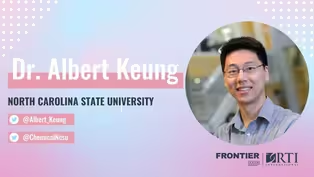
Dr. Albert Keung | North Carolina State University
Video has Closed Captions
Clip: 9/23/2022 | 15m 25s | Dr. Albert Keung talks about the process of studying the brain. (15m 25s)
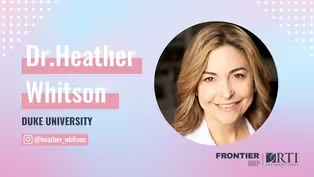
Dr. Heather Whitson| Duke Aging Center, Duke University
Video has Closed Captions
Clip: 9/23/2022 | 13m 45s | Dr. Heather Whitson discusses when is best to study Alzheimer's disease. (13m 45s)

Dr. Karl Thor | Dignify Therapeutics, LLC.
Video has Closed Captions
Clip: 9/23/2022 | 12m 46s | Dr. Karl Thor focuses on the nervous system in relation to bladder and bowel usage. (12m 46s)

Dr. Somnath Mukhopadhyay | NCCU
Video has Closed Captions
Clip: 9/23/2022 | 12m 22s | Dr. Somnath Mukhopadhyay expounds on the combined effect of alcohol and THC on the brain. (12m 22s)
Providing Support for PBS.org
Learn Moreabout PBS online sponsorship
- News and Public Affairs

Top journalists deliver compelling original analysis of the hour's headlines.

- News and Public Affairs

FRONTLINE is investigative journalism that questions, explains and changes our world.












Support for PBS provided by:
RTP180 is a local public television program presented by PBS NC