Signature Dish
The Secret to NEUTRAL GROUND's Grits and Grillades Starts at the Mill
Clip: Season 4 Episode 1 | 7m 45sVideo has Closed Captions
Seth samples Neutral Ground's seasoned grits topped with slow-braised brisket grillades.
Seth Tillman and Neutral Ground Chef David Guas head to George Washington’s Distillery and Gristmill to pick up freshly ground white corn grits—milled using centuries-old techniques. Back in the kitchen at Neutral Ground restaurant, those grits become the foundation for a comforting brunch classic: creamy, seasoned grits topped with slow-braised brisket grillades and a rich Creole tomato gravy.
Problems playing video? | Closed Captioning Feedback
Problems playing video? | Closed Captioning Feedback
Signature Dish is a local public television program presented by WETA
Signature Dish
The Secret to NEUTRAL GROUND's Grits and Grillades Starts at the Mill
Clip: Season 4 Episode 1 | 7m 45sVideo has Closed Captions
Seth Tillman and Neutral Ground Chef David Guas head to George Washington’s Distillery and Gristmill to pick up freshly ground white corn grits—milled using centuries-old techniques. Back in the kitchen at Neutral Ground restaurant, those grits become the foundation for a comforting brunch classic: creamy, seasoned grits topped with slow-braised brisket grillades and a rich Creole tomato gravy.
Problems playing video? | Closed Captioning Feedback
How to Watch Signature Dish
Signature Dish is available to stream on pbs.org and the free PBS App, available on iPhone, Apple TV, Android TV, Android smartphones, Amazon Fire TV, Amazon Fire Tablet, Roku, Samsung Smart TV, and Vizio.
Providing Support for PBS.org
Learn Moreabout PBS online sponsorshipDAVID: We're here to grab our white corn grits that are going to be part of our signature item for our brunch menu, which is our grits and grillades.
So Cory is actually the master miller.
He's actually waiting for us inside.
So you want to go check him out?
SETH: Let's do it.
DAVID: All right.
Hey, Cory.
How are you, man?
CORY: Morning, Chef.
Good.
How are you, sir?
DAVID: Good to see you.
CORY: Good to see you.
DAVID: This is Seth.
SETH: Cory.
CORY: Hi, Seth.
Nice to meet you.
SETH: Well, I love stepping into this little piece of history.
I love the sound of the water that's rushing in from the creek outside.
How does this whole process work?
CORY: So this hopper's going to feed the millstones below us.
Everything is powered off our 16-foot water wheel.
Water comes in, turns a series of gears below our feet, which makes the top stone turn with the bottom stone stationary that cuts the corn like a pair of stone scissors.
DAVID: The first time I came here to see the mill in full action, it was a spiritual experience.
It was one of those things that everything else, sound-wise, just drops and you can just hear the turning and the clacking and the grinding and it's like a symphony.
SETH: A beautiful symphony powered entirely by water.
I love that.
After Cory adds the remaining white corn to the hopper, it's down a level to start the flow of water and power up the massive machinery.
SETH: And the wheels are turning.
CORY: So we're going to be looking for consistency on the size of the grits.
They're a little small, so we got to make adjustment.
SETH: And this is what's changing the gap between the two stones?
DAVID: And I think Cory knows, because we've tweaked it over the years.
I like a two nickel gap between the stones.
SETH: That's how you measure, in nickels?
DAVID: That's the Neutral Ground spec.
So this is the part I was talking about.
When it's in full operation and you just be quiet for a second, almost even close your eyes, you can feel the vibrations under your feet.
[rhythmic wood clacking] It's wild, man.
It forces you to slow down.
SETH: And amazing that it's just water from a small creek that can create this level of power.
DAVID: I know.
It is.
SETH: As the mill continues to turn, three products are sorted into bins.
The grits, a finer grind called meal, and the leftover hulls, traditionally used for chicken feed.
CORY: Okay, Seth.
We're getting a lot of good grits here.
I'm going to go ahead and shut this off and start bagging them up.
SETH: Sounds good.
And this thing doesn't exactly stop on a dime.
DAVID: No.
I think for me, this relationship is what makes what I do the reason I do it.
It's the fulfillment and the sustainability of these types of partnerships that are so important.
CORY: And Chef Guas, here's your 20 pounds of white grits.
DAVID: Give it to this guy.
SETH: I'm carrying it today?
DAVID: Yeah you are.
That's why I brought you.
SETH: All right, well Cory, thank you so much for this fascinating peek into this little bit of Virginia history right here.
CORY: Absolutely.
And please come back and see us again here at Mount Vernon.
SETH: Oh, we absolutely will.
All right, let's get cooking, Chef.
DAVID: Yeah, man.
SETH: Chef, is this your bike right here?
DAVID: It is indeed.
SETH: You have room in the back there to hold this bag of grits?
DAVID: Not only do I have space for the grits, but guess what, my friend?
You're coming with me.
SETH: Space for me too?
DAVID: You betcha.
SETH: So we're heading up the George Washington Parkway together?
DAVID: We are.
We're going to go back to the restaurant, man.
SETH: Well, thank you for giving me a good, safe helmet here.
DAVID: Safety first always.
Fashion later.
I'm the bug catcher, so I'll be blocking everything that hits me before it hits you.
I'm going to get her upright and then you're just going to go ahead.
SETH: Just go for it.
DAVID: Jump on.
SETH: Here we go.
All right, Chef.
Let's ride.
All right, Chef, that was a fun ride back up here.
Here's your heavy ol' bag of grits.
DAVID: Thank you.
Appreciate it.
SETH: And so everything I know about grits, I think I learned from the movie, "My Cousin Vinny."
DAVID: Nice.
SETH: So what does a modern-day chef do to take grits up to the next level?
DAVID: Well, a commonly missed step is to soak the grits and skim the top.
So I'm going to get going on that real quick.
We'll pour cold water over the top and then those outer husks will float to the top.
I'll do that until it's basically clear.
So you see, I just finished these.
SETH: All right.
So now we're getting down to the nitty-gritty.
DAVID: Nice.
SETH: Sorry.
Sorry.
I had to do it.
DAVID: It's all good.
Now, just like gumbo, there's a million different sort of recipes for grits.
Some people put heavy cream, some people put half-and-half, some people put cheese and milk.
For me, the simplest form is just butter and salt.
So we'll get this up to a quick boil.
Now, we've got our washed grits, so we'll add all of that.
So at this point, I don't step away to fold laundry or to go check my Instagram, because the weight of the grits can go to the bottom and then you get it scorched.
SETH: Eyes here.
DAVID: That's right.
I'm actually going to just push this guy to the back a little bit.
And now, we're just going to sort of whisk that every five minutes.
So now it's all about the grillades, right?
The centerpiece is the brisket, so we're getting a brisket instead of a cheapest cut and then we dry rub it with a blend of Creole seasoning that we make in-house with a little bit of coffee and then we'll sear it.
And then from there, we remove the meat and then in that same pan, we'll sauté up some more of our rough vegetables and then a little bit of bay leaf.
Our tomato paste as well.
We'll pour cold water in there.
We'll bring that up to a simmer and then we'll put it in the oven at about 220 and it goes anywhere from 12 to 18 hours.
Here we are 18 hours later, right, and we braised a beautiful brisket.
SETH: Oh, beautiful.
DAVID: So I've actually extracted the braising liquid, so I can focus on our finished sauce.
All right.
So we're going to start off with our onions.
A bit of bell, a little bit of celery and we've got some fresh garlic.
So we'll just sweat this until this is translucent.
So we can't forget about our beautiful grits here.
SETH: Chef, I was so distracted by the garlic, I forgot about the grits.
So I'm glad you're keeping an eye on it.
DAVID: This is my world right here.
And then we've got some fresh heirloom tomatoes.
So we're going to go ahead and keep this simmering.
We got our braising liquid.
A nice Creole brisket stock.
And add a little bit of tomato paste as well.
SETH: Just a little more richness going in the dish.
DAVID: Yeah.
Exactly.
Why not, right?
Can't forget this guy.
We're going to let this come up to a simmer and we're going to reduce it down a little bit.
So once we get this to where we want it, we'll grab our brisket and then take these beautiful, hot grits.
We'll portion that into the bowl and then we'll take this beautiful Creole tomato gravy and put it right over the top of the brisket, finish it with a little chiffonade of green onion.
Call it a day.
SETH: All right, Chef.
The long journey from the gristmill to the plate is complete.
DAVID: We made it.
SETH: This dish looks beautiful.
I got to start with those grits though.
DAVID: Yeah.
Are you kidding me?
SETH: All right, top-notch flavor right there, Chef.
Knowing how much work goes in... DAVID: Sure.
SETH: ...to both creating this product and knowing how little you did to gussy it up and yet still, they are so creamy and fresh tasting.
DAVID: Oh, yeah.
And comforting.
SETH: Very comforting.
But the grillades, that's half the battle right there.
DAVID: Agreed.
SETH: Going for a little brisket here.
DAVID: Do you do the dink it and sink it?
SETH: You tell me, Chef.
DAVID: I already ate mine.
SETH: Dink it and sink it.
Here we go.
DAVID: You're falling behind.
What I love in the sauce is you can pick up the dry rub with the Creole seasoning and the coffee's what gives it the depth.
SETH: Oh, yeah.
But the brisket itself, I guess all of that cooking and it just falls apart when you take a bite.
DAVID: It's unbelievable.
SETH: The dink it and sink it, that's how I'm going to be eating grits for the rest of my life now.
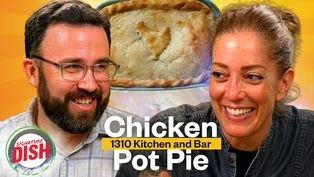
1310 KITCHEN AND BAR's Chicken Pot Pie Takes Three Days to Make!
Video has Closed Captions
Clip: S4 Ep1 | 4m 32s | Seth heads to 1310 Kitchen and Bar to learn the secrets behind Chef Jenn Crovato's chicken pot pie. (4m 32s)
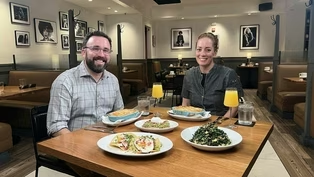
Preview: S4 Ep1 | 30s | Neutral Ground in McLean; 1310 Kitchen and Bar in Georgetown; Unconventional Diner in Shaw. (30s)
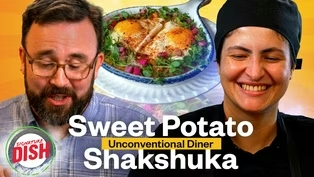
Watch the UNCONVENTIONAL DINER Make Shakshuka with a Twist: Za'atar and Sweet Potato
Video has Closed Captions
Clip: S4 Ep1 | 4m 14s | Seth heads to the Unconventional Diner where Chef Leena puts an unconventional spin on shakshuka. (4m 14s)
Providing Support for PBS.org
Learn Moreabout PBS online sponsorship
- Food
Christopher Kimball’s Milk Street Television
Transform home cooking with the editors of Christopher Kimball’s Milk Street Magazine.





Support for PBS provided by:
Signature Dish is a local public television program presented by WETA