
Nevada Legislature Starts and Helping Nevada's Moms-to-Be
Season 5 Episode 31 | 26m 46sVideo has Closed Captions
The 2023 Nevada Legislature has started. Advocates hope for new laws for moms-to-be.
We check in with a reporter from the Nevada Independent about the start of the 2023 Nevada State Legislature and we look at some of the bills that advocates want to pass during the legislative session to help moms-to-be in the state.
Problems playing video? | Closed Captioning Feedback
Problems playing video? | Closed Captioning Feedback
Nevada Week is a local public television program presented by Vegas PBS
Nevada Legislature Starts and Helping Nevada's Moms-to-Be
Season 5 Episode 31 | 26m 46sVideo has Closed Captions
We check in with a reporter from the Nevada Independent about the start of the 2023 Nevada State Legislature and we look at some of the bills that advocates want to pass during the legislative session to help moms-to-be in the state.
Problems playing video? | Closed Captioning Feedback
How to Watch Nevada Week
Nevada Week is available to stream on pbs.org and the free PBS App, available on iPhone, Apple TV, Android TV, Android smartphones, Amazon Fire TV, Amazon Fire Tablet, Roku, Samsung Smart TV, and Vizio.
Providing Support for PBS.org
Learn Moreabout PBS online sponsorshipThe 2023 Nevada Legislature is underway.
Which bills we're watching... Plus, babies: They need diapers and lots of them, but one in three families reportedly cannot afford them.
How a local organization is helping, and what other issues soon-to-be parents in the Silver State are facing, that's this week on Nevada Week .
♪♪♪ Support for Nevada Week is provided by Senator William H. Hernstadt.
-Welcome to Nevada Week .
I'm Amber Renee Dixon.
The 82nd session of the Nevada legislature kicked off February 6 with a Republican governor at the helm for the first time since 2019.
While Governor Joe Lombardo should benefit from an ample state budget, he will have to work with a Democratic controlled Assembly and Senate.
Joining us to talk about what's in store for Nevadans this biennial session is Jacob Solis, State House Reporter for The Nevada Independent .
Jacob, welcome.
So a Republican Governor and an Assembly and Senate controlled by Democrats, how much activity can actually happen?
How much can get accomplished this session?
-Well, there should be plenty of compromise, because there's actually lots of places where Democrats and Republicans agree with each other.
Obviously, there'll be some clashes in some of the places that they don't, but things like state worker raises, maybe there's some areas on, you know, education, for instance, right?
There's plenty of little areas where Republicans and Democrats can find common ground and end up passing some bills.
I think it's really those big topic areas where we're going to see the clashes.
-And if we're talking about the Governor using his power to veto, how will the legislature be able to, this legislature in particular, be able to override that?
-Well, it'll be tricky.
So the Democrats have a supermajority in the Assembly, which could override a veto, but they don't have one in the Senate.
And so if there is a veto and they can't find that extra Senator, then they can't override a veto, and that's that.
Now, things could change after the 2024 elections, and Democrats could pick up another seat in the Senate.
And that'll make the next legislative session very different, but that's all in the future.
-Hey, and according to your reporting, this is not a terribly unique situation with a Republican Governor and then a Democratically controlled legislature, right?
-That's right.
We-- Actually, 9 out of the last 15 years has had a Republican Governor and a Democratically controlled legislature in both houses.
So we've really returned to the norm here.
-All right.
So you talked about education as being an area for bipartisan support.
Governor Lombardo is proposing $2 billion to fund K through 12 education.
Democrats want $250 million more.
What do they want it for, and how likely is it Republicans will approve that?
-That's right.
Well, the Democrats have proposed that money to pay for teacher raises.
Now, the Republicans have said that they want the money for teacher raises to be a local decision.
They leave that up to the school districts.
And certainly we've we've heard the Governor's Chief of Staff, Ben Kieckhefer say he's welcoming that proposal if the Democrats can say where that money is going to come from.
Now, one of the sticking points may be that the Governor's office wants to put a lot of money, hundreds of millions of dollars, in the state's rainy-day fund, which the state drained under the Sisolak administration because of COVID and to pay for all these kinds of pandemic costs.
So I think if there's going to be a point of friction, it's going to be the Democrats saying we ought to use that money to pay for things.
And in this instance, you know, $250 million worth for teacher pay raises.
-And then opportunity scholarships, that falls under the kind of controversial topic of school choice.
Governor Lombardo wants $50 million for those.
How will they work?
He also wants to expand access to them.
And what's the argument against them?
-Right.
So opportunity scholarships are an existing program the state has.
It basically allows parents to use government money to send their kids to a private school.
So right now the program is funded at about $7 million and is available to anyone up to about 300% of the federal poverty line.
What the Governor wants to do is fund it to $50 million and allow anyone at 500% of the poverty line to get access to it.
That ends up being over $100,000 in annual income-- [background noise] That ends up being over $100,000 in annual income for a family of four.
And so it's a big change, but it's also a lot less than what a lot of school choice advocates were asking for.
Frankly, there was a program under Brian Sandoval called Education Savings Accounts that was much more expansive.
That was a sort of quote/unquote true school choice program.
And Lombardo's office chose not to attempt to fund that because of an ongoing court battle over, you know, the program might be legal, but the funding mechanism they originally used wasn't.
And so now it's in this legal limbo, and no one wants to touch it.
-On the topic of housing, there seems to be bipartisan support for changing the rapid summary eviction process.
That could impact a lot of Nevadans.
What is the process currently, and how likely do you think it'll be changed?
-That's right.
And I think that this is one of those compromise points where I think both Democrats and Republicans agree that something's got to give on summary evictions specifically.
And the Governor, Joe Lombardo, told our CEO, John Ralston, that, you know, he doesn't know exactly what he wants to see change.
But certainly the onus needs to shift away from the tenant in these sort of eviction proceedings toward the landowner.
But what does that look like?
What do the specifics look like?
I think that's really when we're going to get into the meat of things.
And that's where disagreements might start to arise.
-It is interesting that if you are evicted, you have to pretty much go to the courthouse yourself and file to protect yourself before that landlord even has to do anything.
It makes Nevada a unique state.
We'll be watching that.
And finally, health care costs, reproductive health care access for women, those could be some contentious topics under the health care umbrella.
But mental health, that is somewhere we may see some bipartisanship as well, right?
-That's right.
The Governor, in particular, has made mental health a focus, right?
If you heard his State of the State, he talked about mental health in interviews.
He loves to talk about it.
And he likes to talk about the infrastructure around mental health, providing bed space, providing, you know, clinical care to people who might need assistance.
And certainly the Democrats are all for that as well.
You know, it's gonna come down to money: Who's paying for what?
Where does that money go?
How is it being spent?
Again, the devil is always in the details.
-I think that will be what we see throughout this legislative session.
Jacob Solis, thank you for joining us.
Our viewers can expect regular reports from you throughout this legislative session, you and your Nevada Independent colleagues who you told me are all staying in a an apartment together right now.
Maybe that was something that happened with that audio issue.
-For now, thank you for your time and your thorough coverage.
-Thank you.
-We move now to a November report from the Centers for Disease Control and Prevention.
The CDC says that in 2021, home births in the United States reached their highest level in 30 years.
The CDC reports that Nevada has seen its own increase, which is why birth rights advocates argue state legislation is needed to support the workers who provide home birth related services.
And joining us to discuss that legislation is Erika Washington, Executive Director of Make It Work Nevada.
Erika, thank you for joining us.
(Erika Washington) Happy to be here.
Tell me why someone would want to have a home birth, for those who don't understand, and outside of a hospital.
-I think a lot of people want control, and they want autonomy.
They want to have an opportunity to have their baby in a peaceful setting and not a sterile hospital.
They want to be surrounded by their their family or their friends or their pets or what have you.
I think it's just really about autonomy and just feeling safe.
And I think especially after COVID, you know, folks just didn't really want to go to the hospital.
They haven't-- they didn't have a real need to.
And for the longest time, pregnancy and childbirth wasn't considered medical, you know?
So it was something that was done at home for, you know, centuries and in more recently in the 19th century that we started using hospitals as a place for birth.
And so I think people were trying to maybe get back to their roots a little bit.
-And what about the concern for C-sections, also financial costs at a hospital?
-It's huge, though, right?
I had a C-section with my, my youngest child.
And I remember getting the bill and I did have insurance, but the bill that says it's not a bill, it was about $40,000.
And I can't imagine if that was something that actually was a bill.
And that was with a C-section.
Now mind you, sometimes it's medically necessary.
But many times I think those things can be avoided.
And we are, you know, I think as, as moms as parents as folks, were looking for alternative ways to have healthy pregnancies and also healthy births.
-And as you said, sometimes they are medically necessary, but I think there is a concern that if I go to a hospital I'm more likely to have one-- -Yeah.
- --than if I go somewhere else that's outside of that setting.
Maternal mortality rates in the United States are high when you compare the U.S. to similar nations of wealth that we have here.
That's according to the Commonwealth Fund.
How much of a role does that play also in the decision?
-I think it plays a major role.
I think you have extremely high rate of maternal mortality, especially in the Black community.
And what they have found, it really doesn't have anything to do with income levels.
There are folks who are at the higher tier level of income and still have died in childbirth.
Make It Work Nevada has been creating and producing a podcast called American Dreams: Reproductive Justice .
And we have a specific episode where we talk about an actual CDC doctor who died after childbirth because she wasn't listened to, she wasn't heard.
And we believe that comes from, you know, a lot of different components.
But you know, the history of gynecological research and how that started came from experiments on enslaved women, and they weren't able to have any sort of pain medication or anything like that.
They didn't believe that we felt pain.
And for some reason, that seems to still permeate a lot in the medical community that-- And things, things just show up differently.
As much as we'd like to say we're all the same, we're not exactly the same.
And so when something, a medication or a different event, how it might affect and show up on you will look completely different on me.
Someone might say, Oh, well, are you pale?
I may not show up as pale.
So how would you know?
And so I think having more, more research will be helpful in trying to alleviate that.
But also, as you said, I think that people just want to be at home because they feel safer.
-So midwifery and doulas, what are the differences between a midwife and a doula?
-Sure.
Well, a doula is a, is a professionally trained expert that guides clients through various life experiences.
That's pregnancy, that's childbirth, it could be a miscarriage, abortion.
And there are also nonreproductive doulas that are death doulas that help folks through the transition as well.
A midwife, on the other hand, is a healthcare provider that, they catch the babies, you know?
So they can do it both in a hospital in some aspects, and they can also do it at home.
-What legislation are you following concerning midwives this session?
-So there is a midwifery bill.
It is a repeat from last session where it did not pass.
And so we are not-- we're not leading on that bill.
We're more or less keeping an eye on it, because we have deep ties with the midwifery community.
And we just want to make sure that folks are at the table that need to be there.
The bill right now is about licensing and setting standards for midwives.
The issue that we're seeing is that a lot of midwives come from different backgrounds, and they've been trained differently.
So trying to set up a standard is a little bit difficult when there isn't already a standard in the state.
And so another issue that we're hearing is that a lot of midwives, they don't want to be controlled by outside entities.
They want to be able to self govern, making such examples that, a dentist doesn't control how an orthopedic surgeon does their work.
And so they want to make sure that they have, they're in the parameters of the work and that there's not a lot of outside bias for people who just believe midwives shouldn't, you know, do any procedures at all.
-And that's something that's kind of inherent within the profession of-- We don't want to be connected to the medical establishment.
-Yeah.
I think also going back to the-- getting back to the roots, getting back to a more holistic way of bringing a child into this this world.
I think they want to make sure that they are not necessarily-- and I'm saying "they," meaning not all, because they're not a monolith.
There are some midwives who are very pro-licensing, and then there are others who are very anti-licensing.
And so, but what I'm hearing from all of them is that they want to be able to have the same autonomy as doctors and such.
-For doulas, you are watching legislation that's building upon legislation from the last session.
-Yeah, I'm very excited.
We won.
We won, you know, the opportunity to have doulas expanded into Medicaid so that Medicaid recipients would be able to have a doula provider and they could be reimbursed by Medicaid.
And that is something that they're doing across the country in various states.
And so we were able to pass that last session.
This session, what we're trying to do is strengthen that because the reimbursement rate for doulas that was passed last session was about $350 total for five visits, and that includes them being present during the birth.
That's not enough money to do much of anything.
And I'm not even sure if you're gonna buy any eggs with that at this point.
So, and we're one of the lowest reimbursement states.
Michigan just passed their doula, their doula bill, and it's $1,500.
And so what we are wanting to do is be able to also add more visits past five.
So, you know, during pregnancy, childbirth, and postpartum because you also want to be able to keep an eye on the mother and the baby.
But thinking about any side of-- any type of postpartum issues.
But also the birth.
A birth will last as long as it wants to, you know?
We don't control how long it takes for the baby to get here.
And so $350 is just not going to do it.
So we want to expand that.
-And how has that gone so far with doulas registering with the state in order to get reimbursed?
-So it's been real slow, as you can imagine, because I mean, who really wants just $350 to do that much work?
And when you think about the cost of living and when you think about the amount of paperwork that will have to be done and certification, you know, with the state for being able to receive this reimbursement with Medicaid, it just, it wasn't taking.
And so we've had some who have registered, and we're actively trying to get more involved because they want to do the work.
But we have to be realistic about what people need to be comfortable.
-Yeah.
How they should be appropriately reimbursed.
Erika Washington, Make It Work Nevada, thank you for your time.
Continuing on the topic of pregnancy related deaths.
U.S.
Senator Jacky Rosen says Nevada has a maternal morbidity rate higher than the national average, partly due to the state's shortage of healthcare providers and because of the lack of medical resources in rural areas.
That's why she led the way in getting the Data Mapping to Save Moms' Lives Act signed into law.
It utilizes the Federal Communications Commission in order to identify areas where access to telehealth could help lower maternal mortality rates.
(Sen. Jacky Rosen) I'm very proud of this bill, because unfortunately, over the last few years, maternal mortality rates in the United States have just gone up and up.
These are new mothers who are passing away, leaving their children behind.
And so one thing we learned, again during COVID, a lot of-- No silver lining to COVID, but we did learn a lot of lessons.
And one of them was about telehealth.
And we were able to help so many more people, particularly our rural areas, our underserved areas, because they were able to get that continuity of care or even care for the first time because they were able to use some kind of a computer or even a telephone, whatever it was, they were able to use telehealth.
And so what we wanted to do is look at this maternal mortality rate, which is 100% unacceptable.
We don't want to see young mothers die because they don't have care.
Was there a relationship between their lack of access to telehealth or even broadband, even to Google their symptoms, per se?
But on prenatal care, and then of course, postnatal care.
And we would overlay that with the maternal mortality maps, making sure that then we could really focus in on these areas and get some good telehealth and resources so we can save moms' lives.
-This requires cooperation from the Federal Communications Commission, but how does it fit into what the FCC is already doing?
-They've been doing it for diabetes.
I think they've been doing it for some other, other diseases and other things.
And I think it's a really good way.
We have so much data, and the data tells a story if you're smart enough to analyze it, listen to it.
And so these are ways, again, as we invest in our broadband and our infrastructure, we can see where some of the holes are that we need to plug.
-Do we know right now whether one's access to broadband or the internet correlates to maternal health?
-Well, we're going to find out.
That's, that's what it's going to tell us.
And we do know that, from some of those studies, reports that we've already seen from COVID, the amount of care that people have gotten, especially after their first appointment.
So we talked about that "continuity of care."
So say you live in a rural area, you drive in to come see a doctor, then you need follow ups.
If it's 100 miles, if you're particularly not necessarily here in Southern Nevada as much, but if you go to Central and Northern Nevada, the distances are far, or we can pick Laughlin even.
It's not, you know, it's, it's a little bit of a drive.
And this way, you can maybe go for your initial appointment, and then you can still continue to see the doctor.
And then if you have issues or side effects, altering the medicines, whatever, whatever their provider needs to do, you're going to get that follow-up care, which is often what really saves your life in the long run.
-And if indeed there is a correlation between maternal health and access to the internet, who becomes responsible for improving that access in the impacted areas?
-Well, I think it's going to tell us a few things.
So where we need to be sure that we get the broadband out to, number one; that we need to make sure that it is good, reliable broadband, that it's not-- I always say about broadband, I want to put you on the freeway, but not with a flat tire.
I want to put you with four full tires.
We want to have good working broadband, and we want to be sure it's affordable and accessible for people.
That's also very, very important depending on where you are in the country.
If you can't afford it, it doesn't matter if it's there.
So broadband, that's-- some of that is on, on us.
And then we'll see, as we show this, share this data with our cities and counties and communities across the country.
They have social services.
I can tell you another bill that I had passed called the Mobile Act.
And what it is, is for our community health centers, our federally qualified health centers, to allow them to use the funds that they get to create like a mobile, a van like we see them for mammograms or for vaccinations for kids or dental vans.
So this might show that we need some mobile maternal vans, prenatal vans, infant care, whatever that is.
So in those communities, we can work with community partners or they see what the needs are, then they can also fill in those gaps.
So I think it's going to show us a lot once we see the results, and hopefully we'll see those in the next few months.
We'll be talking with the FCC about the timelines and then putting together that data.
-And from data to diapers... according to the nonprofit Baby's Bounty, one-third of families have trouble paying for them.
While diapers are preventative health care supplies, they are not covered by any federal program, and they're even taxed as a luxury good.
Nevada Week 's Maria Silva joins us now.
And Maria, Baby's Bounty is working to try and eliminate that sales tax.
(Maria Silva) And they didn't think it was going to happen this legislative session, but now it looks like it is, Amber.
Actually the executive director, Kelly Maxwell, is in Northern Nevada right there.
And she tells me that she is working with Nevada Senator Edgar Flores, who is sponsoring this bill that would exempt diapers from sales tax.
We'll of course keep an eye on this as the 2023 legislative session continues.
In the meantime, Baby's Bounty, helping parents in need by distributing free diapers at several diaper banks since May of 2020.
They have distributed more than, listen to this, 2 million diapers and 5 million wipes to nearly 31,000 families.
And that is in Southern Nevada alone.
-There we go.
-There he goes!
-All right!
-Baby Legend has a lot of cheerleaders in his corner.
[applause] -His biggest cheerleader, Mom Melanie McMillon.
-He's just, he's just so sweet.
I love him.
I love him.
He's 10 months old, and he's so big.
My big boy.
-Keeping her sweet, big boy happy, healthy, and clean, a top priority.
-He can honestly go to six to eight diapers per day.
Per day.
So it is extremely expensive.
-To help with that expense, Melanie turned to Baby's Bounty.
-We're getting out of the COVID era.
There's inflation.
The last thing you want to worry about is keeping your child clean and, you know, fresh.
It's so great that they're willing to help with giving you the diapers that you need.
-Baby's Bounty launched its first diaper bank during the height of the pandemic.
(Kelly Maxwell) We launched a diaper bank May 20 of 2020.
We served 83 families that first day in the, in the parking lot of Valley High School.
And once we saw the reception from the families, we said, We have to keep doing this; this has to be part of our programming.
-Executive Director Kelly Maxwell says the program has grown to include diaper banks not only in Las Vegas, but also North Las Vegas and in Henderson.
Plus thanks to the generosity of community partners, they were able to purchase this mobile diaper bank, allowing Baby's Bounty to help parents in rural areas.
-Mesquite, Pahrump, far East Las Vegas, Moapa, Sandy Valley, all those outlying areas where it's a two-and-a-half hour bus ride to get to one of our static diaper banks.
So it's just not feasible to get a week's supply of diapers and wipes.
-Baby's Bounty, filling a void as the only consistent diaper resource in the entire state.
-Diapers and food, gas and food, food and diapers.
It's-- These are heartbreaking decisions that no family should have to make.
So we're here to fill that, at least the diaper gap.
-This grateful mom has some encouraging words for other parents struggling to make ends meet.
-Put your children first.
When it comes to Baby's Bounty, they are here to help.
They want to help.
I think that's the most important part.
And once you get here, you'll see-- [baby babbling] - --how much of a family they'll become to you.
[baby babbling] -I think that's Baby Legend saying he agrees with Mom.
-Give them a big smile.
Give 'em a big smile.
[laughter] He wants to play.
Yeah?
Yeah?
My precious.
-So sweet.
Nothing like a mother's love.
Well, next month Baby's Bounty, we're happy to say, is opening another diaper bank, this time in Northern Nevada.
It is important to note though that in order to visit one of the diaper banks, you do need to register ahead of time on the Baby's Bounty website.
We do have a link on our website vegaspbs.org/nevadaweek.
There you will also find other links to more resources for new parents.
And our wonderful viewers, you may have noticed that there's a theme to this show.
We're talking about mothers, mommies to be, and babies.
So we wanted to celebrate our very own Amber with a special basket from your family here at Nevada Week and Vegas PBS.
-Oh, this means so much.
This is my first time as a mom, so wow!
All this is going to come in so handy.
I love Clifford the Red Dog .
Watched that growing up.
Buenas Noches, Luna .
I love the bilingual aspect.
-Well, you speak Spanish.
You're bilingual.
Are you gonna have a bilingual baby?
You have to open that one too.
-Okay.
I really appreciate this.
And it's been a gift, speaking of gifts, to host the show about maternal issues and-- Oh, a little Nevada Week onesie.
I will be taking a picture of the baby in that for sure.
Hopefully we'll get to show it on air.
And also a gift, Maria, knowing that you are going to be filling in for me while I am on maternity leave-- This is my last show before maternity leave.
And, gosh, so thankful to know that it's in good hands.
Thank you so much, Maria Silva.
-You're going to be a great mom.
-Thank you for watching.
For any of the resources discussed here, go to vegaspbs.org/nevadaweek.
And barring any unforeseen circumstances, I will see you in about six weeks.
♪♪♪
2023 Nevada Legislature Starts
Video has Closed Captions
Clip: S5 Ep31 | 6m 47s | We speak with a reporter from the Nevada Independent about the Nevada Legislature. (6m 47s)
Video has Closed Captions
Clip: S5 Ep31 | 5m 20s | The nonprofit Baby’s Bounty is expanding its diaper bank for families in need. (5m 20s)
Video has Closed Captions
Clip: S5 Ep31 | 8m 35s | Advocates are working on new bills to help Nevada’s moms-to-be (8m 35s)
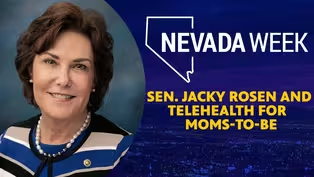
Sen. Jacky Rosen and telehealth for moms-to-be
Video has Closed Captions
Clip: S5 Ep31 | 4m 57s | Sen. Jacky Rosen led an effort to address maternal mortality rates using data. (4m 57s)
Providing Support for PBS.org
Learn Moreabout PBS online sponsorship
- News and Public Affairs

Top journalists deliver compelling original analysis of the hour's headlines.

- News and Public Affairs

FRONTLINE is investigative journalism that questions, explains and changes our world.












Support for PBS provided by:
Nevada Week is a local public television program presented by Vegas PBS