
New Alert System Tracking Overdoses
Clip: Season 4 Episode 121 | 3m 12sVideo has Closed Captions
The system is designed to alert local health departments and recovery groups.
There are many reports about Kentucky's often deadly drug problem. To track spikes in drug overdoses across the state, the Kentucky Injury Prevention and Research Center created a system that alerts local health departments and recovery groups.
Problems playing video? | Closed Captioning Feedback
Problems playing video? | Closed Captioning Feedback
Kentucky Edition is a local public television program presented by KET
New Alert System Tracking Overdoses
Clip: Season 4 Episode 121 | 3m 12sVideo has Closed Captions
There are many reports about Kentucky's often deadly drug problem. To track spikes in drug overdoses across the state, the Kentucky Injury Prevention and Research Center created a system that alerts local health departments and recovery groups.
Problems playing video? | Closed Captioning Feedback
How to Watch Kentucky Edition
Kentucky Edition is available to stream on pbs.org and the free PBS App, available on iPhone, Apple TV, Android TV, Android smartphones, Amazon Fire TV, Amazon Fire Tablet, Roku, Samsung Smart TV, and Vizio.
Providing Support for PBS.org
Learn Moreabout PBS online sponsorshipWe have more medical news tonight.
We've reported many times on Kentucky's often deadly drug problem to track spikes in drug overdoses across Kentucky.
The Kentucky Injury Prevention and Research Center created a system that alerts local health departments and recovery groups.
So the Kentucky Injury Prevention and Research Center at the University of Kentucky, they are instrumental in providing data to health departments as well as to the CDC.
And so they have developed a Kentucky overdose alert system, which kind of is a hub, for all of those systems to kind of give them data so that we can really report what's going on in Kentucky.
So it's a. Semi-automated system that, essentially takes several different data streams.
So rapid hospital data, which is called essence, as well as EMS data, through the bio spatial and ODI map systems.
And essentially it's looking for unusual increases or upticks in overdoses.
And so usually that's by county.
But it can also be by hospital.
And the goal is essentially to find overdose spikes or clusters as quickly as possible.
And to get eyes on them and to notify the the localities where they're occurring.
Here at the health department.
We work with participants who are using drugs, and we operate a syringe program.
And so when they come in, we're able to let them know about these clusters and that kind of thing.
We can see if it was a death.
We can see if Narcan was used.
We can see a whole lot of different information about overdoses that are happening.
We can break it down by zip code.
We can break it down by individuals.
Giving people warning that there's something going on with the drug supply or the drug that they normally take might be more dangerous and more potent than a normal is.
Without a system like this in place.
Those people will never have any way to prepare when an alert goes out.
Not only that, county can better respond, but neighboring counties can also be like, oh, we might want to get you no more.
No more naloxone prepared.
We might want to have we might want to modify our hours of our, you know, syringe service program.
We're currently in the process of talking to the Kentucky Board of Emergency Medical Services about, potentially getting access to daily EMS data, which would allow us to essentially detect clusters at a much higher resolution so we could detect down to more like the neighborhood or like cross street level.
We're hoping that it will just be really robust in what it can provide us.
I'm thinking along the lines of gender, age, race, ethnicity, all of the demographics that we could hit.
And when we put that on top of zip codes and locations and what drugs were used and if the person survived, we can really get a good picture of what's happening in the street and in people's homes.
The university launched the alert system in 2023, in partnership with the Kentucky Department of Public Health.
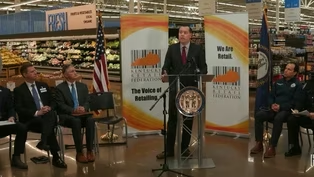
Attorney General Targeting Organized Retail Crime
Video has Closed Captions
Clip: S4 Ep121 | 1m 36s | AG Coleman is asking the state legislature for more money for a new organized retail crime unit. (1m 36s)

EKU's President Discusses Transfer Credits
Video has Closed Captions
Clip: S4 Ep121 | 4m 31s | McFaddin says EKU has made great strides when it comes to easing the transfer of course credits. (4m 31s)

Ford Shifting Focus of Battery Plants in Kentucky
Video has Closed Captions
Clip: S4 Ep121 | 1m 31s | Ford is laying off all of the 1,500 employees at the Hardin County plant. (1m 31s)

Local Pediatrician Still Recommending Hepatitis B Vaccine
Video has Closed Captions
Clip: S4 Ep121 | 3m 8s | The move is in contrast with a new recommendation from a CDC advisory panel. (3m 8s)
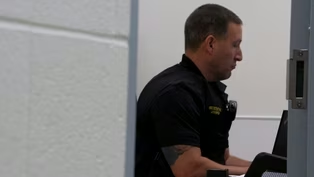
Meet Kentucky's First School Resource Detective
Video has Closed Captions
Clip: S4 Ep121 | 3m 16s | Warren County Public Schools is adding to its SRO roster. (3m 16s)

Sen. Paul Shows Support for Kentucky Hemp Business
Video has Closed Captions
Clip: S4 Ep121 | 2m 36s | Cornbread Hemp unveiled its expanded facility in Louisville on Monday. (2m 36s)
Providing Support for PBS.org
Learn Moreabout PBS online sponsorship
- News and Public Affairs

Top journalists deliver compelling original analysis of the hour's headlines.

- News and Public Affairs

FRONTLINE is investigative journalism that questions, explains and changes our world.












Support for PBS provided by:
Kentucky Edition is a local public television program presented by KET