
New Alzheimer's Treatment May Offer Hope for Patients
Clip: Season 5 Episode 38 | 4m 13sVideo has Closed Captions
Neurologist explains new Alzheimer's treatment and its potential impact.
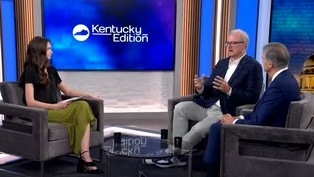
A promising advancement in Alzheimer's treatment may soon make life a little easier for patients and their families. Our Christie Dutton talks to a neurologist to help us understand this new option and what it could mean for patients.
Problems playing video? | Closed Captioning Feedback
Problems playing video? | Closed Captioning Feedback
Kentucky Edition is a local public television program presented by KET
New Alzheimer's Treatment May Offer Hope for Patients
Clip: Season 5 Episode 38 | 4m 13sVideo has Closed Captions
A promising advancement in Alzheimer's treatment may soon make life a little easier for patients and their families. Our Christie Dutton talks to a neurologist to help us understand this new option and what it could mean for patients.
Problems playing video? | Closed Captioning Feedback
Where to Watch Kentucky Edition
Kentucky Edition is available to stream on pbs.org and the PBS app.
Providing Support for PBS.org
Learn Moreabout PBS online sponsorshipA promising advance in Alzheimer's treatment may soon make life a little easier for patients and their families.
Our Christy Dutton talks to a neurologist to help us understand this new option, and what it could mean for patients.
More in tonight's look at medical News.
Doctor Gregory Cooper is here from Norton Neuroscience Institute to talk about a new Alzheimer's treatment that has gotten a bit of a facelift.
Even just this month.
Tell us about it.
Yeah.
Thank you for having me.
So the medicine is lecanemab or it's known as LA can be its trade name.
It's a it's called an amyloid targeting therapy.
It's a medication that targets and removes amyloid from the brain.
And in that way, it slows down the progression of Alzheimer's disease.
We've been using that for about three years.
Up until now, patients have had to come to an infusion center, receive an infusion every two weeks.
And that's gone well.
But it is a burden on patients.
Now we have what's called I click.
It's a injection that you can give yourself at home and they'll be once a week.
It's the exact same medicine.
It appears to be equally effective.
The difference being the convenience.
Now, patients can administer that at home.
Okay.
Instead of going to say Norton Health Care to Institute and, it's sitting with like an IV drip.
Or that for the infusion or the.
Infusion.
So instead of doing that, they can just do it right at home.
That's correct.
Okay.
And so who would this benefit.
Well, it's really people that perhaps travel, where it's difficult for them to get to the infusion center.
We have people that drive 2 to 3 hours each way to get to our infusion center, and that's.
That's difficult.
So giving them that possibility of being able to do this at home, they still have to come back to visits with us, but it can significantly reduce that burden.
Yeah.
I'm thinking about people who live in rural areas.
You know, this could really help out there, with transportation and trying to get the medicine they need.
It would be right at home.
That is exactly right.
That's been a real barrier for people.
People have to kind of consider that when they decide whether or not to go on treatment.
Oh, wow.
Yeah.
And so who is eligible for this type of treatment?
So these medicines are really most effective when we catch this condition very early on.
So people really that have very mild memory problems will either call that mild cognitive impairment or it's a little worse mild Alzheimer's disease.
And when we are able to start a medication like that in in these cases we can significantly slow down their progression.
We've had a number of patients that, have really maintained a very high level of function for a long period of time.
Oh that's wonderful.
And Norton is sort of on the leading edge of tracking this.
We are.
So we were one of the first centers in the nation, certainly the first in the state to start this treatment.
And that's been exciting.
We've treated a lot of people overall.
We've treated about 400 people, which puts us at the lead.
And also very exciting.
We've been able to participate in what are called real world experience studies, looking at how patients are doing in the real world, receiving these medications to see is it as effective as we thought it would be from the clinical trials?
Is it as safe as we thought it would be?
Unfortunately, we're saying it is as effective and maybe a little bit safer.
So that's been good news.
It's also been a real thrill to, present these findings that international meetings.
Yeah, I can see that this may help to really expand treatment.
That's a lot more.
Well, that is wonderful.
Thank you, Doctor Gregory Cooper, for your time and for letting us know about.
All right.
Well, thank you for having me.
I received FDA approval last month, and drugmakers expect it to be available in U.S.
pharmacies this fall.
 New
NewThe 2026 Kentucky State Fair Opens
Video has Closed Captions
Clip: S5 Ep38 | 2m 56s | The Kentucky State Fair kicks off in Louisville. (2m 56s)
 New
NewVideo has Closed Captions
Clip: S5 Ep38 | 9m 7s | Inside Kentucky Politics with Bob Babbage and Trey Grayson. (9m 7s)
 New
NewKentucky Housing Shortage Focus of Chamber Roundtable
Video has Closed Captions
Clip: S5 Ep38 | 3m 18s | Congressman Brett Guthrie and Kentucky Chamber discuss Kentucky's housing shortage. (3m 18s)
Providing Support for PBS.org
Learn Moreabout PBS online sponsorship New Episode
- News and Public Affairs

Top journalists deliver compelling original analysis of the hour's headlines.
 New Episode
- News and Public Affairs

Today's top journalists discuss Washington's current political events and public affairs.
 New Episode
 New Episode
 New Episode
 New Episode
 New Episode
 New Episode
 New Episode
 New Episode
 New Episode
Support for PBS provided by:
Kentucky Edition is a local public television program presented by KET