
New CPS Budget Relies on More State Funding. Lawmakers Weigh In
Clip: 8/5/2026 | 10m 35sVideo has Closed Captions
The new CPS budget assumes an additional $150 million in state funding that hasn't been approved.
A divided Chicago Board of Education last week approved a nearly $10 billion budget that relies on an additional $150 million in state funding. But any effort to pass funding that would be available in time for CPS to avoid midyear cuts would require a three-fifths supermajority in both houses.
Problems playing video? | Closed Captioning Feedback
Problems playing video? | Closed Captioning Feedback
Chicago Tonight is a local public television program presented by WTTW
WTTW video streaming support provided by members and sponsors.
New CPS Budget Relies on More State Funding. Lawmakers Weigh In
Clip: 8/5/2026 | 10m 35sVideo has Closed Captions
A divided Chicago Board of Education last week approved a nearly $10 billion budget that relies on an additional $150 million in state funding. But any effort to pass funding that would be available in time for CPS to avoid midyear cuts would require a three-fifths supermajority in both houses.
Problems playing video? | Closed Captioning Feedback
Where to Watch Chicago Tonight
Chicago Tonight is available to stream on pbs.org and the PBS app.

WTTW News Explains
In this Emmy Award-winning series, WTTW News tackles your questions — big and small — about life in the Chicago area. Our video animations guide you through local government, city history, public utilities and everything in between.Providing Support for PBS.org
Learn Moreabout PBS online sponsorship>> After closing their own 2 billion dollar deficit.
Illinois lawmakers may spend the fall veto session looking for more funding for Chicago.
Public Schools.
The Chicago Board of Education recently passed its budget, assuming 150 million dollars in additional state funding.
That hasn't been approved.
Money that board members say is needed to avoid layoffs.
House Speaker Emanuel, Chris Welch and Senate President Don Harmon say they're ready to pursue more funding for CBS.
But the effort faces an uphill climb as lawmakers outside Chicago argue their school districts need more state support, too.
Joining us now are state representative.
Will Davis, a Democrat from east Hazel crest who chairs the elementary and secondary education, Appropriations Committee and Zoom State, Senator Dave Seaver sent a Republican whose district includes portions of DeKalb Kane and McHenry counties.
Gentlemen, thank you both for joining us.
A few Representative Davis, any changes to the state spending plan that would reach CPS in time to avoid midyear cuts would require a three-fifths supermajority.
Indoor 3. right.
3 fifths.
majority vote in both chambers is there the political will in Springfield to get that done?
>> I don't know.
Specifically does the political will to address just the CPS problem?
My position has been that we need to look at using education funding We have our evidence based funding formula that we have to not only address funding needs for CPS, but also funding needs for school districts throughout the state.
If we look at their distance away from advocacy using adequacy target as the benchmark, then you could say that all school districts are in deficit.
So therefore, in order to try to address those broader funding needs, we must look at the evidence base funding model as a way to do it.
Senator.
>> Well, there is a formula in place and that's our concern is if if we take away from that formula and we try to give more funding to Chicago that that is going create a significant problem because as you mentioned, other school districts suffering too.
And so if we change the evidence base funding formula that we have in place that is going to, you know, thing start an uproar from suburban school districts that seen so much growth from people leaving Chicago and their schools are struggling to all way to downstate.
And so to change the formula now, I think just opens up the floodgates.
Chicago is going to have to make the tough decisions like every other school district has had to do over the last few years.
>> So Senator Severson, you know, as we've obviously, lots of other school districts across the state, very few of them, not all of them.
Nowhere near all of them are at their their benchmark or level for adequacy under the state's evidence-based funding formula.
Could this be sort of a pivot if if you all said get back to Springfield in and realize, you know what, maybe we need to just its Chicago's raise.
The problem.
But all districts are facing.
This.
Could we find money for more districts?
>> Well, certain right down the state can find that that kind of money.
They're facing a significant budget shortfall going into this next year already.
So finding those kinds of dollars would I think early be an issue, but we still think Chicago room to make some, you know, tough decisions like other schools have done when you have over 100 schools that are less than 50% vacancy.
You've got a number schools that 30% vacancy or I can see in the schools they need to make tough decisions in Chicago just like our suburban school districts have had to make.
So I think before they come for more money, they need to look at one making the same decisions and tough, tough budget decisions are districts have had to make to look at their own, you know how they can solve their own problem.
Just like every other districts had to do.
Representative Davis?
Well, kind of disagree with the senator and that the adus adequacy targets are based on student population.
What it needs educate the students in that district.
>> So that's a number that we can come up with.
So not the disc how schools that aren't field appropriate as the senators say it.
But we know what the adequacy target is for Chicago.
Public schools and we can get there.
And I think if we continue down the road of progressive revenue like we have done in the past budget year and put more on the table that we can get to the amount of resources that's necessary to help all school districts.
Again, this is not just a Chicago public school system problem.
It is a statewide problem to help districts get to adequacy target.
So that said, do you think in a potential fall veto session that you and your colleagues could come up with a plan?
>> To bring more school districts to adequacy.
Oh, absolutely.
I mean, if it's a matter of finding money, there are some things that were left on the table in terms of progressive revenue options that we didn't address digital at acts, you know, could possibly bring 1.2 billion dollars in revenue to the state of Illinois.
couple of tax decoupling from the federal government tax breaks like tax breaks investors who invest in opportunity zones as well as closing the loophole that allows corporations to put money in tax countries and not account for if we close those loopholes and make that accountability measure available to us that those last 2 could bring 450 million dollars.
And so there are things that we can consider.
And that's not to say that you shouldn't work to try to make the system work better as the senator said, but we still need revenue just to address our adequacy targets within school, school districts that are below that adequacy target.
If we put more money on the table using some of these mechanisms, that is a way we can do it.
I want to thank my colleague Lindsey Lapointe for giving me this information and helping me to understand how we can get there.
Even if you were to come up with those other, maybe progressive revenue measures this fall.
That does not give see.
But it's going to be some time before that money starts to come in.
Cps is not going to have $150 in hand.
>> In fall, what I agree with you did not go necessarily have it in hand this fall.
But again, we've been putting 300 million new dollars into the tier distribution.
For my let's continue to do that.
>> So CPS really wants to help us less work to make sure that we raise the amount of money going into the formula and with of which CPS is a direct beneficiary of those resources.
I've even asked the state Board of Education to come up with numbers that if we were even to remotely look at what they need, what does that mean in terms of the allocation and must go into the formula in order to get there?
I'm still waiting for them to come back with some data on that.
But I think there's opportunities to get it done.
That benefit CPS in all school.
Senator Severson, what do you say to some of those some of those options that Representative Davis just named as ways to >> generate revenue for school for all school districts.
Not yes.
Well, we can always look at raising taxes.
The answer, you know, that was the answer a few years ago, we've raised taxes were back in the same problem that we're in.
So.
>> Raising taxes may solve a short problem for a year or 2.
But if you don't get a handle on spending, if you don't go the to the common sense reforms, then other districts have done.
We're going to be right back in the same situation.
Except then we have more taxes and more businesses leaving.
So as the state we need to look at and growing our economy, improving our jobs, climate.
But as school districts, they have to make the tough decisions and the tough cuts to live within their means just like every other business and every other taxpayer has to do and local governments and school districts around the state of had to do.
Chicago needs to make those again.
Those tough decisions like other school districts have had to do.
So they do that first and then they come back.
Then we can talk about it.
But we don't think they've made the the same painful decisions that other school districts have done by the painful decision.
Senator we've heard CPS mentioned multiple times layoffs and they've had, you know, some layoffs this year.
>> But they've all the district has also said a lot of those teachers aides will be rehired at other schools.
Just it's part of a normal shift, but they are down 160 for school-based positions overall in the outback get this year.
Are those the kind of tough decisions that you think the districts we'll have to thousands.
>> Yeah, since.
Well, since 2019 there at about maybe get my 10,000 lead, 10% less students.
And they've added about 15% increase in staffing.
So when you're losing student population and increasing staffing.
That tells us that there's room there.
As we mentioned, there are there are numerous numerous schools that over 50% vacancies.
There needs to mergers of those districts which would save significant dollars those are the decisions that every other school districts have had to make with closing schools, merging schools, reducing staff.
That's not classroom related staff.
Those are things other schools have had to do.
Chicago needs to make those tough, same tough decisions that are districts have had before they come back to look at them, you know, asking for more money from the state.
All right.
So so we're out of time.
But just so that our viewers know, want them to know that under the Illinois evidence-based funding formula, 63% of Illinois school districts are below.
>> Than 90% funding adequacy bar.
That was set by the uvf funding formula that was passed.
>> 10, 11 years ago, 2017 2017, OK?
That's where we'll have to leave it.
Best of luck to both.
Senator Severson representative Will Davis, we appreciate Thank you.
My pleasure.
Thank you.
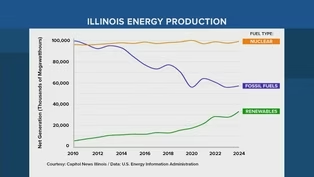
Up next, why some communities across Illinois say they are interested in landing new nuclear facilities as the state lifts its moratorium.
>> In education, reporting on Chicago tonight is brought to
 New
NewSome Illinois Communities Say They’re Interested in New Nuclear Facilities
Video has Closed Captions
Hear from communities that are opening the doors to new nuclear reactors. (9m 58s)
Providing Support for PBS.org
Learn Moreabout PBS online sponsorship New Episode
- News and Public Affairs

Top journalists deliver compelling original analysis of the hour's headlines.
 New Episode
- News and Public Affairs

Today's top journalists discuss Washington's current political events and public affairs.
 New Episode


 New Episode
 New Episode
 New Episode
 New Episode

Support for PBS provided by:
Chicago Tonight is a local public television program presented by WTTW
WTTW video streaming support provided by members and sponsors.