
New Guidelines For Mammograms
Clip: Season 2 Episode 241 | 3m 19sVideo has Closed Captions
Most women should get their first mammogram earlier, according to an expert panel.
New guidelines from the U.S. Preventive Service Task Force recommend women get a mammogram every other year beginning at age 40, a decade sooner than the previous recommendation.
Problems playing video? | Closed Captioning Feedback
Problems playing video? | Closed Captioning Feedback
Kentucky Edition is a local public television program presented by KET
New Guidelines For Mammograms
Clip: Season 2 Episode 241 | 3m 19sVideo has Closed Captions
New guidelines from the U.S. Preventive Service Task Force recommend women get a mammogram every other year beginning at age 40, a decade sooner than the previous recommendation.
Problems playing video? | Closed Captioning Feedback
How to Watch Kentucky Edition
Kentucky Edition is available to stream on pbs.org and the free PBS App, available on iPhone, Apple TV, Android TV, Android smartphones, Amazon Fire TV, Amazon Fire Tablet, Roku, Samsung Smart TV, and Vizio.
Providing Support for PBS.org
Learn Moreabout PBS online sponsorshipMost women should get their first mammogram earlier, according to an expert panel.
New guidelines from the US Preventive Services Task Force recommend women get a mammogram every other year, beginning at age 40.
A decade sooner than the previous recommendation.
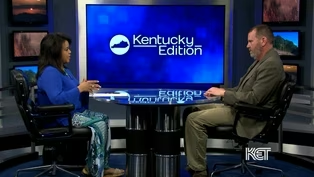
Our Kristy Dutton spoke to a radiologist specializing in breast cancer imaging to find out what's causing the change.
That in today's medical news.
The new breast cancer screening is receiving high praise from some, but it's leading others to wonder why the sudden change.
Joining us now is Dr. L.Z.
Cool from U of L Health.
Why is this change happening?
Why are we seeing these guidelines change from where they were?
I think it's become a lot of pushback from a lot of national organizations such as the Society of Breast Imaging, American College of Radiology, American College of Gynecology, and Obstetrics of All really pushed for the screening age for an average each to be starting at the age of 40.
And so with increased breast cancer screening.
So will that also increase false positives?
So that's a really common misconception.
A lot of data, as is shown both in United and in European trials, that this doesn't necessarily increase false positives.
There might be a slightly increased callback rate by just by increasing your screening pool.
You're seeing more patients, you're calling backward patients.
However, the amount of cancers that are being detected, which is building for particularly the ages of 40 and 49, are increased in that it's not a cohort.
Okay.
Well, some people think that this is maybe too much screening.
Others.
Others think it's we could do more.
Where do you lie in that spectrum?
Well, I agree with the Society of Breast Imaging and the American College of Radiology, as we're in certified breast doubles and a breast imager.
I agree that we should start at the age of 40 for the average patient.
However, I do think that we should be doing annual screening in my presence, not every other year, because that has been shown to actually improve overall mortality and increase your gain for all of our patients who are screened at particularly at the ages of 44.
So you think that it could even go another step further, a little bit more?
And so with this new recommendation, which will increase at least a step in the right direction, in your opinion, how do you hope this changes the lives of those that have breast cancer?
I think for women who, you know, we're seeing more and more women at a younger age getting diagnosed with breast cancer.
And I think by starting screening at the age of 48, particularly when it's an early, we'll be able to detect early and subtle breast cancers that are much more treatable.
You don't really have a cure for breast cancer.
And while the breast cancer treatment has to be a long way in the last couple of decades, really the closest thing we've got to a cure is by screening and screening every year, because we can detect the further subtle breast cancers improve them.
Okay.
Well, thank you so much for your time and thank you for that information and your perspective.
Thank you so much for having me.

DEA Moves to Reclassify Marijuana
Video has Closed Captions
Clip: S2 Ep241 | 1m 56s | What impact might the DEA's proposal to reclassify marijuana have on those researching cannabis? (1m 56s)

Impact Of Bird Flu In Kentucky
Video has Closed Captions
Clip: S2 Ep241 | 4m 18s | Commissioner Jonathan Shell talks about the impact a new outbreak of bird flu is having in KY. (4m 18s)

Video has Closed Captions
Clip: S2 Ep241 | 3m 35s | A pro-Palestine protest gets loud, but stays calm, at the University of Kentucky. (3m 35s)
UK Professor Discusses Current Conflict
Video has Closed Captions
Clip: S2 Ep241 | 6m 17s | Prof. Robert Farly talks about campus protests and helps us better understand the current conflict. (6m 17s)

Upgraded Paddock at Churchill Downs
Video has Closed Captions
Clip: S2 Ep241 | 3m 41s | Churchill Downs is showing off a two-year, $200 million dollar upgrade to its paddock. (3m 41s)
Providing Support for PBS.org
Learn Moreabout PBS online sponsorship
- News and Public Affairs

Top journalists deliver compelling original analysis of the hour's headlines.

- News and Public Affairs

FRONTLINE is investigative journalism that questions, explains and changes our world.












Support for PBS provided by:
Kentucky Edition is a local public television program presented by KET