
New laws help domestic violence survivors
Season 6 Episode 15 | 26m 46sVideo has Closed Captions
A discussion on domestic violence in Nevada and the new laws aimed at helping survivors.
New laws recently passed in Nevada aim to reduce domestic violence rates. We explore how with SafeNest CEO Liz Ortenburger. We’re also discussing the Las Vegas Aces and their second WNBA Championship win in a row. And we’ll have a fun look at the history of bison in Nevada, just in time for the Vegas PBS special The American Buffalo!
Problems playing video? | Closed Captioning Feedback
Problems playing video? | Closed Captioning Feedback
Nevada Week is a local public television program presented by Vegas PBS
New laws help domestic violence survivors
Season 6 Episode 15 | 26m 46sVideo has Closed Captions
New laws recently passed in Nevada aim to reduce domestic violence rates. We explore how with SafeNest CEO Liz Ortenburger. We’re also discussing the Las Vegas Aces and their second WNBA Championship win in a row. And we’ll have a fun look at the history of bison in Nevada, just in time for the Vegas PBS special The American Buffalo!
Problems playing video? | Closed Captioning Feedback
How to Watch Nevada Week
Nevada Week is available to stream on pbs.org and the free PBS App, available on iPhone, Apple TV, Android TV, Android smartphones, Amazon Fire TV, Amazon Fire Tablet, Roku, Samsung Smart TV, and Vizio.
Providing Support for PBS.org
Learn Moreabout PBS online sponsorshipNew laws in Nevada aimed to address the state's high rate of domestic violence, plus...
The Las Vegas Aces win back-to-back championships.
The historical significance and where they stand in the "greatest WNBA team of all time" conversation, that's this week on Nevada Week.
♪♪♪ Support for Nevada Week is provided by Senator William H. Hernstadt.
-Welcome to Nevada Week.
I'm Amber Renee Dixon.
October is Domestic Violence Awareness Month, and there are new laws in the state to help survivors and crack down on abusers.
We'll discuss those ahead.
But we begin with the Las Vegas Aces who on Wednesday night won their second straight WNBA title, defeating the New York Liberty 70-69 in Game 4 of their championship series and, in doing so, became the first WNBA team to win back-to-back championships in more than two decades.
Following the Aces' entire season has been Melissa Ferris, Co-host of Gi rl Chat Sports with Mo & Mel.
-Yes.
-Couldn't get Mo, but we've got Mel-- -Yes.
- --a good part of the dynamic duo.
(Melissa Ferris) Thank you for having us.
She's with us in spirit.
-We're happy to have you on because it means a big win for the Aces.
Not only do they come from behind to pull off this victory, but they do it without two of their starters, including the point guard, who they refer to as the "point god," Chelsea Gray.
How did they do this?
How did they pull it off?
Who stepped up?
-I think it's what Becky has said all along.
When we lost Game 3, it was like, We just got to pull together.
We've been through more adversity through the entire season than just this game.
They've been through so much.
I mean, even losing Candace Parker over two months ago, and then, of course, yesterday, Chelsea Gray.
And then Kiah Stokes comes up injured as well.
It's like everybody was thinking the worst, but people-- the team had positive thoughts.
The team was praying.
The team was ready to take this challenge.
And of course, I mean, A'ja Wilson steps up.
-There you go.
-Who else, you know?
Alysha Clark had a big game.
She played 37 minutes last night, which is like more than ever she played probably this season for the team.
So she did phenomenal.
The whole team really pitched together; it was a real team effort.
-And it's interesting because throughout the season, we've been talking about the lack of bench for the Aces, right?
-Correct.
-And then in this... -You know, I mean, these-- we saw Cayla George, who maybe played a few minutes a game, was out there for, I don't know, 10, 15, 20 minutes.
Sydney Colson had, I think, 10 or 12 minutes.
She might not even play some games.
I mean, it was using everybody because we really didn't have a bench.
We barely even had relief players to come off to help the rest of the team, so-- amazing.
Amazing game.
-Oh, how cool.
Yeah, A'ja Wilson recording 24 points and 16 rebounds.
She wins Finals MVP.
Does that make up for her not getting league MVP?
-Me and Mo had talked last night.
It's like, I feel like a championship is always better than getting a league MVP.
However, I think come next season, too, she's got it in her mind that you guys got it wrong.
Becky's been saying it for since the vote came out, They got it wrong.
Everybody knows you got it wrong.
After seeing last night's game and Breanna Stewart struggle so bad, I think we all-- -Who earned MVP title.
-Who earned.
Now she's a back-to-back champion and back-to-back Finals MVP.
I mean-- -Olympic champion.
-I mean, you know, her trophy, her trophy closet isn't too bad.
-No.
I'd like to see that.
I wonder if it's here in Las Vegas.
You brought up Coach Becky Hammon.
She has made it clear that, "If I had played A'ja Wilson more minutes during the season, I think she would have gotten MVP."
But she held her out, rested her in some of the fourth quarters as a good coach would do.
You've got to protect your resources.
-Absolutely.
-Do you think the Aces would have repeated as champions if they did not have Coach Becky Hammon?
-Well-- and I don't mean to say this in a bad perdicament, but it's-- I don't know if the Aces would have won if it wasn't for Becky to begin with.
I mean, that-- -Even the first time?
-The first time.
I mean even the addition of Chelsea Gray as well.
We saw some changes between when Bill left and Becky came on as far as the roster went as well.
You know, Becky, as a player, as a former NBA assistant coach and then now coaching a WNBA level, I feel like she's kind of had the whole gambit, and can relate to these players however they need to be related to, to perform their best.
-So better than Bill Laimbeer did, you think?
How do you know?
-I mean, I was there since the beginning.
I've been covering the Aces since they came to Las Vegas.
I think Bill Laimbeer is a great coach.
I think he was a great player.
I just think that he maybe didn't have the ability to talk to the players sometimes like they needed to be talked to, or how how they received that information the best.
I think Becky does it.
When you see her on social media with a teammate or on interviews now, she's getting emotional.
She deeply cares for these girls, for these ladies.
-We mentioned in the intro, the Aces are the first team to win back-to-back championships in more than two decades.
The other teams that have done it, the Houston Comets from 1997 to 2000 and the Los Angeles Sparks in 2001 to 2002.
Where do the Aces rank in terms of greatest WNBA team of all time?
-Well, there was a conversation we had on our show last night about the Houston Comets, that they won four straight.
They were initially one of the initial teams there.
They won four straight championships.
But there was also only eight teams back then.
And you're also thinking about the players too.
They had a heavy point guard status there.
They didn't necessarily have a hybrid player like A'ja Wilson or the Breanna Stewarts that you see these days.
So can you compare and contrast them?
Yeah, but it could be like apples and oranges.
I mean, you know, people might say that the Aces need to win another championship to make it into that, you know, "Who's the best of the-- of the WNBA" conversation.
But they're definitely on the right track.
-And the chances of a three-peat, what do you think?
-I mean, we've got these ladies.
Our starters are in until 2025 or 2026.
Becky's here-- -Contract-wise?
-Contract-wise.
Becky's here for five years.
She's got a five-year contract.
So really, we're not changing a whole lot in these next couple years.
So depending on how the bench may change or what may happen in regards to if Candace wants to come back, because she only signed a one-year deal and she was injured.
So she wants to probably come back and give it one more go if nothing else.
-I would think so.
Right?
-Yeah.
-But you are concerned past 2024 because of the expansion.
Why?
-Well, there's a WNBA expansion that hasn't happened in I don't know how many years, not since the Dream.
I think it was 2008 or something.
But they've already announced the Warriors will have an expansion team in San Francisco.
And then there'll be a second team.
They're still debating on the second city, but that's in 2025.
-Okay.
-So when expansion comes, just like most of us knew from the Golden Knights' experience is that we're taking players from other teams.
-Right.
-So who may get taken?
-Oh, boy.
We will have to see, but we will be rooting for a three-peat this upcoming season.
Melissa Ferris with Girl Chat Sports with Mo & Mel, available wherever you get your podcasts.
On YouTube as well.
Thank you for joining Nevada Week.
-Thank you.
-October is Domestic Violence Awareness Month.
And here's a startling statistic for you: So far this year, Metro Police say they've responded to 25 domestic violence-related homicides, a 47% increase from the year before.
Here now to discuss that increase as well as new laws in Nevada meant to help survivors of domestic violence is Liz Ortenburger, CEO of SafeNest, Nevada's largest and most comprehensive charity dedicated solely to solving domestic violence issues.
Liz, welcome back to Nevada Week.
(Liz Ortenburger) Thank you for having me.
-Okay.
So what do you believe is behind this increase in domestic violence-related homicides?
-So when we had the recession 10 years ago, we became number one in the country for homicides per capita related to domestic violence.
We're seeing some of those similar stressors now.
That financial stress is an overlay.
If there's already violence in the household, these are the things that trigger it.
And now we're seeing that become lethal.
-And also it's a reason why people who are being abused don't leave their abusers.
Finances, correct?
-Absolutely.
In 2006, ACLU did a study.
50% of women who are homeless cite domestic violence as the root cause for that homelessness.
-How are you getting the message across at a time of such high cost of living to people who are being abused that they need to get out of the situation?
-Right.
So we communicate in two channels.
One is to survivors that, Here's the red flags.
And if these things are happening inside your relationship--strangulation, if there's a gun in the home, if there's recent job loss--those are indicators that we could be escalating a homicide.
Call and get support.
But we also talk to abusers in that if you're creating an environment in your home that's out of control or your kid is looking at you with fear, we have support and confidential resources for you as well.
-And that's a little bit controversial that you're working with the abusers, correct?
-Yeah.
SafeNest has been doing that for 30 years, but it is constantly sort of something that I have to defend, which is odd because the root cause of domestic violence is an abusers' behavior.
So while, yes, we want to have all the resources and support for survivors, because nobody should have to suffer inside a relationship, if we don't actually start working on the root causes of domestic violence, beginning in youth and working their way into adulthood, we will never have a solution for this epidemic.
-All right.
So you held a press conference recently to discuss the new legislation that was passed this past session.
And at it, Metro Undersheriff Andy Walsh said that Metro has seen a more than 50% increase in which the victims of these domestic violence-related homicides are Hispanic females.
-Yes.
-He had no answer as to what was behind that.
Do you have any idea?
-So when we look at-- when we look at wealth and wealth distribution, we know that our Hispanic communities in Nevada are some of our most low-income communities.
When we tie that with undocumented status and all of the other complications and the cultural elements within the Latin community, it can be very, very hard for a survivor to exit.
And so we make sure we're available at places like the Mexican consulate, on calls with Metro in the areas where domestic violence is high, in the Northeast Area Command, and some of the other hot spots for where those homicides are happening.
But it's really about making sure that undocumented survivors and survivors in the Latin community understand services are available for you.
They're available for you in a bilingual fashion.
But also leaving your abuser and getting the abuse to stop does not mean you have to leave your family.
And that's what becomes very complicated in that cultural context.
-All right.
So the key piece of legislation that you held that press conference to discuss, Governor Joe Lombardo was there, also Assemblywoman Shondra Summers-Armstrong, the bill sponsor, AB257, what does that do?
-So it basically creates a pathway for strangulation exams to be free of charge for a survivor.
So in the past, you would walk in and say, I need a strangulation exam.
The cost will be between $515 and $1,500.
That is no longer the case.
Any survivor would be able to walk into UMC and share that they've been a victim of domestic violence and get that exam for free.
-And why is that exam so important?
-For two reasons.
One is there is a lot of long-term health detriments tied to strangulation.
If you think about your airway being blocked, small bones can break off.
That can create scar tissue that can actually lead to your death 10 years down the road.
So the health of the survivor is one piece.
The other piece is absolutely for the forensic exams.
Strangulation is a felony offense in Nevada.
But without the strangulation exam, we have almost no luck, or just judicial process, in getting that felony charge to stick.
The other piece of this that's so critical, we don't talk enough about.
If mom's being strangled, 10% of the time, the kids are also being strangled.
And a strangulation exam gives us an opportunity to ask that question to the mom.
-To intervene.
Wow!
Prior to this law, I'm assuming victims were paying for this on their own.
And were they actually ending up getting them?
-Yeah.
Actually, I don't-- I have some anecdotal cases where people had gone to an emergency room.
Some of our survivors received a strangulation exam through their insurance, but because it wasn't done by forensic nurse, it doesn't hold up in Justice Court.
-Oh, I see.
-One of the problems in Clark County is that we have one forensic nurse for our 2.3 million residents.
And then we balloon up to 3 million on the weekends, especially, you know, as we have these great things coming to town.
We simply aren't resourced as a county in the way to deal with the needs of these survivors in any kind of a timely manner.
And a strangulation exam has to happen within three days of the incident.
You cannot eat, drink, change clothes, or shower.
So imagine you have been strangled, passed out, you've been unconscious, you may have defecated on yourself--that is a common occurrence--and you cannot do anything to clean yourself up until you have access to an exam.
-So, Liz, this is great legislation.
But if there is only one nurse you can go to in all of Clark County, how does this even work?
-So I am in favor of like, let's then figure this out.
Right?
So we've actually been talking with Commissioners Naft, Jones, and McCurdy to bring together a domestic violence advisory group at the county level to talk about the bottlenecks like this.
This is one bottleneck on a victim's path to justice, but there are others in the system.
If we get all of the stakeholders at the table: How does UMC get more forensic nurses?
Can Roseman University help?
Can Dignity Health help?
How do we create a solution that's survivor-centered and meets the economic needs of our county in a way that is efficient?
-So you still have work to do?
-Absolutely.
-So the County can be reimbursed for these tests via the State.
The State set aside a million dollars for this fiscal year and a million for next fiscal year, but they have to actually bill the State.
And have you found that they are billing the State?
Because right now, rape kits can be reimbursed.
-Right.
So we've heard from the State that the County has not been billing for rape kits, which does not mean rape kits aren't happening, it just means the County is covering that cost themselves.
So part of figuring out how to get this to work seamlessly is, what is the billing mechanism, and who can bill a county?
Is it only UMC?
Or can other providers if they are to hire a forensic nurse and have the equipment to do the exam, can other providers also bill the County?
So that's all the work that has to be figured out to make sure we clear this pathway.
-And as you explained to me, if the County does not bill the State, the State does not have the data that you need to support getting more funding for these strangulation tests in the future.
-Yeah, absolutely.
So we're the fourth state in the country to allow for strangulation exams to be free of charge.
We're the first state to do it with a line item in our budget.
So I'm very proud of Nevada for that, but that line item will go away if we do not see the data to support the expense.
So now it's clear all the bottlenecks, make sure survivors have access, and then let's collect the relevant data and adjust as needed.
-How are other states paying for this?
-ARPA funding.
-Oh.
-Yes.
-Which will run out, as well?
-Yes, it will.
-Other domestic violence legislation signed into law this past session was AB51.
What does it do?
Why was it needed?
-Yeah, so AB51 did two important things.
The first was if you are an abuser and you fled the scene, you really had to hide for 24 hours and then there was no consequence.
The police couldn't arrest you after 24 hours.
So it added seven days to that.
We had asked for two weeks.
It got cut down to seven days.
So that should help police.
Right now about 50% of domestic violence incidences that don't result in an arrest is because the abuser fled.
So this will help police follow up shift-to-shift and find these abusers.
It's harder to hide for seven days than it is to hide for 24 hours.
-Why on earth was 24 hours ever deemed sufficient?
-You know, you have to think about-- we have such a great working relationship with LVMPD, but they are really busy.
And so it felt like holding it over was probably where we started, and then no one had really looked at it.
And so as we started working with the AG's office and others, it's like, This is a barrier for LVMPD.
Let's fix this.
Let's get this to change to seven days.
So I think it was just probably put there as a placeholder to start, and now we improve.
-So do abusers, do you find that they're going to get up to date on these new laws and try to start hiding for seven days?
-You know, I will never underestimate the savviness of an abuser to know the criminal justice system and to manipulate it to their will, which is absolutely what we see all the time at court.
And so, you know, it will be interesting to see what happens and how many of these that flee the scene we're able to actually get now on the seven-day.
And that information is all tracked publicly, which is another great thing about Nevada.
We can see the data and see where the adjustments are working or not working.
-I want to go back to strangulation.
What do we know about people who strangle other people?
-Yeah.
So this is a terrifying statistic.
So a survivor strangled once is 750% more likely to be murdered than her peer who is also being abused but not strangled.
And that's on the first strangulation.
When it escalates, that percentage goes up each time.
On average, women do not call 911 until they've been strangled five times.
So there's that element.
But we also know there's an incredible tie between mass shootings and domestic violence.
So 68% of mass shooters have a known domestic violence on their record.
It is believed of that 68%, 100% have strangulation.
And then there's also a terrifying link between those that strangle and killing police.
We know domestic violence is the most dangerous call that police will go on.
But when we look from a different lens and say, Who are cop killers, we find very often 80% of the time, there's domestic violence.
And it is believed that 100% of that 80% has got a strangulation on their record.
So this is a terrifying red flag.
We need to not only catch it for the safety of the survivor and the family unit, but the safety of our community as well.
-And one more thing I do want to bring up, when you are trying to talk to survivors or people who still need to leave the domestic violence situation, do you make a plea about their children?
Because if there is violence in the home, it can severely impact a child, correct?
-So here's how all domestic violence agencies need to work: We do not tell survivors what to do.
Because the minute we tell somebody what to do or they feel like they're being told what to do, our behavior, while our intentions are different, is exactly the same as the abuser.
So what we do when we safety plan is we lay out all of the options and we talk about all those options.
We have some tremendously brave survivors that choose to stay inside that relationship for reasons that makes sense for them.
But what we want to do is make sure there are always the resources available in Clark County for a survivor to find safety when they need it.
And I will tell you, last month we had 432 survivors who called our hotline who because they were not in lethal enough danger, they could not find a bed.
And Shade Tree is full, and Safe House is full.
And so our county is under-resourced in the-- in the places for lethal survivors to find safety.
-Lastly, Nevada, where do we rank in terms of domestic violence compared to the rest of the country?
-Yeah.
So we're the seventh most dangerous place in the country on a 10-year average for women being murdered by men, which is the most common domestic violence homicide statistic.
And then we rank about fifth for the numbers of domestic violence that don't result in homicide, necessarily.
So we have an epidemic here.
-Yeah.
A lot to work on.
Liz Ortenburger, CEO of SafeNest, thank you for joining Nevada Week.
-Thank you for having me.
-We move now to a new film by Ken Burns.
It's called The American Buffalo and is now available to watch here on Vegas PBS and on Passport.
The two-part series takes viewers through 10,000 years of North American history while tracing the animal's evolution, its significance to indigenous people, it's near extinction, and efforts to save the magnificent mammals.
According to the National Park Service, in the early 1800s, between 30 million and 60 million American bison roamed most of North America, and it's believed bison once existed in Nevada as well.
That is according to Dawn Andone, a Nevada State Parks Interpretive Ranger.
She joins us now from Cathedral Gorge State Park in Panaca, Nevada.
Dawn, thank you for joining Nevada Week.
(Dawn Andone) Thank you for having me.
-So can we first establish the difference between bison and buffalo?
-Yes.
Well, American buffalo has become kind of the nomenclature, right?
Everybody thinks that that's an actual thing.
But it's, really, the difference between bison and buffalo are they're in the same family, but they're a completely different species.
So what we really have in America are bison; whereas, buffalo live in places like Africa and Asia.
-Got it.
Okay.
So for the purpose of this interview, we're going to say bison, because that's what is correct, even though the film is "American Buffalo."
How do we know that there were bison once in Nevada?
-Well, we actually have the evidence right here at Cathedral Gorge.
In the 1970s, a young man found a whole bunch of bones here in the park and took them home with him.
And to him, he didn't know what they were.
About 20 years later, when he-- when he grew up, he decided that he needed to find out what they were.
So he took them in to be identified.
And as that happened, they said, Well, wait a minute.
Where did you find this thing, because they knew that it was old and that it had to go back to wherever it came from.
Well, when he said that he found it here, the result of that ended up being in the 1990s, the Desert Research Institute came out here to do a dig because as this buffalo head behind me, or bison head actually, behind me was found and then they ID'd it, it was found to be over 900 years old.
So we know for sure that right here in Cathedral Gorge State Park, there were bison roaming around here anywhere from 400 to 1,000 years ago.
-And-- -Go ahead.
-What do we know about these bison?
I mean, it wasn't just one random bison that ran away from some herd?
-Yeah, right.
No, the actual bison would-- DRI, Desert Research Institute, did their dig in the 1990s.
What they ended up finding was just layers of bones.
Because the way Cathedral Gorge is designed is, what happened was, floods would come in and bring depositional material into what was a lake.
Well, when that lake drained away, the bison were able to be here and to roam around.
And they figure what happened was they would go into these little slot canyons that we have here to get out of, say, the rain.
And then there would be a mud event, a big mudslide, and they would be trapped in there.
So they were able to actually identify through hide that was left on the body and content in the stomach, they could identify what they were eating.
They could identify how old they were because of the organic substances, and they could identify that they were mostly female and then youth.
So they were mamas with their babies.
Because what happens when the males after they mate, the males go into their own herd and the mamas stay with the babies.
-Uh-huh.
-So that, that's what's been found here in the park.
-And then there was a separate dig that you told me about on the phone, and that was in the caves of Lincoln County.
When was that, and what was discovered?
-Yeah.
So back in the 1970s, a number of researchers from UNR, from University of Nevada, Reno, actually were down here in Lincoln County looking through a number of the caves.
These archaeologists were looking for evidence of Native Americans and who was here, what they were eating, what they were doing, all of the cultural part of it.
And there were a number of caves that they looked at that are right around here, and one within, you know, 20 miles, As The Crow Flies, from Cathedral Gorge.
And in that particular cave, they dug down so many layers.
They dug down like 29 layers, which is huge.
Well, once they got down there, 29 layers is like 7,000 years ago.
So 7,000 years, what they found at that layer was they found a metate down there, and that's a grinding-- basically a grinding stone so you can grind different kinds of things like flour, grind up flour and stuff like that.
But they also found bison bones.
So we know that bison were in Lincoln County and in this area up to 7,000 years ago.
-You may not see that on those maps that show where bison have roamed in North America, but they were here in Nevada.
Dawn Andone, thank you so much for joining Nevada Week.
-Thank you for having me.
You have a great day.
-You too.
-And thank you at home for watching.
For any of the resources discussed on this show, go to our website, vegaspbs.org/nevadaweek.
And I'll see you next week on Nevada Week.

Helping kids understand empathy.
Video has Closed Captions
Clip: S6 Ep15 | 5m 20s | Sherrika Myers' advice on the best ways to teach kids empathy and how to combat bullying. (5m 20s)

Las Vegas Aces win second WNBA!
Video has Closed Captions
Clip: S6 Ep15 | 6m 33s | The Las Vegas Aces celebrate their second WNBA Championship win in a row! (6m 33s)
New Nevada law helping survivors of domestic violence.
Video has Closed Captions
Clip: S6 Ep15 | 12m 55s | Liz Ortenburger of SafeNest explains why a law dealing with strangulation is needed. (12m 55s)
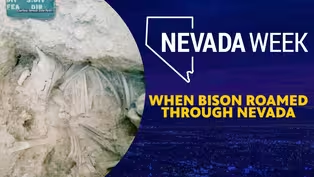
When Bison roamed through Nevada
Video has Closed Captions
Clip: S6 Ep15 | 5m 53s | The Vegas PBS special “The American Buffalo”, looks at Nevada’s history with the buffalo. (5m 53s)
Providing Support for PBS.org
Learn Moreabout PBS online sponsorship
- News and Public Affairs

Top journalists deliver compelling original analysis of the hour's headlines.

- News and Public Affairs

FRONTLINE is investigative journalism that questions, explains and changes our world.












Support for PBS provided by:
Nevada Week is a local public television program presented by Vegas PBS